




-
 Redaction
String theory explained: a cosmic symphony
Explore string theory's vibrating strings, hidden dimensions and the graviton - a poetic yet rigorous journey into physics' quest for a theory of everything.
The music of the void
There is a profound stillness in the way we traditionally imagine the smallest building blocks of our world. For centuries, our intellectual heritage has taught us to see the fundamental constituents of reality as discrete, hard points of matter - billiard balls on a microscopic table, or dust motes dancing in a beam of light. This classical vision, while helpful for early mechanics, eventually led us to a fragmented understanding of the cosmos. It created a world of things rather than a world of relationships.
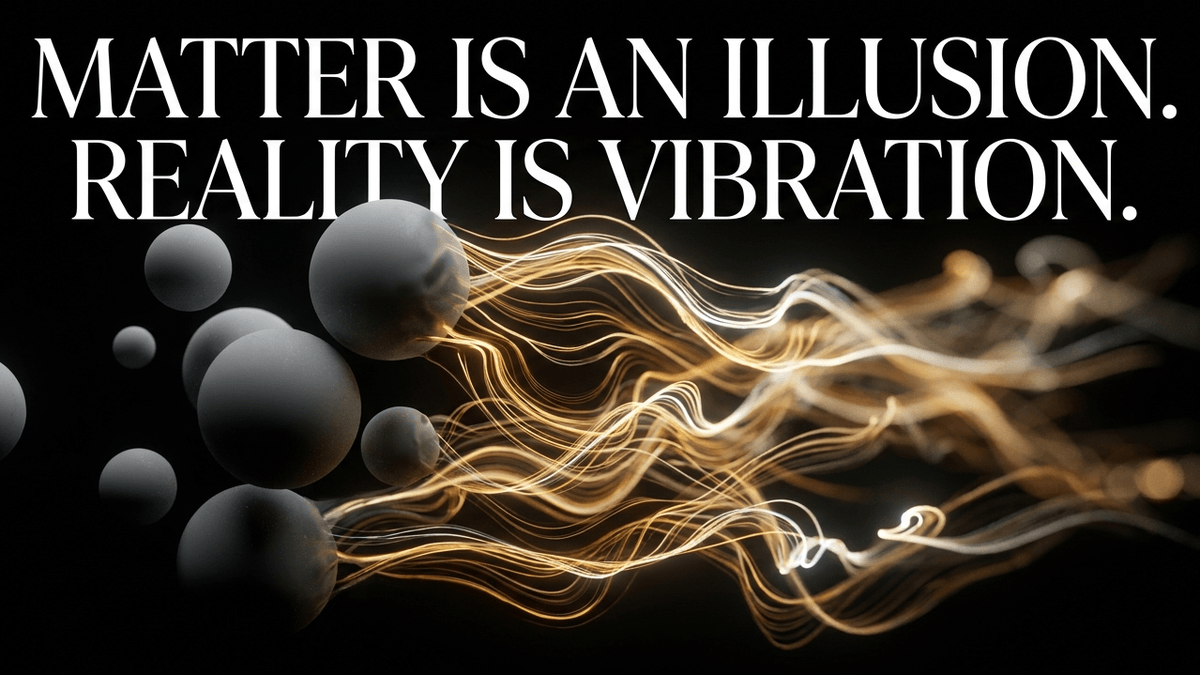
Yet, as we peer deeper into the fabric of existence, the imagery of the static point begins to dissolve, replaced by something far more fluid, rhythmic, and hauntingly beautiful. In the quiet halls of theoretical physics, a different narrative has emerged: the story of a universe that is not built from things, but from movements. This is the realm of string theory, where the rigid concept of the particle gives way to the elegant, undulating grace of the string.
According to this framework, if we were to zoom in past the atom, past the nucleus, and past the quarks that reside within, we would not find a final, solid dot of existence. Instead, we would encounter a tiny, vibrating filament of energy. These strings are unimaginably small, residing at the Planck length of approximately 10^-35 meters. To grasp this scale, one must indulge in a staggering comparison: if a single hydrogen atom were expanded to the size of the entire solar system, a fundamental string would still be no larger than a home office.
It is at this infinitesimal scale that the music begins. The universe, in its most honest form, is not a collection of objects, but a vast, shimmering field of vibration. This shift in perspective is not merely a change in mathematical modeling; it is a profound philosophical invitation to view ourselves and the stars as part of a single, continuous symphony.
Where the idea came from
It is worth pausing, before we go further into the music, to ask where this idea was even born. String theory did not arrive as a grand vision of cosmic harmony. It arrived, rather humbly, in the late 1960s, as an attempt to describe the strong nuclear force - the force that binds protons and neutrons together inside the atomic nucleus. Physicists studying particle collisions noticed strange mathematical patterns in the data, patterns that seemed to hint at particles behaving less like points and more like tiny, stretchy bands.
At the center of that early puzzle stood a young Italian theorist named Gabriele Veneziano, who in 1968 wrote down a formula meant to capture something colliders kept revealing: a strange, orderly "tower" of particles, each heavier than the last, their masses and spins climbing in tidy steps as if arranged by some hidden hand. Nobody quite knew what to make of it at the time. It was only later that physicists recognized the pattern for what it was - the harmonic overtones of a vibrating string, the same mathematics that governs a plucked violin string, dressed up in the language of particle physics.
That early model, now called bosonic string theory, was eventually abandoned as a theory of the strong force once quantum chromodynamics offered a more accurate picture. But something curious lingered in its equations: a massless particle with a spin of two kept appearing, uninvited, like a stray note in a piece of music no one had asked for. It took years before physicists realized what this note actually was. It was gravity, showing up where nobody expected it. What had begun as a flawed theory of the nucleus transformed into something far more ambitious: a possible theory of everything.

The anatomy of a cosmic string
To understand the mechanics of this universal orchestra, we must look at the nature of the strings themselves. Unlike the particles of the Standard Model, which occupy zero dimensions - meaning they have position but no extension - a string is one-dimensional. It possesses length. These strings can exist in two primary configurations: they can be open-ended, like a strand of silk, or they can form closed loops, like a tiny rubber band. This distinction is vital because the way a string is anchored or looped determines how it interacts with the space around it. The movements of these strings are governed by a mathematical surface known as a worldsheet, which describes the two-dimensional area a string sweeps out as it travels through time and space.
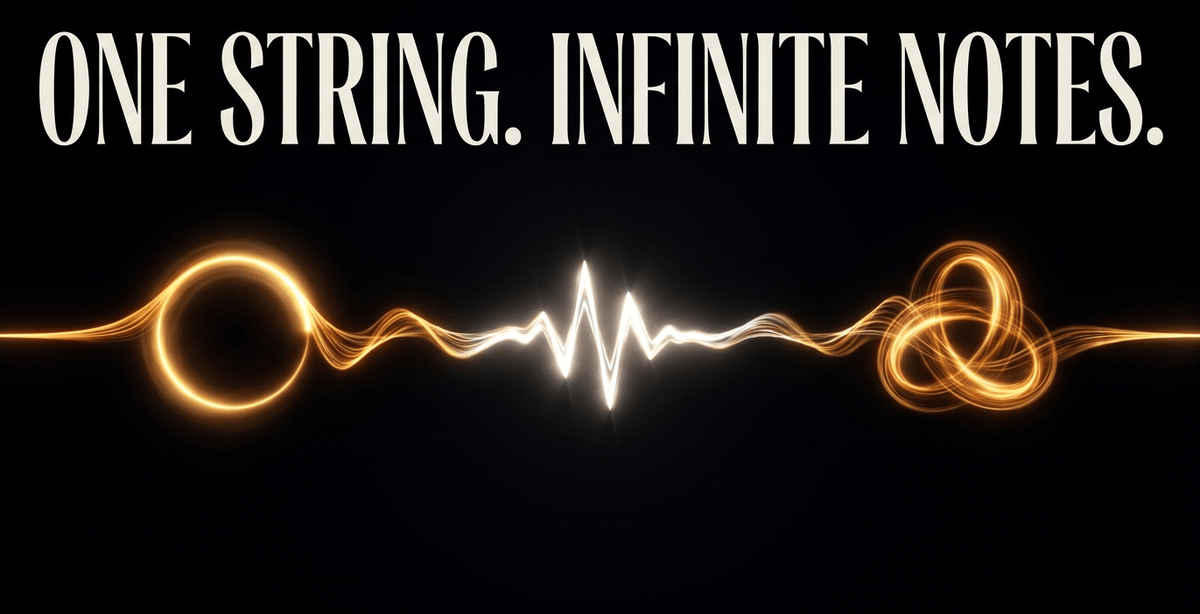
What makes this concept so powerful is its ability to explain the vast diversity of the natural world through a single mechanism. In the old paradigm, we had to invent different "species" of particles - electrons, neutrinos, and various types of quarks - each with its own unique and seemingly arbitrary set of properties. String theory proposes that these are not different types of "stuff" at all. Rather, they are different vibrational modes of the same fundamental string.
Just as a violin string can produce a G, a D, or an A depending on how it is plucked and held, a fundamental string produces the properties of an electron when it vibrates in one pattern and the properties of a photon when it vibrates in another. The mass, the electric charge, and the spin of a particle are simply the "notes" played by the underlying string. This realization brings an incredible sense of unity to the chaotic variety of the subatomic world.
As the physicist Michio Kaku has described it, in this picture all particles are vibrations on a tiny rubber band, and physics itself becomes the harmonies played upon the string.
Gravity and the birth of harmony
Perhaps the most significant triumph of string theory is its natural inclusion of gravity. For nearly a century, the greatest rift in physics has been the incompatibility between general relativity, which describes the curved geometry of space and time on a large scale, and quantum mechanics, which describes the jittery, uncertain behavior of the very small. When physicists try to combine these two frameworks using point-like particles, the math breaks down into nonsensical infinities. The "point" becomes a source of infinite density and energy that the equations cannot handle.
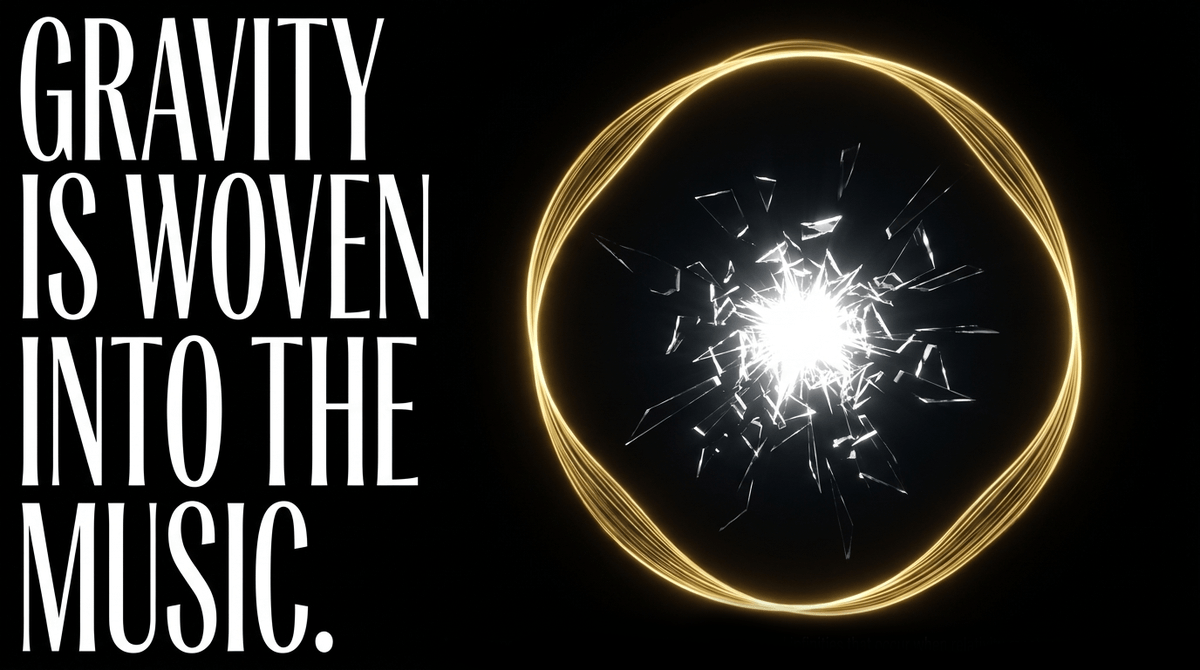
Strings, however, have a finite size. They "smear" the interactions of gravity, preventing the math from collapsing. Within the mathematics of string theory, one particular vibrational state of a closed loop emerges with zero mass and a spin of two. These are precisely the characteristics required for the graviton, the hypothetical particle that carries the force of gravity.
Because the graviton appears naturally as a vibrational mode of the string, gravity is not something "added" to the theory; it is woven into the very fabric of the music. This suggests that the curvature of spacetime and the fall of an apple are both results of the same subatomic resonance that defines the light of a star.
Interestingly, recent theoretical work has approached this same conclusion from an entirely different direction - not by building string theory up from its usual assumptions, but by asking what any sensible theory of colliding particles is forced to look like at very high energies. In a paper published in May 2026, physicists at Caltech and New York University, Clifford Cheung, Grant Remmen, Francesco Sciotti, and Michele Tarquini, showed that when strings collide at extreme energy, they do not concentrate their energy into an infinitely small point the way ordinary particles do. Instead, they spin faster and stretch, avoiding catastrophe by growing gentler rather than sharper. When the researchers demanded only that this "ultrasoft" behavior hold, together with a handful of basic consistency conditions, the entire architecture of string theory - including the Veneziano-style tower of particles - emerged from the mathematics, unbidden. It is a striking echo of the very story that began this section: a stray note appearing in the equations because the music, in some sense, insists on completing itself.
The architecture of hidden dimensions
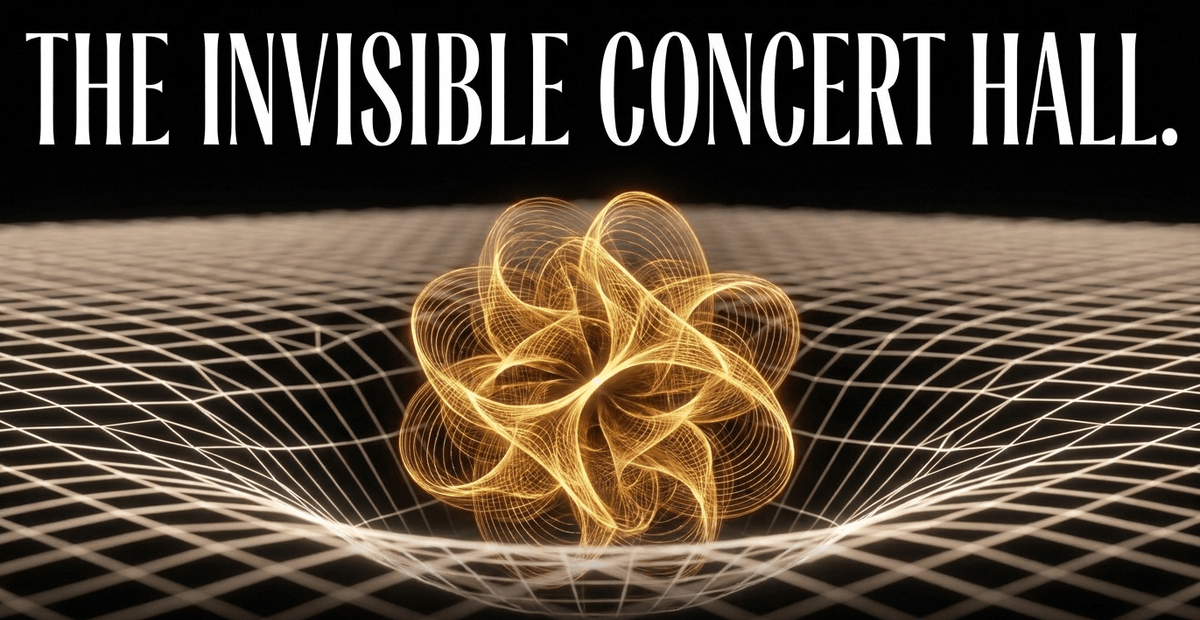
If the universe is a symphony, where is the concert hall? To allow for the complex vibrational patterns we observe, the mathematics of string theory requires more than the three dimensions of space and the one dimension of time we experience in our daily lives. Most versions of superstring theory require ten dimensions, while the overarching framework known as M-theory requires eleven. The earliest formulation of the idea, bosonic string theory, called for twenty-six - a mathematical curiosity that has since largely given way to its more refined superstring descendants.
To the human mind, which evolved to track prey and find fruit in a three-dimensional world, these extra dimensions seem impossible. However, theorists suggest they are "compactified" - curled up so tightly into intricate shapes like Calabi-Yau manifolds that they are invisible to our senses.
Imagine a garden hose seen from a great distance. To an observer far away, the hose looks like a one-dimensional line. It has length, but no apparent thickness. However, if an ant were to crawl on that hose, it would discover a second dimension: the circular path around the hose's circumference. The extra dimensions of string theory are thought to be like that circular path, but on a scale so small that even our most powerful particle colliders cannot yet resolve them.
These hidden geometries are far from empty; they are the shapes that constrain and direct the vibrations of the strings. The geometry of the extra dimensions determines the "tuning" of the strings, which in turn determines the laws of physics in our four-dimensional world. In this sense, the very laws of nature are dictated by the shape of the silent spaces we cannot see.
When strings collide: cosmic strings and the sky
There is a second, and rather different, meaning of the word "string" that has crept into the astrophysical literature in recent years, and it deserves a moment of its own attention, if only to avoid confusion. Cosmic strings are not the microscopic filaments of string theory itself, but hypothetical, thread-like defects that some models predict may have formed in the fabric of space during the earliest fractions of a second after the Big Bang - much as cracks form in ice as it freezes unevenly. If they exist, they would be extraordinarily thin yet potentially stretch across entire galaxies, carrying immense tension and warping the space around them.
In 2023, pulsar timing array collaborations - including NANOGrav in North America, along with the European, Indian, Parkes, and Chinese arrays - announced that they had detected a faint, persistent "hum" in the arrival times of radio signals from dozens of pulsars scattered across the galaxy, consistent with a background of gravitational waves oscillating over years to decades. The leading explanation remains a cosmic chorus of merging supermassive black holes, and most researchers in the field still consider that the most probable source. But cosmic strings are among the alternative explanations that theorists have taken seriously enough to model carefully, alongside possibilities like phase transitions in the early universe. So far, the data has not been able to rule string-based explanations out entirely, even as black hole mergers remain the frontrunner.
Looking ahead, physicists hope that next-generation gravitational wave observatories - including the planned space-based LISA mission and ground-based detectors like the Einstein Telescope - may be sensitive enough to distinguish a cosmic string signature from other sources by looking at how such strings would bend and lens gravitational waves passing near them, rather than relying on frequency alone. It is a delicate hunt, and it is worth being honest about how far it still has to go: no result to date confirms the existence of cosmic strings, but the search itself has become one of the more promising open frontiers where string-inspired physics might one day leave a fingerprint we can actually read.
The historical and philosophical resonance
The idea that the world is composed of vibration is not entirely new. It finds a strange and beautiful echo in ancient philosophical traditions. In the Vedic tradition of India, the concept of Nāda Brahma - the idea that the entire universe is sound - predates modern physics by millennia. Ancient thinkers intuited that the solid world was an illusion and that underneath the surface of things lay a primordial hum.
While the mathematics of string theory is a modern development, the shift from a "particle" mindset to a "vibrational" mindset aligns with this ancient wisdom. It moves us away from a materialistic view of the world as a collection of cold, hard objects and toward a view of the world as an interconnected process.
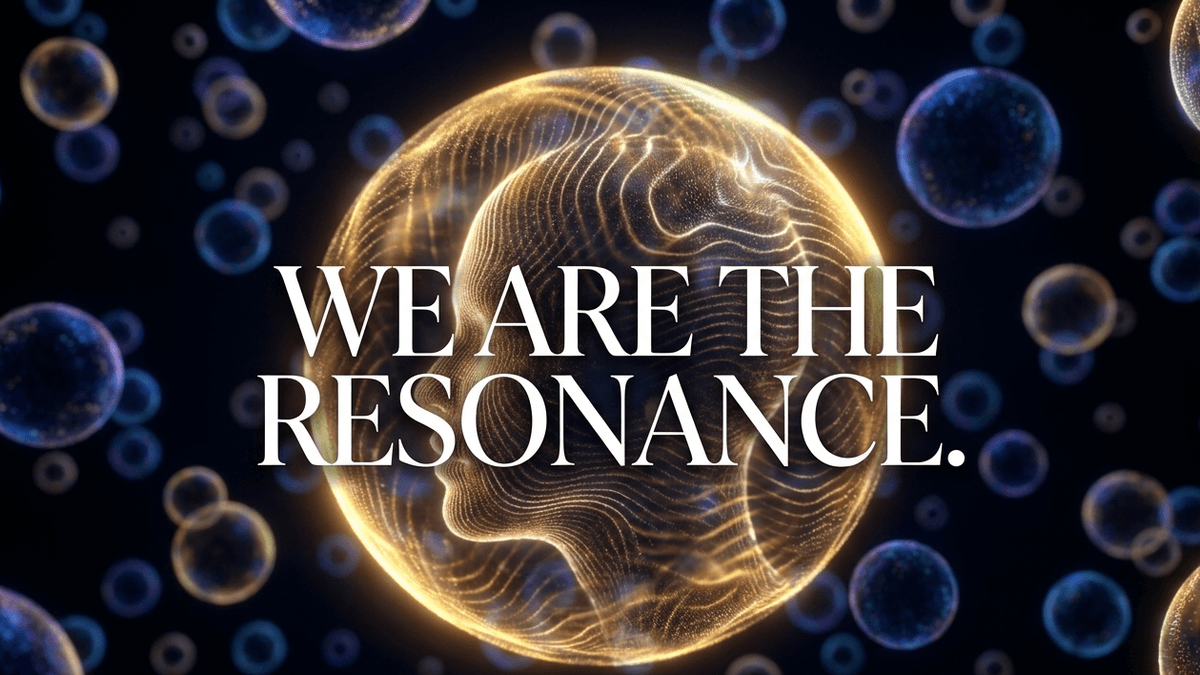
This shift also impacts how we view the human mind. Some contemporary philosophical discussions use the vibrational nature of reality as a metaphor for consciousness itself. If the universe is a set of frequencies, then our sensory organs and our brains act as receivers that decode these vibrations into the sights, sounds, and textures of our experienced reality. We are not just observers of the symphony; we are part of the resonance. The boundary between the "self" and the "other" becomes blurred when we realize that both are made of the same vibrating strings, differing only in their rhythm and tempo.
It is a quiet companion piece to the questions raised by other corners of quantum theory - questions about what quantum mechanics reveals about the nature of reality, and how deeply our observations may be entangled with the observed.
The challenge of the unobservable
Despite its mathematical elegance and its ability to unify the forces of nature, string theory faces a significant hurdle: it has yet to be proven through direct experiment. Science, at its core, requires empirical verification, and the energy required to see a string directly is so vast that it remains beyond our current technological reach. To probe the Planck scale head-on, we would need a particle accelerator the size of a galaxy. This has led some critics, including the physicist Sabine Hossenfelder and mathematician Peter Woit, to argue that string theory has drifted from physics into the realm of pure mathematics, untethered from experiment. Hossenfelder has put the criticism memorably, describing string theory as an idea that refuses to die even as it refuses to be confirmed, too compelling mathematically to abandon and too remote from experiment to settle.
However, proponents of the theory point to a newer line of reasoning known as the "bootstrap" approach. Rather than beginning with a proposed theory and testing it, the bootstrap method starts from only the most minimal assumptions - the basic consistency conditions that any sensible theory of particle scattering must obey - and asks what necessarily follows. In recent theoretical work, researchers at Caltech, New York University, and the Autonomous University of Barcelona showed that these minimal assumptions, applied to the mathematics of how particles scatter at extreme energies, lead almost inevitably to the same equations found in string theory. A separate line of bootstrap work published in January 2026 by Henriette Elvang at the University of Michigan and her collaborators went further still, starting from ordinary assumptions about quantum field theory and arriving, as the unique answer permitted by those assumptions, at the very same scattering formula Veneziano wrote down nearly sixty years earlier. It is a delicate, indirect kind of evidence: not a photograph of a string, but a demonstration that the music writes itself, whether or not we ever hear it.
Not everyone finds the bootstrap argument persuasive as proof of anything physical. Woit, for his part, has been openly skeptical of leaning on the mathematical inevitability of "ultrasoft" scattering behavior as a substitute for experimental confirmation, calling the approach more a matter of internal consistency than of physics answering to nature. The proponents of bootstrapping tend to shrug off this kind of challenge rather than take it personally - their view, roughly, is that the assumptions are stated plainly enough that anyone who disagrees is free to challenge them directly, rather than the conclusion.
There is also hope that we might find gentler, indirect evidence of the theory through cosmology. Observations of the Cosmic Microwave Background - the afterglow of the Big Bang - might contain faint "fingerprints" of the extra dimensions or the behavior of strings in the early, high-energy universe. Furthermore, the concept of supersymmetry, which is integral to most versions of string theory, predicts the existence of a partner particle for every known particle. Physicists at the Large Hadron Collider have searched for these partners for well over a decade, and while no supersymmetric particle has yet been found, each new search only narrows the range of masses where one could still be hiding, sharpening rather than closing the question. If such particles are ever discovered, it would provide a substantial boost to the credibility of the entire string framework.

The multiverse and the landscape of possibilities
One of the most controversial aspects of string theory is the "landscape" of possible universes. Because there are so many ways to curl up the extra dimensions, theorists estimate the number of distinct mathematical solutions, or "vacua," at something on the order of 10^500 - and some more recent estimates push this number far higher still. Each version of compactification results in a different "tuning" of the cosmic strings, and therefore a different set of physical laws.
This has led to the idea of the multiverse, where our universe is just one bubble in a vast foam of realities, each playing its own unique song. While some find this idea unsettling because it seems to diminish the uniqueness of our world, others see it as the ultimate expression of the theory's power. It suggests that everything that can happen, does happen, and that we find ourselves in a universe with these specific laws simply because these are the laws that allow for the existence of complex life - a concept known as the anthropic principle.
"String theory is not dead; it's undead," the physicist Sabine Hossenfelder has quipped, capturing the strange purgatory the theory occupies: too mathematically compelling to abandon, too far from experiment to confirm.
Within this landscape, string theory has evolved to include more than just strings. We now speak of "branes" (short for membranes), which are higher-dimensional objects. A string is a 1-brane, but there can also be 2-branes (surfaces), 3-branes (volumes), and so on. In some radical cosmological models, our entire three-dimensional universe is a 3-brane floating in a higher-dimensional space. The Big Bang itself might have been the result of two such branes colliding, a cosmic cymbal crash that set the strings of our universe into motion. This "ekpyrotic" model offers an alternative to the standard inflationary theory, suggesting a cyclic universe that expands and contracts in a rhythmic, eternal pulse.


Share now









Key takeaways
- Fundamental particles are hypothesized as one-dimensional strings rather than zero-dimensional points, vibrating at the Planck length of roughly 10^-35 meters.
- Properties like mass, electric charge, and spin are determined by the specific vibrational pattern of a string, much as a musical note depends on how a string is plucked.
- String theory naturally incorporates gravity through the vibrational state of a closed string called the graviton - a massless, spin-two particle that emerges directly from the theory's mathematics.
- Mathematical consistency requires extra dimensions, most commonly ten for superstring theory or eleven for M-theory, which are thought to be compactified into shapes too small to detect.
- String theory originated in 1968, when Gabriele Veneziano's formula for particle scattering was later recognized as describing the harmonics of a vibrating string.
- A May 2026 study from Caltech and NYU physicists showed that string theory's mathematics can emerge almost automatically from minimal assumptions about how particles scatter at extreme energies.
- Strings can be either open (with two loose ends) or closed (forming a loop), and this distinction shapes how they interact with space and other strings.
- The theory's "landscape" of possible universes is estimated at around 10^500 distinct vacua, with some estimates placing the true number far higher still.
- No supersymmetric partner particles - a key prediction tied to most string models - have yet been found at the Large Hadron Collider, though searches continue to narrow the possibilities.
- Cosmic strings (thread-like early-universe defects, distinct from fundamental strings) remain an unconfirmed but actively studied possible source behind the gravitational wave "hum" detected by pulsar timing arrays like NANOGrav since 2023.
- The concept of a vibrating, unified reality echoes the ancient Vedic notion of Nāda Brahma - the idea that the universe itself is sound.
- Despite decades of theoretical development, string theory remains unconfirmed by direct experiment, as testing it would require energies far beyond current technological reach.
Sources
- Wikipedia https://en.wikipedia.org/wiki/String_theory
- Quanta Magazine https://www.quantamagazine.org/are-strings-still-our-best-hope-for-a-theory-of-everything-20260323/
- ScienceDaily (Caltech/NYU study) https://www.sciencedaily.com/releases/2026/05/260518041424.htm
- NYU News https://www.nyu.edu/about/news-publications/news/2026/may/string-theory-emerges-from--almost-nothing-.html
- CERN (ATLAS Experiment) https://atlas.cern/tags/supersymmetry
- Published 2026-08-01 18:12
- Modified 2026-08-01 18:12

-
Redaction