

-
 Redaction
Where the quantum world ends: the classical boundary
Explore the quantum-classical boundary: how decoherence, emergence, and pointer states give rise to the stable macroscopic world we experience every day.
To gaze upon the world is to see a tapestry of permanence. We trust the chair to remain beneath us, the moon to follow its steady arc, and the tea to cool in its ceramic vessel according to the patient laws of thermodynamics. Yet beneath this veneer of reliable solidity lies a shimmering, restless ocean of the infinitesimal. Here, the rules of our childhood intuition are not only broken but rendered meaningless. This transition - the quiet threshold where the frantic, probabilistic dance of the atom matures into the predictable stillness of the object - is what physicists refer to when they speak of the quantum-classical boundary. It is not merely a set of equations; it is the physical boundary where the macroscopic world begins.
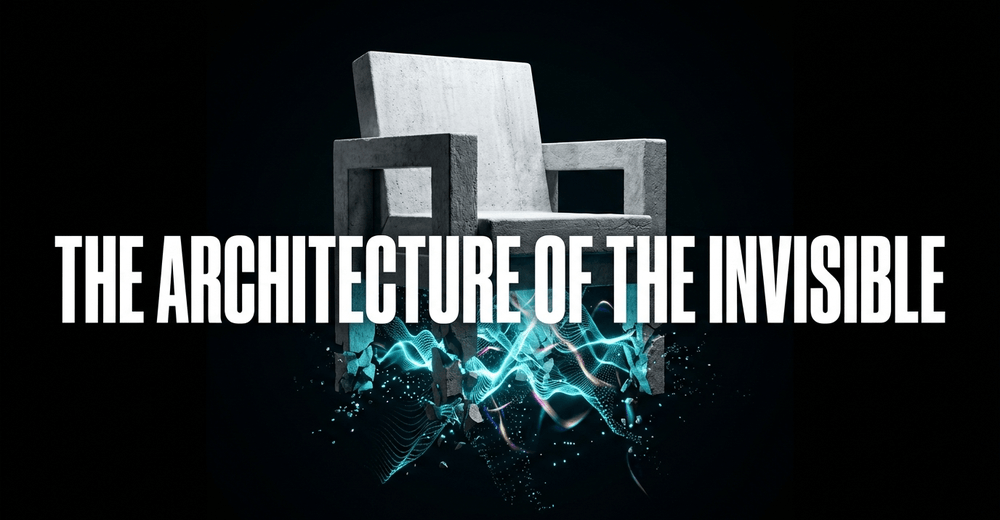
In the quiet chambers of theoretical physics, we often find ourselves asking why the universe chooses to hide its strangeness from our naked eyes. If the foundation of reality is quantum, why does a stone never exist in two places at once? Why does the moon exist only when we look at it - or more accurately, why does it seem so indifferent to our observation? The answer lies in the delicate, often violent, relationship between a system and its surroundings. The macroscopic world is an emergent tapestry woven from the threads of quantum interactions, filtered through the sieve of the environment.
The anatomy of the threshold
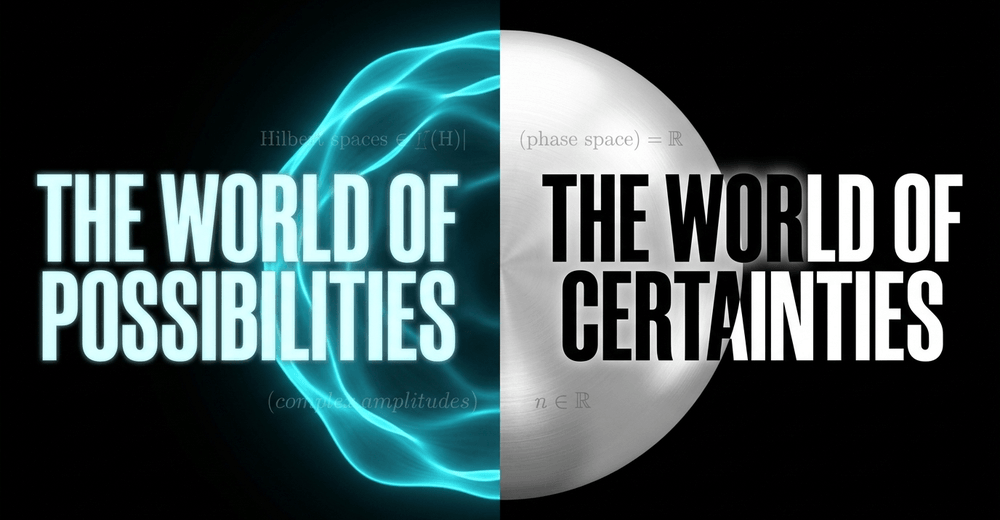
The quantum-classical boundary is perhaps the most evocative mystery in modern science. Historically, we have viewed the world through two incompatible lenses: the microscopic world, governed by the Schrödinger equation and the principles of superposition, and the macroscopic world, ruled by Newton and Einstein. The former is a world of possibilities, where particles are waves of probability; the latter is a world of certainties, where objects have definite positions and momenta. Bridging these two realms is not a matter of finding a sharp line, but of understanding a gradual, blurry fading of one into the other.

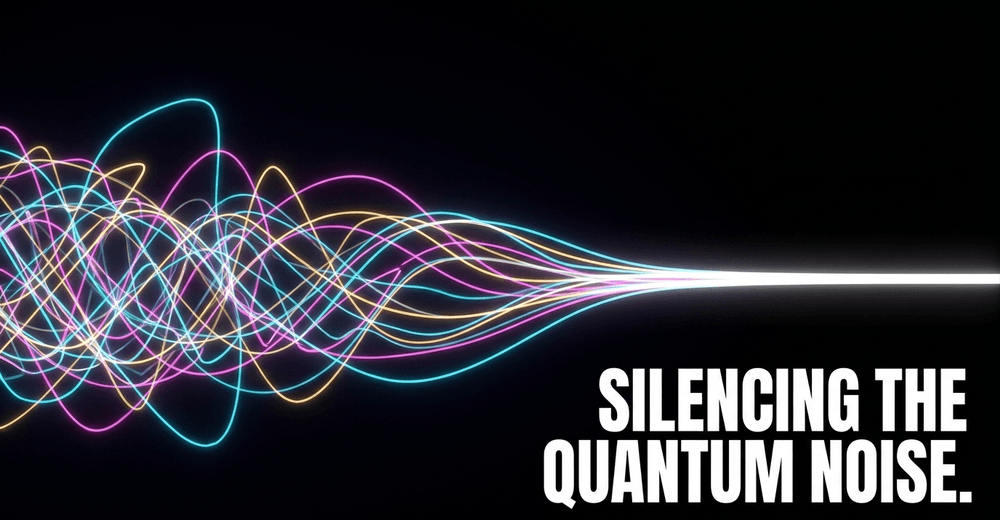
Mathematically, the descriptions of these two worlds are dissonant. Quantum mechanics relies on Hilbert spaces and complex amplitudes, while classical mechanics breathes through phase space and real numbers. The transition is not a sudden snap but a transformation of information. As a system grows in complexity, the quantum interference patterns - those ghost-like signatures of particles being in multiple states at once - begin to wash away. This is the first movement in the symphony of the macroscopic: the silencing of quantum noise.
The mechanism of decoherence
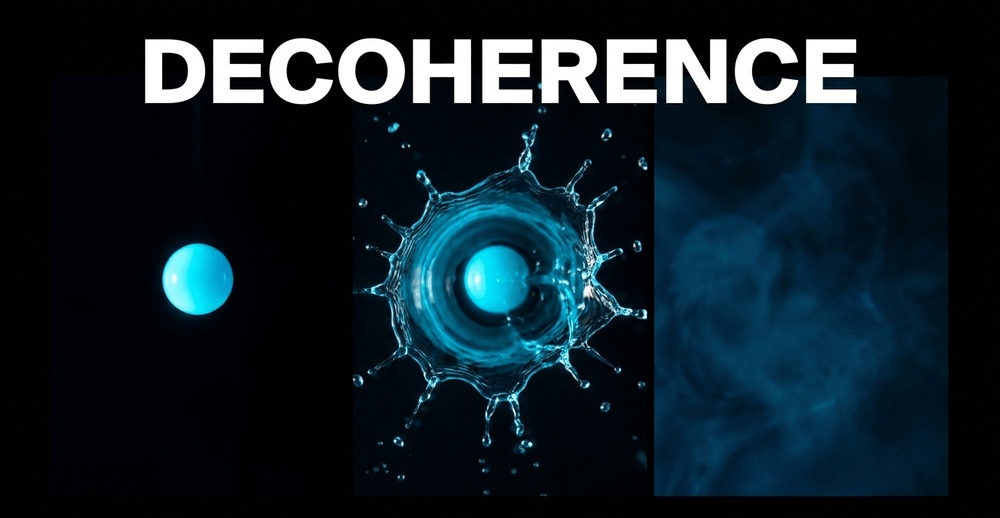
If we are to understand how the classical world emerges, we must speak of decoherence. This is the primary process through which the quantum world surrenders its secrets to the environment. Imagine a single drop of ink falling into a vast, turbulent ocean. For a fleeting moment, the drop is a distinct entity, a concentrated point of color. But as it interacts with the countless molecules of water, it disperses. It does not disappear from existence, but its information is spread so thinly across the ocean's expanse that it can no longer be recovered as a single drop.
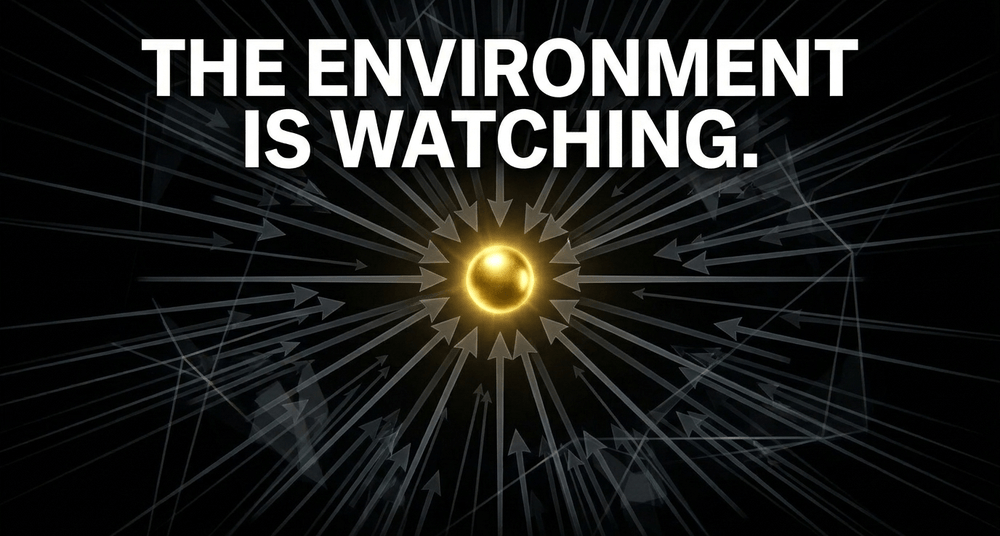
Decoherence acts in much the same way. When a quantum system - such as an electron - interacts with its environment (be it air molecules, stray photons, or even thermal vibrations), it becomes entangled with those external degrees of freedom. This interaction effectively "measures" the system. The environment acts as an unblinking observer, constantly asking the system where it is and what it is doing.
The speed of the disappearing act
For macroscopic objects, this process is unimaginably fast. A grain of dust floating in sunlight is struck by millions of photons every second. Each collision carries away a tiny fragment of the dust grain's quantum coherence. According to research pioneered by physicist Wojciech H. Zurek, the decoherence timescale for a macroscopic object is many orders of magnitude shorter than the shortest time intervals humans can measure.
This extreme speed explains why we never see a table in a superposition of being in the kitchen and the living room. Before our neurons could even begin to process the image, the table has already interacted with the surrounding air and light, forcing its wavefunction to appear to collapse into a single, definite location. It is important to note that decoherence does not actually cause a physical collapse of the wavefunction in the way the Copenhagen interpretation suggests. Instead, it creates the appearance of collapse by leaking the quantum information into the environment, making the different branches of the superposition unable to interfere with one another.
Pointer states and quantum Darwinism
Decoherence is only part of the story. Zurek's work goes further, introducing the concept of einselection - environment-induced superselection. Not all quantum states are equally vulnerable to environmental disruption. The states that withstand the constant scrutiny of the environment are called pointer states, and they are precisely the states we recognise as classical: position, velocity, energy. Everything else is dissolved.
"The only 'failure' of quantum theory is its inability to provide a natural framework for our prejudices about the workings of the Universe." - Wojciech H. Zurek
This idea leads naturally to Quantum Darwinism, a framework Zurek proposed to explain how objective classical reality emerges from a quantum substrate. When a system's pointer state interacts with its environment, information about that state is copied into many independent environmental fragments. A photon scattered off a chair carries information about the chair's position. So does the next billion photons. Any observer sampling only a tiny fraction of the environment can determine the chair's state without disturbing it - because the information is redundantly encoded everywhere. We do not see the quantum world; we see the copies it has left behind.
The grace of emergence
As we cross the boundary into the macroscopic, we encounter the phenomenon of emergence. In physics, emergence is the process where large-scale patterns and properties arise from the collective behavior of simpler components, yet these properties are not present in the components themselves. It is the transition from the individual musician to the full resonance of the orchestra.
Phase transitions are the most tangible examples of this grace. Consider the boiling of water. At the level of a single H₂O molecule, there is no such thing as "boiling." There is only kinetic energy and intermolecular forces. When billions of these molecules interact under specific conditions of temperature and pressure, however, a collective transformation occurs. The liquid becomes a gas. This is a macroscopic event - a shift in the state of matter that only has meaning at a certain scale.
Weak emergence and scale-dependence
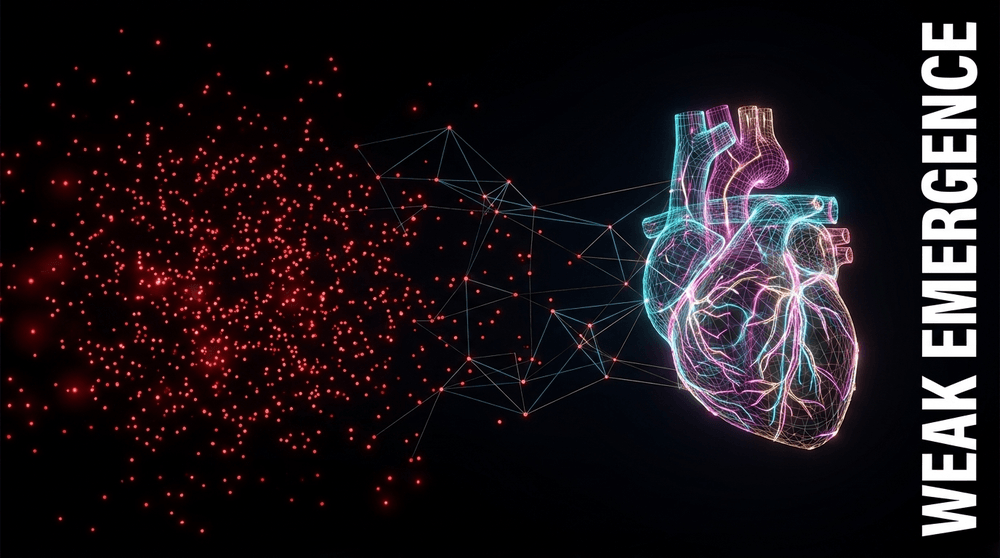
Many scientists categorise these macroscopic properties as weakly emergent. This suggests that while we can theoretically derive the behavior of the whole from the parts, we can only do so through immense simulation. These properties are strictly scale-dependent.
Magnetism, for instance, is not a property of a single isolated electron in the same way it is a property of a bulk material where spins align in a collective march. Life itself is perhaps the most profound example of emergence. A single carbon atom is not alive. A molecule of water is not alive. Yet, when organised into the intricate, self-sustaining architectures of a cell, life emerges. It is a property that exists only above a certain physical threshold, where the complexity of the system allows for functions like metabolism and reproduction. We might place these phenomena on a continuum - viewing life and consciousness not as separate from physics, but as the highest expressions of emergent complexity.
Defining the macroscopic scale
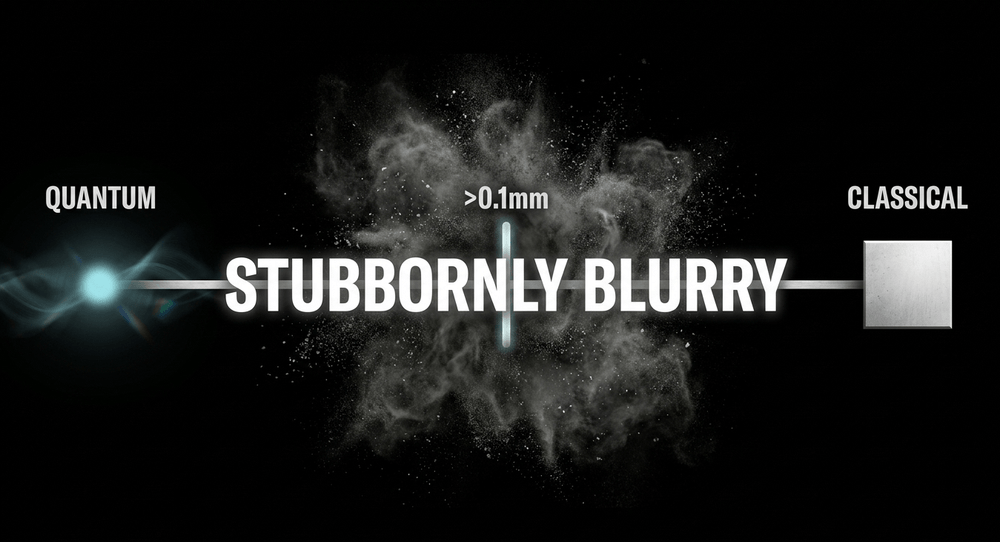
Where exactly does the "macro" begin? In practical terms, we often define the macroscopic scale as anything visible to the naked eye - typically starting around 0.1 millimetres. This is a human-centric definition, of course. From a physical perspective, the boundary is defined by the number of particles and the degree of environmental coupling:
- Size and observability - Microscopic systems require lenses to resolve, whereas macroscopic systems interact with light in ways that allow for direct human perception.
- Environmental complexity - A system becomes macroscopic when its internal degrees of freedom are so numerous that it cannot be meaningfully isolated from its surroundings.
- Predictability - Macroscopic systems follow deterministic laws because the statistical averages of billions of quantum events smooth out the underlying uncertainty.
- Thermal energy - At room temperature, thermal energy vastly exceeds the quantum energy level spacings in macroscopic systems, yielding classical statistical ensembles rather than discrete quantum behaviour.
Despite our desire for a clean line, the transition remains stubbornly blurry. There is also a mesoscopic scale - systems typically ranging from around 10 nanometres to 1 micrometre - where quantum mechanical effects coexist uneasily with classical behaviors. It is physics in two minds at once.
Pushing the boundary: experiments at the edge
Recent experiments have shown that quantum behavior can be maintained in increasingly large objects. Perhaps the most striking experimental confirmation of this came when the 2025 Nobel Prize in Physics was awarded to John Clarke, Michel H. Devoret, and John Martinis for demonstrating that quantum tunneling and energy quantisation can occur in a millimetre-scale electrical circuit - a device containing billions of electrons. Before their work, many experts doubted that quantum coherence could survive in devices made from macroscopic components. Their experiments quietly dismantled that assumption.

More recently, a team at the University of Vienna created the largest superposition state ever recorded, placing clusters of more than 7,000 sodium atoms into a quantum superposition at locations 133 nanometres apart - more than 20 times the width of the nanoparticles themselves. This result beat all previous records of "macroscopicity" by more than tenfold. The researchers confirmed, once again, that quantum mechanics sets no fundamental size or mass limits.
These results suggest that the boundary is not a fixed physical wall, but rather a limit of our ability to isolate a system from its environment. Engineer that isolation carefully enough, and the quantum world reasserts itself at scales that would have once seemed impossible.
The phenomenon of quantum breaking
Even when a system appears perfectly classical, the underlying quantum nature eventually reasserts itself through a process known as quantum breaking. This is the accumulation of tiny deviations from classical predictions. Over vast stretches of time, or at very small scales, the classical approximation begins to fail. The quantum break-time is the duration over which a classical description remains valid.
The quantum break-time depends on the system's properties. For a large, stable object far from any classical instability, this time can scale as a power of the particle number - potentially longer than the age of the universe. For a system exhibiting classical instabilities with large Lyapunov exponents, quantum breaking can occur logarithmically fast. This highlights that classicality is always an approximation - a beautiful, useful fiction that we use to navigate the world, with a finite warranty.
The philosophical weight of the boundary
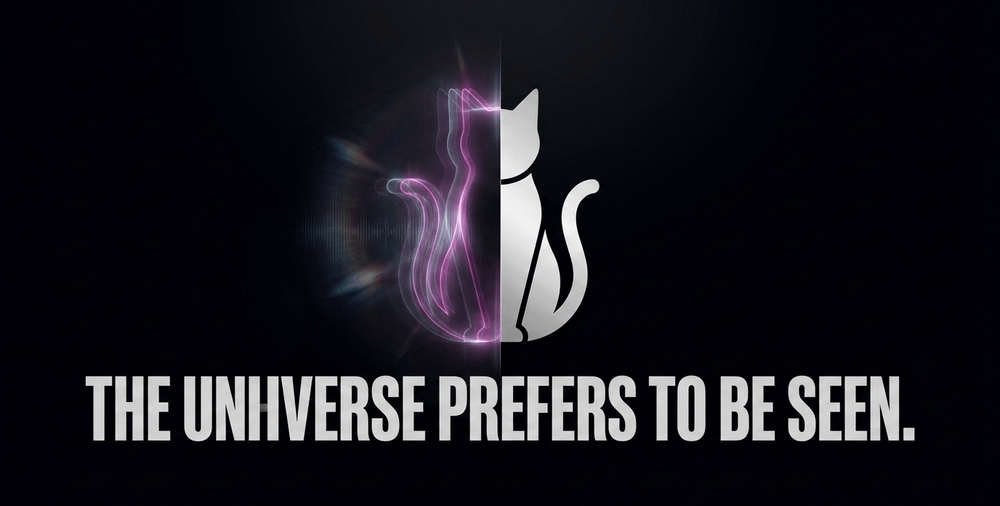
To contemplate the quantum-classical transition is to invite a sense of wonder about our place in the cosmos. The boundary is the stage for the most famous thought experiment in the history of physics: Schrödinger's cat. By linking the fate of a cat to a subatomic event, Erwin Schrödinger - in 1935 - forced us to confront the absurdity of a world without a clear boundary.
If there were no decoherence, if the environment did not constantly act as a witness, the cat would truly remain in a state of being both alive and dead. The fact that we only ever find a living or deceased cat tells us something fundamental about the universe: it prefers to be seen. The boundary is where the universe's infinite possibilities are pruned into a single, shared reality.
The observer and the observed
Is the boundary dependent on the observer? Some interpretations of quantum mechanics suggest that the "macroscopic" is an inferential boundary. It depends on what physical quantities we are capable of measuring simultaneously. If we were vast, cosmic beings capable of tracking every single photon and air molecule in a room, the world might still appear quantum to us. We see a classical world because we are finite; we lack the capacity to perceive the entanglement that binds all things.
In this light, the classical world is a result of our limitations. It is the simplified version of reality that our minds can process. The quantum-classical boundary acts as a bridge between our constrained perception and the limitless complexity of the quantum realm. It allows us to build bridges, fly planes, and understand the stars, even while the foundation of those stars remains a mystery of wavefunctions and probabilities.

Beyond the particle limit
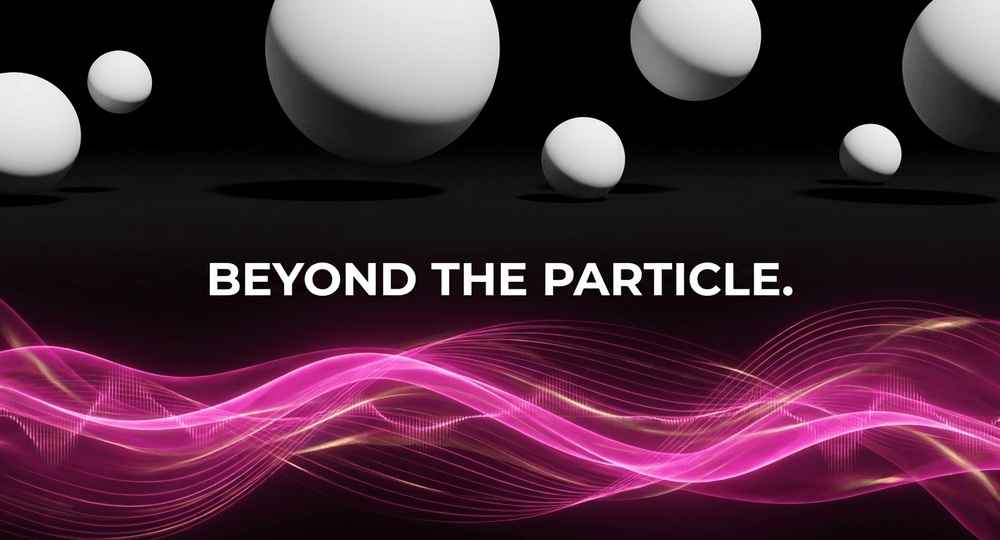
Recent research into massless quanta - such as photons and gravitons - has added a new layer of complexity to our picture of the boundary. Unlike massive particles, which have a well-defined classical limit where they behave like little balls of matter, massless particles do not possess a traditional classical particle limit. Instead, they give rise to classical fields - electromagnetic radiation, gravity. The way a field emerges is different from the way a solid object emerges. Yet the underlying principle remains: the macroscopic world is the collective result of quantum origins.
Data from statistical mechanics reinforces this view, showing how the chaotic, undirected activity of trillions of atoms results in the organised, steady behavior of a gas or a solid. The individual quantum randomness dissolves into the classical average, like a vast ocean whose surface is smooth, even though every water molecule beneath it churns and spins in restless, uncertain motion.
A universe of continuity
As we look toward the future, the edges of the quantum-classical boundary continue to shift. We are building machines that operate in the liminal space between the micro and the macro. Quantum computers and sensors are pushing the limits of how large a system can be while still retaining its quantum soul. Current superconducting qubits achieve coherence times ranging from tens to hundreds of microseconds - some now reaching into the millisecond regime - long enough to execute sophisticated quantum algorithms before the classical world reasserts its authority.
There is still no evidence of a fundamental principle that limits quantum mechanics. We have not yet found a point where the laws of the atom simply stop working. Instead, we find only the overwhelming influence of the environment, the rapid spread of information, and the rise of emergent properties.
The macroscopic world is not a separate place; it is a specific perspective. It is the view from the top of the mountain, where the individual trees and stones blur into a single, breathtaking landscape. While the individual parts of our world are strange and uncertain, the whole is a masterpiece of stability. We live in the transition. We are the macroscopic world beginning to understand its own quantum heart.
In the end, the boundary is a testament to the coherence of nature. It is the reason we can breathe, think, and love in a universe that, at its core, is made of nothing but waves of possibility. We are the observers who turn those waves into a world - standing forever on the edge where the microscopic ends and our journey begins.
Share now









Key takeaways
- The transition from quantum to classical physics is a gradual, blurry shift - not a sharp line - governed by the growing influence of environmental interaction.
- Decoherence is the primary mechanism by which quantum systems lose their coherence: the environment continuously entangles with the system, spreading its quantum information irreversibly outward.
- Macro-scale objects decohere almost instantaneously - many orders of magnitude faster than the shortest time intervals humans can measure - which is why quantum effects are invisible in everyday life.
- Wojciech Zurek's concept of einselection (environment-induced superselection) explains why only certain "pointer states" survive decoherence: those robust under environmental monitoring, which correspond precisely to classical properties like position and momentum.
- Quantum Darwinism proposes that classical reality becomes objective because information about pointer states is copied redundantly into countless environmental fragments (such as scattered photons), allowing multiple observers to agree on what they see.
- Emergence describes how large-scale properties - phase transitions, magnetism, and even life itself - arise from microscopic interactions yet are absent in any single component, making them strictly scale-dependent.
- The practical definition of the macroscopic scale begins at roughly 0.1 millimetres (visible to the naked eye), but the physical boundary is defined by environmental coupling and particle number, not size alone.
- The mesoscopic scale (roughly 10 nanometres to 1 micrometre) is a zone where quantum and classical behaviors coexist, making it a crucial frontier for nanotechnology and quantum devices.
- Quantum breaking refers to the finite timescale over which a classical description remains valid; for large, stable objects this break-time can exceed the age of the universe, but for systems with classical instabilities it can be logarithmically short.
- The 2025 Nobel Prize in Physics was awarded to John Clarke, Michel H. Devoret, and John Martinis for demonstrating macroscopic quantum tunneling and energy quantisation in a millimetre-scale electrical circuit - proving that the quantum-classical boundary is an engineering constraint, not a fundamental law of nature.
Sources
- Wikipedia: Quantum decoherence https://en.wikipedia.org/wiki/Quantum_decoherence
- SpinQ: Understanding quantum decoherence - the ultimate expert guide https://www.spinquanta.com/news-detail/understanding-quantum-decoherence-the-ultimate-expert-guide
- Wikipedia: Quantum Darwinism https://en.wikipedia.org/wiki/Quantum_Darwinism
- Advanced Science News: Where is the boundary to the quantum world? https://www.advancedsciencenews.com/where-is-the-boundary-to-the-quantum-world/
- Physics Today: Superconducting quantum circuits - at the heart of the 2025 Nobel Prize in Physics https://physicstoday.aip.org/features/superconducting-quantum-circuits-at-the-heart-of-the-2025-nobel-prize-in-physics
- Published 2026-07-18 17:27
- Modified 2026-07-18 17:27

-
Redaction