

-
 Redaction
How clay tablets predicted the Bronze Age collapse
Clay tablets from Pylos, Amarna and Ugarit reveal an over-administered Bronze Age world creaking under its own bureaucratic weight before it collapsed.
Administrative nightmare
To walk the ruins of a Mycenaean palace today is to witness the silence of a failed machine. The stones of Pylos or Mycenae are not merely monuments to kings; they are the skeletal remains of a complex, hyper-specialized bureaucratic engine that eventually crushed itself under its own weight. As an archaeologist, I have often stood in the central archives of these sites, feeling the dust of three thousand years on my boots, and realized that the story of the Late Bronze Age collapse is not primarily one of swords and fire, but of ink and clay.
For decades, popular accounts of the collapse leaned on the image of the "Sea Peoples" - a loose confederation of seaborne raiders sweeping across the Mediterranean and toppling kingdoms in their wake. That picture isn't wrong so much as incomplete. The true precursors to the end are found in the ledgers. The clay tablets recovered from the ashes of these civilizations offer a granular, often unsettling look at states that had become so administratively over-extended that almost any external shock - drought, earthquake, piracy, war - was likely to prove fatal.
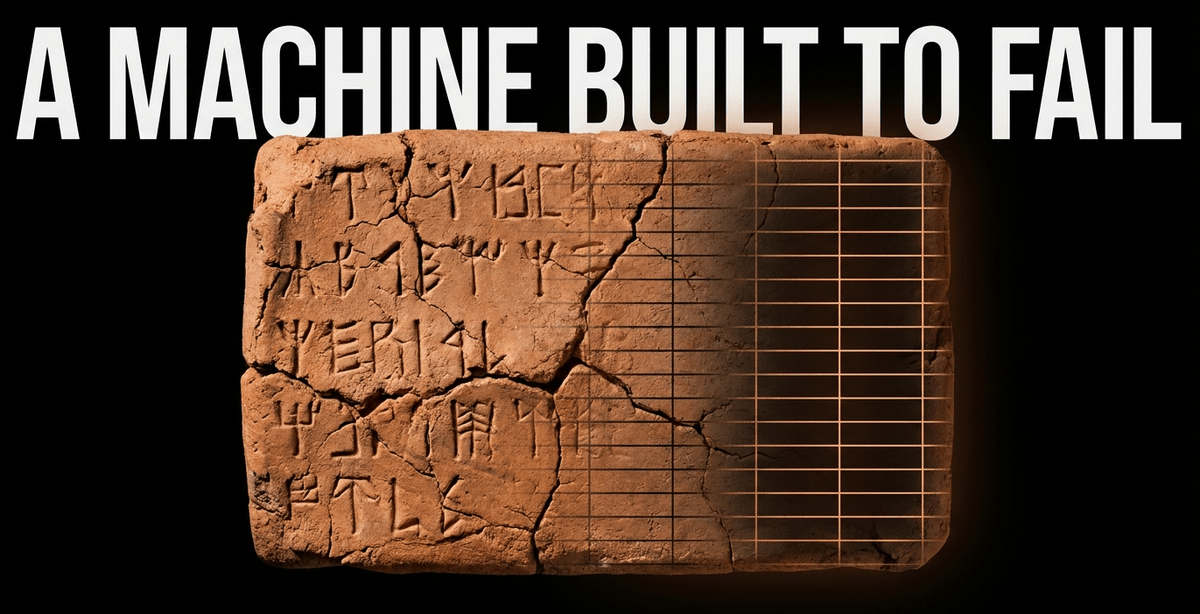
These documents were never meant to be permanent. They were working notes, sun-dried clay meant to be recycled once the fiscal cycle closed out. It is a haunting irony that they only survive today because the very fires that destroyed these cities baked the clay into ceramic, preserving the final, frantic moments of a dying administrative world.
The micro-managed state and the fragility of Linear B
In the palace of Nestor at Pylos, the scribal records known as Linear B reveal an economy governed with almost obsessive detail. Unlike the literary epics of later Greece, Linear B was never used for poetry, law, or history. It was a syllabic script, each sign standing for a syllable rather than a letter, and it appears to have functioned strictly as an accounting tool - inventories, labor assignments, land grants, ration lists. Archaeologists working at Pylos have identified the handwriting of roughly forty-five individual scribes across the archive, a reminder of just how small the literate class actually was.
A Linear B tablet, baked hard by the same fire that ended the palace archive.
Take tablet PY Ub 1318. It catalogs bovine, pig, and deer hides assigned specifically to saddle and shoe makers - the kind of granular tracking you'd expect from a modern supply-chain spreadsheet, not a Bronze Age kingdom. This was not a free market. It was a command economy where every scrap of leather, every jar of oil, every sacrificial animal was tracked by a central authority.
This level of micro-management created a rigid system that lacked resilience. When the palace controls the flow of nearly every resource, the local population loses the ability to improvise around a local shortage. There's no slack in the system, because slack was never the point - control was.
The final weeks at Pylos make this vulnerability plain. A set of documents known as the "o-ka" tablets - written, most scholars believe, in the days or weeks before the palace fell - record the frantic deployment of "watchers on the coastline" and the mobilization of rowers in groups of thirty. Other tablets from the same final months show the palace requisitioning bronze from temples, presumably to be melted into spearheads. These are not the records of a confident empire. They are the records of a bureaucracy trying to solve a fast-moving military crisis with the same ledger-based logic it had always used to count sheep. When the center could no longer deliver the grain or bronze it had promised in exchange for service, the social contract holding the kingdom together came apart with it.

Economic gravity and the mathematics of ancient trade
The vulnerability of these networks isn't just a matter of historical interpretation - it turns out to be a matter of mathematics. In a study published in the Quarterly Journal of Economics, the Harvard Assyriologist Gojko Barjamovic teamed up with economists Thomas Chaney, Kerem Coşar, and Ali Hortaçsu to apply a modern "gravity model" of trade to roughly twelve thousand cuneiform tablets recovered from the merchant colony of Kanesh, in what is now central Turkey. The gravity model is the mathematical framework economists use today to predict trade flows between countries based on economic size and geographic distance.
The results are startling. The researchers found a distance elasticity of trade in the Bronze Age close to modern estimates - in other words, the rate at which trade volume dropped off as distance between two cities increased followed almost the same mathematical curve we see in 21st-century international commerce. The team went further, using their model to help pinpoint the likely locations of several long-lost Assyrian trading cities based purely on the patterns embedded in the correspondence.
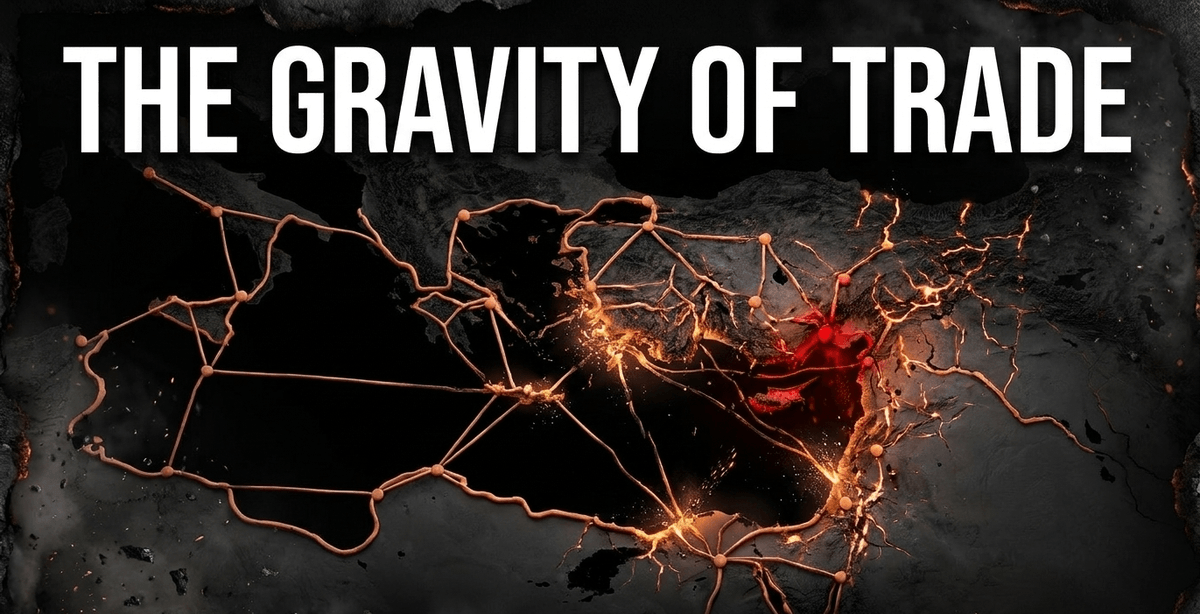
This interconnectedness cut both ways. The Bronze Age "palace economy" ran partly on a prestige-goods circuit, in which kings exchanged gold, lapis lazuli, tin, and finished luxury goods to maintain status and reward their subordinates. When one node in that network faltered - a disrupted grain harvest in Hatti, a blockade of Cypriot copper - the shock could travel across the entire interconnected system. It's a pattern that should feel uncomfortably familiar to anyone who has watched a modern supply-chain disruption ripple into inflation and shortages thousands of miles from its source.
What network science says about the collapse
I find it striking that some of the most persuasive recent work on this period hasn't come from archaeologists digging in the dirt, but from risk analysts working with spreadsheets and simulation software. A team led by the systems scientist Igor Linkov, working alongside the historian Eric Cline - whose book 1177 BC: The Year Civilization Collapsed remains the standard popular account of the period - built a network model of the political and economic ties linking Late Bronze Age states. Their aim was to test, mathematically, whether the shape of the network itself could explain why the collapse was so total.
The model treated each kingdom as a node and each diplomatic or trade relationship as a connective link, then simulated what happens when individual nodes are stressed or removed. The result reads less like ancient history and more like an engineering postmortem. As the team put it in a 2025 follow-up published in the journal Risk Analysis, the network structure of these societies likely amplified compounding threats, producing a cascade of failures that culminated in a precipitous, broad systemic collapse. The very connections that had spread prosperity for centuries became, under sufficient strain, the conduit for its opposite.
That framing matters because it resolves an old debate. Archaeologists have long argued over whether the Late Bronze Age fell to a single catastrophic blow or to the terrible coincidence of several blows landing at once. The network models suggest both camps are half right. A tightly interconnected system doesn't need every node to fail. It only needs enough of the load-bearing ones to fail in close succession, and the connections do the rest of the damage on their own. Ugarit is the case study the researchers return to again and again, because its own archive shows a city that, in the words of the historian Eric Cline, appears to have maintained normal operations right up until the moment of its destruction - a system that looked healthy from the inside even as its foundations were already gone.
Cracks in the facade: the Amarna letters
While the final collapse is generally dated to somewhere around the twelfth century BC, the symptoms of systemic decay were visible more than a century earlier. The Amarna letters - a cache of several hundred cuneiform tablets discovered at Akhetaten, the short-lived capital of the pharaoh Akhenaten - offer a glimpse into the diplomatic strains of that earlier era. Written mostly in Akkadian, the era's international language of choice, these letters trace a slow shift from mutual courtesy to increasingly desperate demand.
King Burna-Buriash II of Babylon, for instance, repeatedly pressed Egypt to match his own generous gifts and honor prior agreements, at one point protesting the poor quality of gold he'd received and accusing the pharaoh of disrespect. It reads less like diplomacy between equals and more like a client chasing an overdue invoice.
More revealing still are the letters from vassal rulers like Rib-Hadda of Byblos, who authored at least sixty surviving letters - more than any other correspondent in the archive - and whose pleas for military help form a continuous narrative of decline as Egyptian influence in the region eroded. His letters describe raids by a group the Egyptians called the Habiru, and by the end of his correspondence he is warning that Byblos will fall without swift support. It never came. His persistence, and his eventual silence, suggest a tragic end for a loyal vassal abandoned by his imperial patron.
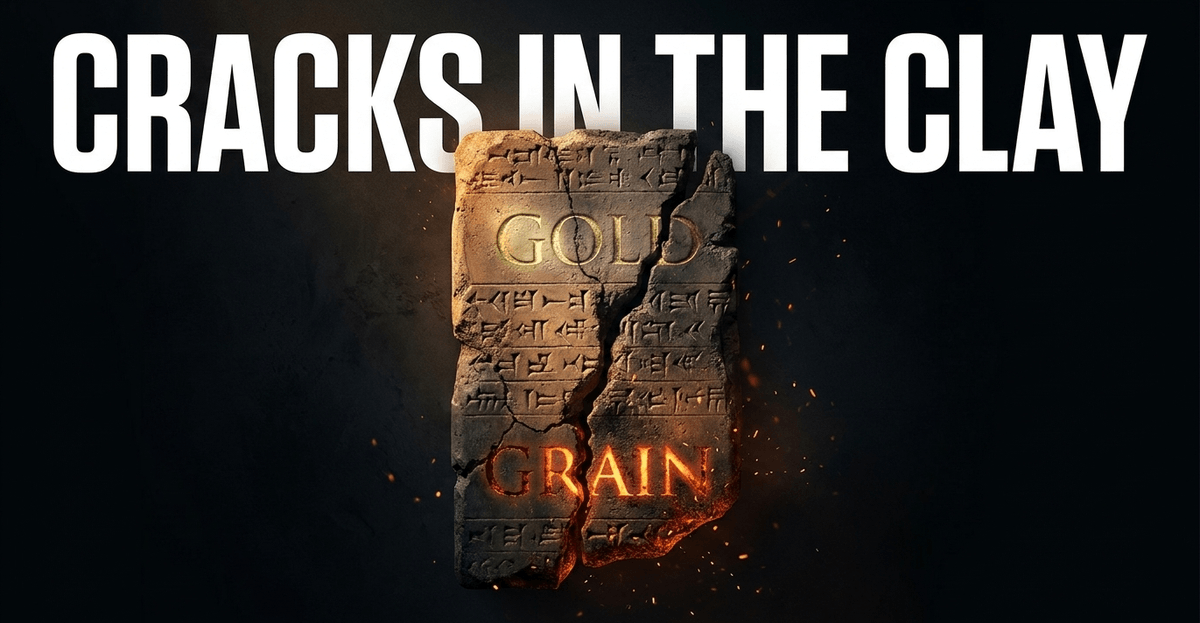
These records indicate that central security was already fraying more than a century before the final fires. The great powers were so focused on the administrative flow of gold and luxury goods that they were slow to register the erosion of the physical security required to move that gold in the first place. Historian Igor Linkov and his colleagues point to the relationship between the Hittites and Egyptians, formalized in the Treaty of Kadesh, as an example of how diplomatic ties could underwrite decades of stability - and how their breakdown could just as easily transmit instability across the whole network. If you're curious how oral tradition preserves memories of catastrophe long after the written record goes silent, it's worth reading about how myths encode real ancient disasters - a different kind of archive entirely, but one that often confirms what the tablets only hint at.
The Ugarit archives and the final famine
Ugarit, a wealthy port city on the coast of modern Syria, offers perhaps the most visceral evidence of the endgame. Its royal palace, along with a private merchant archive belonging to a trader named Urtenu, has yielded hundreds of tablets documenting both diplomacy and business right up to the city's destruction.
By the final years before the fall, the tone of the correspondence shifts unmistakably from commerce to survival. Grain, not gold, becomes the subject of nearly every urgent letter. One letter found in Urtenu's archive, from the Egyptian pharaoh Merenptah, records a shipment of grain being sent because famine had struck Ugarit. Around the same time, the Hittite king Tudhaliya IV sent an urgent demand to Ugarit for a ship and crew to transport some four hundred and fifty tons of grain, framing it bluntly as a matter of life and death. This wasn't hyperbole.
That desperation now has a name and a date attached to it. In 2023, a team of Cornell researchers led by the dendrochronologist Sturt Manning analyzed juniper tree-ring samples recovered from Gordion, west of modern Ankara, cross-referencing ring width against carbon isotope data to reconstruct year-by-year growing conditions in the Hittite heartland. Their findings, published in Nature, identified a punishing three-year run of severe drought around this same period - a climatic anomaly severe enough to show up as visibly stunted rings in trees that had weathered centuries of ordinary dry spells. Manning described it as the kind of shock that pushes a society past the point where its usual "adaptive capacities" can keep up. Inscriptions from the same period point to famine conditions reaching into central Anatolia as well - the crisis was breaking out horizontally across the map, not sweeping in from one direction.
The most haunting artifact of this era is a letter known as RS 20.238, a dispatch copied by the king of Ugarit to the king of Alashiya, informing him that several of Ugarit's cities had been destroyed by a flotilla of seven enemy ships. A related and even more frequently cited letter, RS 18.147, was written by Ugarit's last king, Ammurapi, and captures the panic directly: the enemy's ships had come, cities were burning, and the king protested that his own troops and chariots were all away in the land of Hatti while his ships were off in Lukka, leaving his country to fend for itself.
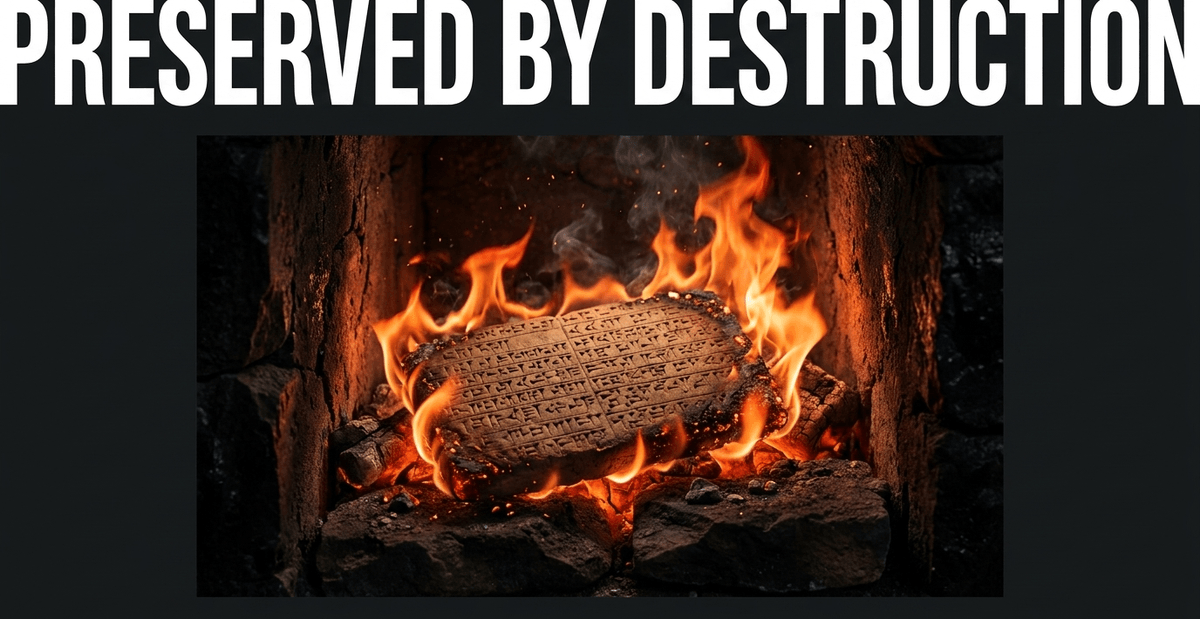
What makes this group of letters so eerie isn't just their content. Several of them, including RS 20.238, were still in the process of being fired in a kiln - part of the routine work of preserving outgoing correspondence - when Ugarit itself was sacked. The city fell before the letters could be dispatched. The administrative heart was still beating right up to the moment the fire that both destroyed and preserved it swept through.
The scribal bottleneck and systemic amnesia
One of the most consequential technical features of the collapse is what might be called the scribal bottleneck. Literacy across the Mycenaean world appears to have been restricted to a genuinely small elite - the identifiable hands at Pylos number only in the dozens, working within a population likely numbering in the tens of thousands. This extreme specialization was a structural weakness disguised as efficiency.
In a modern society, institutional knowledge is distributed across countless individuals, redundant systems, and, increasingly, machines. In the Late Bronze Age, the entire operating logic of the palace state lived inside the heads of a handful of scribes and the clay tablets they filled out, season after season.

When the palaces burned, that bureaucratic class was among the first casualties - killed, scattered, or simply left with nothing left to administer. Without the scribes, the state lost its institutional memory. It could no longer collect taxes accurately, mobilize labor for irrigation and construction, or coordinate the redistribution of food from central stores. This helps explain not just why the collapse was so severe, but why the "Dark Age" that followed in Greece lasted as long as it did, with writing itself disappearing from the mainland for several centuries. It wasn't only that the buildings were gone. The administrative code that ran the society had been deleted, and nobody remaining knew how to rewrite it. The shift from a centralized palace economy to small, decentralized, subsistence-level communities wasn't a lifestyle choice. It was what remained once the machinery for anything more complex had vanished.
Was it really just administration? Weighing the other causes
It would be a mistake to present bureaucratic fragility as the sole cause of the Late Bronze Age collapse - the archaeological consensus today favors a tangle of interacting pressures rather than a single trigger. Paleoclimate records from lake sediments and cave formations across the eastern Mediterranean point to a period of prolonged drought beginning in the thirteenth century BC, coinciding closely with the famine letters from Ugarit and Hatti, and with the tree-ring evidence from Gordion. Seismological studies have identified what looks like a cluster of major earthquakes striking multiple palace sites within a few decades of one another - what some archaeologists call an "earthquake storm." And the movements of the Sea Peoples themselves, whatever their precise origins, were real.
It's also worth saying plainly that the scholarly picture has grown more cautious in recent years. Researchers such as Jesse Millek have gone back through a century and a half of excavation reports and found that some earlier tallies of "destroyed" cities overstated the case - a number of supposed destruction layers turn out, on closer inspection, to reflect abandonment, reoccupation, or ordinary fire damage rather than violent conquest. That doesn't overturn the broader collapse narrative, but it's a useful reminder that even a "black-box flight recorder" needs careful, skeptical reading.
What the administrative record adds to this picture isn't a replacement for these explanations but a mechanism for understanding why the shock proved so total. A resilient, decentralized society facing drought or piracy can often absorb the blow and rebuild. A society whose food distribution, labor mobilization, and military logistics all ran through a single narrow bureaucratic channel had no such flexibility. The palaces didn't just get unlucky. They had spent generations building a system with no capacity to fail gracefully.

Lessons from the baked earth
Looking back through the lens of economic forensics, the Bronze Age collapse appears less like a sudden barbarian invasion and more like the systemic failure of an over-leveraged civilization. The clay tablets of Pylos, Amarna, and Ugarit act as something close to the black-box flight recorders of an ancient crash. They tell a story of administrators so focused on the precision of their ledgers that they remained partly blind to the fragility of the network those ledgers depended on.
Today, we operate a world of digital ledgers and global supply chains that mirror, with unsettling fidelity, the mathematical "gravity" of the ancient trade routes uncovered at Kanesh. The lesson of the clay tablets isn't that complexity itself is bad - it's that complexity is a kind of debt, one that has to be serviced continuously and that comes due all at once when the environmental or social carrying capacity of a system is exceeded.
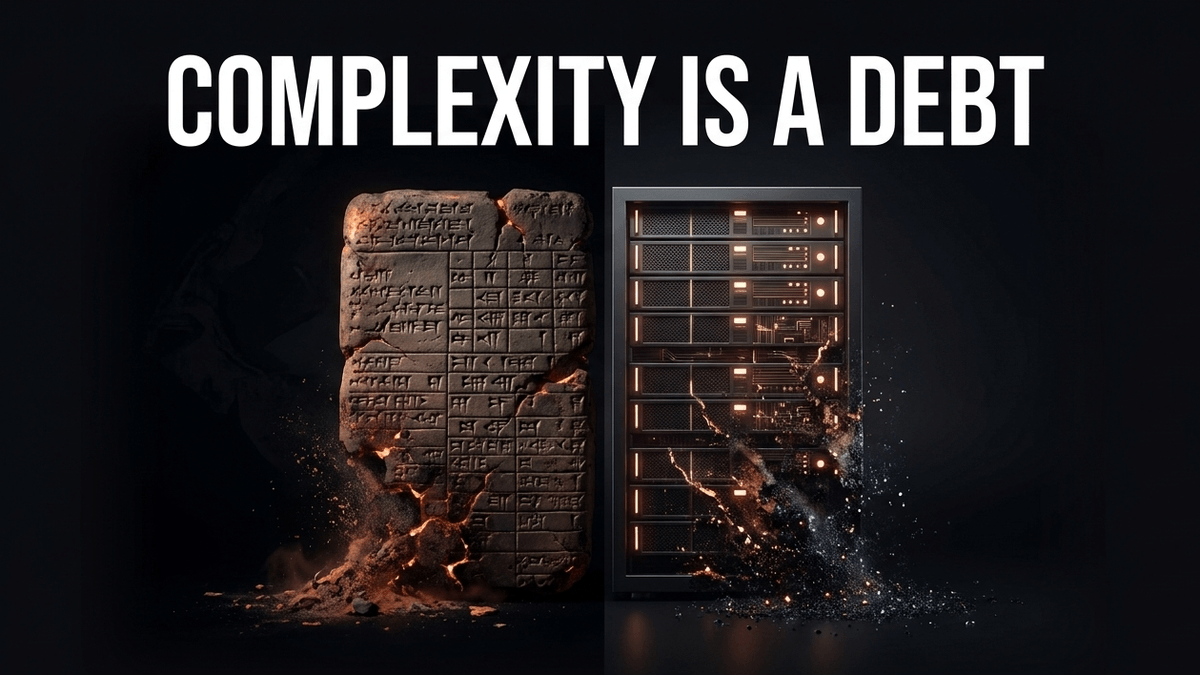
The fires of the twelfth century BC didn't just destroy cities. They fired the clay into a permanent, accidental warning for any civilization convinced its systems have grown too complex to fail. The silence that followed the fall of the palaces was, in part, the sound of a world released from the weight of its own records - and the long, slow climb back from the ashes beginning in earnest.
Share now









Key takeaways
- Linear B tablets from Pylos and other Mycenaean palaces survive today only because the fires that destroyed those palaces accidentally baked the sun-dried clay into permanent ceramic.
- Linear B functioned almost exclusively as an accounting script - tracking inventories\, land grants\, and labor - and was never used for poetry\, law\, or history.
- Scholars have identified the handwriting of roughly forty-five individual scribes at Pylos, showing how narrow the literate administrative class actually was.
- Tablet PY Ub 1318 records bovine, pig, and deer hides assigned specifically to saddle and shoe makers, revealing a tightly controlled command economy.
- The "o-ka" tablets at Pylos, written in the final weeks before the palace fell, record coastal watch deployments and the mobilization of rowers in groups of thirty.
- A study in the Quarterly Journal of Economics by Barjamovic, Chaney, Coşar, and Hortaçsu applied a modern gravity trade model to roughly 12,000 tablets from the merchant colony of Kanesh, finding a distance elasticity of trade close to modern estimates.
- A 2024-2025 network science model by Linkov, Cline, and colleagues found that the diplomatic and trade ties linking Late Bronze Age states likely amplified rather than absorbed compounding shocks, turning isolated failures into a systemic cascade.
- Tree-ring and isotope analysis of juniper wood from Gordion, published in Nature in 2023, identified a severe three-year drought around 1198-1196 BC coinciding with the collapse of the Hittite Empire.
- The Amarna letters, written mostly in Akkadian and recovered from Akhenaten's capital, document diplomatic strain and vassal pleas for help more than a century before the final collapse.
- Rib-Hadda of Byblos authored at least sixty surviving letters pleading for Egyptian military aid against the Habiru raiders - more than any other Amarna correspondent.
- The letter RS 20.238 was still being fired in a kiln - part of the process of preserving outgoing correspondence - when Ugarit itself was destroyed, meaning it was never sent.
- The Bronze Age collapse is now understood by archaeologists as a convergence of causes - administrative fragility\, prolonged drought\, earthquake clusters\, and the movements of the Sea Peoples - rather than any single trigger.
Sources
- National Bureau of Economic Research (Barjamovic, Chaney, Coşar, Hortaçsu, "Trade, Merchants, and the Lost Cities of the Bronze Age") https://www.nber.org/system/files/working_papers/w23992/w23992.pdf
- Nature (Manning, Kocik, Lorentzen, Sparks, "Severe multi-year drought coincident with Hittite collapse around 1198-1196 bc") https://www.nature.com/articles/s41586-022-05693-y
- Risk Analysis (Galaitsi, Trump, Cline, Kitsak, Linkov, "Navigating the precipice: Lessons on collapse from the Late Bronze Age") https://onlinelibrary.wiley.com/doi/10.1111/risa.70019
- Wikipedia - Amarna letters https://en.wikipedia.org/wiki/Amarna_letters
- Wikipedia - Late Bronze Age collapse https://en.wikipedia.org/wiki/Late_Bronze_Age_collapse
- Published 2026-07-13 20:49
- Modified 2026-07-13 20:49
