

-
 PRO
PRO -
 Redaction
Vampire graves: the science behind the stones
Archaeologists reveal how iron sickles, weighted stones, and soil chemistry were engineered to stop the dead from rising in post-medieval Poland and beyond
Deep within the silt and clay of European archaeological sites lies a specific class of interment that challenges our understanding of historical funerary rites. These are not merely burials. They are containment systems.
The mechanics of apotropaic burial centers on the mechanical immobilization and biological containment of the deceased, carried out to prevent reanimation. In recent years, the technical focus in archaeology has shifted toward the taphonomic and biogeochemical specifics of these deviant, or atypical, interments - moving beyond folklore and into the realm of material analysis.
When we stand over an open trench, looking at a skeleton pinned beneath a boulder, we are witnessing a structural response to decomposition anxiety. The community that dug this grave was not simply performing a ritual. They were applying a primitive but calculated form of engineering, designed to counteract the perceived physical capabilities of a revenant. Every sickle, every stone, and the very density of the soil around them was selected to act as a physical barrier against a biological impossibility.
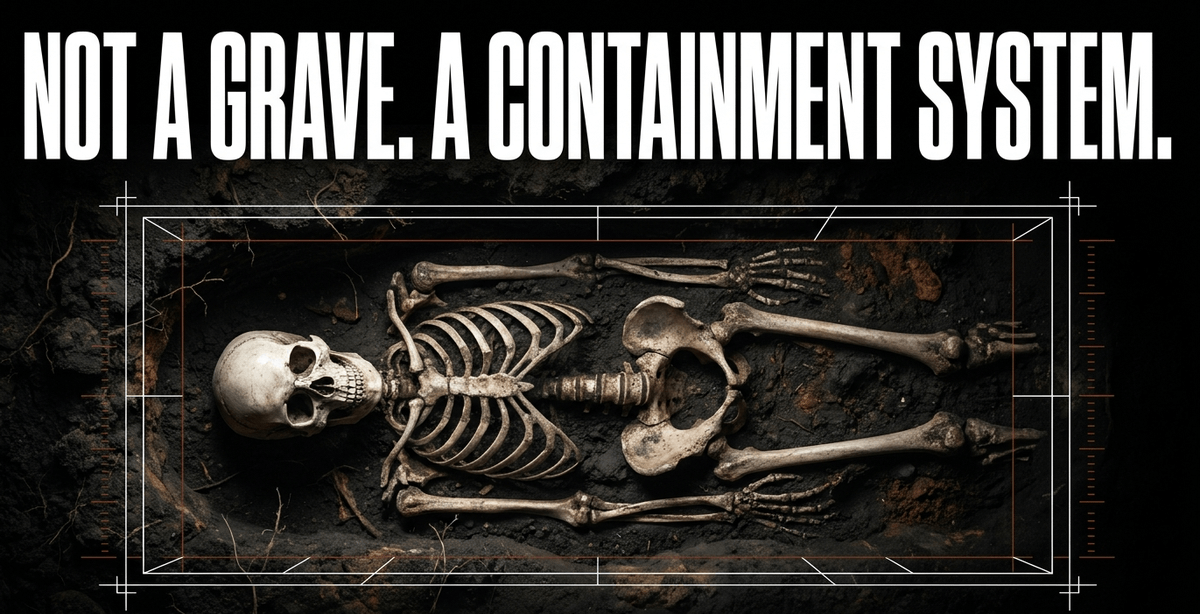
Archaeologists generally avoid the word "vampire" in published research, preferring "deviant," "atypical," or "apotropaic" burial - terms that describe the treatment without importing a folkloric label the dead themselves never asked for.
Mechanics of sickles and sharp objects
The placement of iron sickles in graves is perhaps the most visceral example of biomechanical prevention on record. These objects were not tossed in as grave goods meant for an afterlife journey. Their placement follows a pattern with clear biomechanical consequences for the corpse, should reanimation somehow occur.
At the postmedieval cemetery of Drawsko, in northwestern Poland, researchers excavating between 2008 and 2012 documented a precise logic in how these tools were positioned. Of roughly 285 burials recovered at the site, six were classified as deviant. Five of those six featured a sickle placed either across the throat or over the pelvis and abdomen, four with the cutting edge tightly against the throat, and the fifth located on the pelvis.
For the throat placement, researchers studying the practice have proposed that the blade's sharp inner edge faced the neck deliberately. Sickles placed across the throat may have served to prevent the deceased from rising - if reanimated by an unclean spirit, the corpse's own attempt to lift its head would drive the edge into the neck. It functioned as a kind of failsafe: a trigger mechanism that required the corpse's own movement to complete its own undoing.
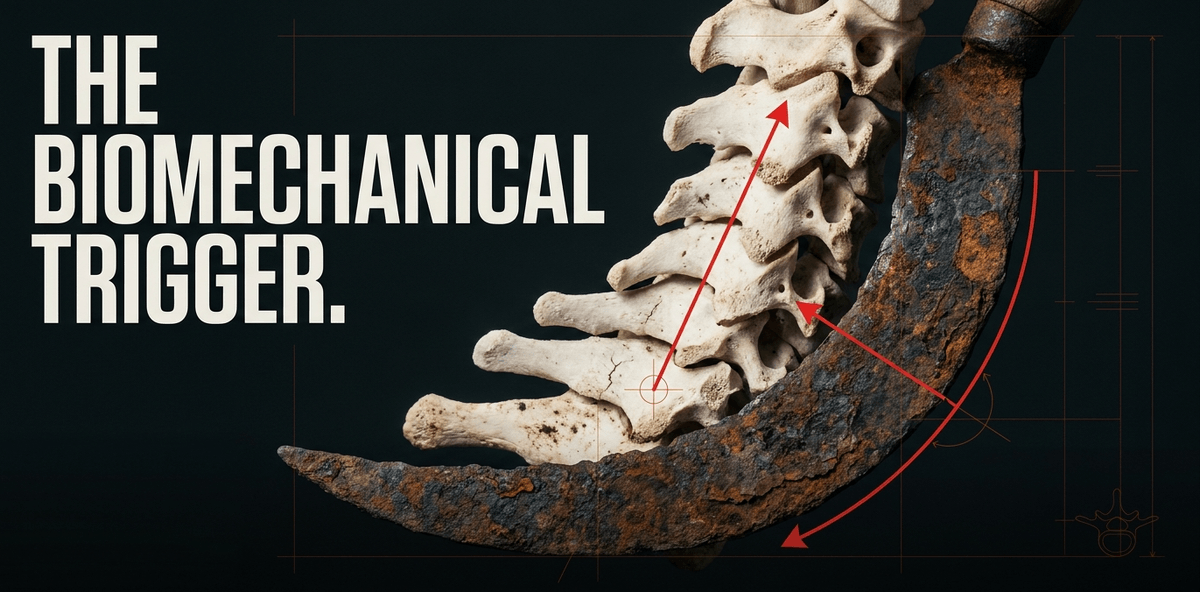
Abdominal placement served a related but distinct purpose. Blades set over the abdomen were thought to open the gut, preventing a reanimated body from preying on the living. There's a practical reading here too - the abdomen is where decomposition gas builds fastest, and a blade resting there would be the first thing punctured by any bloating or shifting.
Not every archaeologist reads these placements as anti-vampiric in the folkloric sense. The team that first published the Drawsko sickle burials in Antiquity has pushed back on the word "vampire" entirely, noting that the sickle interments there lack the hallmarks of true anti-vampiric practice: the graves were never reopened, the bodies were never desecrated, and the dead were buried in hallowed ground alongside everyone else. They prefer "anti-demonic" - a subtle but important distinction. This wasn't punishment or exile. It was precaution, offered to people the community still considered its own.
As Marek Polcyn, an anthropologist who has spent years working the Drawsko site, put it when describing the broader belief system behind the practice:
"Throughout the world, people believe that sharp tools, iron - anything that was created by fire, by hammering - had anti-demonic properties."
Iron's appeal wasn't purely symbolic, either. It provided a rigid, sharp edge that wouldn't yield or dull under the slow, pressurized movements of a body shifting inside a coffin - a material chosen as much for its mechanical reliability as for its folkloric reputation.

Physical properties and weight of stones
Stoning, or "weighting," involved applying mass to physically pin the parts of the body thought necessary for feeding or movement. This is where the physics of burial becomes most apparent. The underlying goal was to overcome the kinetic energy of a rising corpse with the static load of mineral weight.
At Pień, another Polish cemetery dating to the 17th century, excavators found a young woman - identified anthropologically as between 17 and 21 years old - buried with an iron sickle placed around her neck and a padlock fastened to the big toe of her left foot. The sickle, researchers noted, was likely meant to decapitate the corpse if it tried to rise. The padlock is rarer still: it's the first documented Polish case combining both a sickle and a padlock in the same grave, and the message of a locked toe seems almost redundant in its clarity - this body was not meant to walk anywhere.
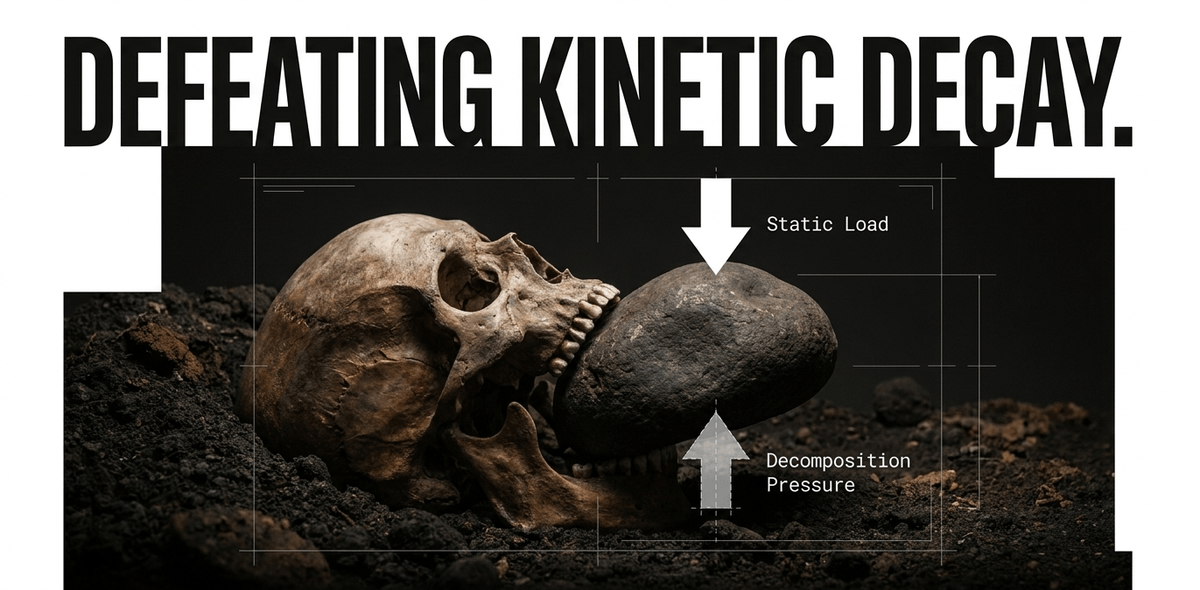
Stone weighting shows up with similar intent elsewhere. At the early Bronze Age cemetery of Mikulovice in the Czech Republic, a roughly 4,000-year-old grave was found with the skeleton weighed down at the head and the chest by two large stones. It's worth noting that not every archaeologist reads a stone-weighted grave as apotropaic. Cambridge archaeologist David Barrowclough has urged caution here, pointing out that while a belief in the undead was clearly widespread across Europe, absolute claims of "vampire burial" are hard to sustain archaeologically, since alternate explanations - punishment for a crime, for instance - often fit the evidence just as well. Weighted graves, in other words, aren't self-explanatory. Context, and the presence of other markers like sickles or jaw stones, matters enormously.
Specific attention was often paid to the head and jaw. This was a direct response to what's sometimes called the "shroud-chewer" phenomenon - a folk explanation for the sounds of decomposition. A community hearing the pop of trapped gases or the settling of a jaw might interpret those sounds as the dead chewing through their own burial shroud, or worse. Jamming a stone or brick between the mandible and cranium physically prevented that movement. One of the clearest examples comes not from Poland but from Venice, where Italian anthropologist Matteo Borrini identified a skeleton from a mass plague grave on the island of Lazzaretto Nuovo, dated to the 1576 outbreak, with a brick forced into the mouth after death - likely by the gravediggers themselves. It's become one of the most cited images in the field, sometimes nicknamed the "vampire of Venice," and it shows the same logic at work far outside Poland's borders: a physical object, jammed into a physical space, to stop a physical fear.

Soil density and taphonomic dynamics
Soil is often treated as a passive backdrop in these stories, but it isn't. In the context of apotropaic burial, soil functions as an active taphonomic agent - one that quietly dictated how quickly a body would show the signs of decay that fueled these panics in the first place.
Burial itself slows decomposition considerably, thanks to more stable below-ground temperatures and restricted access for necrophagous insects. That much has been confirmed repeatedly in modern forensic studies. One comparative study of buried remains found that carcasses interred at greater depth decomposed more slowly and attracted far less insect activity than those buried closer to the surface, and separate research on postmortem interval estimation reached a similar conclusion: bodies buried deeper decomposed more slowly than shallower burials, largely due to reduced insect access and cooler, more stable temperatures.
Compact, clay-rich soil compounds this effect. It restricts the movement of blowflies and beetles even more severely than looser, sandier ground. And here is the cruel irony at the heart of the whole practice: this preservation effect is precisely what could trigger these burials in the first place. If a grave was reopened - during a plague, during a drought, during any moment of communal panic - and the body inside looked less decayed than expected, that wasn't read as good soil chemistry. It was read as proof of continued life. The very earth meant to hide the dead sometimes preserved them just well enough to seem like they hadn't finished dying.
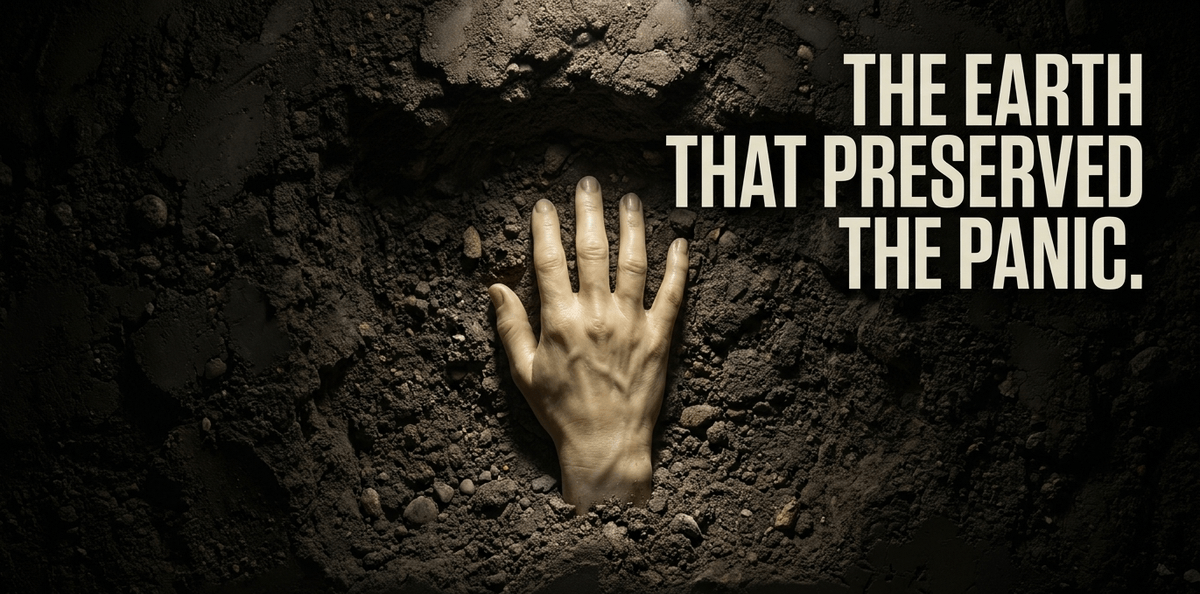
There's a chemical layer to this too. As soft tissue breaks down, it releases volatile organic compounds and shifts the surrounding soil's pH and nitrogen content. Forensic soil studies have tracked this directly: nitrogen and nitrogen isotope levels in gravesoil rise sharply within the first weeks after burial, peaking within about three weeks before gradually declining over months. In denser, low-permeability soils, these compounds don't disperse as readily. They can concentrate locally, occasionally producing pockets of adipocere - a soap-like, waxy substance that can leave skin looking eerily leathery and intact rather than skeletal. To a 17th-century gravedigger with no knowledge of saponification chemistry, that kind of unexpected preservation would have looked like something far stranger than biology.
Prone burial - positioning the body face-down - offered a different kind of mechanical trick, one that used geography rather than restraint. If a corpse buried face-up were somehow to claw its way upward, it would be digging toward the surface. Flip it face-down, and any such effort would drive it deeper into the earth instead. It's a strange, almost elegant piece of folk engineering: using the mass of the ground itself as a secondary containment layer, a redirection of threat rather than a blockade against it.

Who ended up in these graves
To understand who these individuals actually were, we have to look past the objects and into the chemistry of their bones.
Isotopic profiling has done real work here, debunking a long-standing assumption that the "outsider" or wandering stranger was the typical target of deviant burial. At Drawsko, researchers measured strontium isotope ratios (⁸⁷Sr/⁸⁶Sr) from dental enamel and found an average ratio of roughly 0.7112 - a value consistent with the local geology, not with someone who grew up drinking water and eating food from a different region. A follow-up study using oxygen and carbon isotopes reached the same conclusion from a different angle, finding values consistent with a local population rather than recent arrivals.
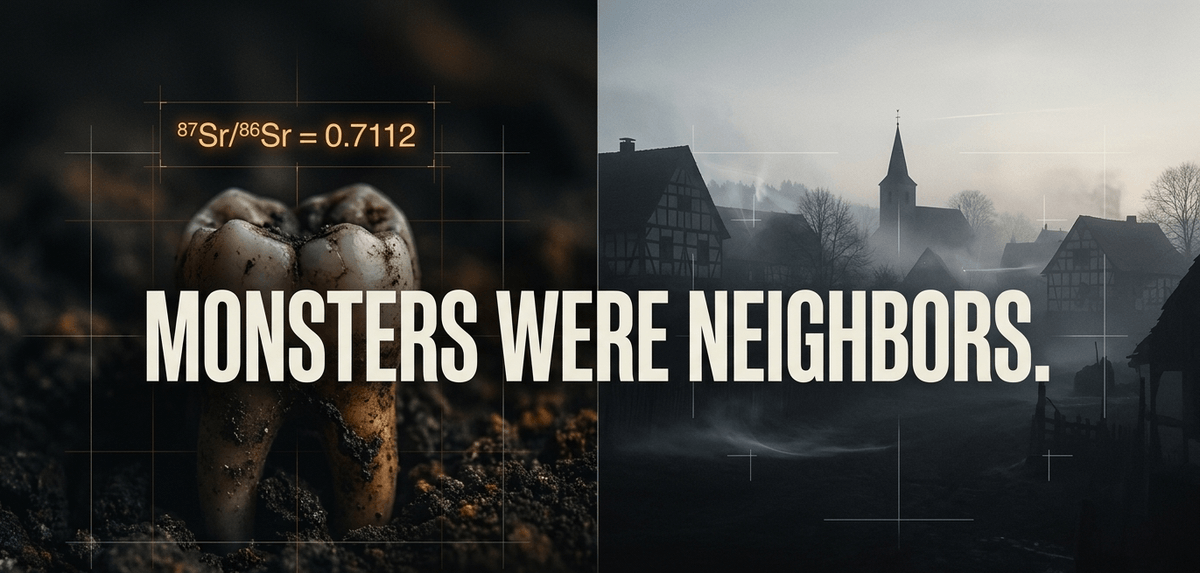
That finding reframes the whole picture. These weren't strangers who wandered into town and died under suspicious circumstances. They were neighbors - people the community had watched grow up, marry, work, and then die in a way, or at a time, that felt wrong. Perhaps they were among the first to die in an epidemic. Perhaps they'd shown some behavioral "otherness" before death that made their neighbors uneasy long before any grave was dug.
Despite the outsized attention these burials receive in popular coverage, they remain rare within the broader archaeological record. At the early medieval cemetery of Culmen, in what is now Chełmno, Poland, a study spanning 568 excavated graves found that only a small fraction received high-intensity apotropaic treatment. And interestingly, disease alone doesn't appear to explain who was singled out. Researchers there tested whether chronic conditions like tuberculosis, anemia, or scurvy - diseases that can leave a person visibly wasted and "corpse-like" before death - correlated with deviant treatment. They largely did not: individuals with these conditions were, for the most part, given standard burials, suggesting communities had grown accustomed to the visible effects of chronic illness rather than reading them as signs of impending vampirism. Out of dozens of documented cases of skeletal disease or disability at the site, only a small handful ended up in anti-vampire graves - a reminder that fear, in this period, was targeted rather than indiscriminate.
The biomechanics of the grave
When we analyze the structural response at play in these sites, it helps to think in terms of forces rather than folklore.
As a body decomposes, gas production inside the torso builds internal pressure. In an ordinary burial, that pressure can shift limbs or force the jaw open over time - normal, if unsettling, biology. To a community already primed to fear the dead, that same movement looked like autonomous action.
- Static load - stones supplied the sheer weight needed to counteract the upward force of gas-driven bloating.
- Shear force - a sickle's edge was positioned to turn the body's own swelling or shifting against itself.
- Friction and confinement - dense, compacted soil raised the energy required for any limb to move at all, effectively locking the remains in place.
There's a case to be made that the people carrying out these burials were, in their own way, amateur forensic engineers. They understood the physical realities of a decomposing body and a sealed grave with real precision, even while misreading the biological causes behind what they saw. Each deviant burial is, in that sense, a record of a community solving a problem with the tools available to it: iron, stone, and the earth itself.
What these graves teach modern forensic science
Modern forensic archaeology has, somewhat unexpectedly, found these sites useful as natural experiments in long-term preservation. The presence of iron sickles often leaves a faint "rust halo," or iron staining, on nearby bone - a mark that can, oddly enough, help preserve fine surface detail on the periosteum that might otherwise erode away. Similarly, sustained localized pressure from a heavy stone can produce distinctive patterns of postmortem bone warping, patterns that help researchers distinguish an intentionally weighted burial from one merely disturbed by later grave-robbing or plough damage.
This overlap between historical ritual and modern forensic taphonomy isn't coincidental. Both fields are, at bottom, asking the same question: what does the ground do to a body over time, and what can we learn by reading those changes backward? It's a question that connects a 17th-century gravedigger and a present-day forensic anthropologist far more closely than either would probably expect.
For readers curious about how archaeologists reconstruct belief systems from indirect evidence more broadly, the same interpretive caution shows up across the discipline - including in how myths and oral traditions can encode memories of real ancient disasters, long after the physical evidence itself has faded.
A very human need for closure
By studying the material behavior of the grave, we gain a clearer view of something quietly universal: fear of the unknown, in this period, was met not just with prayer but with a physical, tactile response. The sickle and the stone were the final lines of defense in a world where the boundary between life and death felt, for a time, dangerously thin.
In the end, the archaeology of apotropaic burial isn't really about vampires. It's about the living. It's about how far a small, frightened community was willing to go to secure its own peace, using whatever tools it had - iron, stone, and an understanding of gravity - to make sure the dead stayed exactly where they'd been placed.
The precision of a sickle's edge, the mass of a river stone pressed over a collarbone: these are, in their own quiet way, monuments to a very human need for closure. In these particular graves, that closure had to be enforced.
Share now









Key takeaways
- At Drawsko, Poland, five of six deviant burials featured a sickle placed across the throat or the abdomen, with the blade's edge typically facing the neck.
- The sickle's placement functioned as a biomechanical failsafe - if the corpse moved to rise, the blade would cut into the throat or puncture the abdomen.
- At Pień, Poland, a young woman was buried with a sickle around her neck and a padlock fastened to her toe - the first documented Polish case combining both objects.
- Large stones or bricks were wedged beneath the chin or jaw to prevent the "shroud-chewing" sounds of decomposition from being mistaken for the dead eating their own burial cloth.
- A ~4,000-year-old grave at Mikulovice, Czech Republic, held a skeleton weighted down at the head and chest with two large stones - though scholars caution this could also reflect punishment rather than apotropaic fear.
- Burial itself slows decomposition, since below-ground temperatures are more stable and insect access is far more restricted than at the surface.
- Compact, clay-rich soil intensifies this effect, sometimes preserving tissue well enough that a reopened grave could look disturbingly "undecayed" to frightened observers.
- Decomposition gradually shifts gravesoil chemistry - nitrogen levels typically spike within the first few weeks after burial before slowly declining.
- Strontium isotope analysis at Drawsko (average ⁸⁷Sr/⁸⁶Sr ≈ 0.7112) showed the individuals in deviant burials were local community members, not outsiders or travelers.
- Follow-up oxygen and carbon isotope testing at the same site reinforced that finding, ruling out a significant "nonlocal" population among the deviant burials.
- At the medieval cemetery of Culmen (568 graves studied), chronic diseases like tuberculosis, anemia, and scurvy generally did not correlate with receiving an anti-vampire burial.
- Archaeologists increasingly favor terms like "deviant," "atypical," or "apotropaic" burial over "vampire burial," since many of these graves show no sign of desecration or exclusion from consecrated ground.
Sources
- PLOS ONE https://journals.plos.org/plosone/article?id=10.1371/journal.pone.0113564
- Antiquity (Cambridge Core) https://www.cambridge.org/core/journals/antiquity/article/buried-with-sickles-early-modern-interments-from-drawsko-poland/791AADE59597383DA4D5EA0221034AF9
- The Past (NCU/Pień excavation) https://the-past.com/news/archaeologists-uncover-17th-century-vampire-burial-in-poland/
- Popular Archaeology https://popular-archaeology.com/article/digging-vampires/
- Journal of Forensic Sciences (PMC) https://pmc.ncbi.nlm.nih.gov/articles/PMC9293349/
- Published 2026-07-17 12:30
- Modified 2026-07-17 12:30

-
Redaction