

-
 Redaction
Supernovae: How dying stars build the cosmos
An exploration of the cataclysmic mechanisms of supernovae, from iron core collapse to thermonuclear runaway, and their role in seeding the universe with life.
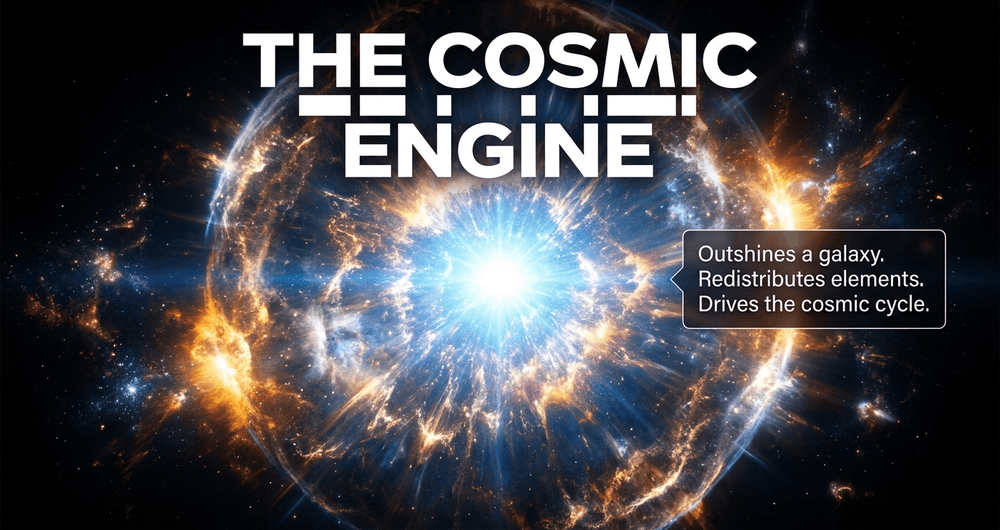
Looking up at the night sky, one sees a tapestry that appears eternal. The stars seem like fixed points of light, steady and unchanging. Yet the universe maintains a delicate balance between creation and destruction. Among the most profound events in the cosmos is the supernova - a stellar explosion of such magnitude that it can briefly outshine a galaxy of hundreds of billions of stars. These events are not merely endings; they are the moments when the universe redistributes its wealth, casting the heavy elements forged in the hearts of stars out into the void to become the seeds of new worlds. This cycle of life and death is the heartbeat of our galaxy, a process that has occurred countless times over billions of years.
We contemplate these distant flares of light not as terrifying omens, but as the fundamental architects of our own existence. Without the violent demise of massive stars, the iron in our blood and the gold in our jewelry would remain locked away in the gravity-bound furnaces of stellar interiors. To understand the supernova is to understand the origin of the physical matter that constitutes every person on Earth.
What is a supernova?
A supernova is the most energetic explosion a single star can produce - a cataclysmic event marking the violent death of a star. The term derives from the Latin nova, meaning "new star," reflecting how early observers interpreted sudden bright objects appearing in the sky. In reality, they were witnessing stellar destruction on a cosmic scale. A supernova can release more energy in a matter of seconds than our Sun will radiate across its entire ten-billion-year lifetime.
Supernovae are not rare in the universe. Astronomers estimate that a supernova occurs somewhere in the observable universe approximately every second. Within a galaxy the size of the Milky Way, a supernova is expected roughly once or twice per century - though the last supernova observable with the naked eye in a nearby galaxy occurred in 1987 in the Large Magellanic Cloud. There are two primary pathways by which stars meet this fate, each with distinct physical triggers and profound consequences for the cosmos.
How supernovae are classified
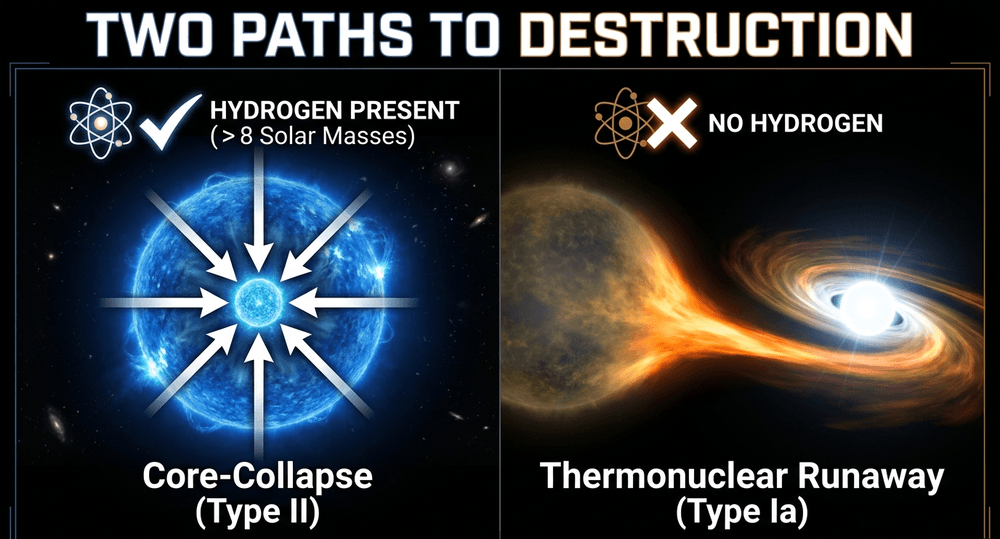
Astronomers classify supernovae into two broad categories - Type I and Type II - primarily based on the presence or absence of hydrogen in their observed spectra.
Type II supernovae show prominent hydrogen absorption lines, indicating that the progenitor star retained its outer hydrogen envelope before exploding. These are the core-collapse events driven by the deaths of massive stars. Within Type II, there are further subtypes - IIb, IIn, IIL, and IIP - each distinguished by the shape of their light curves and spectral features.
Type I supernovae lack hydrogen lines entirely. This broad category includes:
- Type Ia - thermonuclear explosions of white dwarfs in binary systems; the standardizable candles of cosmology
- Type Ib - core-collapse supernovae in which the progenitor star shed its hydrogen envelope before exploding
- Type Ic - similar to Type Ib but also stripped of their helium envelope; associated with some of the most energetic explosions known, including certain gamma-ray bursts
This classification, while rooted in spectroscopy, reflects fundamentally different physical processes and progenitor stars. Understanding both branches is essential to grasping the full role supernovae play in shaping the universe.
The anatomy of core collapse
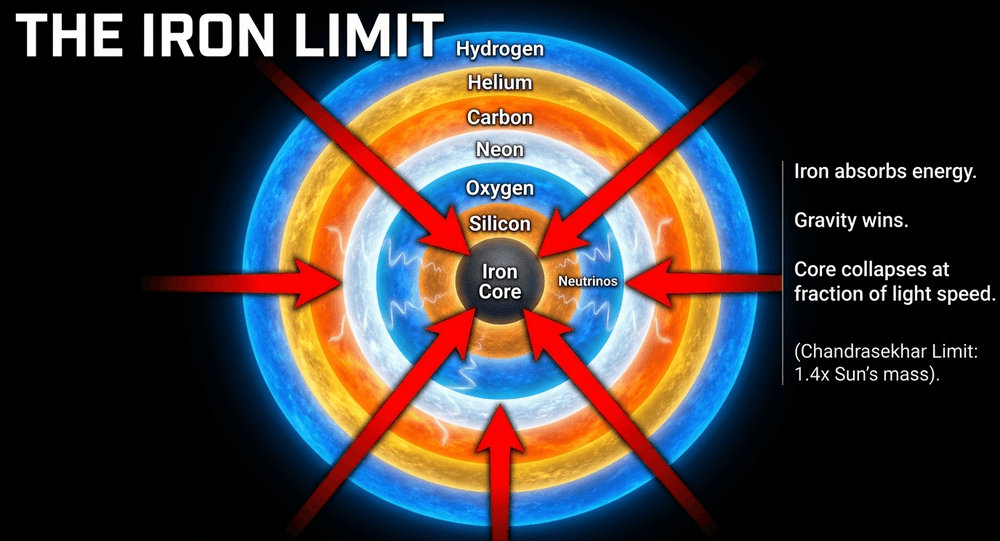
For a star to end its life in a core-collapse supernova, it must begin with a significant presence. These events are reserved for stars at least eight times the mass of our Sun. Throughout its long life, such a star maintains a state of equilibrium. Gravity pulls inward, while the energy generated by nuclear fusion in the core pushes outward. This balance is maintained as the star fuses lighter elements - hydrogen into helium, helium into carbon, and eventually onward through neon, oxygen, and silicon.
The formation of the iron core
As the star ages, it develops layers like an onion. Each layer represents a different stage of nuclear burning. The outermost layers contain hydrogen, while the deeper layers contain increasingly heavier elements. The process continues until the star begins to create iron - and this marks a terminal point in the star's stability. While fusing lighter elements releases energy, fusing iron into heavier elements absorbs it. When iron begins to accumulate at the center, the star is effectively running on empty. It no longer generates the outward pressure needed to resist the crushing weight of its own gravity.
The timescale of this final phase is strikingly short. A massive star may spend millions of years fusing hydrogen, but its final silicon-burning stage - the last step before iron accumulation - lasts only a matter of days.
The moment of instability
Once the iron core reaches a specific mass known as the Chandrasekhar limit - approximately 1.4 solar masses - it can no longer support itself. Within a fraction of a second, the core collapses at a significant fraction of the speed of light. During this brief moment, the density becomes so extreme that protons and electrons are squeezed together to form neutrons. This process releases a staggering flood of neutrinos, ghostly particles that carry away the vast majority of the explosion's energy - roughly 99% of it. The collapse is halted by neutron degeneracy pressure and the strong nuclear force, once the core reaches nuclear densities of approximately 4×10¹⁷ kg/m³.
Rebound and the re-energized shockwave
As the core's collapse stops abruptly, the outer layers of the star - which are still falling inward at incredible speed - slam into the now-solid core. They rebound, creating a powerful shockwave that begins to travel outward. Often, this initial shockwave loses momentum as it fights through the infalling matter. A small fraction of the neutrinos deposit energy behind the stalled shockwave, helping to re-energize it. This neutrino re-energization mechanism drives the shockwave through the star's remaining mass, blowing the outer layers into space at velocities between 10,000 and 30,000 km/s.

The thermonuclear runaway of white dwarfs
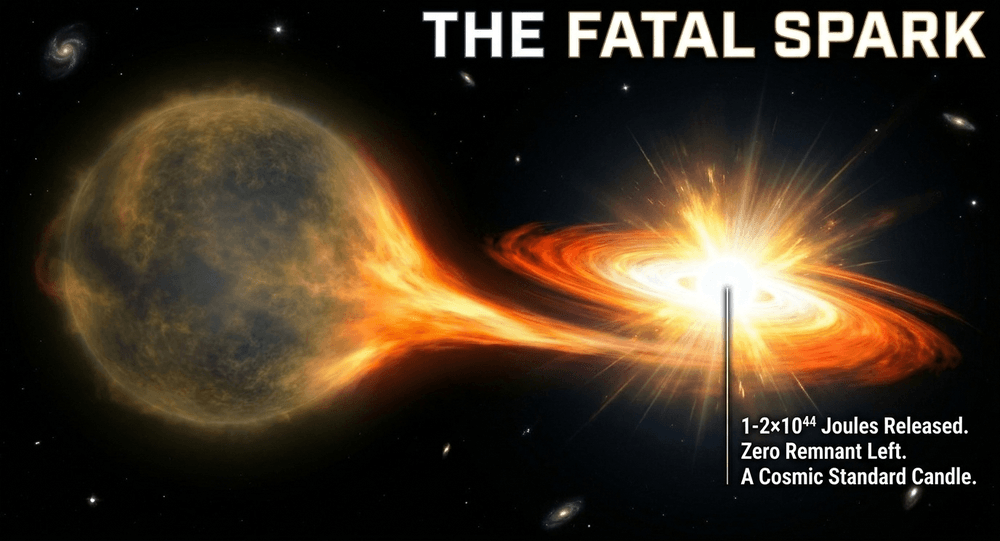
Not every supernova comes from a massive star. Type Ia supernovae follow a completely different path, involving a white dwarf in a binary star system. A white dwarf is the dense, cool remnant of a Sun-like star - a quiet object, no longer undergoing fusion, composed mostly of carbon and oxygen. However, if this white dwarf has a companion star, it can begin to pull matter from that companion through a process known as accretion.
Reaching the breaking point
As the white dwarf gains mass, its internal pressure and temperature increase. Unlike a normal star, a white dwarf is composed of degenerate matter, which does not expand when it heats up. Consequently, the temperature can rise to a point where carbon fusion begins uncontrollably - a thermonuclear runaway. Within seconds, a substantial portion of the white dwarf's matter undergoes fusion, releasing on the order of 1-2×10⁴⁴ joules of energy. This energy is so immense that it completely disrupts the star. Unlike core-collapse events, Type Ia supernovae leave no compact remnant behind; the entire white dwarf is pulverized and scattered into the cosmos.
It is worth noting that the precise trigger mechanism for Type Ia supernovae remains an area of active research. Some models propose that the white dwarf accretes mass from a companion until it nears the Chandrasekhar limit. Others suggest that two white dwarfs in a binary system merge - a double degenerate scenario. Both pathways may contribute to the overall population of Type Ia events observed across the universe.
The alchemy of the explosion: how supernovae forge the elements
One of the most profound aspects of a supernova is the nucleosynthesis that occurs during the blast. The heat and pressure within the shockwave are so extreme that they enable the creation of elements heavier than iron through a process called the rapid neutron-capture process, or r-process. In these few seconds of cataclysm, the universe manufactures elements such as zinc, selenium, silver, tin, and lead, which are then cast out into the interstellar medium.
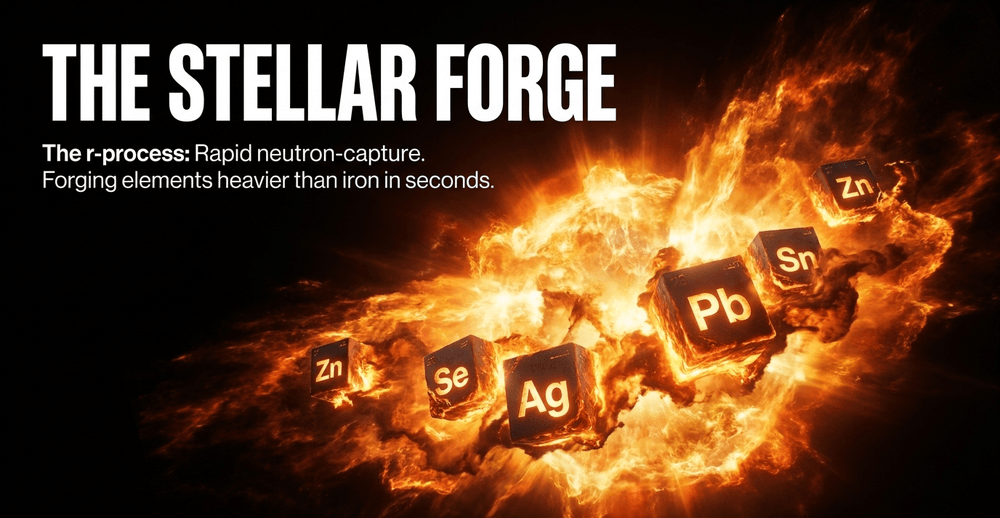
It is worth noting that the heaviest and rarest r-process elements - including gold, platinum, and uranium - are now understood to be produced primarily in the mergers of two neutron stars, rather than in standard core-collapse supernovae alone. These cataclysmic collisions were confirmed as sites of r-process nucleosynthesis following the detection of a neutron star merger event in 2017, and they contribute significantly to the cosmic inventory of precious metals.
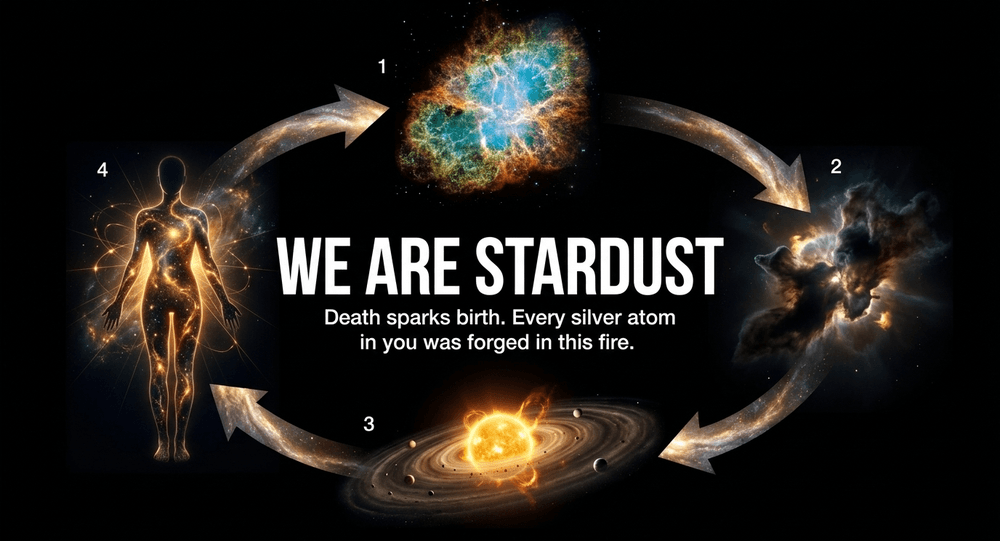
Nevertheless, every atom of silver on our planet was very likely forged through one of these extreme astrophysical processes. We are, in a very literal sense, walking pieces of stellar debris. This realization provides a sense of intimacy with the vast, cold reaches of space. The atoms that make up our bodies have traveled across light-years and endured the most violent conditions imaginable before finding their way into the soil, the water, and eventually, us.

The neutron stars and black holes
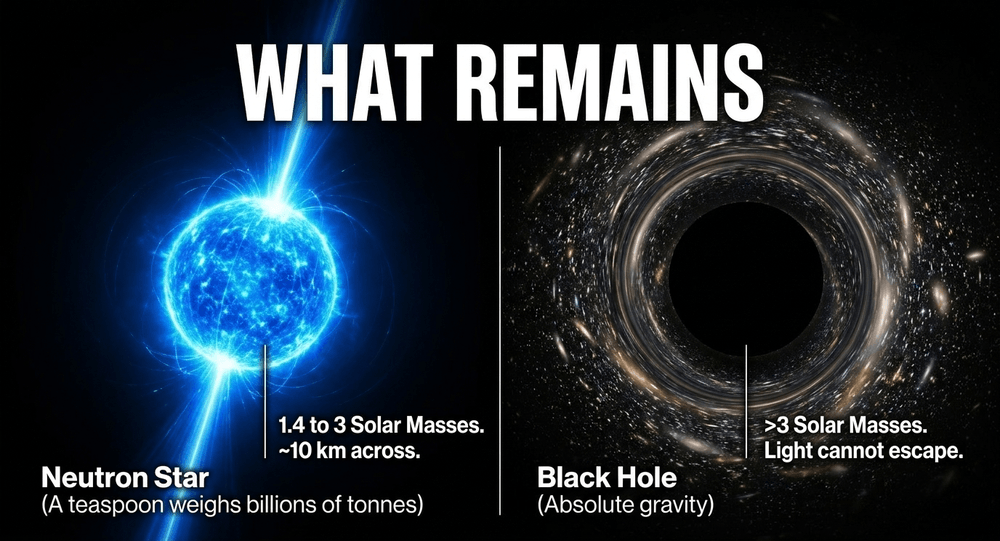
In core-collapse supernovae, the fate of the remaining core depends on its mass. If the remnant contains between approximately 1.4 and 3 solar masses of material, it forms a neutron star - an extraordinarily dense object packing the mass of a star into a sphere only about 10 kilometres across. A single teaspoon of neutron star material would weigh billions of tonnes. These objects often spin rapidly and with extraordinary regularity, emitting beams of radiation that we observe as pulsars - natural cosmic clocks of remarkable precision.
However, if the remnant core exceeds roughly 3 solar masses, gravity becomes the absolute victor. No force in the known universe can stop the collapse. The material shrinks beyond the point of no return, forming a black hole - a region of spacetime so dense that even light cannot escape its grasp. In some cases, a massive star with a progenitor mass above roughly 25 solar masses may skip the visible explosion entirely and collapse directly into a black hole, an event sometimes referred to as a failed supernova or direct collapse.
The legacy in the interstellar medium
After the light of the explosion fades, the story is far from over. The ejected material continues to expand outward, forming what is known as a supernova remnant. These structures - such as the Crab Nebula or the Tycho remnant - are glowing clouds of gas and dust that can persist for tens of thousands of years. As they expand, they sweep up the surrounding interstellar gas, sculpting the local environment of a galaxy in ways that influence stellar formation for billions of years.
These shockwaves serve a dual purpose. First, they enrich the surrounding medium with the heavy elements created during the explosion. Second, the pressure from the expanding wave can compress nearby clouds of gas and dust, triggering the gravitational collapse necessary to form new stars. In this way, the death of one star provides the literal and figurative spark for the birth of many others. The Sun and our solar system likely formed in a region of space that had been enriched and disturbed by one or more nearby supernovae billions of years ago.
Supernovae in recorded history
Long before modern telescopes, human observers documented what they called guest stars - sudden new points of light appearing in the sky where none had been before. Several of these are now understood to have been supernovae, and they permanently altered humanity's understanding of the cosmos.
SN 1006 remains the brightest stellar explosion ever recorded in human history. Appearing in the constellation Lupus, it was documented by astronomers in Egypt, Iraq, China, Japan, and Europe. Estimates of its apparent magnitude reach as high as −7.5, making it far brighter than any planet in the night sky, with some accounts suggesting it was bright enough to cast shadows after dark.
In 1054, Chinese and Arab astronomers recorded a new star in the constellation Taurus. The remnant of this explosion is the Crab Nebula - today one of the most studied objects in the sky, home to a rapidly spinning pulsar completing roughly 30 rotations per second.
Tycho's Supernova of 1572 and Kepler's Supernova of 1604 were the last supernovae observed with the naked eye within our own Milky Way. Their appearances shook the Aristotelian belief in an unchanging celestial sphere, contributing to the scientific revolution that followed. No supernova has been seen with the naked eye within our galaxy since.
The most scientifically significant modern event was SN 1987A, which appeared in the Large Magellanic Cloud - a satellite galaxy of the Milky Way - making it the closest observed supernova in nearly 400 years. It provided the first direct confirmation of core-collapse theory and the first detection of neutrinos from an astrophysical source beyond our solar system, captured simultaneously by detectors in Japan, the United States, and the Soviet Union. The expanding remnant of SN 1987A continues to be monitored by astronomers today as a living laboratory of stellar death.

Could a nearby supernova threaten Earth?
For most readers, this question comes to mind quickly. The answer is nuanced: a supernova close enough to harm Earth is extremely unlikely in the foreseeable future, but the threshold matters.
A supernova within approximately 25-50 light-years of Earth could deliver enough radiation - gamma rays, X-rays, and high-energy particles - to significantly erode the ozone layer, exposing the surface to elevated ultraviolet radiation. Some researchers have proposed that one or more nearby supernovae may have contributed to ancient mass extinction events in Earth's deep past, though this remains a hypothesis under active investigation.
The nearest well-known candidate for an eventual supernova is Betelgeuse, the red supergiant marking the shoulder of the constellation Orion. It lies approximately 700 light-years from Earth - far enough that its eventual explosion will be a spectacular celestial event rather than a threat. At peak brightness, it is expected to be visible during the day and cast faint shadows at night for weeks. When this will happen, however, is genuinely uncertain. Betelgeuse may explode within the next 100,000 years, or it may surprise observers within the next few centuries. On cosmic timescales, these possibilities are functionally identical.
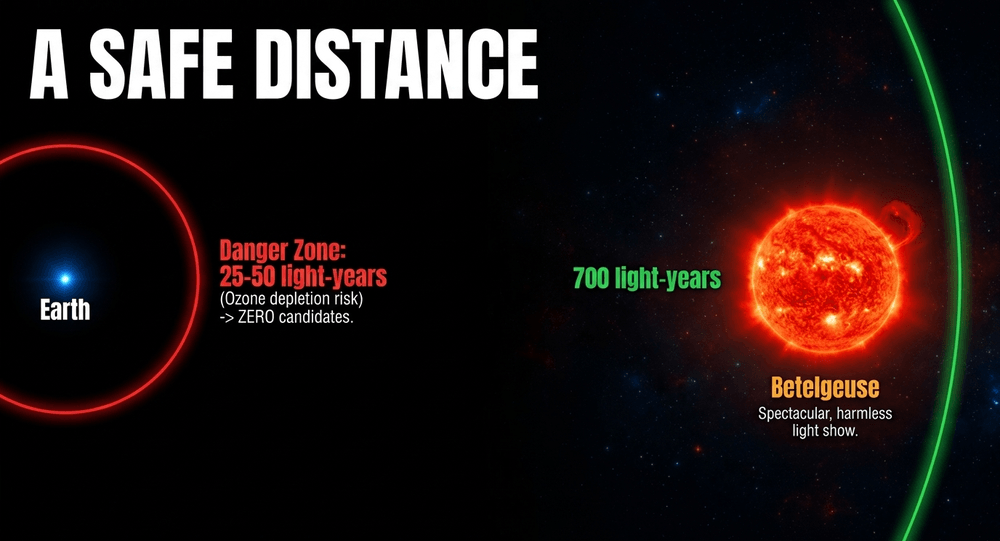
No known star within the danger threshold is considered likely to explode in any timeframe relevant to human civilization.
How do we detect and study supernovae?
Modern astronomers detect supernovae using a combination of ground-based observatories, space telescopes, and automated sky survey programs such as the Zwicky Transient Facility (ZTF) and the Vera C. Rubin Observatory's Legacy Survey of Space and Time (LSST). These systems scan enormous swaths of sky nightly, flagging sudden changes in brightness that could signal a new explosion anywhere in the visible universe.
Beyond optical light, supernovae are studied across the full electromagnetic spectrum. Neutrino detectors - like Super-Kamiokande in Japan - can capture the ghostly flood of particles that arrive even before the optical flash brightens. This is because neutrinos travel almost unimpeded through the stellar envelope, escaping seconds before the shockwave reaches the surface. The detection of neutrinos from SN 1987A remains one of the landmark events in the history of astrophysics.
More recently, gravitational wave observatories such as LIGO and Virgo have opened an entirely new window. While no supernova has yet been definitively detected in gravitational waves, the 2017 neutron star merger (GW170817) produced both a gravitational wave signal and a visible kilonova, confirming the site of heavy r-process element production in spectacular fashion. A sufficiently close core-collapse supernova within our galaxy would almost certainly produce a detectable gravitational wave signal - an event the astrophysics community eagerly anticipates.
Multi-messenger astronomy - the simultaneous observation of an event through gravitational waves, neutrinos, and electromagnetic radiation - represents the frontier of supernova science. The next nearby core-collapse supernova within the Milky Way could deliver an unprecedented dataset that transforms our understanding of stellar death and the physics of dense matter.
Frequently asked questions about supernovae
How often do supernovae occur?
In a galaxy the size of the Milky Way, a supernova is estimated to occur roughly once or twice per century. Across the entire observable universe, the rate is approximately one per second.
What is the difference between a nova and a supernova?
A nova occurs when a white dwarf accretes hydrogen from a companion star and ignites a surface thermonuclear explosion - far less energetic than a supernova, and the white dwarf survives intact. A supernova marks the complete destruction of a star and releases vastly more energy, often many billions of times more than a nova.
Will Betelgeuse go supernova in our lifetime?
Possibly, but not certainly. Betelgeuse is a red supergiant near the end of its stellar life, but its precise timeline is unknown. When it does explode, it will be spectacularly visible from Earth - but at approximately 700 light-years distance, it poses no danger whatsoever.
Could a supernova destroy Earth?
A supernova within roughly 25-50 light-years could seriously damage Earth's ozone layer and potentially trigger ecological disruption. No known star within that range is expected to explode. The risk from any currently identified stellar candidate is considered negligible by the scientific community.
What elements do supernovae create?
Core-collapse supernovae synthesize many elements heavier than iron through the r-process, including zinc, selenium, silver, tin, and lead. The heaviest r-process elements - gold, platinum, and uranium - are produced primarily in neutron star mergers rather than in supernovae alone.
Observing the distant past
Because supernovae are so luminous, they allow us to see back into the deep history of the universe. When we observe a supernova in a galaxy millions of light-years away, we are witnessing an event that preceded human existence by an almost incomprehensible span of time. These observations have delivered some of the most important cosmological discoveries of the modern era - including the finding, using Type Ia supernovae, that the universe's expansion is accelerating, a result that reshaped our understanding of the cosmos and introduced the concept of dark energy.
Supernovae are also considered a major source of cosmic rays - high-energy particles that travel through space at nearly the speed of light, and which may play a role in shaping the chemistry of interstellar clouds and, indirectly, conditions on planets throughout the galaxy.
In the quiet of our own lives, it is easy to forget the violent processes that permit our existence. The universe is not a static place; it is a dynamic, recycling system. The supernova is the ultimate expression of this recycling. It is a reminder that in the grand cosmic narrative, endings are often just beginnings in disguise. The light that travels across the void to reach our telescopes is a message from a star that gave everything it had so that the universe could continue to evolve - and, eventually, observe itself through our eyes.
Share now









Key takeaways
- Supernovae can briefly outshine entire galaxies, releasing more energy in seconds than the Sun will emit across its entire ten-billion-year lifetime.
- Core collapse occurs in stars at least eight times more massive than the Sun, triggered once an iron core exceeds approximately 1.4 solar masses - the Chandrasekhar limit.
- Neutrinos carry away roughly 99% of the total energy released in a core-collapse supernova and play a critical role in re-energizing stalled shockwaves.
- Type Ia supernovae result from a white dwarf in a binary system accumulating mass until it undergoes thermonuclear runaway, completely destroying the star and leaving no compact remnant.
- Core-collapse supernovae synthesize many elements heavier than iron via the r-process, including zinc, selenium, silver, tin, and lead; the heaviest r-process elements - gold, platinum, and uranium - are produced primarily in neutron star mergers.
- The remnant core of a core-collapse supernova forms a neutron star if it contains roughly 1.4-3 solar masses, or a black hole if it exceeds approximately 3 solar masses.
- Supernova remnants such as the Crab Nebula can persist for tens of thousands of years and trigger the formation of new stars by compressing surrounding gas clouds.
- SN 1006 is the brightest stellar explosion ever recorded in human history, with an estimated apparent magnitude of around −7.5, documented across multiple continents.
- Kepler's Supernova of 1604 was the last supernova observed with the naked eye within our own Milky Way galaxy.
- SN 1987A, in the Large Magellanic Cloud, provided the first direct confirmation of core-collapse theory and the first extrasolar detection of neutrinos from a stellar explosion.
- The nearest likely naked-eye supernova candidate is Betelgeuse, roughly 700 light-years away - spectacular but posing no threat to Earth.
- Type Ia supernovae were used to discover in 1998 that the universe's expansion is accelerating, introducing the concept of dark energy to cosmology.
- In a Milky Way-sized galaxy, a supernova is expected roughly once or twice per century; across the observable universe, approximately one occurs every second.
- Multi-messenger astronomy - combining gravitational wave, neutrino, and electromagnetic observations - represents the frontier of supernova research.
- A supernova within approximately 25-50 light-years of Earth could damage the ozone layer; no known nearby star is expected to pose this risk.
Sources
- Wikipedia - Supernova https://en.wikipedia.org/wiki/Supernova
- Wikipedia - Type II supernova https://en.wikipedia.org/wiki/Type_II_supernova
- Wikipedia - Type Ia supernova https://en.wikipedia.org/wiki/Type_Ia_supernova
- Wikipedia - Supernova nucleosynthesis https://en.wikipedia.org/wiki/Supernova_nucleosynthesis
- Wikipedia - Neutron star https://en.wikipedia.org/wiki/Neutron_star
- Wikipedia - SN 1987A https://en.wikipedia.org/wiki/SN_1987A
- Wikipedia - SN 1006 https://en.wikipedia.org/wiki/SN_1006
- Wikipedia - Betelgeuse https://en.wikipedia.org/wiki/Betelgeuse
- Wikipedia - GW170817 https://en.wikipedia.org/wiki/GW170817
- Wikipedia - R-process https://en.wikipedia.org/wiki/R-process
- NASA - Supernova remnants https://imagine.gsfc.nasa.gov/science/objects/supernova_remnants.html
- NASA - What is a supernova? https://www.nasa.gov/universe/what-is-a-supernova/
- U.S. Department of Energy - Supernovae explained https://www.energy.gov/science/doe-explainssupernovae
- Published 2026-06-06 18:01
- Modified 2026-06-10 23:18

-
Redaction