

-
 Redaction
What is quantum decoherence? A complete guide
Quantum decoherence explains why superpositions vanish in the classical world. Explore einselection, quantum Darwinism and the unsolved measurement problem.
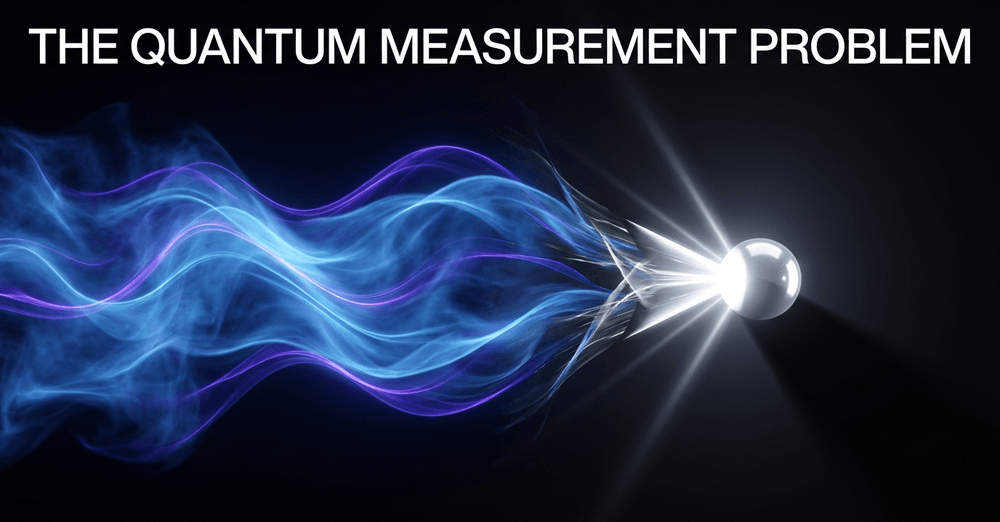
In the silent depths of the quantum realm, where the very fabric of existence seems to shimmer with possibilities, lies an enigma that has haunted physicists and philosophers for nearly a century: the measurement problem. It is a profound disjunction, a chasm between the elegant mathematical descriptions of quantum theory and the stark, singular reality we experience. What happens when a potential becomes a certainty? Why does the universe, so fluid in its quantum dance, suddenly coalesce into one definite outcome when we choose to look? It is here, in this moment of observation, that the observer emerges not merely as a passive witness, but as the most disruptive force in the grand theatre of physics, fundamentally altering the play itself.
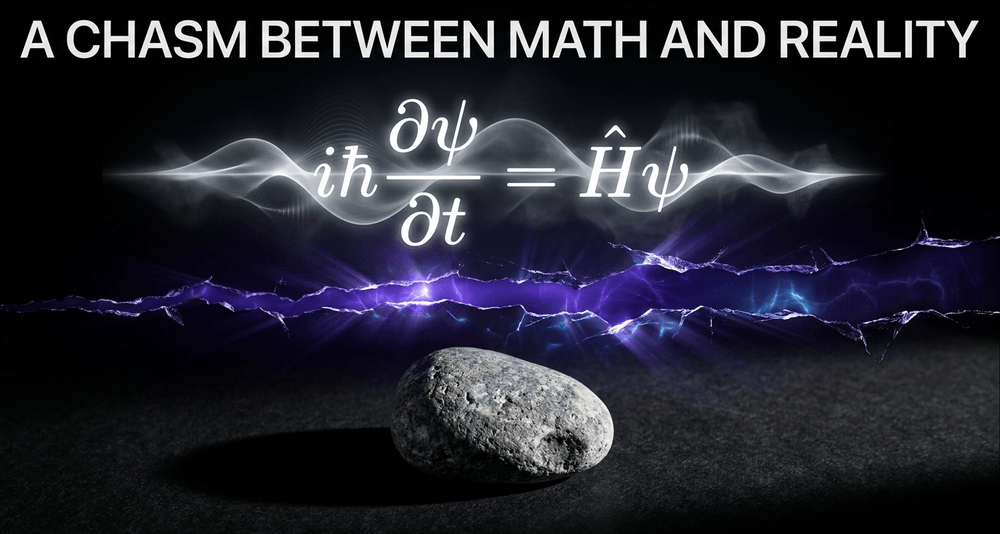
Quantum systems, in their undisturbed state, are theorised to exist in a superposition - a bewildering condition where a particle can be in multiple states simultaneously. Imagine a single electron not simply spinning up or down, but simultaneously spinning both up and down, a ghostly blend of all its potential realities. This incredible multiplicity is mathematically encoded within its wave function (ψ), an entity that, according to the linear Schrödinger equation, evolves deterministically and continuously, holding within it the probabilities of all possible futures. Yet, the moment a measurement is performed, this symphony of possibilities collapses into a single, definite outcome. This abrupt and non-linear transition from a probabilistic superposition to a singular state is known as wave function collapse - a phenomenon for which the Schrödinger equation, in its pristine linearity, offers no direct account. The exact mechanism, the very nature of this collapse, and crucially, the precise role of the observer in orchestrating it, continue to fuel intense scientific and philosophical debate.
Unveiling the quantum paradox: core concepts and technical details
To truly appreciate the profound implications of the measurement problem, one must first grasp the foundational concepts that underpin it. These are the building blocks of quantum reality, yet they also contain the seeds of its most perplexing paradoxes.
- Superposition: At the heart of quantum weirdness lies superposition. It describes a system existing as a linear combination of all its possible states until the moment of measurement. Consider an atom whose electron, before observation, is not in a specific energy level, but rather in a blend of several. It is as if the universe is holding its breath, waiting for a cue before deciding which note to play. The beauty is in this potential, the quiet hum of all possibilities coexisting.
- Wave function (ψ): This mathematical construct is the quantum state vector, a profound repository of information. It meticulously describes a physical system, encapsulating the contributions from every conceivable outcome of a potential measurement. Its evolution is governed by the timeless elegance of the Schrödinger equation - a deterministic flow that seems to suggest an underlying order beneath all the quantum tumult.
- Wave function collapse: This is the moment of quantum drama. Upon measurement, the wave function, which once held a tapestry of probabilities, inexplicably and instantaneously reduces to a single, definite state. All other possibilities, all those potential realities, simply vanish. This non-linear event is not predicted by the Schrödinger equation, leaving a gaping explanatory void in the heart of quantum theory. It is as if the grand symphony, suddenly, chooses but one note to resonate.
- Born rule: A cornerstone of quantum mechanics, this postulate bridges the gap between the abstract wave function and our concrete observations. It states that the probability of obtaining a specific measurement outcome is directly proportional to the absolute square of the amplitude of that part of the wave function corresponding to the desired outcome. It tells us how likely an outcome is, but not why only one occurs.
At its deepest level, this is the dual nature of quantum evolution that haunts physicists. Left undisturbed, a quantum state evolves deterministically under the Schrödinger equation, forming superpositions of extraordinary delicacy. Upon measurement, a stochastic process governed by the Born rule collapses it to a single outcome. These two modes - one smooth and deterministic, the other sudden and probabilistic - seem to belong to entirely different physical stories. And yet quantum mechanics asks us to accept both without fully explaining the seam between them.
Schrödinger's cat: a philosophical cage
The measurement problem is perhaps nowhere more vividly illustrated than in Schrödinger's cat, a thought experiment devised by Erwin Schrödinger in 1935. This conceptual trap was set to highlight what he perceived as absurdities within the Copenhagen interpretation. Imagine a cat sealed within a steel box, its very life linked to a quantum event - the decay of a radioactive atom. If the atom decays, a Geiger counter triggers a hammer, which smashes a vial of poison, and the cat perishes. If the atom does not decay, the cat remains alive.
According to the tenets of quantum mechanics, until the box is opened and an observation is made, the radioactive atom exists in a superposition of both decayed and undecayed states. Consequently, the cat, entangled with the atom's fate, exists in a grotesque superposition of being both alive and dead simultaneously. Only upon opening the box is the cat definitively found to be either alive or dead, never in that macabre quantum limbo.
Schrödinger presented this scenario not as a literal prediction, but as a reductio ad absurdum - a challenge to the notion that quantum mechanical rules governing the microscopic world could be naively extended to macroscopic objects. If a subatomic particle can exist in superposition, and if measurement alone collapses that superposition, then when, precisely, does a chain of events become large enough to constitute a "measurement"? Where, exactly, is the border between the quantum and the classical? That question, still unanswered, is the very heart of the problem. You might find this connects naturally to the broader landscape explored in Solving the mystery of Schrödinger's quantum cat, which examines how recent experiments continue to probe this very frontier.
The disruptive echo of the observer
The central tension of the measurement problem crystallises around a question deceptively simple to ask and torturously difficult to answer: what, precisely, is a measurement? Quantum mechanics does not offer a clear physical definition. There is no precise moment decreed by the equations. No signal, no threshold, no mechanism formally inscribed in the theory to mark the transition from "quantum" to "observed." The observer, it seems, is a ghost that haunts the mathematics without ever quite appearing inside it.
What we do know is that measurement is deeply, irreversibly disruptive. The observer effect - the well-documented phenomenon wherein the act of observing a quantum system inevitably alters that system - is one of the most striking signatures of quantum weirdness. It is not, as common intuition might suggest, simply a matter of using clumsy instruments. At the quantum level, there is no gentle way to look. Any interaction that yields information about a system necessarily exchanges energy, momentum, or some physical influence that disturbs what was being observed.
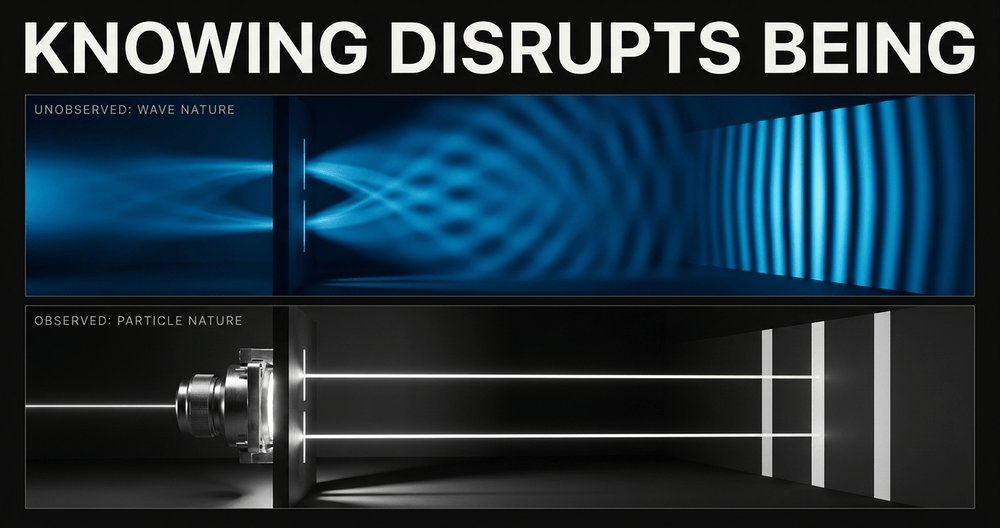
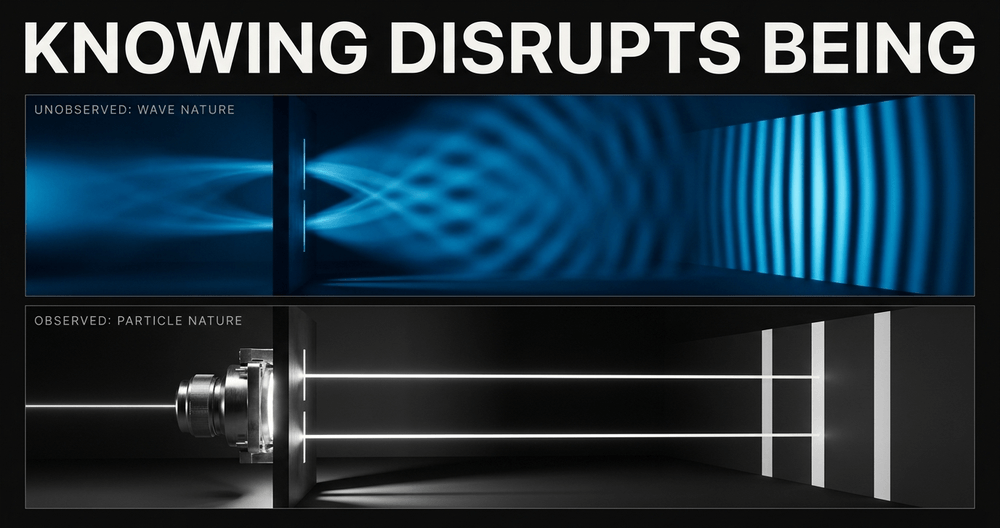
The double-slit experiment offers perhaps the most elegant demonstration of this truth. When electrons pass through two slits without any attempt to track their path, they produce an interference pattern on the detector screen - a signature of wave-like behaviour, of possibilities overlapping and coexisting. The moment a detector is placed at one of the slits to determine which path the electron takes, the interference pattern vanishes entirely, and two simple bands appear instead. The electron now behaves as a particle. Knowing disrupts being. The act of gaining information changes the nature of what was found.
This is intimately connected to Heisenberg's uncertainty principle, though the relationship is more nuanced than it first appears. The uncertainty principle, formulated in 1927, establishes that it is fundamentally impossible to simultaneously know both the precise position and the precise momentum of a quantum particle. The more exactly one is measured, the more uncertain the other must become. It is important to note - and this distinction matters - that this is not merely a technological limitation of imperfect instruments. It is a feature of nature itself, woven into the mathematical structure of quantum theory. Attempting to measure which slit an electron passes through requires fixing its position, which necessarily disturbs its momentum, and in doing so, destroys the interference. Observation and disturbance are, at this scale, inseparable.
The landscape of interpretations
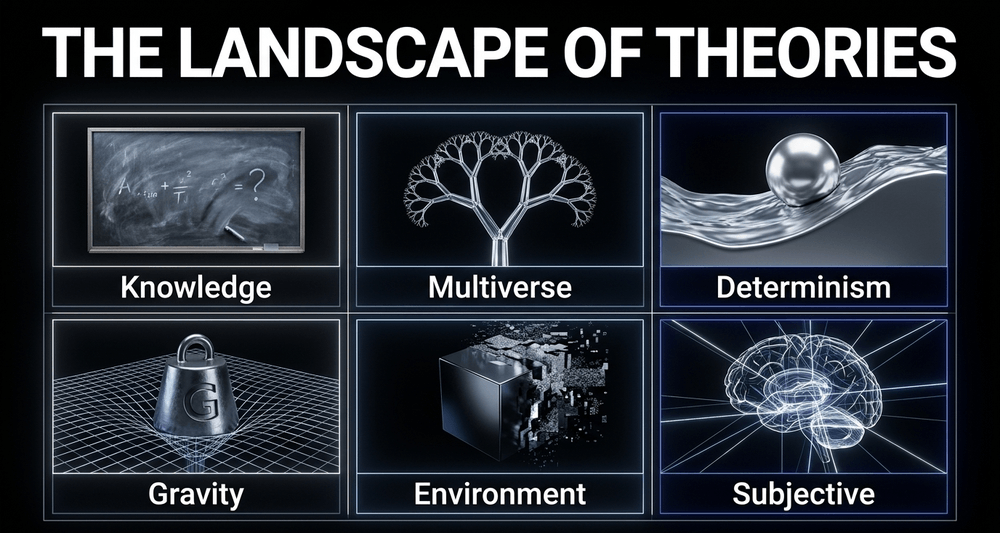
A century of grappling has produced not one answer to the measurement problem, but many - a proliferation of competing interpretations, each philosophically distinctive, each mathematically consistent with quantum mechanics' extraordinary predictive power, and each, in some crucial way, unsatisfying. At a World Science Festival event, when physicist Brian Greene asked three quantum mechanics specialists about the measurement problem, he received three entirely distinct answers. The cacophony, if anything, grows louder with time.
The Copenhagen interpretation
The oldest and, in many textbooks, still the default response is the Copenhagen interpretation, associated with Niels Bohr, Werner Heisenberg, and their colleagues of the 1920s and 30s. In this view, quantum mechanics is fundamentally a theory about observations obtained with classical measuring apparatus. The wave function describes not the independent reality of a particle, but our knowledge of it - the probabilities we can assign to different outcomes before we look. Upon measurement, the wave function "collapses" to a definite outcome, not because something physical literally snaps into place, but because our knowledge is updated. Reality, in this view, is not something that exists independently of the act of asking.
The Copenhagen interpretation is elegant precisely because it refuses to ask certain questions. It tells us to accept the formalism, use it to make predictions, and not demand a deeper picture of what is really happening between observations. This is sometimes called the "shut up and calculate" approach - a phrase often attributed to physicist David Mermin, though the sentiment was implicit in the Copenhagen camp from the beginning. The pragmatic physicist appreciates it. The philosopher of science finds it deeply, almost defiantly, incomplete.
The many-worlds interpretation
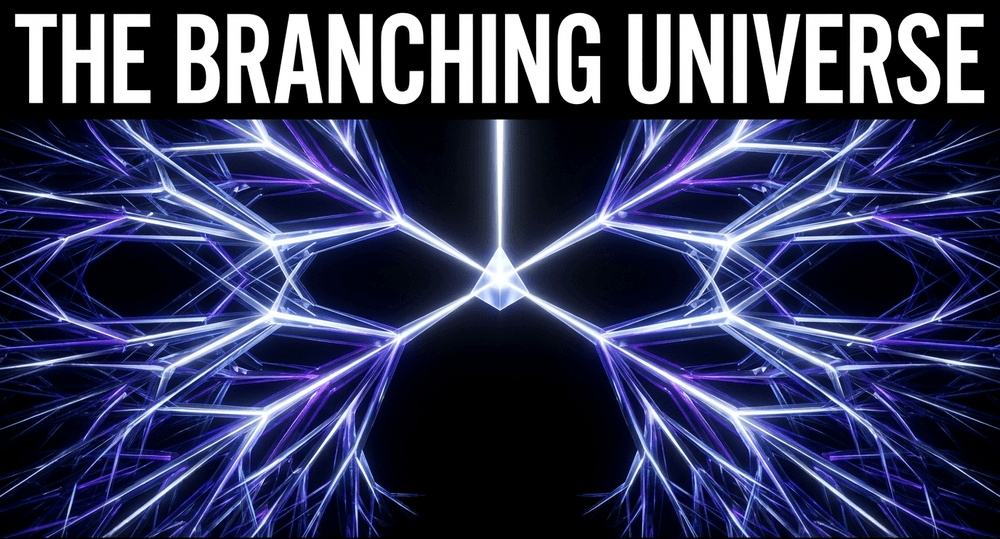
In 1957, the physicist Hugh Everett III proposed a radical alternative. What if the wave function never collapses at all? What if, instead, every possible outcome of a measurement actually occurs - each in its own branching version of reality? This is the many-worlds interpretation (MWI), popularised by Bryce DeWitt in the 1970s and since championed by a growing community of physicists, particularly those working in quantum information and cosmology.
In the many-worlds picture, there is only one rule: the Schrödinger equation always applies, without exception. When a measurement is made, the universe itself branches - one branch for each possible outcome, all equally real, all evolving independently thereafter. Our experience of a single, definite outcome is not a collapse but a selection: we are always in some branch, and from within that branch, the others become inaccessible to us.
The MWI eliminates the measurement problem in one stroke. There is no collapse to explain, no mysterious seam between quantum and classical. But it replaces the problem with something that troubles many physicists in a different way - an enormous, unobservable proliferation of entire universes. Questions about the Born rule (why probabilities emerge in these branches the way they do) and about what counts as a "branch" remain genuinely contested. And there is something philosophically vertiginous about a framework that places every possible outcome in simultaneous existence. You can explore this further in our look at Many-worlds theory: the quantum multiverse.
Pilot-wave theory
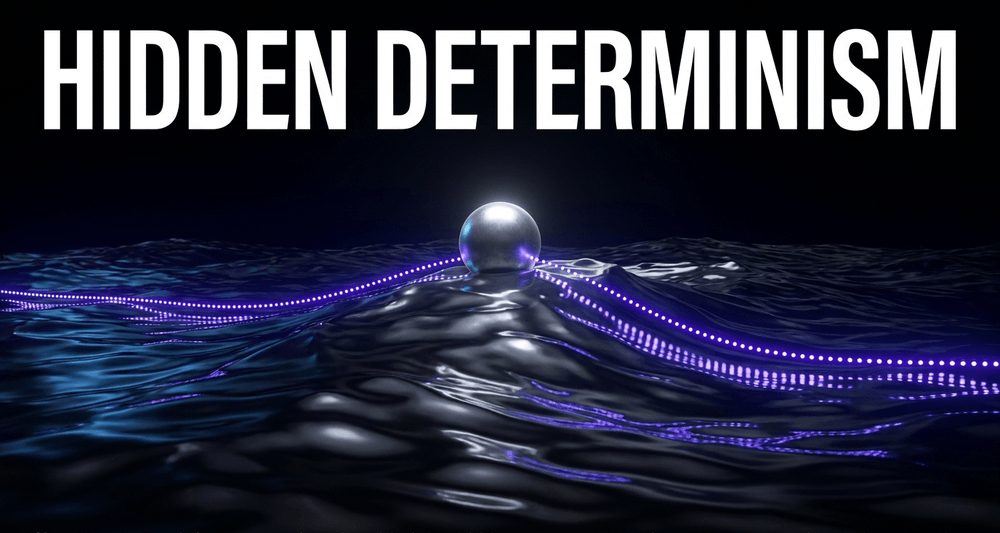
A very different kind of solution was proposed by Louis de Broglie in 1927 and resurrected with greater mathematical rigour by David Bohm in 1952. Pilot-wave theory, also known as Bohmian mechanics, restores determinism to quantum mechanics by introducing hidden variables - specifically, the precise positions of particles at all times, which standard quantum theory ignores.
In this picture, particles are always real, always located somewhere definite, and always following determined trajectories. They are guided by a real, physically existing wave - the pilot wave - which encodes all the probabilistic structure of quantum mechanics. What looks like random collapse is, from this perspective, simply a reflection of our ignorance of the exact initial conditions. If we knew where the particle actually started, we could in principle predict exactly where it would end up.
Pilot-wave theory reproduces all the predictions of standard quantum mechanics, which means it cannot be ruled out by experiment. Its greatest philosophical virtue is clarity: it dissolves the measurement problem by making measurement simply a discovery of a pre-existing property. Its main tension is with relativity - making the theory fully consistent with special relativity remains an unresolved challenge - and with a certain philosophical preference for simplicity, since the pilot wave itself requires explanation.
Objective collapse theories
Rather than reinterpreting the rules, objective collapse theories propose modifying the Schrödinger equation itself. They introduce additional, physical mechanisms - spontaneous, stochastic terms in the evolution equation - that cause wave functions to collapse on their own, without requiring any observer or measurement, when systems grow large enough.
The most prominent example is the Ghirardi-Rimini-Weber (GRW) model, which proposes that each particle undergoes spontaneous random localisation in position space at rare, random intervals. For a single electron, such a collapse is extraordinarily rare, meaning quantum behaviour is preserved at the microscopic scale. But for a macroscopic object composed of vast numbers of particles, the combined effect of these rare collapses is sufficient to ensure that superpositions decay almost instantaneously. The cat in the box never truly reaches a sustained superposition - it collapses long before we open the lid.
A closely related refinement, the Continuous Spontaneous Localisation (CSL) model, replaces the instantaneous jumps of GRW with a continuous stochastic process, offering somewhat cleaner mathematics. Both models make predictions that differ - in principle - from standard quantum mechanics in the mesoscopic regime, the delicate intermediate scale where systems are neither purely quantum nor fully classical. Experiments have already placed meaningful constraints on the parameter space of the CSL model, and efforts to probe these limits further are ongoing worldwide.
A more speculative but deeply compelling variant is Roger Penrose's proposal that gravity is the mechanism of collapse. Penrose argues that a quantum superposition of two distinct mass distributions would produce two slightly different spacetime geometries, and that this ambiguity is physically unstable. Nature, in his view, cannot sustain two different spacetime geometries simultaneously - the incompatibility leads to a spontaneous collapse, with a timescale that depends on the gravitational self-energy of the mass difference between the superposed states. The heavier the object, the faster the superposition decays. For a dust grain, the collapse would occur in about a second; for a single electron, the timescale extends to cosmological lengths. It is an elegant idea that ties quantum mechanics to general relativity in an unexpected way - though experiments to date have placed significant constraints on its simplest formulations.
Decoherence: the environment as observer
A more widely accepted approach - one that does not claim to fully resolve the measurement problem but substantially clarifies it - is the theory of quantum decoherence. Developed primarily in the 1970s and 80s through the work of H. Dieter Zeh and Wojciech Zurek, decoherence describes what happens when a quantum system interacts with its environment.
No real system is ever truly isolated. An electron in a laboratory is surrounded by air molecules, thermal radiation, electromagnetic fields, and countless other environmental influences. Each of these interactions entangles the system with its surroundings, and the quantum coherence - the delicate phase relationships that make superposition possible - leaks away into the environment with extraordinary speed. The system appears, for all practical purposes, to have taken on a definite classical state.
The timescales involved are almost incomprehensibly fast. Zurek's theoretical analysis showed that a macroscopic object of roughly one gram at room temperature, in a superposition of two positions separated by just one centimetre, would lose its coherence in approximately 10⁻²³ seconds - a span far shorter than the time it takes light to cross a single atomic nucleus. The environment, it turns out, is not a passive backdrop. It is a relentless and instantaneous witness.
Experimental evidence for decoherence is compelling. In landmark experiments, physicist Markus Arndt and his collaborators at the University of Vienna demonstrated that large molecules, including C₆₀ fullerenes (the soccer-ball-shaped carbon cages containing 60 atoms), could be made to exhibit wave-like interference patterns when passed through a diffraction grating under carefully controlled conditions. When gas molecules were introduced into the interferometer, the resulting collisions - which effectively "measured" the fullerenes' positions - caused the interference fringes to systematically disappear, in precise agreement with theoretical models. Coherence could be preserved or destroyed by controlling the degree of environmental interaction. The experiment provided a vivid, controlled demonstration that decoherence is a real and quantifiable process.
Einselection and quantum Darwinism
Decoherence does more than merely suppress interference. It selects. Not all quantum states are equally vulnerable to environmental disruption. Through a process Zurek named einselection (environment-induced superselection), interactions with the environment favour particular states - called pointer states - that are robust against environmental monitoring. These are the states that survive, that persist, that become the stable properties of classical reality we can reliably observe and agree upon. Superpositions of pointer states, by contrast, are washed out almost instantaneously.
The analogy to natural selection is deliberate. Zurek extended this into a framework called quantum Darwinism: the idea that classical reality emerges not merely through the survival of pointer states, but through their proliferation. When a system's pointer state interacts with its environment, information about that state is copied redundantly into many independent environmental fragments - scattered photons, scattered air molecules, thermal radiation. Any observer sampling a small fraction of the environment can determine the system's state without disturbing it directly, because the same information is encoded in countless copies. This is why different observers can agree on what they see. Classical objectivity, in this picture, is not a given. It is an achievement - something the universe actively produces through the redundant broadcasting of information.
Three experiments have provided early empirical support for quantum Darwinism, examining how environmental fragments carry information about quantum systems. The results are broadly consistent with the framework's predictions, though the full picture remains an active area of research.

Decoherence is an experimentally well-documented phenomenon, central to quantum computing and quantum information processing, where maintaining coherence against environmental noise is the central engineering challenge. It explains, beautifully, why we never observe macroscopic superpositions - why tables and cats and planets behave classically. But it does not, on its own, explain the selection of a single outcome from the decohered mixture. After decoherence has suppressed interference between alternatives, the system is left in what looks like a mixture of possible outcomes. The problem of why only one of those outcomes is actually realised remains open. Decoherence tells us which outcomes are possible in a given basis; it does not tell us which one happens.
QBism and epistemic interpretations
A philosophically distinct approach has emerged in recent decades under the name QBism - Quantum Bayesianism - developed by physicists Christopher Fuchs, Carlton Caves, and Rüdiger Schack. In this framework, the wave function is not a description of the world at all. It is a representation of an agent's beliefs - the subjective probabilities that a given observer assigns to the outcomes of future experiences.
Measurement collapse, in this view, is not a physical event. It is simply an observer updating their beliefs after receiving new information - no more mysterious than a person revising their expectations once they have learned the result. As Fuchs has put it, quantum mechanics is, in this reading, a law of thought - a tool for navigating uncertainty, not a picture of mind-independent reality.
QBism dissolves the measurement problem by refusing to ask what happens to the wave function "out there." There is no "out there" in the relevant sense - only agents, experiences, and the coherent management of expectations. Critics point out that this move comes at a philosophical cost: it is unclear what, if anything, QBism says about physical reality beyond the observer's subjective experience.
Consciousness and the quantum observer
Perhaps the most culturally resonant - and scientifically controversial - strand of thought holds that consciousness itself plays a special role in wave function collapse. The idea was given early prominence by John von Neumann and later developed by Eugene Wigner, who argued in 1961 that a state of consciousness cannot be in superposition, and that the presence of a conscious observer is what ultimately forces the quantum system into a definite state.
Wigner illustrated this with a thought experiment - Wigner's friend - in which a friend inside an isolated laboratory performs a quantum measurement. From the friend's perspective, the wave function collapses to a definite result. But from Wigner's perspective, outside the sealed laboratory, his friend and the quantum system are jointly described by a wave function that has not yet collapsed. Who is right? The paradox highlights the deep tension in assigning a special physical role to consciousness.
It is worth noting that Wigner himself eventually abandoned this position, coming to regard his 1961 argument as a sign that quantum mechanics needed revision rather than evidence that mind literally shapes matter. Nevertheless, the idea persists, and has been developed in different directions. Roger Penrose and anaesthesiologist Stuart Hameroff have proposed the Orchestrated Objective Reduction (Orch OR) theory, in which quantum superpositions within structures inside neurons called microtubules collapse according to gravitational objective reduction thresholds, and in which collapse causes consciousness - inverting the original conjecture rather than confirming it. Experiments probing this theory have placed it under significant experimental pressure, and the majority of physicists regard the brain's warm, wet environment as far too noisy to sustain the quantum coherences that Orch OR requires.
What most physicists are careful to note is that the "observer" in quantum mechanics need not be, and almost certainly is not, a conscious observer in any meaningful sense. A detector, a measuring apparatus, even a stray photon can constitute an observation. The disruption is physical, not cognitive.
Decoherence in the wild: quantum effects in living systems
One of the stranger frontiers opened by decoherence research is the question of whether biology - warm, wet, relentlessly noisy - might, in certain circumstances, exploit rather than suppress quantum coherence.
The emerging field of quantum biology suggests that the answer, in at least some cases, is yes. In photosynthesis, energy captured by light-harvesting molecules does not simply diffuse randomly toward the reaction centre. Instead, it appears to travel via multiple quantum pathways simultaneously, sampling many routes at once in a manner that resembles quantum superposition. The result is an efficiency of energy transfer that classical models cannot fully account for. Exactly how quantum effects persist in such thermally noisy environments - and whether "coherence" in this biological context means the same thing as coherence in a laboratory interferometer - remains a subject of active, sometimes heated debate.
Stranger still is the case of bird navigation. Migratory birds appear to navigate using the Earth's magnetic field, and the most compelling mechanism proposed involves the radical pair mechanism in cryptochrome proteins within the birds' eyes. When light strikes these molecules, electrons briefly become entangled in pairs whose quantum spin states are sensitive to the direction and magnitude of weak magnetic fields. The spin correlations persist long enough - perhaps tens of microseconds - to influence the chemistry in a way the bird's nervous system can detect. That quantum entanglement might function as a biological compass, preserved in the warm interior of a living eye, is one of the more remarkable prospects decoherence research has opened.
These examples do not overturn the general rule that macroscopic biology is classical. They suggest, rather, that nature has in certain niches found structural ways to shield fragile quantum states just long enough to put them to work - before decoherence, inevitable and unforgiving, does its job.
Why the problem is not merely philosophical
One might ask whether the measurement problem is truly a scientific issue at all, or merely a philosophical puzzle that careful experimentalists can afford to ignore. The practical success of quantum mechanics is beyond question - it underpins semiconductor physics, lasers, MRI machines, GPS satellites, and the nascent field of quantum computing. If it works so well without a resolved foundation, does the foundation matter?
The answer, increasingly, is yes. The frontier of quantum technology makes the measurement problem an urgent practical question. In a quantum computer, the preservation and manipulation of quantum superpositions across multiple qubits depends critically on understanding and controlling decoherence. The boundary between measurement and evolution - between collapse and coherence - determines what a quantum computer can and cannot do. Getting this wrong is not an abstract philosophical error. It is an engineering failure.
Decoherence leads to computational errors, so error correction is the central challenge of quantum computing. The problem is that the process of error correction itself involves large numbers of qubits performing many operations, which introduces yet more opportunity for errors. In late 2024, researchers at Google made a breakthrough with their Willow quantum processor - a 105-qubit superconducting chip - demonstrating that, given the right error-correction techniques, quantum computers actually become more accurate, not less, as the number of qubits increases. The achievement turned a long-standing obstacle into a confirmation that scale can, under the right conditions, work in decoherence's despite rather than on its behalf. Meanwhile, different qubit architectures take different approaches: superconducting qubits typically maintain coherence for microseconds to milliseconds, while trapped-ion systems achieve coherence times stretching to minutes, by virtue of the superior isolation available in electromagnetic traps.
Moreover, the measurement problem sits at the intersection of quantum mechanics and general relativity - two theories that do not, as yet, speak the same language. Any future theory of quantum gravity must explain what measurement means in a universe without a preferred time, without a fixed background, without an external observer standing outside spacetime to collapse wave functions. The measurement problem is not a footnote to modern physics. It may be one of its most important open questions.
The horizon: what remains open
A thorough survey of the field's current state, drawing on decades of theoretical work and the competing interpretations, reveals a landscape that is clearer than it once was, but not yet resolved. Decoherence and the many-worlds framework have clarified much of the structure. Objective collapse theories provide testable alternatives to standard quantum mechanics. Epistemic interpretations offer internal consistency at the cost of ontological austerity. But no single answer commands consensus.
When physicist Brian Greene asked three leading quantum physicists to explain the measurement problem, he received three entirely different answers. That anecdote is not a failure of science. It is a portrait of science at work - at its most honest, most uncertain, and most alive.
The measurement problem endures because it asks something that physics has rarely had to ask so starkly: does reality exist independently of the act of looking? Is the universe something that unfolds whether or not there is anyone watching, or does observation play a constitutive role in bringing definite facts into being? These are questions that cut to the philosophical core of what it means to do physics at all.

For nearly a century, quantum mechanics has given us the tools to predict, to build, and to transform the world - while simultaneously withholding a final answer about what, exactly, the world is. Decoherence stands as one of the most honest and productive responses to that withholding: not a solution, but a map of the territory between the quantum and the classical, drawn with extraordinary precision. Perhaps that is its most honest teaching of all - that the universe is stranger than any story we have yet told about it, and that some of the most profound questions are still waiting, quietly, for us to ask them in the right way.
Share now









Key takeaways
- Quantum decoherence is the loss of quantum coherence caused by a system becoming entangled with its environment, transforming delicate superpositions into effectively classical states.
- Decoherence is extraordinarily fast for macroscopic objects: a 1-gram object in a superposition separated by 1 cm at room temperature loses coherence in roughly 10⁻²³ seconds - far shorter than the time light takes to cross an atomic nucleus.
- The theory was developed primarily by H. Dieter Zeh and Wojciech H. Zurek, whose work from the 1970s onward established the theoretical framework that remains central to the field today.
- Through a process called einselection (environment-induced superselection), decoherence selects certain "pointer states" that are stable against environmental disturbance - these pointer states form the foundation of the classical properties we observe.
- Quantum Darwinism, developed by Zurek, proposes that classical reality becomes objective because information about a system's pointer state is copied redundantly into many fragments of the environment, allowing multiple independent observers to agree on what they find.
- Decoherence has been experimentally confirmed, most strikingly in C₆₀ fullerene interferometry experiments, where controlled introduction of background gas molecules caused interference fringes to disappear in precise agreement with theoretical predictions.
- Decoherence does not fully solve the measurement problem: it explains why superpositions appear to collapse, and which outcomes are possible, but it does not explain why one specific outcome occurs rather than another.
- In quantum computing, decoherence is the primary obstacle to stable computation. Different qubit architectures achieve vastly different coherence times: superconducting qubits last microseconds to milliseconds, while trapped-ion qubits can maintain coherence for minutes.
- Quantum biology has revealed surprising exceptions to the rule that warm, wet environments destroy coherence: migratory birds appear to use entangled radical pairs in cryptochrome proteins for magnetic navigation, and photosynthetic systems show quantum-assisted energy transfer at room temperature.
- Decoherence is distinct from wave function collapse - it describes the apparent loss of quantum superposition through environmental entanglement, but remains, at the fundamental level, a unitary and theoretically reversible quantum process.
Sources
- Wikipedia - Quantum decoherence https://en.wikipedia.org/wiki/Quantum_decoherence
- Stanford Encyclopedia of Philosophy - Quantum Decoherence https://plato.stanford.edu/archives/win2017/entries/qm-decoherence/
- Schlosshauer, M. - Decoherence: From Interpretation to Experiment (PDF) http://faculty.up.edu/schlosshauer/publications/DecoherenceExperimentsSchlosshauer.pdf
- Zurek, W. H. - Decoherence, einselection, and the quantum origins of the classical (arXiv) https://arxiv.org/pdf/quant-ph/0105127
- Quanta Magazine - Quantum Darwinism, an idea to explain objective reality, passes first tests https://www.quantamagazine.org/quantum-darwinism-an-idea-to-explain-objective-reality-passes-first-tests-20190722/
- Published 2026-07-25 22:30
- Modified 2026-07-25 22:30

-
Redaction