





-
 Redaction
Blue carbon: Seagrass and mangroves as climate sinks
An analytical examination of seagrass and mangrove ecosystems as efficient carbon sinks, their sequestration mechanics, and global economic implications.
The architecture of blue carbon sequestration
Blue carbon is the term for carbon captured and stored within coastal and marine ecosystems - principally seagrass meadows, mangrove forests, and salt marshes. I've spent enough time standing knee-deep in tidal mud with a sediment corer to say this plainly: these systems don't just participate in the carbon cycle, they arrest it. While terrestrial forests have historically dominated carbon mitigation strategy, the scientific record increasingly supports coastal marine environments as more concentrated and more stable long-term carbon sinks. The efficiency of these systems derives from their unique biological architecture and the anaerobic sediment conditions that underpin millennial-scale storage.
Global estimates place total blue carbon reserves - across mangroves, salt marshes, and seagrass meadows combined - somewhere between 10 and 24 billion metric tons of organic carbon, the majority of it locked away in sediment rather than in living plant tissue. That range is wide, which tells you something honest about the field: measurement science here is still catching up to the scale of what these habitats are doing.
This article examines the technical sequestration capacity of seagrass, mangrove, and salt marsh systems, the mechanisms that drive carbon burial, the restoration approaches being deployed at scale, and the fiscal and policy implications of their conservation.

Seagrass meadows as high-density carbon reservoirs
Seagrasses are submerged flowering plants found in coastal waters across every continent except Antarctica. Despite covering less than 0.2% of the total ocean surface, these meadows account for roughly 10% of all carbon buried in marine sediments annually - a flux on the order of 27 teragrams (Tg) of carbon per year, depending on which global synthesis you consult. That disproportion between area and output is the defining characteristic of blue carbon systems, and it's the number I find myself returning to whenever someone asks why a patch of underwater grass matters more than it looks like it should.
Why seagrass outperforms terrestrial forests
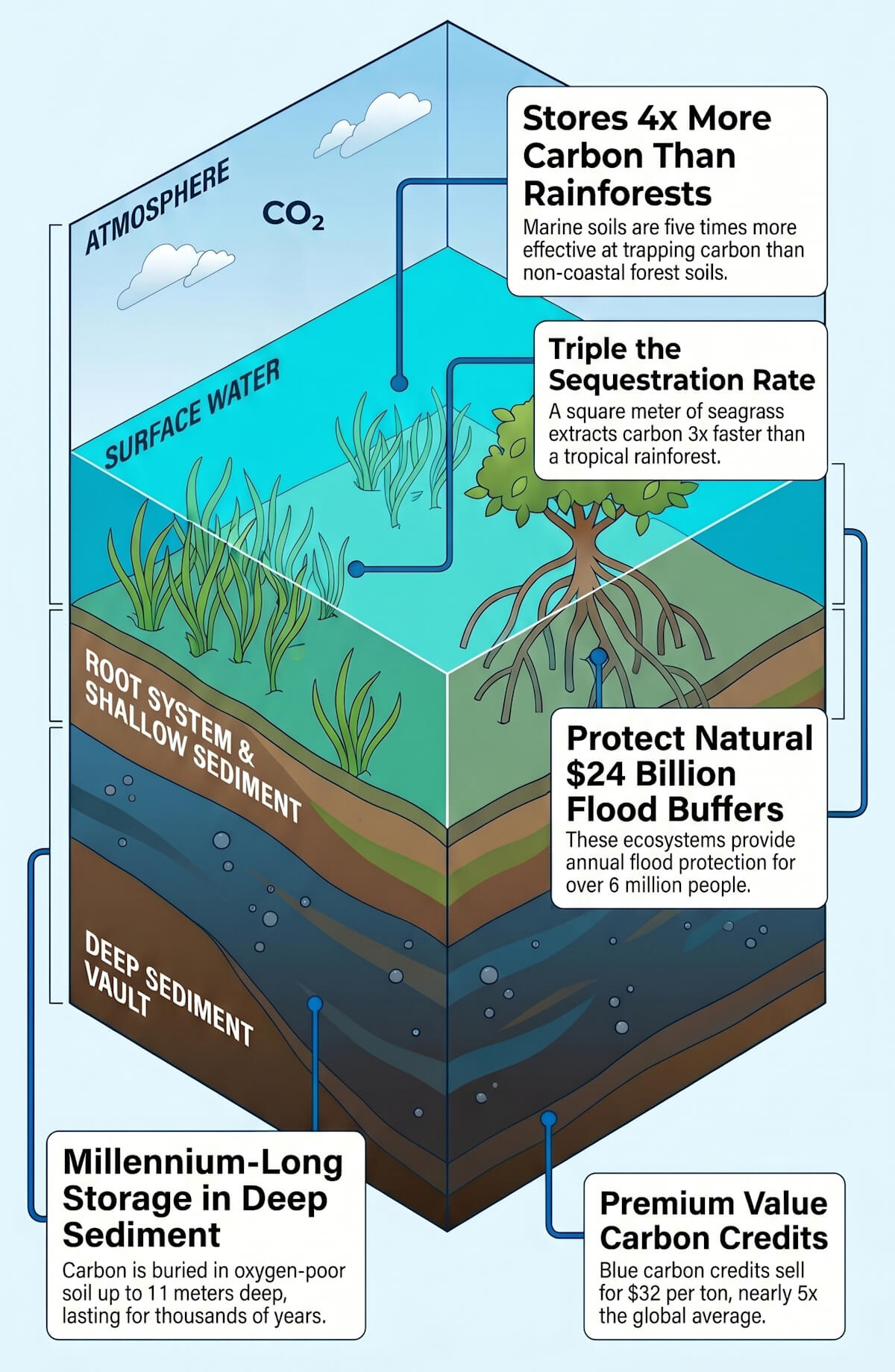
On a per-hectare basis, seagrasses can store up to twice as much carbon as temperate or tropical forests. The global organic carbon pool within these ecosystems is estimated at roughly 19.9 billion metric tons in biomass and near-surface sediment - a figure that, notably, is comparable to the combined carbon stocks of the world's mangrove forests and tidal marshes. The decisive advantage over land-based systems lies in where the carbon is stored: rather than in living biomass susceptible to fire or decay, seagrass carbon is locked into waterlogged, oxygen-depleted sediment that is physically and chemically resistant to decomposition.
These soils reach depths of four meters in typical systems, with specific Mediterranean Posidonia oceanica meadows exhibiting carbon deposits up to 11 meters thick - strata accumulated over centuries, in some cases millennia, of uninterrupted growth. In the upper meter of soil alone, seagrass meadows hold somewhere in the range of 45 to 144 Mg C per hectare, depending on species composition, latitude, and sediment type - figures that translate to roughly 165 to 530 Mg CO₂eq per hectare. When vegetative biomass is included, mean storage across global meadows is often cited near 600 Mg CO₂eq per hectare, though local variation is considerable, and I'd caution against treating any single figure as universal - a Bahamian Thalassia bed and a Mediterranean Posidonia meadow are, geologically speaking, different animals.
One of the more striking regional case studies comes from the Bahamian archipelago, which hosts the largest contiguous seagrass meadow on Earth. Sediment coring there has estimated that Bahamian seagrass alone stores between 0.42 and 0.59 billion metric tons of organic carbon in just the top meter of sediment - equivalent to roughly a fifth to a third of documented global seagrass sediment carbon. It's a useful reminder that "global average" figures often conceal enormous geographic concentration.
Sequestration rates and the anoxic advantage
A single square meter of healthy seagrass extracts somewhere in the range of 140 to 220 grams of carbon from the atmosphere each year for burial in the sediment below, with the exact figure varying by species and site - a rate that in many meadows exceeds that of a tropical rainforest several times over, and comfortably outpaces terrestrial grasslands.
The mechanism is structurally elegant: the plants trap fine particles and organic matter from the water column, which settles into sediment beneath the canopy. Because these soils are waterlogged and anoxic, organic decomposition is reduced to a fraction of its upland rate, allowing carbon to persist for millennia if the habitat remains undisturbed. It is this near-permanent storage, rather than just the intake rate, that makes seagrass systems so valuable to the global carbon budget. Seagrass meadows build soil vertically at a median rate of around 5.5 millimeters per year - slow by human standards, geologically almost hasty.
The cost of seagrass degradation
Estimates of seagrass loss vary by methodology and time window. NOAA and allied assessments, drawing on a synthesis of over 200 studies, put current annual losses at roughly 7% globally, driven by coastal development, industrial pollution, and warming ocean temperatures. Other long-term syntheses, measuring loss since the mid-twentieth century, cite an average annual decline closer to 1.5%, with cumulative global seagrass loss estimated at around 29% of historic coverage. Both figures are correct in their own frame - the higher number reflects the accelerating rate observed in recent decades at documented sites, while the lower number averages that acceleration out over seventy-plus years. Either way, the trend line points the same direction, and it isn't a good one.
Crucially, destruction does not merely halt sequestration - it reverses it. Disturbance of stored sediments releases previously captured carbon back to the atmosphere, converting a sink into a source.
Research from Florida International University indicates that protecting at-risk seagrass could prevent the emission of 1.2 billion tons of carbon, avoiding climate-related damages valued at more than $200 billion - a figure that substantially exceeds the cost of protection.
Mangrove forests and subterranean carbon density
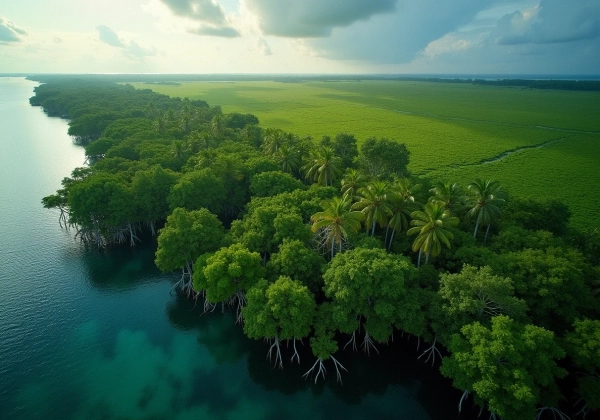
Mangroves are specialized tropical forests positioned at the land-sea interface, regularly inundated by tidal cycles. They are categorized among the most carbon-dense forests on Earth, with global soils storing more than 6.4 billion tons of blue carbon. Between 49% and 98% of a mangrove forest's total carbon stock is located below ground in the soil, depending on site and region - a distribution that sharply distinguishes them from upland forests, where biomass dominates the carbon ledger.
Soil carbon stratification and volume
In the Indo-Pacific, mangrove forests average roughly 456 tons of carbon per acre - three to four times greater than the density recorded in many mature terrestrial rainforests. Indonesia alone, which hosts the largest extent of mangrove forest of any nation on the planet, is estimated to hold over 4,500 Tg of carbon in its mangrove stocks - a single-country figure larger than most regional totals elsewhere in the world. The specific anaerobic chemistry of mangrove soils, typically 1.5 to 10 feet deep, prevents the rapid oxidation of organic material that occurs in aerated upland substrates.
Estimates for the first meter of mangrove soil place storage as high as 1,023 Mg C per hectare at the most carbon-dense sites, translating to roughly 3,750 Mg CO₂eq per hectare under peak conditions - though global mean figures, once averaged across latitude and forest condition, tend to sit meaningfully lower, closer to 250-535 Mg C per hectare. When living biomass is integrated into the calculation, storage capacity in Indo-Pacific systems can approach or exceed 1,500 Mg CO₂eq per hectare. The annual sequestration rate sits between roughly 6 and 8 Mg CO₂e per hectare - significantly higher than mature tropical forests - and mangrove soils are, on average, several times more effective at trapping carbon than the soils of non-coastal forests.
The impact of mangrove deforestation
Between 2000 and 2015, the degradation of mangrove forests released over 122 million tons of carbon. Despite comprising only 0.7% of tropical forest area, mangrove removal accounts for roughly 10% of global deforestation carbon emissions - a disproportionate contribution that reflects the extraordinary density of their carbon stocks.
Estimates suggest that as much as 35% to 67% of the world's original mangrove coverage has now been lost, depending on the region and the historical baseline used. In direct response, the Mangrove Breakthrough - launched at COP27 in Sharm el-Sheikh in 2022 - set a target of securing 15 million hectares by 2030 through halting current losses, restoring 50% of recent losses, and doubling formal protection zones globally, underpinned by a goal of mobilizing $4 billion in sustainable finance.
The initiative has gathered real momentum heading into its 2030 deadline. By early 2026, 48 national, state, and municipal governments had formally endorsed the Breakthrough, including Indonesia - home to roughly 23% of the world's mangrove area - alongside Brazil, Mexico, and Papua New Guinea, which all joined in 2025. Tracked large-scale investments (those exceeding $1 million each) had by that point mobilized more than $750 million in mangrove-positive finance since 2020, supported by the newly launched Mangrove Catalytic Facility, an instrument designed specifically to de-risk early-stage restoration finance. Mangroves remain chronically underfunded relative to their climate value, receiving an estimated 1% of total global climate finance - a gap the Breakthrough's architects have been explicit about closing.
Salt marshes: the overlooked third pillar
Seagrass and mangroves tend to dominate the blue carbon conversation, largely because they're more visually dramatic and more heavily studied, but salt marshes deserve equal billing. These intertidal grasslands - dominated by salt-tolerant species like cordgrass and pickleweed - occupy temperate and subarctic coastlines where mangroves cannot survive the cold, and by some estimates they contribute the majority of blue carbon storage globally simply by virtue of their extensive coverage.
Salt marsh soils typically hold between 100 and 199 Mg C per hectare, sitting between seagrass and mangrove densities, while their annual sequestration rate - often cited around 150 to 250 grams of carbon per square meter per year - is comparable to or exceeds that of many mangrove and seagrass systems. Marsh soils also accrete vertically at a slower pace than seagrass beds, contributing to soil buildup at a median rate of roughly 1.5 millimeters annually, which over centuries produces peat-like carbon deposits of remarkable density.
Salt marshes face many of the same pressures as their tropical counterparts - diking, agricultural conversion, and coastal squeeze, where rising seas leave marshes with nowhere landward to migrate because of seawalls and development. Recent modeling work suggests that under high coastal-squeeze scenarios, global mangrove sediment carbon stocks alone could decline by 15% to 30% by 2100, and researchers have flagged that comparable projections for salt marshes and seagrass remain underdeveloped - a genuine data gap that limits national-scale planning for these habitats in the way it now exists for mangroves.

How blue carbon projects generate carbon credits
The translation of ecosystem services into tradable financial instruments requires a structured, defensible methodology. Blue carbon projects typically follow a three-stage process: baseline carbon stock assessment, conservation or restoration activity, and third-party verification.
Measurement, reporting, and verification (MRV)
Quantifying carbon stocks in submerged and tidal soils demands site-specific sediment coring, biomass sampling, and long-term monitoring protocols. The Verified Carbon Standard (VCS) and the Gold Standard both maintain approved methodologies for coastal wetland carbon accounting, though standardization across jurisdictions remains inconsistent - a point researchers reviewing blue carbon data across South and Southeast Asia have specifically flagged, noting that seagrass carbon stocks in particular remain far less studied than mangrove stocks in the same region. Satellite-based remote sensing and, increasingly, nuclear and isotopic dating techniques for sediment cores are being integrated into MRV frameworks, reducing per-hectare cost and substantially improving spatial coverage - particularly relevant for mangrove systems spanning thousands of hectares in data-sparse coastal nations.
Additionality and permanence requirements
For a blue carbon credit to be considered credible, the project must demonstrate additionality - the sequestration would not have occurred without the intervention - and permanence - the carbon will remain stored across the designated crediting period, typically 20 to 100 years. Marine sediment carbon generally scores well on permanence relative to terrestrial forestry credits, given the stability of anoxic conditions. However, sea-level rise, storm damage, and future policy changes introduce reversal risk that must be accounted for through buffer pool reserves, typically 10-20% of issued credits.
It's worth noting, as a matter of scientific honesty, that reversal risk is not merely theoretical. Hurricane Dorian in 2019, for instance, destroyed roughly 30% of mangrove cover across two islands in the Bahamas in a single event - a reminder that permanence guarantees on paper still contend with the physical unpredictability of a warming coastline.
Carbon market dynamics
In 2023, mangrove restoration credits on the voluntary carbon market averaged $26.03 per tCO₂e. By early 2024, individual trades reached $32 per tCO₂e - nearly five times the global average of roughly $6.63 per tCO₂e for generic carbon offsets. This sustained price premium reflects the perceived quality, co-benefit richness, and storage permanence of marine sediment carbon relative to terrestrial alternatives.
Restoration techniques and project timelines
Active restoration of blue carbon habitats has accelerated over the past decade, driven by both conservation mandates and the expanding economics of the voluntary carbon market.
Seagrass restoration approaches
Seagrass restoration employs either seed-based propagation or transplant methods, where donor shoots are collected and replanted at target sites under appropriate light and water quality conditions. More recent approaches disperse hessian bags of collected seeds by vessel, enabling restoration at landscape scale - a technique pioneered in projects such as the UK's Seagrass Ocean Rescue. Recovery timelines vary considerably: pioneer colonization may be visible within months, but full sediment carbon accumulation to pre-disturbance levels can require decades to centuries, depending on deposit depth and species composition.
Mangrove restoration techniques
Mangrove restoration generally employs direct planting of propagules - the species' ready-to-germinate seeds - or passive natural regeneration, achieved by removing the stressor that caused the original loss. The most common restoration failures are linked to planting in unsuitable hydrological conditions, typically areas where tidal flow has been permanently altered by road embankments or aquaculture infrastructure. Successful projects require hydrological assessment prior to any planting to confirm that tidal inundation regimes match the target species' physiological requirements.
Large-scale programmes coordinated through the Mangrove Breakthrough and national NDC commitments are demonstrating that cost-effective restoration is achievable at national scale when institutional and legal frameworks are properly structured in advance. Jamaica's updated national climate commitment, for example, now targets protection of roughly two-thirds of its remaining mangrove forest by 2033, alongside restoration of 7,000 hectares by 2027 - the kind of specific, measurable target that donors and verification bodies increasingly expect to see.
Salt marsh restoration
Salt marsh restoration typically centers on reconnecting tidal hydrology - removing or breaching the earthen dikes historically built to convert marshes into farmland or development sites - followed by natural or assisted revegetation with native halophytic species. Because marshes accrete carbon-rich peat relatively slowly, restored sites often take longer to match the carbon density of undisturbed marsh than seagrass beds take to recover biomass, though the underlying hydrology, once corrected, tends to be more stable long-term than a replanted mangrove stand contending with altered sediment supply.

Multifunctional benefits of blue carbon ecosystems
Carbon sequestration is the primary metric for climate mitigation, but blue carbon ecosystems deliver a range of secondary services that directly support coastal resilience, biodiversity, and regional economic stability. It's a pattern I've noticed in nearly every coastal system I've studied: the habitats doing the most invisible work below the sediment line are usually doing the most visible work above it too.
Physical protection and hazard mitigation
Mangroves and seagrasses function as natural coastal infrastructure, attenuating wave energy and stabilizing shorelines against erosion and storm surges. This biological buffer is frequently more cost-effective than engineered alternatives such as concrete seawalls. Mangrove systems currently provide flood protection for over 6 million people annually, preventing approximately $24 billion in productive asset losses from storm and flood events. Roughly half of the world's remaining mangrove ecosystems are now considered at risk, putting an estimated 2.1 million people directly in harm's way should those protective buffers continue to erode.
Biological and water quality services
These habitats function as essential nurseries for marine species, supporting biodiversity and sustaining commercial fisheries. Seagrasses and mangroves filter chemical pollutants and suspended sediment from terrestrial runoff, improving water clarity and reducing nutrient loading in nearshore waters. This filtration service is critical for adjacent ecosystems - particularly coral reefs, which are highly sensitive to turbidity and eutrophication, and which increasingly share formal policy alliances with mangrove conservation efforts, as coral and mangrove restoration bodies have begun coordinating shared coastal targets. The preservation of these habitats directly correlates to food security for coastal populations dependent on marine protein sources.
Socioeconomic co-benefits
For coastal communities in Southeast Asia, West Africa, and Central America, mangrove and seagrass systems support livelihoods through fisheries, ecotourism, and shoreline protection. Indonesia alone has roughly 60% of its population living in coastal areas dependent, in some measure, on these ecosystems for food security and storm protection. These co-benefits increasingly factor into the premium pricing of blue carbon credits on the voluntary market, reflecting growing buyer demand for projects that deliver measurable social impact alongside verified carbon outcomes.
The interconnection between coastal geology and long-term carbon storage isn't unique to marine sediments, either - it echoes a broader pattern seen in terrestrial systems, where weathering and mountain-building processes have shaped Earth's carbon budget over geological time, a dynamic explored in more depth in how Tibet's rocks helped cool the Earth's climate.
Economic valuation and policy implementation
The integration of blue carbon into global financial markets has opened new pathways for conservation funding - particularly significant given the chronic underfunding of coastal ecosystem protection relative to terrestrial conservation programmes.
Global policy frameworks
Currently, more than 130 countries have jurisdiction over blue carbon ecosystems. As of late 2018, nearly 60 nations had formally included these systems in their Nationally Determined Contributions (NDCs) under the Paris Agreement, and that number has continued to climb as more governments formalize mangrove and seagrass targets within their national climate strategies. To align international monitoring and restoration strategy, organizations including Conservation International and the IUCN co-developed the International Policy Framework for Blue Carbon Ecosystems, which seeks to standardize scientific accounting and optimize restoration investment across jurisdictions.
Persistent structural barriers
Several systemic obstacles constrain the pace of blue carbon market development:
- Measurement complexity. Standardized methodologies for quantifying and verifying subsurface carbon remain technically demanding and costly to deploy, particularly in data-sparse coastal nations with limited institutional capacity.
- Land tenure and legal rights. Questions over who holds legal authority over carbon sequestration in coastal and intertidal waters create significant barriers for private investment and long-term project security.
- Long-term maintenance liability. Preventing the reversal of sequestration gains over 20 to 100-year crediting periods requires durable institutional frameworks and, in many host countries, legal instruments that do not yet exist.
- Uneven regional data. Seagrass carbon stocks in particular remain poorly quantified across large parts of Asia, Africa, and the Pacific relative to mangrove stocks, limiting the formulation of credible national blue carbon strategies in those regions.
Resolving these barriers is critical to closing the gap between blue carbon's theoretical sequestration potential and its realized contribution to national and global climate targets.
"Coastal wetlands tend to be very productive ecosystems - meaning that the plants grow a lot each year," notes NOAA's overview of coastal blue carbon science, pointing to the dual role these habitats play in both active uptake and long-term storage.
Frequently asked questions about blue carbon
What is the difference between blue carbon and green carbon?
Green carbon refers to carbon stored in terrestrial vegetation - forests, grasslands, and upland soils above the tidal zone. Blue carbon applies specifically to carbon captured and stored by coastal and marine ecosystems, including seagrasses, mangroves, and salt marshes. The principal distinction is storage location and stability: blue carbon systems hold the majority of their carbon in waterlogged, anoxic sediments, where decomposition rates are orders of magnitude slower than in aerated terrestrial soils, enabling storage over geological timescales.
Can blue carbon offset industrial emissions?
Blue carbon credits generated through verified conservation or restoration projects can be used by companies and governments to offset greenhouse gas emissions within the voluntary carbon market. However, the total theoretical capacity of blue carbon systems, while globally significant, is not sufficient to offset industrial emissions at current rates in isolation. Blue carbon is most effectively deployed as a complementary mechanism within a broader portfolio of deep emissions reductions - not as a substitute for structural decarbonization.
How long does blue carbon remain stored?
In undisturbed, waterlogged sediments, blue carbon can remain stored for thousands of years. The defining feature is the anoxic conditions that suppress rapid microbial decomposition. Disturbance - whether from coastal development, dredging, or significant climate-driven shifts in hydrology - can mobilize stored carbon and convert these systems from reliable sinks into net emissions sources. This reversibility risk is why habitat protection is considered more immediately valuable than restoration alone.
Do salt marshes count as blue carbon too?
Yes. Salt marshes are one of the three principal blue carbon ecosystems alongside seagrass meadows and mangrove forests, and in terms of sheer global coverage, they may contribute the largest single share of total blue carbon storage. They receive comparatively less research attention than mangroves, largely because they occur in temperate rather than tropical latitudes, where blue carbon science first developed.
Conclusion
The data surrounding blue carbon reinforces the strategic necessity of coastal ecosystem preservation within any credible climate stabilization framework. Seagrasses, mangroves, and salt marshes are not marginal contributors to the global carbon budget - they are high-density, high-permanence sinks that simultaneously deliver economic value, coastal protection, and biodiversity outcomes that most terrestrial alternatives cannot replicate.
As global policy increasingly pivots toward nature-based solutions, the rigorous management, restoration, and financial accounting of these marine assets becomes operationally critical. The continued expansion of blue carbon into national climate commitments, voluntary markets, and institutional conservation frameworks represents one of the most measurable and cost-effective pathways available for reducing atmospheric carbon concentrations - while simultaneously fortifying coastal communities against the escalating hazards of a changing climate.
Share now









Key takeaways
- Seagrass meadows cover less than 0.2% of the ocean surface but account for roughly 10% of all carbon buried in marine sediments each year.
- Per hectare, seagrass can store up to twice as much carbon as terrestrial forests, with sediment deposits at specific Mediterranean sites reaching up to 11 meters deep.
- A single square meter of seagrass extracts roughly 140-220 grams of carbon annually - several times the rate of a tropical rainforest.
- The Bahamian seagrass meadow, the largest contiguous meadow on Earth, alone stores an estimated 0.42-0.59 billion metric tons of organic carbon in its top-meter sediments.
- Between 49% and 98% of total mangrove carbon stock is stored in anoxic, below-ground soils; global mangrove soils hold more than 6.4 billion tons of blue carbon in total.
- Salt marshes are the third major blue carbon ecosystem, storing 100-199 Mg C per hectare and, by some estimates, contributing the largest overall share of global blue carbon due to their extensive coverage.
- Protecting at-risk seagrass meadows could prevent the release of 1.2 billion tons of carbon and avert climate-related damages valued at over $200 billion.
- Despite covering only 0.7% of tropical forest area, mangrove deforestation accounts for roughly 10% of global carbon emissions from deforestation.
- Mangrove restoration carbon credits reached prices of up to $32 per tCO₂e in early 2024 - nearly five times the global average of $6.63 per tCO₂e for generic carbon offsets.
- The Mangrove Breakthrough, launched at COP27 in 2022, had secured endorsements from 48 governments by early 2026 and mobilized more than $750 million in tracked mangrove-positive finance since 2020, working toward its 2030 target of 15 million hectares.
- Mangroves currently provide flood protection for over 6 million people annually, preventing an estimated $24 billion in productive asset losses.
- More than 130 countries hold jurisdiction over blue carbon ecosystems, yet mangrove and coastal wetland restoration still receives only around 1% of global climate finance.
Sources
- NOAA - Coastal blue carbon and fast facts https://coast.noaa.gov/states/fast-facts/blue-carbon.html
- The Blue Carbon Initiative - About blue carbon https://www.thebluecarboninitiative.org/about-blue-carbon
- Global Mangrove Alliance - Mangrove soils hold 6.4 billion tons of carbon https://www.mangrovealliance.org/news/new-study-shows-mangrove-forests-soils-hold-more-than-6-4-billion-tons-of-carbon-globally
- The Mangrove Breakthrough - Official initiative page and 2026 progress updates https://www.mangrovebreakthrough.com/
- Florida International University - Protecting seagrasses prevents climate damages https://news.fiu.edu/2025/protecting-seagrasses-is-essential-to-preventing-climate-damages-research-finds
- Published 2026-05-03 21:02
- Modified 2026-08-01 20:12

-
Redaction