

-
 Redaction
Cosmic web: filaments, voids and dark matter
Explore the largest structure in the universe - the cosmic web. Learn how dark matter filaments, galaxy clusters, and vast voids shape all of existence.
When we look up at the night sky, our eyes are naturally drawn to the bright pinpricks of stars and the soft glow of the Milky Way. Yet these luminous points are merely the froth on waves of a much deeper, more silent ocean. Beyond the visible lies the Cosmic Web - the largest known structure in existence. It is a vast, intricate network of filaments and sheets spanning the entirety of the observable universe, forming the skeletal framework upon which all galaxies are suspended.
To understand the Cosmic Web is to understand the blueprint of reality. And it turns out, reality has been extraordinarily patient.
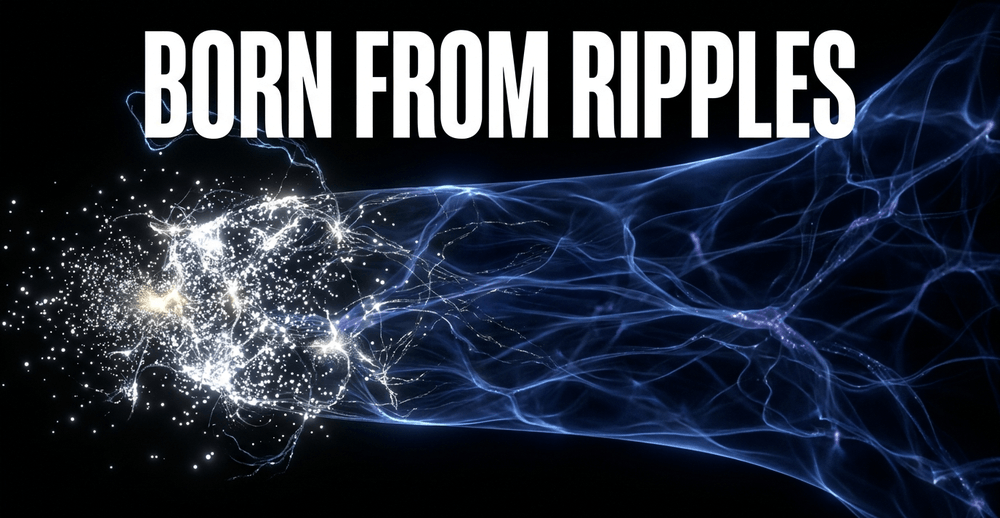
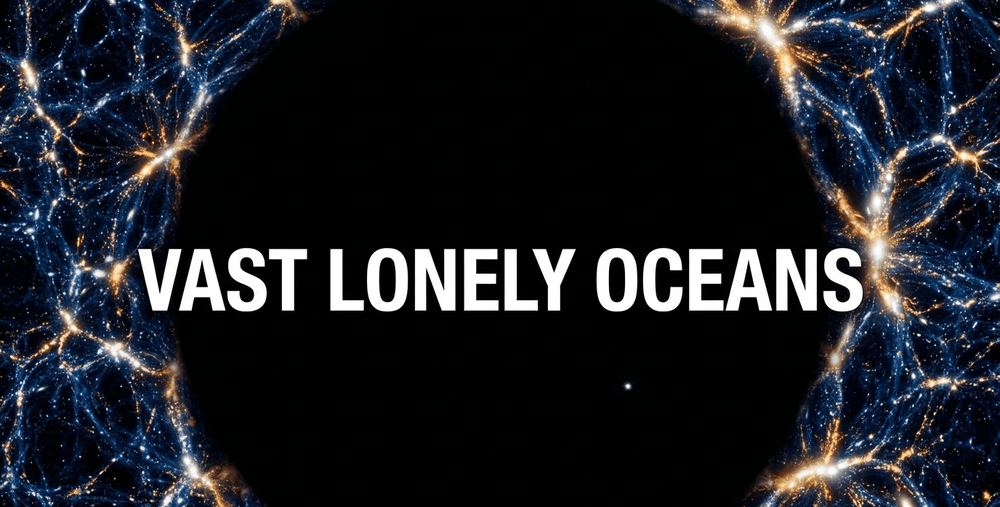
This structure is not chance or accident. It is a testament to gravity operating over billions of years, quiet and relentless. Imagine a translucent, silver-threaded tapestry stretched across the void, where the threads are made of dark matter and gas, and the knots where those threads intersect are the great galaxy clusters. This web defines where matter lives - and where it doesn't - creating a cosmic landscape of crowded metropolises and vast, lonely deserts.
The genesis of cosmic structure
The story begins nearly 13.8 billion years ago, in the immediate aftermath of the Big Bang. During the first fractions of a second, the universe was a hot, dense plasma of particles. But this soup was not perfectly smooth. Tiny quantum fluctuations - microscopic ripples in the density of matter - were present from the very start. As the universe underwent rapid expansion in the period known as inflation, these subatomic ripples were stretched to macroscopic scales.

Approximately 400,000 years after the Big Bang, the universe had cooled enough for neutral hydrogen to form. During the period astronomers call the Dark Ages, the invisible influence of dark matter began to dominate. It does not interact with light, so it had already started clumping in regions where the initial density ripples were slightly higher. These clumps acted as gravitational seeds, pulling in surrounding gas and ordinary matter.
Gravity then worked its asymmetric magic - pulling matter more strongly along certain axes, flattening it into sheets and then drawing it into long, thin filaments. Over tens of millions of years, these features matured into the defined network we observe today. The Cosmic Web wasn't built in a day. It was sculpted, slowly and irresistibly, by the oldest force we know.

The pillars of the web: filaments and nodes
At the heart of the Cosmic Web are the filaments - the thread-like formations that stretch across millions of light-years. These are the highways of the universe, along which matter - primarily in the form of gas and dark matter - flows toward the densest regions of space. Catalogues derived from the Sloan Digital Sky Survey (SDSS) have identified thousands of these structures, ranging from 30 to 100 megaparsecs in length.
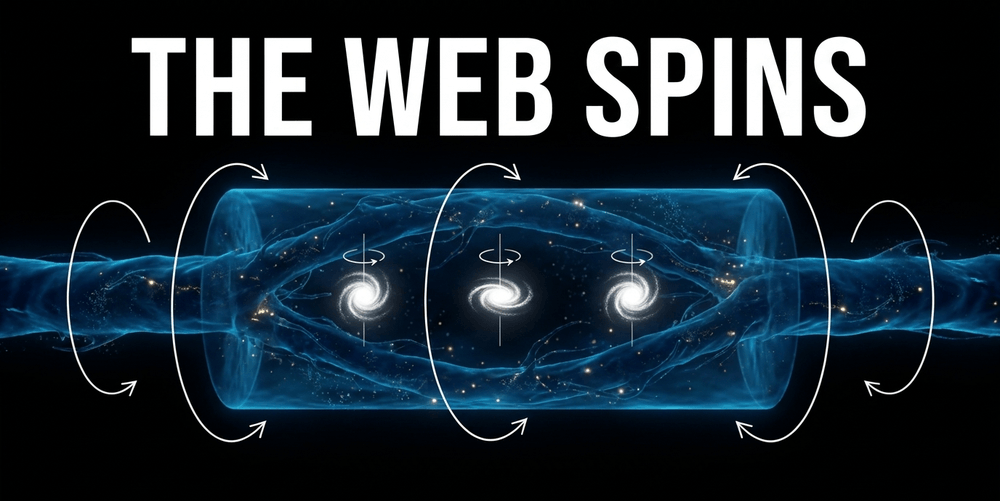
One recently discovered filament stretches 50 million light-years and contains approximately 300 galaxies. What makes it exceptional, however, is not merely its length - it's rotating. Research led by the University of Oxford found that galaxies on either side of this filament's central spine are moving in opposite directions, consistent with a coherent spin of the entire structure. Using models of filament dynamics, researchers inferred a rotation velocity of 110 km/s - the whole thing turning like a slow, vast axle in space. As co-lead author Dr. Lyla Jung of Oxford put it:
"You can liken it to the teacups ride at a theme park. Each galaxy is like a spinning teacup, but the whole platform - the cosmic filament - is rotating too. This dual motion gives us rare insight into how galaxies gain their spin from the larger structures they live in."
This discovery suggests that large-scale cosmic structures shape galaxy rotation more strongly, and for longer, than previous models predicted.
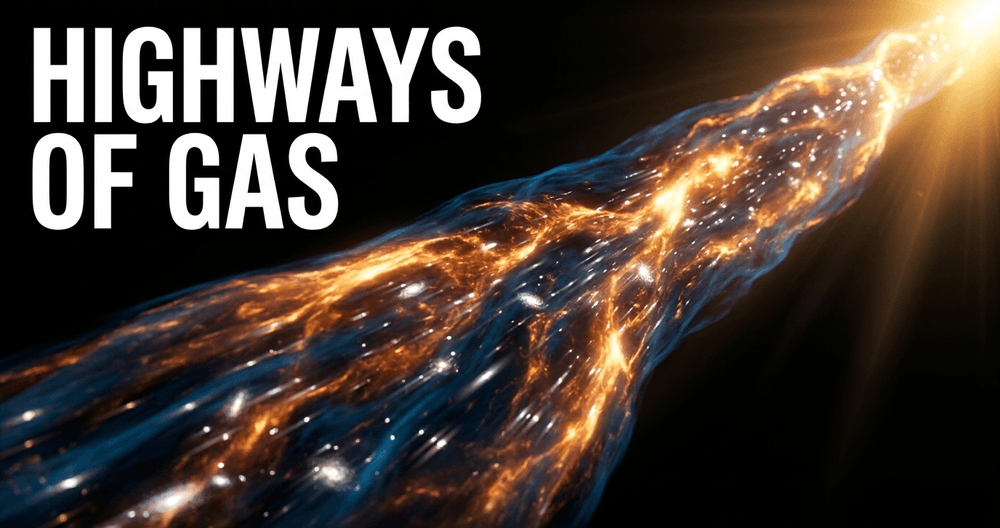
Filaments also harbour extraordinarily energetic matter. A filament 23 million light-years long was detected bridging four galaxy clusters within the Shapley Supercluster, with temperatures reaching around 10 million degrees Celsius - plasma so hot it glows in X-rays. Though incredibly sparse at approximately 10⁻⁵ particles per cubic centimetre, this strand carries a gas mass roughly ten times that of the Milky Way. Its detection also has deeper significance, as we explore in the section on missing matter below.
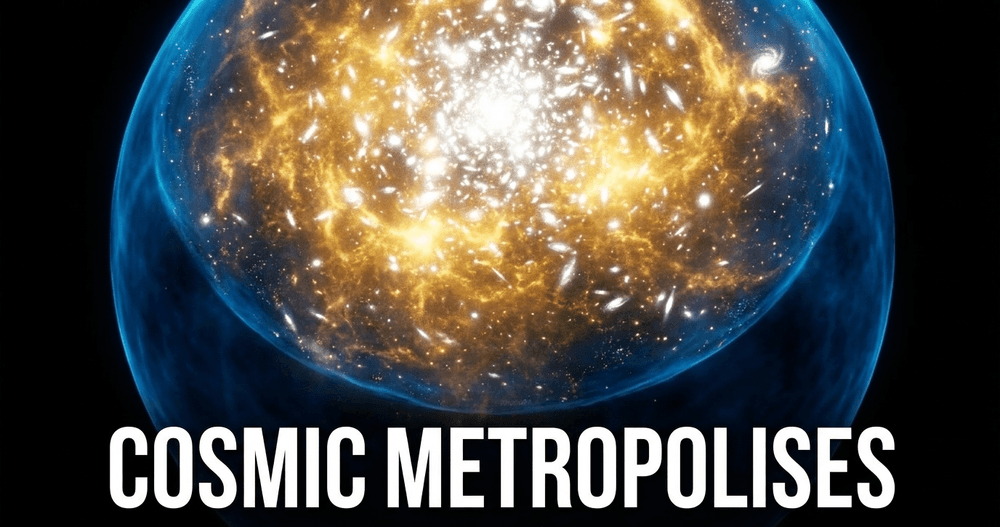
Where filaments intersect, we find the galaxy clusters, or nodes. These are the most massive gravitationally bound objects in the universe. A single cluster can contain thousands of galaxies, all wrapped in an enormous halo of dark matter. The space between those galaxies is filled with the intracluster medium (ICM) - a superheated gas that emits powerful X-rays. While the galaxies themselves are breathtaking, they represent only a fraction of the cluster's total mass. Approximately 80% of a cluster is dark matter, with the remaining 20% a mixture of hot gas and stars.
The silent majority: voids and sheets
If filaments and clusters are the mountains and cities of the cosmos, voids are its vast, empty oceans. These roughly spherical regions contain very little matter - sometimes 100 times less than the cosmic average - though they are not entirely empty. A scattering of stray galaxies lingers inside them, along with the ever-present glow of the cosmic microwave background radiation. Despite their relative emptiness, voids dominate the universe by volume, occupying approximately 80% of all space.
Voids vary enormously in size. Some span 30 million light-years. Others are genuinely staggering.
The Boötes void, discovered in 1981 by astronomer Robert Kirshner and his team during a galaxy redshift survey, stretches approximately 330 million light-years in diameter. It contains only about 60 known galaxies - a region that should, statistically, hold thousands. Astronomer Greg Aldering once captured its scale with a memorable thought: "If the Milky Way had been in the centre of the Boötes void, we wouldn't have known there were other galaxies until the 1960s."
Even larger voids have since been identified. A supervoid aligned with the CMB's famous Cold Spot - a persistently colder-than-average region of the sky - was measured at approximately 1.8 billion light-years across, making it one of the largest single structures ever catalogued. The Cold Spot had long defied explanation; a void of this scale, steadily draining energy from photons passing through it, may be part of the answer.
These regions grow over time. As gravity pulls matter toward the filaments and clusters, voids are effectively emptied - expanding like bubbles in rising bread dough. Surrounding each void are sheets, or walls, which are planar distributions of galaxies acting as boundaries between different empty regions. The Sloan Great Wall, for instance, spans nearly 1.5 billion light-years and remains one of the longest known structures in the observable universe.
The invisible hand: dark matter and energy
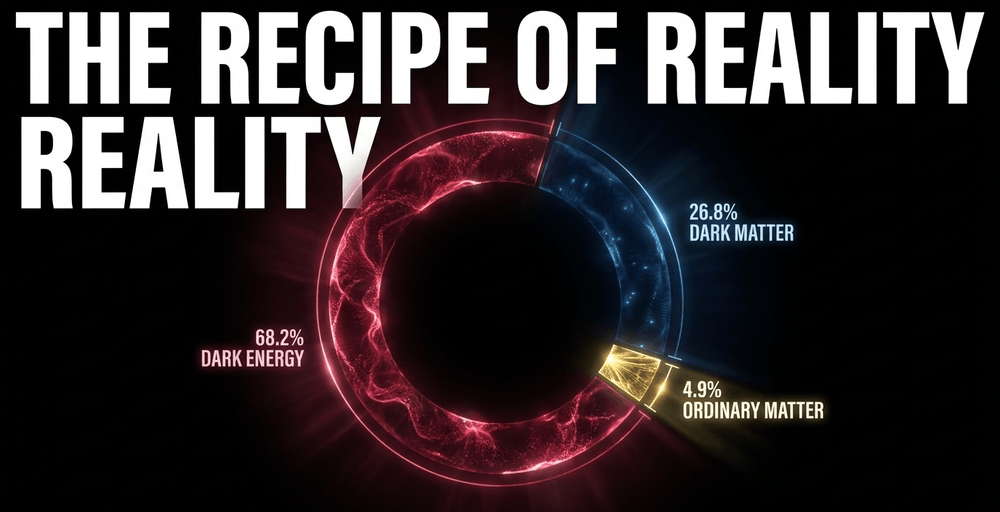
To understand why the Cosmic Web looks the way it does, we have to look at the Lambda-CDM model - the current standard in cosmology. It holds that the universe's mass-energy content divides roughly as follows:
- 68.2% dark energy
- 26.8% dark matter
- 4.9% ordinary (baryonic) matter
Dark matter is the silent architect. It constitutes approximately 85% of all matter in the universe. Because it does not emit, absorb, or reflect light, we cannot see it directly. We see its fingerprints, though. Through gravitational lensing - the way its mass warps the path of light from distant galaxies - astronomers have mapped its distribution with growing precision. Dark matter forms the primary scaffolding of the filaments, creating the gravitational wells that trap gas and allow stars to be born.
If you're interested in how scientists are attempting to detect this elusive substance directly, from underground detectors to space-based observatories and quantum experiments, see our article Hunting dark matter: From space to quantum labs
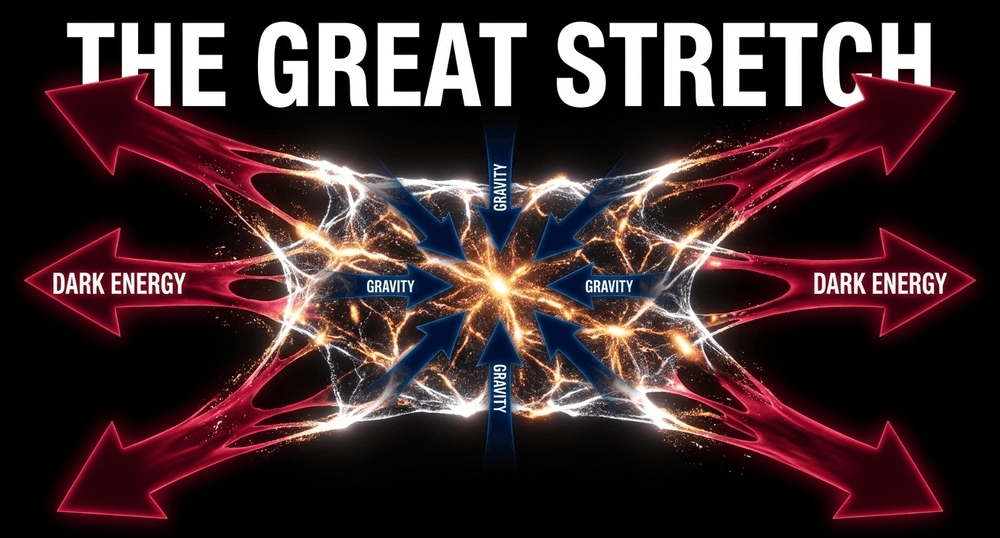
Dark energy acts as a counter-force. While gravity tries to pull the web together, dark energy drives the universe's accelerating expansion, stretching the web and widening the voids. The tension between these two forces defines the ultimate fate of the Cosmic Web. If dark energy dominates - as current evidence suggests - the connections between distant parts of the web will eventually stretch so far they become unreachable, leaving galaxy clusters as isolated islands in an ever-expanding dark sea.
Recent data from the Dark Energy Spectroscopic Instrument (DESI) has introduced a striking complication: dark energy may not be constant after all. Analysis of over 15 million galaxies and quasars - and when combined with cosmic microwave background, supernova, and weak lensing datasets - suggests it might be evolving over time. The preference for an evolving dark energy has reached between 2.8 and 4.2 sigma depending on which datasets are combined, not yet the 5-sigma "discovery" threshold but compelling enough to demand attention. If confirmed, it would represent one of the most significant revisions to our cosmological model in decades.
"It's looking more and more like we may need to modify our standard model of cosmology to make these different datasets make sense together - and evolving dark energy seems promising." - Will Percival, co-spokesperson for DESI
The web may be changing faster than we thought.
A universe of missing matter
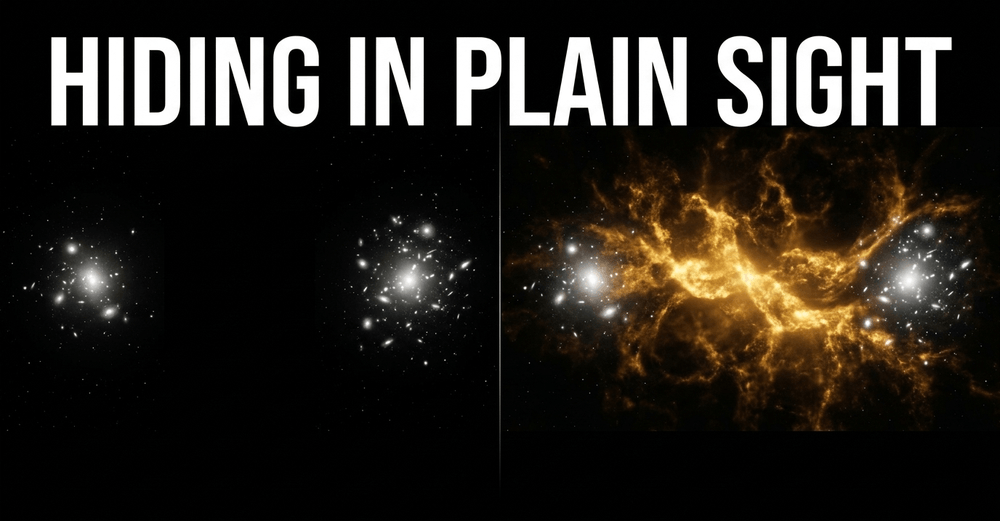
For decades, astronomers faced a strange bookkeeping problem. Big Bang theory predicted a certain amount of ordinary, baryonic matter - the stuff that makes up stars, planets, gas, and us. But when scientists tallied what they could actually observe, roughly a third of it was unaccounted for. Not dark matter. Just ordinary matter, vanished from view.
The leading suspect has long been the warm-hot intergalactic medium, or WHIM - a diffuse, superheated plasma thought to reside in the filaments of the Cosmic Web at temperatures ranging from 100,000 to 10 million degrees. So hot it emits X-rays. So sparse it nearly vanishes against the brighter background sources that telescopes are drawn to.
An international team confirmed this picture in striking detail. Using the XMM-Newton and Suzaku X-ray observatories, researchers mapped a 23-million-light-year filament inside the Shapley Supercluster, carrying a gas mass roughly equivalent to ten Milky Ways. Lead author Konstantinos Migkas of Leiden Observatory concluded:
"For the very first time, our results closely match what we see in our leading model of the cosmos - something that's not happened before. It seems that the simulations were right all along."
The missing matter had been hiding in plain sight, threaded through the cosmic web all along. It is one of those moments in science where the model and the universe finally agree.
Echoes of the beginning: baryon acoustic oscillations
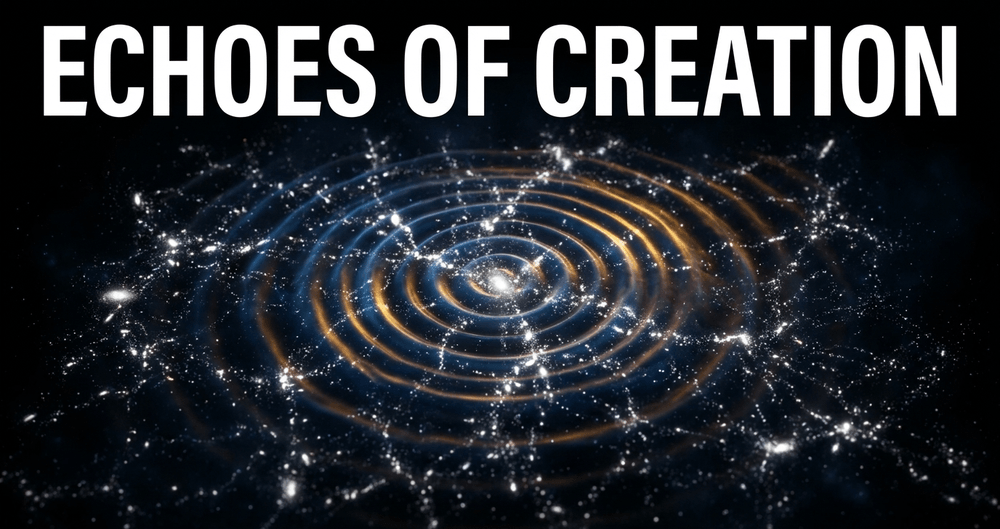
One of the most profound aspects of the Cosmic Web is how it preserves the history of the Big Bang. The spacing of the voids and the thickness of the filaments are not random - they are dictated by Baryon Acoustic Oscillations (BAO). These were sound waves that propagated through the plasma of the early universe. When the universe had cooled enough for matter and light to decouple, these waves were frozen into the distribution of matter, like ripples set in amber.
By measuring the distances between galaxy clusters today, astronomers can use these frozen waves as a "standard ruler" to gauge the expansion of the universe across cosmic history. It is humbling to realise that the largest structures we see today are the direct descendants of sound waves that rang out in the first moments of time. The Cosmic Web is, among other things, a bridge across 13.8 billion years - linking the quantum fluctuations of the beginning to the vast galaxies of the present.
This is part of why dark energy's potential evolution matters so much. If the "ruler" depends on expansion history, any change in dark energy alters our measurements. The web holds the record. We are still learning to read it.
Mapping the unmappable: observational milestones
Our ability to visualise the Cosmic Web has evolved alongside our technology. In the early 20th century, pioneers like Edwin Hubble and Fritz Zwicky began to realise that galaxies were not distributed uniformly. It wasn't until the late 20th century that the true scale of the web became apparent. Cosmologist J. Richard Gott III famously compared its topology to a sponge - a continuous network of matter and a continuous network of empty space, perfectly interlocking. The term "cosmic web" itself was coined in 1996 by University of Toronto cosmologist Richard Bond, who described the tangled structure of clumps and filaments naturally formed by dark matter under gravity.
In recent years, the instruments have grown extraordinary.
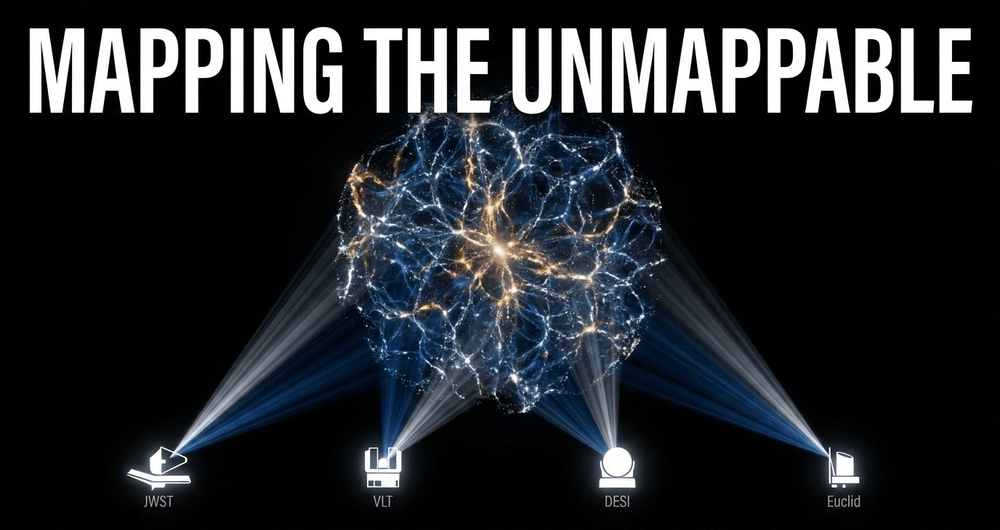
An international team from the University of Milano-Bicocca and the Max Planck Institute for Astrophysics used the MUSE spectrograph on the Very Large Telescope (VLT) in Chile to capture the sharpest direct image ever obtained of a single cosmic filament - a 3-million-light-year strand of intergalactic gas connecting two ancient galaxies, dating back to when the universe was just two billion years old. The observation required hundreds of hours of telescope time. For the first time, researchers could directly measure the boundary between gas inside a galaxy and gas belonging to the cosmic web itself.
Then came JWST. The COSMOS-Web survey - the largest JWST programme to date - has mapped galaxies all the way back to when the universe was only a billion years old, tracing the large-scale structure of the cosmos across nearly 14 billion years of cosmic history. "JWST has completely changed our view of the universe, and COSMOS-Web was designed from the start to give us the wide, deep view we need to see the cosmic web," said lead author Hossein Hatamnia of UC Riverside.

In a separate milestone, scientists using JWST data published the largest and highest-resolution dark matter map ever produced, covering nearly 800,000 galaxies in the constellation Sextans. The map reveals a complex network of filamentary bridgelike features stretching between galaxy clusters - dark matter's invisible scaffolding rendered in unprecedented detail, twice as sharp as any map previously made. "Previously, we were looking at a blurry picture of dark matter. Now we're seeing the invisible scaffolding of the universe in stunning detail," said researcher Diana Scognamiglio of the COSMOS-Web team.
On the ground, DESI has completed its survey, having mapped approximately 47 million galaxies and quasars - far exceeding its original targets. Installed on the Nicholas U. Mayall 4-metre Telescope at Kitt Peak National Observatory in Arizona, with 5,000 robotic fibre-optic positioners, DESI has produced the largest 3D map of the cosmos ever constructed. Its precision measurements of baryon acoustic oscillations now reach back 11 billion light-years.
The European Space Agency's Euclid telescope, launched on 1 July 2023, has already catalogued over 26 million galaxies across roughly 14% of its planned survey area in its first data release. When complete, Euclid will measure the shapes of over a billion galaxies, building the most comprehensive map of dark matter and dark energy ever assembled. Its first major cosmology data release is expected in 2026, with full cosmological results from the first survey year to follow.
These are not just maps. They are portraits of time.
The influence on galaxy life and death
The Cosmic Web is not a passive backdrop. It actively shapes the lives of the galaxies within it.
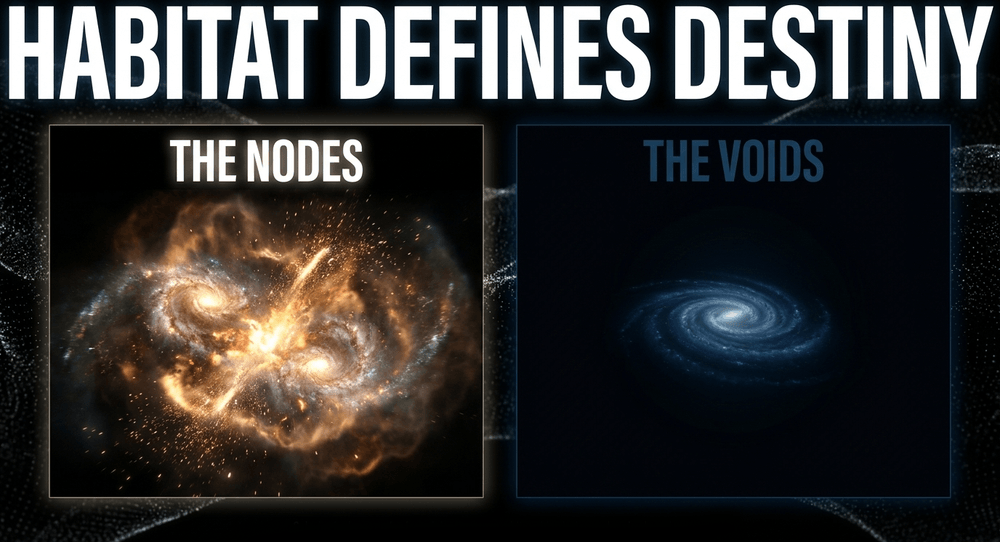
Galaxies in dense nodes experience a very different existence than those marooned in the lonely voids. In high-density environments, galaxies frequently collide and merge, fuelling bursts of star formation. But these same environments contain hot gas that can "ram-pressure strip" a galaxy of its own cool gas supply - effectively starving it of the raw material for new stars. At high redshifts, in the early universe, galaxies in dense regions actually show enhanced star formation as they rapidly pull in gas from the surrounding filaments. Closer to the present, the extreme heat and turbulence of galaxy clusters tends to suppress it.
The densest regions of the Cosmic Web are also where some of the universe's most extreme objects reside. Repeated mergers and the continual inflow of matter help grow supermassive black holes at the centres of galaxies, raising profound questions about entropy, information, and the fundamental nature of spacetime. For a deeper exploration, read Black holes, entropy and the information paradox
Galaxies in voids, by contrast, tend to be smaller, bluer, and more gas-rich - evolving at their own quiet pace, largely untouched by the gravitational dramas of the nodes.
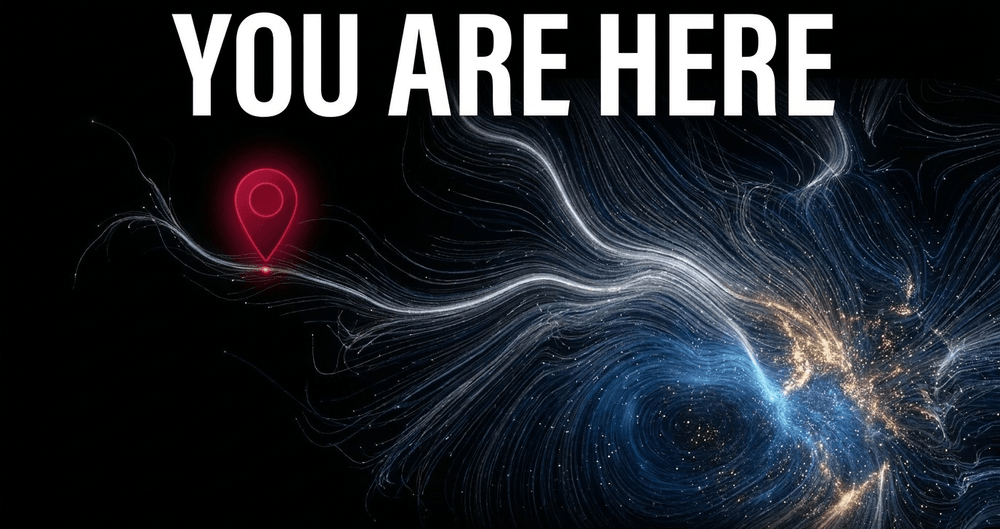
Our own Local Group - which includes the Milky Way and Andromeda - is a small part of this system, embedded in a filament that connects the Fornax and Virgo clusters. We are part of the Laniakea Supercluster, a massive structure approximately 520 million light-years across containing some 100,000 large galaxies. Laniakea itself may be just one branch of the even larger Shapley Concentration, toward which it is slowly, inexorably flowing. Every galaxy, including ours, is not free-floating in space. It is connected. It is moving. It is part of a structure that has been building since before the first star ignited.
What simulations reveal about filament evolution
Cosmological simulations have become indispensable tools for understanding how the Cosmic Web evolved. Projects such as the MillenniumTNG simulation - one of the most detailed computational models of large-scale structure ever run - allow researchers to trace how filaments grew from quantum seeds into the vast threads we observe today.
These models consistently show that filaments are not static pipelines. They thicken and elongate over cosmic time, funnelling ever-greater quantities of gas toward the nodes where galaxy clusters assemble. The simulations also predict that the gas temperature inside filaments should rise as the web matures - a prediction borne out by the detection of the ten-million-degree WHIM plasma described above.
One of the more surprising outputs of these simulations is how strongly the web's geometry influences individual galaxy properties. A galaxy's star formation rate, its shape, even the orientation of its spin axis, all carry statistical imprints of its position within the web - whether it sits in a dense node, along a filament spine, in a sheet, or in the relative isolation of a void. The Cosmic Web, it turns out, is not merely the universe's scaffolding. It is also its sculptor.
A reflection on our place in the web
Standing beneath a clear night sky, it is easy to feel small. The Cosmic Web reinforces this sense of scale in the most extraordinary way - showing us that our entire galaxy is but a single grain of sand on a beach stretching for billions of light-years.
We are not separate from the structure. The atoms in our bodies were forged in stars that formed within the gas clouds trapped by the gravity of the web's dark matter filaments. We are made of the Cosmic Web, in the most literal sense. It is not something out there. It is what we come from.
As we continue to map the heavens with instruments like JWST, DESI, and Euclid, the web becomes less of an abstraction and more of a home. From the smallest quantum ripple in the moments after the Big Bang to the Sloan Great Wall stretching nearly 1.5 billion light-years across the sky, everything is connected by the invisible threads of gravity and time. The universe is not a collection of isolated objects floating in emptiness. It is a single, deeply interconnected system - and we, unlikely as it may seem, are one of its stranger and more attentive features.

Share now









Key takeaways
- The Cosmic Web is the largest known structure in the universe - a vast network of dark matter filaments, gas sheets, galaxy clusters, and enormous voids spanning the entire observable universe.
- The web formed from tiny quantum fluctuations in the moments after the Big Bang, stretched to cosmic scale by inflation and then sculpted over 13.8 billion years by gravity.
- Dark matter makes up approximately 85% of all matter and provides the invisible gravitational scaffolding of the web; ordinary matter - stars, planets, gas, and everything visible - accounts for only about 5% of the universe's total energy content.
- The universe's mass-energy budget: ~68.2% dark energy, ~26.8% dark matter, ~4.9% ordinary matter.
- Cosmic filaments can stretch between 30 and 100+ megaparsecs (roughly 100-330 million light-years); one detected filament spans 50 million light-years and has been observed to rotate at 110 km/s.
- A 23-million-light-year filament bridging four galaxy clusters in the Shapley Supercluster carries gas at approximately 10 million degrees Celsius - and contains roughly ten times the mass of the Milky Way in gas alone.
- Cosmic voids occupy approximately 80% of all space by volume, yet contain only a tiny fraction of all galaxies.
- The Boötes void is roughly 330 million light-years in diameter and contains only about 60 known galaxies, where statistics suggest there should be thousands.
- The so-called missing baryon problem - roughly a third of all ordinary matter unaccounted for by observations - has been solved: it was hiding as the warm-hot intergalactic medium (WHIM), superheated plasma threaded through the web's filaments.
- Baryon Acoustic Oscillations (BAO) - frozen sound waves from the early universe - are imprinted on the web's large-scale structure and serve as a "standard ruler" for measuring cosmic expansion.
- DESI has mapped approximately 47 million galaxies and quasars, producing the largest 3D map of the cosmos ever constructed, with BAO measurements reaching back 11 billion light-years.
- JWST's COSMOS-Web survey and accompanying dark matter mapping work now trace the web's structure across nearly 14 billion years of cosmic history, with a dark matter map covering nearly 800,000 galaxies at twice the resolution of any previous instrument.
- ESA's Euclid telescope has already catalogued over 26 million galaxies and is expected to measure the shapes of over a billion galaxies by mission's end, delivering the most comprehensive dark matter and dark energy map ever assembled.
- DESI data combined with other probes shows the preference for evolving dark energy at a statistical significance of 2.8-4.2 sigma - not yet a confirmed discovery, but among the most significant possible revisions to cosmology in decades.
- Our Laniakea Supercluster - the Milky Way's cosmic home - spans approximately 520 million light-years and contains around 100,000 large galaxies, and is itself likely part of the even larger Shapley Concentration.
- A galaxy's position within the web - node, filament, sheet, or void - directly influences its star formation rate, shape, and even the orientation of its spin axis.
- The term "cosmic web" was coined by cosmologist Richard Bond in 1996; the topology was famously compared to a sponge by cosmologist J. Richard Gott III.
Sources
- ScienceDaily - First-ever direct image of the cosmic web https://www.sciencedaily.com/releases/2026/05/260516034136.htm
- ScienceDaily - Astronomers discover one of the Universe's largest spinning structures https://www.sciencedaily.com/releases/2025/12/251225080729.htm
- Max Planck Institute for Astrophysics - Researchers capture direct high-definition image of the Cosmic Web https://www.mpa-garching.mpg.de/1109034/news20250129
- Max Planck Institute for Astrophysics - Understanding the cosmic web: filaments in the MillenniumTNG simulation https://www.mpa-garching.mpg.de/1098309/hl202406
- NASA JPL - NASA reveals new details about dark matter's influence on universe (JWST) https://www.jpl.nasa.gov/news/nasa-reveals-new-details-about-dark-matters-influence-on-universe/
- UC Riverside - James Webb Space Telescope reveals new details about dark matter https://news.ucr.edu/articles/2026/01/26/james-webb-space-telescope-reveals-new-details-about-dark-matter-universe
- Scientific American - JWST unveils most intricate map yet of cosmic dark matter https://www.scientificamerican.com/article/jwst-unveils-most-intricate-map-yet-of-cosmic-dark-matter/
- Nature Astronomy - An ultra-high-resolution map of (dark) matter https://www.nature.com/articles/s41550-025-02763-9
- COSMOS - COSMOS-Web survey overview and data release https://cosmos.astro.caltech.edu/news/87
- IOPscience - Large-scale structure in COSMOS-Web: tracing galaxy evolution in the cosmic web https://iopscience.iop.org/article/10.3847/1538-4357/ae5bac
- Berkeley Lab News Center - New DESI results strengthen hints that dark energy may evolve https://newscenter.lbl.gov/2025/03/19/new-desi-results-strengthen-hints-that-dark-energy-may-evolve/
- Fermilab - New DESI results strengthen hints that dark energy may evolve https://news.fnal.gov/2025/03/new-desi-results-strengthen-hints-that-dark-energy-may-evolve/
- UKRI - DESI results suggest dark energy may evolve over time https://www.ukri.org/news/desi-results-suggest-dark-energy-may-evolve-over-time/
- ESA - Euclid opens data treasure trove, offers glimpse of deep fields https://www.esa.int/Science_Exploration/Space_Science/Euclid/Euclid_opens_data_treasure_trove_offers_glimpse_of_deep_fields
- Euclid Consortium - New science results and images from Euclid Quick Data Release 1 https://www.euclid-ec.org/public/press-releases/new-science-results-images-euclid-q1/
- Institut d'Astrophysique de Paris - The cosmic web in the first 63 square degrees of the Euclid survey https://www.iap.fr/actualites/laune/2025/EuclidQ1/EuclidQ1-en.html
- Astronomy.com - New dark matter map shows the universe in detail https://www.astronomy.com/science/new-dark-matter-map-shows-the-universe-in-detail/
- Space.com - New galactic supercluster map shows Milky Way's home (Laniakea) https://www.space.com/27016-galaxy-supercluster-laniakea-milky-way-home.html
- Sky at Night Magazine - The Boötes void explained https://www.skyatnightmagazine.com/space-science/bootes-void
- IFLScience - Astronomers found a massive void in the universe 1.8 billion light years across https://www.iflscience.com/astronomers-found-a-massive-void-in-the-universe-18-billion-light-years-across-74121
- Nature - A cosmic web of cosmologies (Nature Astronomy) https://www.nature.com/articles/s41550-026-02804-x
- arXiv - Cosmic web dissection in fuzzy dark matter cosmologies https://arxiv.org/pdf/2301.09762
- arXiv - Dynamical dark energy and the unresolved Hubble tension: multi-model constraints from DESI 2025 https://arxiv.org/abs/2512.07281
- Published 2026-06-10 22:05
- Modified 2026-06-11 19:53

-
Redaction