

-
 Redaction
How future geologists will read our city strata
Cities are quietly forming a new rock layer today. Discover how concrete, plastic, and ballpoint pens will fossilize into the geology of tomorrow's Earth.
The crust of the Earth functions as a slow, cold recorder of planetary history. Over billions of years, the patient accumulation of sand, mud, and organic remains has documented the rise and fall of mountain chains, the chemistry of ancient seas, and the mass extinctions that have punctuated the history of life. Today, a new and unmistakably different layer is forming across the surface of our planet. It is not the product of gradual mountain erosion or quiet marine deposition, but of human agency, compressed into a geological instant.
For future geologists, the urban strata of the Anthropocene will present a uniquely dense record of industrial process and mass production. This emerging archive is defined by human-made minerals, novel materials, and stratigraphic markers that differ fundamentally from anything the rock record has produced before. Looked at through a sedimentological lens, our cities, roads, and consumer objects are already being reworked by gravity, water, and chemical weathering into the rock of tomorrow. I find this transition genuinely remarkable to sit with: we are, in effect, watching a geological unit form in real time, at a pace that would normally require the observer to be immortal.
Urban metabolism and the mechanics of accumulation
Traditional geology treats sedimentary deposition as a process governed by climate, gravity, and the slow work of water or wind. In the modern era, these pathways have been overtaken by a different engine entirely. Cities accumulate their own strata through what researchers call urban metabolism - a term that describes the intake of raw materials, water, and energy, and the corresponding output of products, infrastructure, and waste.
Seen from a sedimentological perspective, this metabolic cycle behaves like an extraordinarily efficient transport mechanism. Sand, gravel, clay, and heavy metals are pulled from quarries and mines, hauled across continents, and concentrated into dense, vertical structures we call buildings. When these structures reach the end of their functional lives, they rarely vanish. Instead, they are demolished, buried, or paved over, settling into a distinct, highly compacted layer within the stratigraphic column.
This human-driven transport of material now exceeds anything nature manages on its own. Geologists researching the technosphere - the sum total of everything humanity has built, from bridges to ballpoint pens - have estimated its mass at roughly 30 trillion tonnes, a figure five orders of magnitude greater than the planet's entire standing biomass. The volume of rock and soil moved annually by construction and mining likewise dwarfs the sediment carried by the world's rivers combined. The result is a rapid, thick accumulation of urban material in low-lying basins, river deltas, and coastal plains - precisely the terrain where most of the world's major cities happen to sit.
Key anthropogenic lithologies and strata
When future geologists come to analyze the layers representing our era, they will encounter materials with no natural precedent whatsoever. These novel substances, alongside heavily altered natural ones, form the basic building blocks of Anthropocene lithology.
Novel materials and technofossils
Future strata will preserve what researchers term technofossils: durable, mass-manufactured objects such as single-use plastics, electronic components, and specific synthetic compounds. These are the physical residue of a global consumer economy - designed for a few years of utility, but destined, quite by accident, for geological preservation.
-
Tungsten carbide. This compound has no natural counterpart at the Earth's surface, yet it sits inside an object most of us carry without a second thought: the tip of a ballpoint pen. Since Société Bic introduced the tungsten carbide ball into its Cristal pen in 1961, the company alone has sold more than 100 billion units. Tungsten carbide is nearly as hard as diamond and highly resistant to chemical weathering, which means these microscopic spheres - smaller than a grain of rice - are likely to persist in sedimentary basins for millions of years, quietly functioning as index fossils for the era of mass literacy and disposable stationery.
-
Aluminum. Elemental aluminum is exceptionally rare in nature. It occurs almost exclusively bound within complex silicate minerals such as bauxite, never as a free metal. Since 1950, humans have produced several hundred million tonnes of pure aluminum - enough, by some estimates, to sheathe a substantial portion of North America in kitchen foil. Because aluminum forms a thin, self-protecting oxide layer on contact with air, it resists corrosion across a wide range of burial conditions, leaving behind a bright, chemically anomalous signal wherever post-industrial strata are exposed.

Anthropogenic rock types
Beyond individual technofossils, cities are converting raw geology into new hardscapes of concrete, steel, glass, and ceramic. By 2020, according to a widely cited study published in Nature, the total mass of human-made objects reached approximately 1.1 teratonnes - matching, and by most projections now exceeding, the combined mass of all living things on Earth. It is a strange milestone to sit with: the physical output of a single restless species now outweighs the biosphere that produced it.
Concrete remains the dominant lithology of this new era. In sedimentological terms, it behaves as a synthetic conglomerate - natural sand and gravel bound together by a calcium silicate hydrate matrix rather than by the slow mineral cements nature would ordinarily use. Given enough geological time, concrete will undergo diagenesis much as any buried rock does: pressure and chemically active groundwater will alter its internal structure, and its calcium carbonate and silicate components will recrystallize, cementing surrounding soils and debris into a tough, cohesive rock layer.
Urban sedimentary volume and local formations
This accumulation is already well documented in major European centers, where centuries of habitation and rebuilding have produced thick, artificial geologies that geologists can study directly.
In Vienna, researchers working on the long-running Anthropocene Surge project have excavated urban sediments at Karlsplatz that record a clean, dateable transition: a levelling episode from the 1950s sits directly above older riverine fill, and the layer itself carries a detectable spike of fallout radionuclides, including plutonium-239, tied precisely to the atmospheric weapons tests of that decade. The site has been proposed by its investigators as a reference section for the base of the Anthropocene - not because it is unusually large, but because it is unusually legible: a clean, well-dated boundary between "before" and "after" preserved in ordinary city fill.
Berlin offers a case of a different character entirely. The Teufelsberg, or "Devil's Mountain," in the city's Grunewald forest is a rubble hill built almost entirely from the wreckage of the Second World War. Between 1950 and 1972, an estimated 26 million cubic meters of shattered brick, concrete, and masonry were trucked to the site and piled atop the unfinished shell of a Nazi-era military college that proved too sturdy to demolish by conventional means. The resulting hill rises roughly 80 meters above the surrounding plateau - about 120 meters above sea level - making it, for a time, the highest point in West Berlin. Like a natural volcanic or landslide deposit, Teufelsberg represents a single, high-energy depositional event, compressed into a couple of decades rather than the millennia such events would normally require, and it has permanently altered the local topography.
Stratigraphic identification markers
Geologists rely on specific physical, chemical, and biological markers to define the boundaries between geological epochs. The base of the Anthropocene, whenever it is formally ratified, will be marked by several unusually sharp and globally synchronous signals.
The radioactive signal
Perhaps the most precise chronostratigraphic marker available for the period of rapid industrial and population growth after 1945 - often called the Great Acceleration - is the artificial radionuclide spike produced by atmospheric nuclear weapons testing between 1945 and 1963.
These detonations released isotopes such as plutonium-239, plutonium-240, and uranium-236 into the stratosphere. Global winds carried the fallout around the planet, and it eventually settled, leaving a distinct radioactive signature preserved in marine sediments, lake beds, and glacial ice. Because plutonium-239 has a half-life of roughly 24,100 years and uranium-236 a half-life of some 23.4 million years, this signal will remain detectable to future observers long after our civilization has changed form - or vanished altogether.
"The technosphere may be geologically young, but it is evolving with furious speed, and it has already left a deep imprint on our planet," notes geologist Jan Zalasiewicz, whose work has done much to define how we think about this new layer of Earth history.

The plastic marker
Plastics have become a ubiquitous sedimentary particle, turning up everywhere from urban landfills to the deepest marine basins. Their durability and chemical inertness mean synthetic polymers can persist in low-oxygen, low-temperature environments for spans of time that are difficult to intuit from a human vantage point.
Geologists studying buried plastics have noted something curious: certain forms of polyethylene, altered during burial, come to resemble natural organic compounds in ways that echo the fossilized organic tubes of graptolites - extinct marine colonial organisms once used as index fossils across much of the Paleozoic era. That structural and chemical resemblance suggests plastic signatures may well remain recognizable in shales and mudstones for millions of years to come, a strange inheritance from a species that once thought of packaging as disposable.
Carbon isotopes and the Suess effect
The combustion of fossil fuels has released vast quantities of carbon dioxide into the atmosphere, and in doing so has shifted its isotopic fingerprint. Fossil fuels derive from ancient plant matter, and plants preferentially take up the lighter carbon-12 isotope during photosynthesis, leaving the heavier carbon-13 isotope relatively enriched in what remains behind in the rock.
By burning these ancient carbon reserves at industrial scale, humanity has steadily lowered the ratio of carbon-13 to carbon-12 in the modern atmosphere - a phenomenon geochemists call the Suess effect. Marine and terrestrial organisms capture this altered ratio as they build their shells and skeletons. As a result, the limestone and calcareous fossils forming in today's oceans are quietly locking in a carbon isotope signature that will be straightforward for future geologists to read, wherever those rocks eventually surface.
Urban landforms and post-human taphonomy
Taphonomy - the study of how organisms and structures decay, fossilize, and interact with the processes of the Earth - does not require deep time to be observed. As our urban infrastructure ages, is abandoned, or is simply left to the elements, it is already undergoing transformations that mirror natural geological processes, only much faster.
Speleothem formations
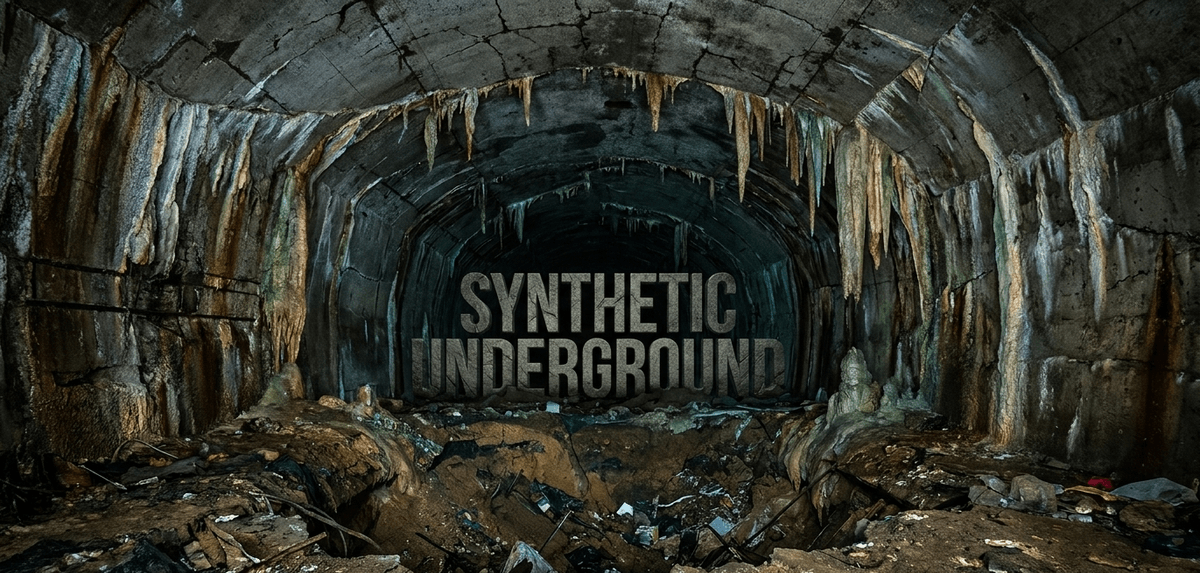
We do not have to wait millions of years to watch human construction shift into geological process. In modern subway tunnels, road underpasses, and basements around the world, stalactites and other speleothems are already forming, often within a matter of decades.
These structures develop when rainwater percolates through concrete, dissolving calcium hydroxide as it goes. When that mineral-rich water reaches an air-filled tunnel or chamber, it reacts with atmospheric carbon dioxide, and calcium carbonate precipitates out of solution - the same basic chemistry that builds stalactites in a natural limestone cave, just compressed into a human lifetime instead of a geological one. These urban speleothems are chemically distinct from their natural counterparts, typically carrying elevated concentrations of industrial pollutants, heavy metals, and microplastics absorbed from the concrete itself.
Subterranean trace fossils
In ichnology - the study of trace fossils, the burrows, tracks, and borings left by living organisms - geologists have a useful analogy ready-made for human infrastructure. Our subterranean works represent, by a wide margin, the largest and most geometrically complex set of trace fossils in the planet's history.
Metro systems, highway tunnels, utility conduits, and deep exploratory boreholes are remarkably durable structures. Tunnels bored through stable crystalline bedrock - the subways of Stockholm, for instance, or the water tunnels beneath New York City - can resist collapse for hundreds of thousands of years. Even once such tunnels eventually fill with sediment, the contrast in color, grain size, and chemical composition between the infill and the surrounding rock will preserve the shape of the original excavation, leaving clean, cylindrical trace fossils that trace the pathways of our movement beneath the surface.
Sinkholes as geological interactions
Urban development creates distinctly unnatural hydrological dynamics, particularly where impermeable surfaces like asphalt and concrete sit atop soft, unconsolidated soils. This arrangement disrupts the natural movement of groundwater, often concentrating runoff into narrow, localized channels.
When water pipes leak or storm drains fail, the resulting concentrated flow can rapidly erode the soft soil beneath the surface, producing what geotechnical engineers call soil-piping sinkholes. These differ markedly from natural limestone sinkholes, which form through the slow chemical dissolution of carbonate rock over thousands of years. Urban sinkholes, by contrast, appear suddenly and locally, often swallowing cars, building debris, and broken asphalt in the process - leaving behind chaotic, jumbled sedimentary deposits that would genuinely puzzle a geologist encountering them cold, without the context of a city overhead.

Share now









Key takeaways
- The urban strata of the Anthropocene form a uniquely dense and recognizable record of industrial process and mass production, distinct from anything in the natural rock record.
- Technofossils - durable, mass-manufactured materials such as plastics, aluminum, and tungsten carbide - are expected to persist in sediments for millions of years.
- Since 1961, more than 100 billion Bic Cristal pens have been sold, each tipped with a tungsten carbide ball that has no natural equivalent at the Earth's surface.
- Humans have produced hundreds of millions of tonnes of pure elemental aluminum since 1950, despite the metal being exceptionally rare in nature.
- By 2020, the total mass of human-made objects reached approximately 1.1 teratonnes, matching or exceeding the mass of all living biomass on Earth.
- Earth's technosphere - all human-built structures and objects combined - has been estimated at roughly 30 trillion tonnes.
- The primary chronostratigraphic marker for the post-1945 "Great Acceleration" is the artificial radionuclide spike left by atmospheric nuclear weapons tests between 1945 and 1963.
- Plutonium-239 has a half-life of about 24,100 years; uranium-236's half-life stretches to roughly 23.4 million years - both will remain detectable long after human civilization changes form.
- Berlin's Teufelsberg, built from roughly 26 million cubic meters of WWII rubble, rises about 80 meters above the surrounding plateau, forming a genuine anthropogenic landform.
- Vienna's Karlsplatz excavation site has been proposed as a reference section for the Anthropocene boundary, thanks to its clean 1950s radionuclide signal.
- Urban infrastructure is already generating its own geology: speleothems grow inside concrete tunnels, and metro systems function as some of the largest trace fossils in planetary history.
- Natural sediments draw on roughly 6,000 recognized mineral species; urban strata already contain more than 200,000 synthetic compounds with no natural counterpart.
Sources
- National Geographic https://www.nationalgeographic.com/history/article/technofossils-paleontology-archaeology-future
- Nature (Elhacham et al., 2020, "Global human-made mass exceeds all living biomass") https://www.nature.com/articles/s41586-020-3010-5
- The Anthropocene Review (Zalasiewicz et al., 2016, "Scale and diversity of the physical technosphere") https://journals.sagepub.com/doi/10.1177/2053019616677743
- The Anthropocene Review (Wagreich et al., 2022/2023, "The urban sediments of Karlsplatz, Vienna") https://journals.sagepub.com/doi/10.1177/20530196221136427
- Wikipedia - Technofossil https://en.wikipedia.org/wiki/Technofossil
- Published 2026-07-27 16:46
- Modified 2026-07-27 16:48

-
Redaction