

-
 PRO
PRO -
 Redaction
The archaeology of survival after ancient disasters
From the Toba eruption to a Siberian plague, discover how archaeologists trace survivors of ancient catastrophes through volcanic ash, wetland mud, and DNA.
Deep in the stratigraphy of the earth, there is a recurring motif that captures the imagination of any field archaeologist: the burnt layer. It is a sharp, dark line of charcoal and ash that marks a sudden end to a chapter of human history. For decades, the presence of these layers - whether from volcanic eruptions, disease, or drought - was interpreted as a definitive stop. We looked at the ash and saw extinction. We looked at the skeletal remains trapped beneath debris and saw the end of a lineage.
But as our analytical tools have sharpened, a more nuanced story is emerging from the dust. We are no longer just cataloging the dead. We are beginning to find the survivors.
Survival is often less dramatic than destruction, which is precisely what makes it harder to track. It is a story of slow migration, of a stone tool knapped a little differently, of a diet quietly shifted from freshwater mussels to salt-tolerant species as the climate dries around a settlement. This shift in focus, from the spectacle of collapse to the quiet persistence of local resilience, is redefining how we understand the history of our species. By looking beyond the burnt layer, we see that ancient catastrophes were rarely the final act. More often, they were catalysts for creativity and social reorganization.
The Toba super-eruption and the myth of the human bottleneck
One of the most enduring narratives in human evolution centers on the Toba super-eruption, which tore through Sumatra roughly 74,000 years ago. For years, the prevailing theory held that this event triggered a punishing volcanic winter and a long cooling period. Geneticists and archaeologists argued that the global human population was decimated, dropping to somewhere between 3,000 and 10,000 individuals. This "bottleneck" was offered by some researchers as one explanation for humanity's relatively low genetic diversity today - though that diversity is now understood to be the product of many overlapping factors, including earlier bottlenecks, migration history, population structure, and reproductive patterns, not a single volcanic event. Even so, the classic version of the story was a dramatic one: a picture of near-extinction, one that painted humanity as a fragile flame almost snuffed out by the earth's fury.
Recent fieldwork tells a different story.
At sites like Pinnacle Point in South Africa and Dhaba in northern India, the evidence of continuity is striking. At Pinnacle Point 5-6, cryptotephra evidence shows that humans occupied the site before, during, and after the eruption, and human activity actually increased with new technological innovations appearing shortly afterward. That is not the signature of a species on its knees. It is the signature of a population that barely broke stride.
The same pattern holds in India. According to Chris Clarkson of the University of Queensland, the fact that stone toolkits at Dhaba did not disappear or change dramatically at the time of the eruption suggests that human populations did not just survive there - they maintained their cultural identity straight through it. The stratigraphic record at Dhaba shows a stable toolkit spanning tens of thousands of years on either side of the blast. The ash fall was a major event, certainly. It was not the apocalypse we once imagined.
This resilience is echoed at Shinfa-Metema 1 in the lowlands of northwest Ethiopia, where cryptotephra from Toba was found in layers that also preserve human activity, with past populations adapting to local environmental changes by following seasonal rivers and fishing in the small, shallow waterholes left behind during long dry seasons. As those waterholes shrank, people didn't retreat. They innovated. Researchers examining projectile points from the site have identified evidence consistent with the use of bow-and-arrow technology, a striking possibility given how early it would place a strategic pivot toward smaller, faster prey as larger game grew scarce - though the interpretation of these points as evidence of the bow, rather than another projectile system, is still debated among specialists.
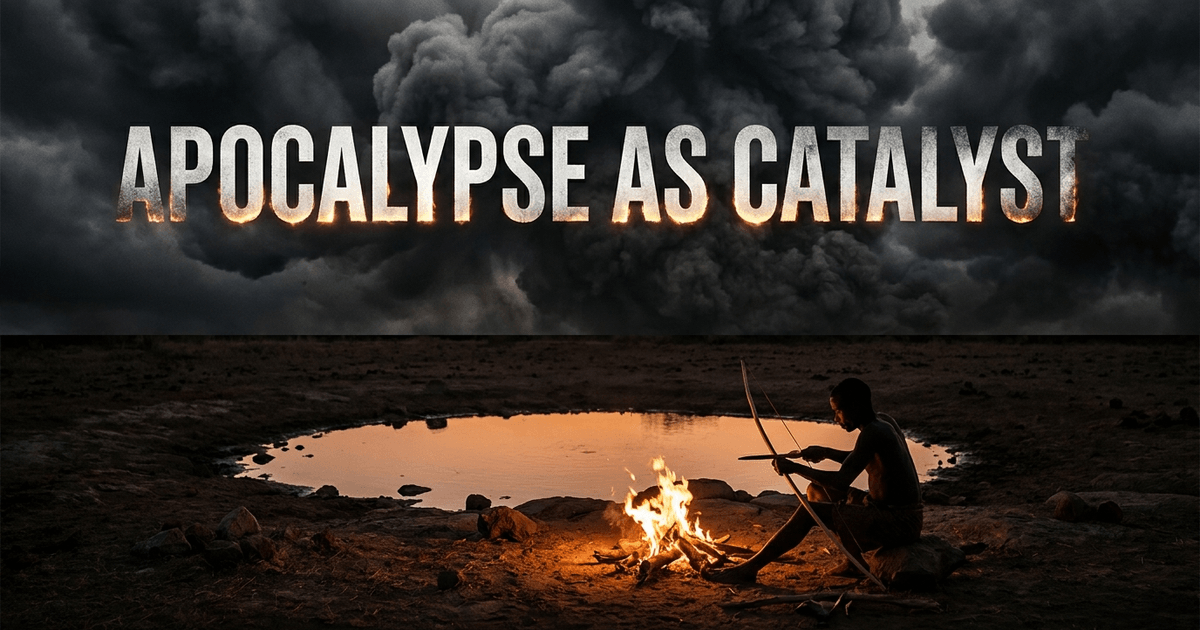
Curtis Marean of Arizona State University, who has worked extensively at Pinnacle Point, has described hunter-gatherer economies as remarkably robust. Flora and fauna may suffer catastrophic losses in the wake of a disaster, but humans possess a behavioral flexibility that plants and animals simply don't have. They change their diet. They move. They remember. The survival of these populations complicates the old picture of a single catastrophic bottleneck, but it doesn't settle the question outright - the relationship between Toba and human population decline remains unresolved, with genetic and demographic modeling still debated alongside the archaeological evidence of continuity. Indeed, researchers who have modeled the eruption's climatic footprint have found that volcanic winter conditions likely never occurred in East Africa after the eruption, and vegetation disturbance in the Southern Rift Valley appears to have been limited - a serious complication for a theory that has been repeated in textbooks for a generation, even if it has not been the final word on the subject.
We are finding that the burnt layer of Toba was, for many communities, just a difficult season in a very long history of persistence.
Technical indicators of the invisible survivor
How do we track people who leave no easy-to-find footprints? When a population is displaced by catastrophe, its members often move into marginal landscapes or fold into existing groups, making them "invisible" in the traditional archaeological record. To find them, we turn to high-resolution forensic techniques that didn't exist a generation ago.
One of the most vital of these is cryptotephra analysis. Unlike visible ash layers, cryptotephra consists of microscopic volcanic glass shards, often invisible to the naked eye and smaller than the width of a human hair. These shards can travel thousands of kilometers from their point of origin, drifting on high-altitude winds long after the more dramatic plumes of an eruption have settled.
By identifying these microscopic markers in the soil, researchers can establish a precise timeline across vast regions - a shared "zero hour" that lets sites separated by continents be compared with a resolution once thought impossible. When artifact density actually increases immediately above these shards, it tells a striking story: not just that people survived, but that they were active, adapting, and perhaps even thriving in the immediate wake of the disaster. We are no longer guessing whether people were there. We are looking at the literal tools they dropped in the weeks after the sky cleared.
Another essential tool is Infrared Stimulated Luminescence (IRSL), which measures when minerals like feldspar or quartz grains were last exposed to heat or sunlight before being buried. At Dhaba, IRSL dating has anchored a chronology of human presence spanning tens of thousands of years. This allows researchers to trace the rhythm of occupation at a site rather than just its beginning and end. Instead of a gap in the record following a catastrophe, IRSL often reveals a steady, ongoing pulse of life that seems almost indifferent to the environmental trauma recorded in the surrounding geology. It is a reminder that the human story is one of cycles, not just sudden stops.
Deep mud and the creative response to drought
Climate change is often framed as a driver of societal collapse, particularly in the arid regions of the eastern Mediterranean. But recent wetland core sampling is complicating the old image of the "helpless victim" of climate shift.
Researchers led by Gilad Shtienberg of UC San Diego's Center for Cyber-Archaeology and Sustainability, working with the University of Haifa, have drilled into a former wetland on Israel's Carmel Coast, pulling up cylinders of ancient mud from depths of up to 16 meters, roughly the height of a four- to five-story building. Each layer in these cores is a frozen snapshot of a different era. Freshwater snails and mussels found in the sediment point to rainy, lush periods, while salt-tolerant species signal drought and a shrinking wetland; charcoal reveals erosion and runoff patterns, and pollen and seeds show what plants were growing nearby.
Stitched together, these clues form a climate record stretching back roughly 8,000 years. And the picture that emerges is not one of gradual, predictable drying. The transition out of the wetter African Humid Period was anything but smooth - the climate lurched between wet and dry extremes, sometimes within a single human lifetime, sometimes over centuries.
"People are problem solvers," said Tom Levy, the study's senior author and co-director of the Center for Cyber-Archaeology and Sustainability. "They cope with environmental stress by developing new technologies and strategies."
During this turbulent period, researchers see the emergence of floodwater farming, an early form of irrigation, along with new strategies for managing herd animals like sheep and goats. Settlements expanded into drier areas rather than retreating from them. The resulting record, covering roughly 6050 to 2050 BCE, captures the entire arc from late Neolithic village life to the eventual collapse of the Early Bronze Age urban system in the southern Levant. When researchers compared this climate record against archaeological evidence to see whether drought directly triggered migration or population decline, the answer was no - or at least, not simply. Communities responded creatively and variably rather than simply retreating. Climate stress formed a backdrop for changing settlement patterns, not a script that everyone was forced to follow.
This "creative response" is a recurring theme in the bioarchaeological record more broadly. Skeletons like the Gore Creek remains, among the oldest known human remains recovered in the American West, offer a personal window into this kind of resilience. By analyzing the sediments surrounding individual remains, bioarchaeologists can often determine whether a death was part of a localized event or a wider regional collapse. Frequently, they find that while an individual perished, the broader community was not abandoned - survivors rebuilt nearby, sometimes applying hard-won lessons to create more durable structures the second time around. Survival, in this reading, is a process of iterative learning: a long, ongoing conversation between a community and its changing landscape.
When resilience has limits: the Lake Baikal plague
It would be a disservice to this subject to suggest that every ancient community weathered every catastrophe. Some did not, and the archaeological record is honest about that too.
Ancient DNA recovered from four cemeteries along the Angara River near Lake Baikal in Siberia has revealed what may be the oldest confirmed evidence of a lethal plague outbreak in human history, striking hunter-gatherer communities there roughly 5,500 years ago. Excavations at these cemeteries had long puzzled archaeologists because of an unusually high number of children and young teenagers buried within a short span of time, with no signs of violence, warfare, or traumatic injury. Genetic analysis of dozens of individuals revealed that many were infected with Yersinia pestis, and that many members of the same families were infected, suggesting the disease spread from person to person within households. The outbreak appears to have struck in two distinct phases across the four cemeteries.
This is not a story of a community sailing through unscathed. It is closer to the opposite: a snapshot of catastrophic, concentrated loss, with children apparently disproportionately vulnerable. What the DNA evidence does show is something quieter and perhaps more poignant - family groups were identified among the dead, with siblings buried together and, in one grave, an aunt buried alongside her nephew. Even in crisis, the community held on to the practice of burying its dead with care, together, as families. That the mortuary tradition persisted even as the plague moved through the population tells us something about what people prioritized when everything else was falling apart.
It is a useful corrective to any narrative that risks romanticizing survival. Some catastrophes were absorbed and adapted around. Others simply hurt, and the dignity of the response lay not in triumph but in how the living chose to bury the dead.


Share now









Key takeaways
- The Toba super-eruption struck Sumatra roughly 74,000 years ago and was long blamed for a human genetic "bottleneck" that reduced global population to as few as 3,000 to 10,000 individuals - a theory now widely disputed by archaeologists.
- At Pinnacle Point, South Africa, cryptotephra evidence shows humans occupied the site before, during, and after the Toba eruption, with activity and technological innovation actually increasing afterward.
- At Dhaba, northern India, stone toolkits show no disruption across the eruption horizon, indicating cultural continuity spanning tens of thousands of years.
- At Shinfa-Metema 1, Ethiopia, evidence suggests the likely adoption of bow-and-arrow technology as communities adapted their hunting strategy to shrinking dry-season waterholes.
- Climate modeling suggests volcanic winter conditions from Toba likely never occurred in East Africa, undermining the classic "nuclear winter" version of the bottleneck story.
- Cryptotephra - microscopic volcanic glass shards invisible to the naked eye - can travel thousands of kilometers and let researchers precisely align archaeological timelines across continents.
- Infrared Stimulated Luminescence (IRSL) dating measures when minerals were last exposed to light or heat, revealing continuous "rhythms" of occupation rather than gaps after disasters.
- Wetland core samples drilled up to 16 meters deep on Israel's Carmel Coast reveal roughly 8,000 years of Eastern Mediterranean climate history, showing sharp swings between wet and dry rather than gradual drying.
- Rather than triggering collapse, drought in the ancient Levant coincided with new adaptations, including early floodwater farming and new herd-management strategies.
- Ancient DNA from cemeteries near Lake Baikal, Siberia, reveals what may be the oldest confirmed lethal plague outbreak in human history, striking hunter-gatherers roughly 5,500 years ago and disproportionately killing children.
- Hunter-gatherers in the southern Caucasus (57,000-27,000 years ago) maintained social networks spanning 40 to 200 kilometers, using shared toolmaking traditions as evidence of long-distance knowledge exchange.
- Not every ancient catastrophe was survived equally well - the Baikal plague shows that resilience had real limits, even as family burial customs persisted through the crisis.
Sources
- The Conversation https://theconversation.com/a-massive-eruption-74-000-years-ago-affected-the-whole-planet-archaeologists-use-volcanic-glass-to-figure-out-how-people-survived-254782
- UC San Diego Today https://today.ucsd.edu/story/scientists-uncover-centuries-of-climate-chaos-and-human-resilience
- EurekAlert! https://www.eurekalert.org/news-releases/1132853
- Live Science https://www.livescience.com/archaeology/oldest-known-plague-victims-found-in-a-5-500-year-old-burial-ground-in-siberia-and-many-of-them-were-children
- Nature https://www.nature.com/articles/s41586-024-07208-3
- Published 2026-07-29 17:32
- Modified 2026-07-29 17:32

-
Redaction