



-
 Redaction
Photon state teleportation reaches 270 meters
Scientists teleport a photon's polarization state 270 meters through open air — a breakthrough step toward a secure, real-world quantum internet.
The bridge of light
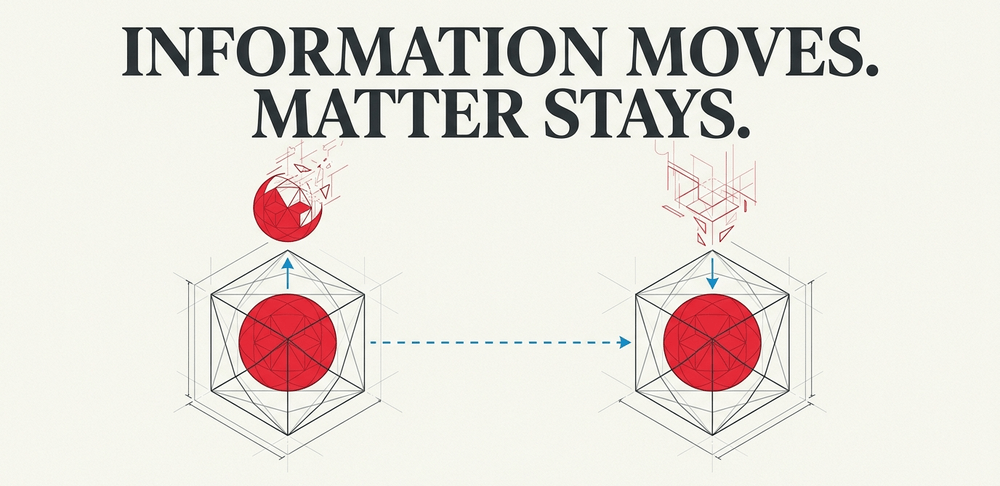
In the quiet dance of the subatomic world, we have long understood that distance is perhaps only a veil. An international research team involving scientists from Paderborn University and Sapienza University of Rome has drawn that veil aside, successfully demonstrating the teleportation of a photon's polarization state across a 270-meter expanse. How do we measure the breath of a particle as it leaps through the open air? This experiment does not move matter, but rather the very essence of information, casting the polarization state of one light particle onto another that has never felt its touch.
Imagine two separate cradles of light - semiconductor quantum dots - positioned far apart. Like two isolated islands in a vast sea, these dots served as the source and the destination. The central challenge the researchers faced was that these two quantum dots were dissimilar: their electronic and optical properties did not naturally match, and bridging that gap required precise engineering of light-matter interaction, multi-axial strain, and magnetic fields. By bringing these distinct emitters into alignment, the team managed to entangle their photons across the distance. The process relies on the Bell state measurement, a profound mathematical embrace where two photons are measured together, forcing their distant partners into a shared destiny. Is it not remarkable that by looking at what is here, we can define what is there?
Overcoming the atmospheric challenge
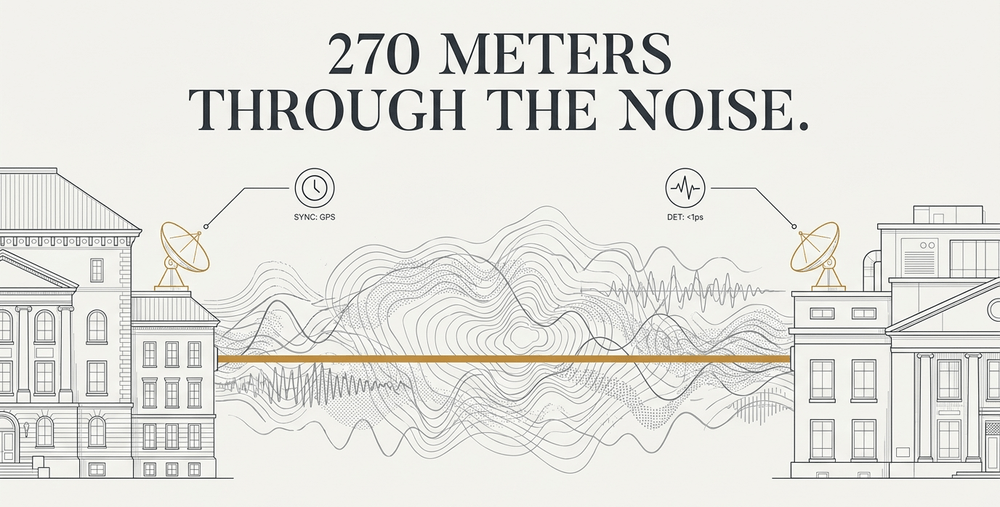
To move beyond the protective glass of fiber optics is to invite the chaos of the world. The experiment employed a hybrid quantum network - combining fiber connections with a 270-meter free-space optical link between two buildings on the Sapienza University campus in Rome - which presented formidable challenges. Turbulence in the atmosphere acts like a gentle but persistent wind against a candle flame, threatening to extinguish the delicate coherence of the quantum state.
The results, published in Nature Communications in November 2025, confirmed that the integrity of the transfer remained intact, achieving a teleportation fidelity of 82 ± 1% - exceeding the classical limit by more than ten standard deviations. This success signals a transition from theoretical elegance to practical infrastructure.
The technical precision required for such a feat is staggering:
- GPS-assisted synchronization kept independent emitters locked in time
- Ultra-fast superconducting nanowire single-photon detectors captured photon arrivals within picosecond-level coincidence windows
- Active stabilization systems compensated for real-time atmospheric turbulence
Each photon must be rendered indistinguishable in wavelength and timing - a symmetry that nature rarely grants without careful guidance. By synchronizing these independent, dissimilar emitters, the team has shown that we can build a network not of cables alone, but of connections that exist in the very fabric of space. This is the architecture of the future: a web of quantum relays that could one day span cities.
Who built the pieces
This milestone was the product of deep international collaboration, with each institution contributing a critical layer:
- Johannes Kepler University Linz developed the semiconductor quantum dots themselves
- University of Würzburg fabricated the nanophotonic resonators that shaped the light
- Paderborn University contributed approximately three years of optical measurements, data evaluation, and analysis
- Sapienza University of Rome provided the urban campus infrastructure for the free-space optical link
That geography matters. The 270-meter link was not a laboratory curiosity - it was a real-world urban environment, with real atmospheric interference, real buildings, and real distance. That is precisely what makes the result compelling.
What quantum teleportation actually means
A common misconception deserves a moment of clarity. Quantum teleportation does not move physical matter. No particle travels between the two quantum dots. Instead, the state - the quantum information describing how a photon is polarized - is transferred from one photon to another, completely destroying the original in the process. This is a consequence of the no-cloning theorem: quantum information cannot be copied, only moved.
The mechanism at the heart of this experiment is quantum entanglement. When two photons are entangled, measuring one instantly determines the state of the other, regardless of the distance between them. Bell state measurement - the precise, joint measurement of two photons - is the lever that triggers this transfer. The result is not a copy of the original state; it is the state itself, now inhabiting a different photon in a different place.
This is why quantum teleportation is so valuable for secure communication. An eavesdropper cannot intercept something that does not travel a classical path.
The soul of the quantum network
Why do we pursue these invisible threads? The implications for our digital existence are profound. Quantum teleportation is the heartbeat of a truly secure network, one where information cannot be intercepted because it does not travel the path between points in a classical sense. It simply manifests.
This achievement over 270 meters serves as a vital proof of concept for quantum repeaters - devices that will eventually allow these signals to travel thousands of kilometers without fading into the noise of the universe. Today's quantum communication is limited by photon loss in optical fiber; roughly every 100 kilometers, the signal becomes too weak to detect reliably. Quantum repeaters, powered by entanglement and teleportation, are the proposed solution - and experiments like this one are the engineering steps that bring them closer to reality.

What comes next
As we look toward the horizon, we must ask ourselves what it means to communicate in a world where distance no longer dictates the speed of understanding. Several near-term milestones now seem reachable:
- Extending the free-space link beyond 270 meters to kilometer-scale urban distances
- Integrating quantum memory to store entangled states while synchronization catches up
- Improving fidelity beyond 82% toward the thresholds needed for error-corrected quantum communication
- Connecting multiple nodes to demonstrate the first primitive quantum network segments
The experiment is a testament to human curiosity and our desire to harness the strangest laws of physics. We are no longer merely observing the quantum world; we are beginning to inhabit it, building bridges of light that defy the traditional boundaries of our physical reality. The silence of the 270-meter gap has been filled with the whisper of a single, teleported photon.
Share now









Key takeaways
- An international research team from Paderborn University (Germany) and Sapienza University of Rome (Italy) achieved the first successful quantum teleportation of a photon polarization state between two spatially separated, independent semiconductor quantum dot emitters.
- The two quantum dots were dissimilar - their electronic and optical properties were deliberately engineered via light-matter interaction, multi-axial strain, and magnetic fields to make teleportation possible.
- The experiment took place on the Sapienza University campus in Rome, using a hybrid quantum network combining fiber connections with a 270-meter free-space optical link between two university buildings.
- Teleportation fidelity reached 82 ± 1%, exceeding the classical limit by more than ten standard deviations.
- The setup relied on GPS-assisted synchronization, ultra-fast superconducting nanowire single-photon detectors (picosecond-level coincidence windows), and active atmospheric stabilization.
- Results were published in Nature Communications on 17 November 2025 (DOI: 10.1038/s41467-025-65911-9).
- The semiconductor quantum dots were developed at Johannes Kepler University Linz; nanophotonic resonators were fabricated at the University of Würzburg; the Paderborn group contributed approximately three years of optical measurements, data evaluation, and analysis.
- The achievement is considered a key milestone toward scalable quantum repeaters and the practical implementation of a quantum internet.
Sources
- Nature Communications (original paper) https://www.nature.com/articles/s41467-025-65911-9
- Paderborn University press release https://www.uni-paderborn.de/en/news-item/154655
- Phys.org https://phys.org/news/2025-12-photon-teleportation-distant-quantum-dots.html
- SciTechDaily https://scitechdaily.com/quantum-teleportation-breakthrough-brings-the-quantum-internet-closer/
- Quantum Computing Report https://quantumcomputingreport.com/quantum-teleportation-achieved-between-dissimilar-quantum-dots-over-hybrid-network/
- Published 2026-04-30 17:42
- Modified 2026-05-23 14:02

-
Redaction