






-
 Redaction
Wind turbine lifecycle: Engineering to recycling
Explore the full wind turbine lifecycle — from raw materials and manufacturing through maintenance, repowering, and composite blade recycling challenges
The technical architecture of wind energy
The development of modern wind turbines represents a complex intersection of materials science, structural engineering, and aerodynamics. These systems are designed to operate in high-stress environments for decades, requiring a meticulous approach to every stage of their existence - from the initial computational fluid dynamics simulations used in design to the final disassembly of massive steel structures.
Understanding the full wind turbine lifecycle matters not just to engineers and developers, but to policymakers, investors, and anyone evaluating the true environmental cost of wind energy. This analysis covers every phase: raw material procurement, manufacturing, installation, long-term operations and maintenance, and the increasingly urgent question of what happens when a turbine reaches the end of its working life.
Material composition and manufacturing
Manufacturing begins with specialised engineering tailored to specific site conditions. Computer modelling optimises aerodynamic shapes and structural integrity based on local wind speeds and directions. The physical construction of these machines involves massive quantities of raw materials.
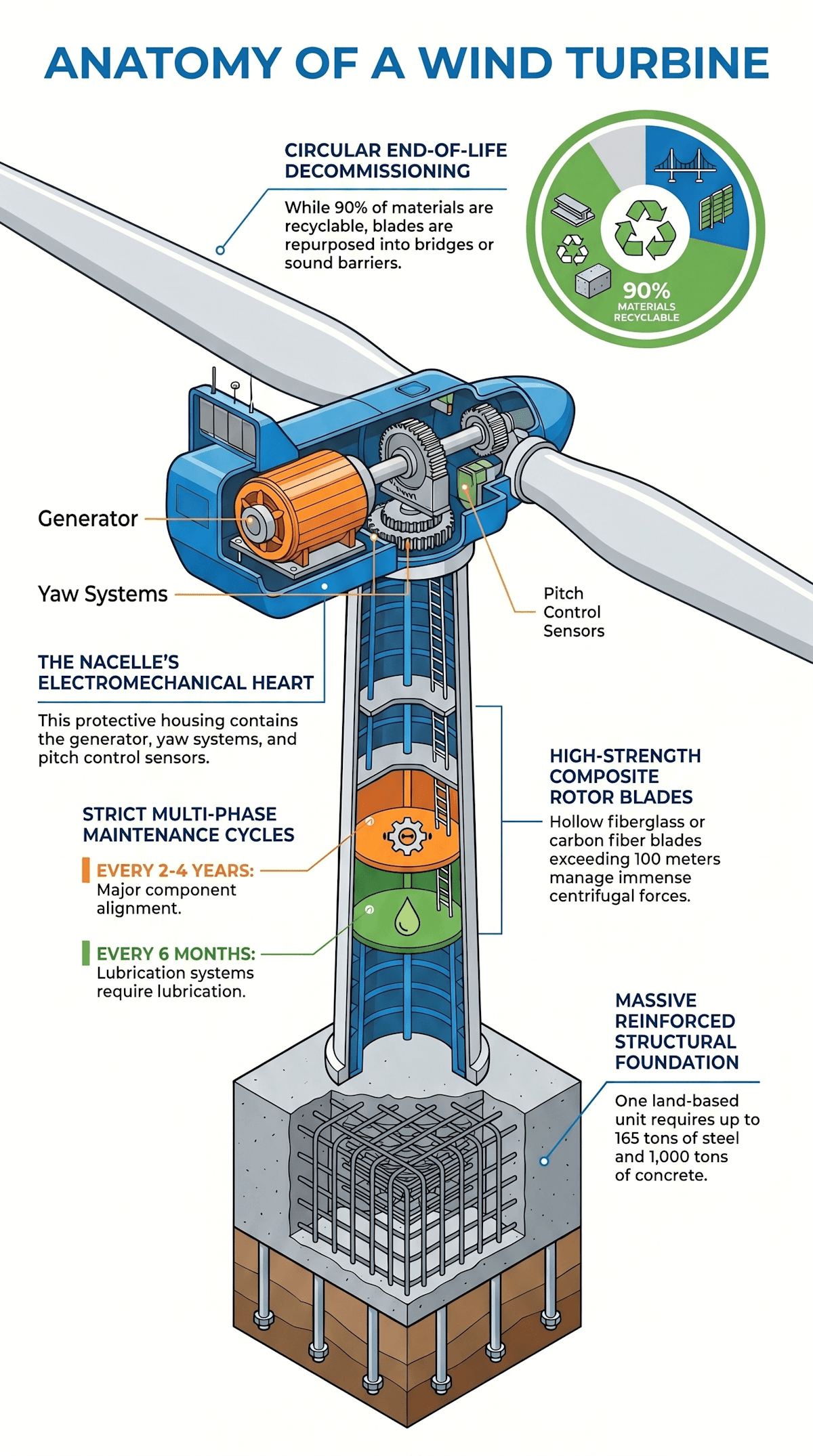
The foundation serves as the primary structural anchor, typically composed of steel and concrete. For a single land-based unit, the foundation may consume 165 tons of steel and between 600 and 1,000 tons of concrete. This base must support the tower, which is manufactured through the cutting, shaping, and welding of steel or concrete sections designed to elevate the rotor to heights where wind currents are most consistent.
The rotor assembly remains the most technically demanding component. Turbine blades are frequently hollow and constructed from fibre-reinforced polymer composites, such as fibreglass or carbon fibre combined with epoxy resins. These materials offer the necessary strength-to-weight ratio to withstand the centrifugal forces and bending moments encountered during operation. During fabrication, manufacturers use high-strength steel or composite moulds to lay up layers of fibre, inject resins, and cure the structure under controlled heat and pressure. Quality assurance is rigorous, employing ultrasound and X-ray technology to detect internal structural defects. Modern blades now reach lengths exceeding 100 metres, presenting significant engineering and logistical challenges.

Raw materials and supply chain considerations
The global wind energy industry depends on a carefully managed network of raw material supply chains. Steel and concrete dominate by weight, but several critical materials merit specific attention.
Permanent magnet generators - increasingly common in direct-drive turbines - rely on rare earth elements including neodymium and dysprosium, the majority of which are currently sourced from a small number of producing countries. This supply concentration introduces geopolitical risk into turbine procurement, a concern that has grown considerably as wind deployment scales globally.
Copper is used extensively in windings, cabling, and transformer equipment, while aluminium appears in nacelle housings and electrical components. Glass fibre, the backbone of most commercial blades, depends on silica sand and boron - both abundant but energy-intensive to process. Carbon fibre reinforcement, used in larger and stiffer blade designs, offers superior performance but remains significantly more expensive and less recyclable than its glass fibre counterpart.
As turbines scale upward, the industry is actively exploring alternative fibre sources and resin systems that maintain structural performance while reducing end-of-life complexity. The shift toward recyclable thermoplastic resins - discussed in more detail later - is closely linked to these supply chain pressures.
The electromechanical heart
Atop the tower sits the nacelle, a protective enclosure housing the turbine's internal organs. This includes the generator, which converts rotational energy into electricity, and the control systems that regulate output. Some designs utilise permanent magnet generators to remove the need for a gearbox, reducing noise and maintenance requirements.
Within the nacelle, the yaw system ensures the rotor remains oriented toward the wind, while pitch control systems adjust blade angles to optimise lift or protect the system during extreme gusts. The integration of these components requires precision alignment to prevent premature wear on the bearings and drive shafts. Nacelle weights vary considerably with turbine size; in large modern turbines they can exceed several hundred tons.
Logistics and site installation
The movement of turbine components from factory to site is a monumental logistical undertaking. Due to the extreme dimensions of blades and the weight of nacelles, specialised trailers and modular loading techniques are necessary. Moving equipment for a 150-megawatt wind farm may require around 650-690 truckloads, 140 railcars, and 8 ships. Route planning must account for the radius of road curves, bridge load capacities, and tunnel clearances - a discipline that has evolved into a specialist field within civil and transport engineering.
Onshore and offshore preparation
Site installation begins with a comprehensive assessment of topography and weather patterns. On land, this involves clearing terrain and constructing reinforced concrete foundations. Offshore projects present greater difficulty, requiring seabed surveys and specialised vessels to install steel monopiles or jacket structures. Floating offshore wind installations, now moving from pilot projects to commercial-scale development, use tension-leg platforms or semi-submersible frames anchored in water depths previously inaccessible to fixed-bottom turbines.
Once the foundation is secure, cranes assemble the tower in sections. The nacelle is then hoisted into position, followed by the attachment of the rotor assembly. Final commissioning involves laying electrical cables to connect the turbine to the grid and conducting extensive testing to verify that all systems operate within specified parameters.
Offshore installation introduces a unique set of variables absent from land-based projects. Vessel availability, weather windows, and tidal constraints all affect scheduling. Installation crews must contend with salt-laden air, wave-induced motion during crane operations, and the physical remoteness of sites that may be dozens of kilometres from the nearest port. These factors compound the engineering challenge and contribute directly to the higher capital cost of offshore wind relative to its onshore counterpart.
Worker safety and installation risk
The scale of modern wind turbine components introduces significant occupational hazards. Working at heights of 100 metres or more, often in exposed conditions, demands rigorous safety protocols. Technicians require specialist training in rope access, confined space procedures, and arc flash prevention. Turbine fires, though statistically infrequent, represent a notable risk: estimates suggest roughly one fire incident per 2,000 turbines per year, and due to the height involved, active firefighting is rarely possible - fire suppression systems integrated directly into the nacelle are therefore standard practice in modern designs.
Operational maintenance and longevity
Wind turbines are generally engineered for a service life of 20 to 30 years. However, environmental factors and operational loads dictate the actual durability of each unit. Offshore installations, though subjected to harsher salt environments, are often designed for up to 35 years of operation. Maintenance is the primary lever for extending these timelines.
Maintenance intervals
- Every 4-6 months: Technicians inspect gearbox oil levels, lubrication systems, and the braking apparatus. They also examine the yaw and pitch systems for signs of wear.
- Annually: A comprehensive audit of the generator, sensors, and electrical systems is performed. Visual inspections look for cracks or erosion on the blades and tower.
- Every 2-4 years: Major servicing occurs, including oil changes and precise component alignment checks.
- Every two years: Cleaning the external surfaces is necessary to remove debris that could otherwise degrade aerodynamic performance.
Despite regular care, certain components have shorter lifespans than the tower or foundation. Gearbox replacement or significant overhaul typically becomes necessary during the second decade of operation. The gearbox remains a critical vulnerability: approximately 76 percent of its failures are linked to bearing degradation, according to data from the National Renewable Energy Laboratory's Gearbox Reliability Collaborative. Generators in geared configurations may similarly require rewinding or replacement over the asset's lifetime, depending on load cycles and operating environment.
Digital monitoring and predictive maintenance
To mitigate the costs and disruptions associated with unplanned downtime, operators increasingly deploy supervisory control and data acquisition (SCADA) systems alongside dedicated condition monitoring equipment. Vibration sensors on main bearings, oil particle counters in gearboxes, and fibre-optic strain gauges embedded within blades generate continuous data streams that allow remote operations centres to track the health of individual components in real time.
Drone-based inspection has substantially reduced the cost and risk associated with visual blade surveys. Unmanned aerial vehicles equipped with high-resolution cameras and thermal imaging sensors can assess kilometres of blade surface in a fraction of the time required by rope-access technicians. Artificial intelligence algorithms analyse the resulting imagery to flag laminate cracks, leading-edge erosion, and lightning strike damage with increasing accuracy.
The combination of digital twin modelling - wherein a virtual replica of each turbine is maintained and updated with live operational data - and machine learning-driven anomaly detection is shifting the industry away from calendar-based maintenance and toward condition-based and predictive strategies. This transition reduces unnecessary interventions, extends the service life of functional components, and concentrates resources on the assets most likely to fail.
Noise, visual impact, and ecological considerations
Turbine noise is a persistent concern in planning applications, arising from both aerodynamic sources (blade interaction with turbulent air) and mechanical sources (drivetrain vibration transmitted through the tower). Modern designs have substantially reduced tonal noise through improved blade profiles and vibration damping, but low-frequency noise remains a subject of active research and regulatory debate.
The ecological impact of operating turbines extends beyond noise. Blade strikes pose a documented risk to birds and bats, and mitigation strategies - including radar-triggered shutdown systems and adjusted operational schedules during migration periods - are increasingly required by regulators in sensitive habitats. Conversely, offshore foundations function as de facto marine habitat, supporting invertebrate colonisation that in turn attracts fish and diving seabirds.

Lifecycle carbon footprint and environmental performance
A rigorous assessment of wind energy must account for the full environmental burden of turbine manufacture, operation, and disposal. Lifecycle assessment (LCA) studies consistently demonstrate that wind energy carries one of the lowest carbon intensities of any power generation technology. Over its operational life, a typical onshore wind turbine produces between 7 and 15 grams of CO₂ equivalent per kilowatt-hour, compared with hundreds of grams per kilowatt-hour for fossil fuel generation.
The energy payback period - the time required for a turbine to generate the equivalent of the energy consumed during its manufacture, installation, and eventual decommissioning - typically ranges from three to six months for modern onshore machines. Given a 20-30 year operating life, the net clean energy delivered is substantial.
Manufacturing remains the most carbon-intensive phase. Steelmaking, concrete production, and the energy-intensive curing of composite blades all contribute significant embedded emissions. These can be substantially reduced as industrial decarbonisation progresses - particularly as green hydrogen-based steelmaking and electrified cement production scale commercially. The recycling of steel and aluminium at end of life already provides meaningful offset, and improvements to blade recycling pathways hold the potential to further reduce the lifecycle footprint of future installations.
End-of-life pathways: repowering and decommissioning
When a turbine reaches the end of its useful life, operators choose between repowering the site or full decommissioning. Repowering involves replacing older, less efficient units with modern technology. This strategy can double or triple energy output at an existing site while utilising established infrastructure such as roads and grid connections.
Data from Wood Mackenzie indicates that 275 gigawatts of onshore wind capacity will reach 20 years of operation during the current decade. Global cumulative repowering capacity is forecast to grow from just over 21 GW in 2023 to 134 GW by 2033, representing one of the most significant capital redeployment cycles the sector has ever seen.
Decommissioning and site restoration
If a site is not repowered, it undergoes decommissioning - a process typically lasting between 12 and 24 months. The turbine is disconnected from the grid, fluids are drained, and the structure is dismantled. Decommissioning carries an average cost of approximately $51,000 per megawatt, a figure that varies significantly with site remoteness, foundation depth, and the extent of restoration required. On land, foundations are typically removed to a depth below tillable ground, allowing the site to return to its previous agricultural or ecological state.
Offshore decommissioning presents an additional layer of technical and regulatory complexity. The removal of monopiles, scour protection rock, and inter-array cabling requires specialised vessels and must comply with international maritime regulations. However, the blanket removal of all subsea infrastructure is increasingly being questioned. Evidence continues to accumulate that submerged structures function as artificial reef systems, supporting elevated densities of benthic invertebrates and the fish populations that depend on them. Regulatory frameworks in several jurisdictions now allow case-by-case assessments of whether full removal, partial removal, or rigs-to-reefs conversion best serves environmental objectives.
The challenge of composite waste
While 85 to 90 percent of a wind turbine's mass - excluding the foundation, underground wiring, and other below-ground infrastructure - consists of commercially recyclable materials including steel, aluminium, copper, and iron, the blades present a persistent environmental challenge. Constructed from thermoset polymers and fibreglass, these components are designed not to break down. Many retired blades are currently sent to landfill, and the scale of the problem is growing as the first generation of large commercial wind farms reaches end of service.
WindEurope has committed to eliminating blade landfilling across Europe. Several EU member states - including Germany, Finland, and the Netherlands - have introduced or are advancing national landfill restrictions specifically targeting composite waste. In parallel, the United States is developing federal guidance around blade disposal, though comprehensive regulatory mandates remain at an earlier stage than in Europe.
Mechanical grinding reduces blades to a granulate suitable as a filler material or cement kiln co-processing feedstock. While technically straightforward, the process degrades fibre quality and offers limited economic return. Pyrolysis - thermal decomposition of the resin matrix in the absence of oxygen - can recover higher-quality glass or carbon fibres, though the economics are sensitive to energy prices and the market value of the recovered material. Solvolysis using chemical solvents offers greater fibre quality preservation but has not yet reached commercial scale. Vestas, Siemens Gamesa, and a number of chemical companies are actively piloting proprietary versions of these approaches.
Innovative reuse and circularity
Research into the circular economy for wind components has led to several creative repurposing initiatives. Retired blades are being used in civil engineering projects as pedestrian bridges, highway sound barriers, and playground equipment. The Re-Wind Network - a multi-university consortium involving the Georgia Institute of Technology, University College Cork, Queen's University Belfast, and Munster Technological University - has designed and constructed full-scale pedestrian bridges from decommissioned blades in Ireland and the United States.
Simultaneously, institutions including the National Renewable Energy Laboratory are investigating recyclable thermoplastic resin systems that would allow future blades to be heated, separated, and reprocessed at the end of their service life without degrading fibre quality. Several blade manufacturers have begun producing prototype thermoplastic blades at commercial scale, and the transition away from thermoset epoxies is widely expected to become a defining feature of next-generation rotor design. Industry analysts anticipate that thermoplastic blades could constitute a meaningful share of new installations by the late 2020s, though full commercial adoption depends on cost parity with incumbent epoxy systems.
These efforts, combined with extended initial operational periods achieved through better maintenance and digital monitoring, are essential for reducing the long-term environmental footprint of wind energy infrastructure.
The economics of a wind turbine's life
Understanding the levelised cost of energy (LCOE) across a turbine's full lifecycle is central to project investment decisions. Capital expenditure - covering manufacturing, logistics, and installation - typically represents the largest single cost category, but operational expenditure accumulates significantly over a 20-30 year asset life. For onshore wind, operations and maintenance costs commonly account for 20-30 percent of total lifecycle expenditure.
End-of-life obligations are an increasingly scrutinised item in project finance. Lenders and regulators now commonly require decommissioning bonds or ring-fenced financial reserves to ensure that site restoration costs are funded regardless of the project owner's financial health at the time of decommissioning. As the first large cohort of commercial turbines reaches retirement age, the accuracy of early cost estimates is being tested against real-world experience - with direct implications for how future projects are structured and priced.
Repowering economics are often compelling. The combination of higher-capacity modern turbines, established grid connections, existing access infrastructure, and accumulated local planning goodwill means that repowered sites can achieve substantially lower LCOE than equivalent greenfield developments. As a result, repowering is expected to constitute a growing share of new capacity additions in mature wind markets throughout the remainder of the decade.
Floating offshore wind: the next cost frontier
The expansion of floating offshore wind introduces a further dimension to lifecycle economics. Fixed-bottom offshore turbines are constrained to water depths of roughly 60 metres; floating platforms remove this limitation, opening up deep-water resources off the coasts of markets including Japan, the United States Pacific coast, and Norway. The capital cost of floating installations currently exceeds that of fixed-bottom projects by a significant margin, but developers and technology providers are targeting cost reductions through standardised hull designs, serial manufacturing, and shared installation vessels. Lifecycle planning for floating assets introduces novel decommissioning questions - including the management of mooring systems and dynamic power cables - that the industry is only beginning to address systematically.
Share now









Key takeaways
- A single land-based wind turbine foundation requires between 600 and 1,000 tons of concrete and up to 165 tons of steel.
- Modern turbine blades can exceed 100 metres in length and are built from fibre-reinforced polymer composites such as fibreglass and carbon fibre.
- Approximately 85 to 90 percent of a wind turbine's above-ground mass - including steel, aluminium, copper, and iron - is commercially recyclable at end of life.
- Decommissioning a wind farm costs an average of $51,000 per megawatt, varying with site remoteness and foundation depth.
- Around 76 percent of gearbox failures are caused by bearing degradation, according to the NREL Gearbox Reliability Collaborative.
- Global onshore repowering capacity is projected to grow from just over 21 GW in 2023 to 134 GW by 2033, according to Wood Mackenzie.
- The carbon intensity of onshore wind generation is typically 7 to 15 g CO₂e per kWh - among the lowest of any electricity source.
- A modern onshore turbine reaches its energy payback point within 3 to 6 months of operation, against a 20-30 year service life.
- Moving components for a 150 MW wind farm requires approximately 650-690 truckloads, 140 railcars, and 8 ships.
- Offshore turbines are often designed for up to 35 years of operation, despite harsher salt-laden environments.
Sources
- Union of Concerned Scientists - How are wind turbines made? https://blog.ucsusa.org/charlie-hoffs/how-are-wind-turbines-made/
- U.S. Department of Energy - Wind energy end-of-service guide https://windexchange.energy.gov/projects/end-of-service
- U.S. Department of Energy - Statistics show bearing problems cause majority of wind turbine gearbox failures https://www.energy.gov/eere/articles/statistics-show-bearing-problems-cause-majority-wind-turbine-gearbox-failures
- Wood Mackenzie - The big question for onshore wind: what to do with ageing turbines? https://www.woodmac.com/news/opinion/the-big-question-for-onshore-wind-what-to-do-with-ageing-turbines/
- National Renewable Energy Laboratory - Transportation of large wind turbine components https://docs.nrel.gov/docs/fy16osti/67014.pdf
- CompositesWorld - Re-Wind Network completes first US BladeBridge in Georgia https://www.compositesworld.com/news/re-wind-network-completes-first-us-bladebridge-in-georgia
- Center for Rural Affairs - Decommissioning wind energy systems https://www.cfra.org/sites/default/files/publications/decommissioning-wind-energy-systems.pdf
- Published 2026-05-05 20:58
- Modified 2026-05-24 13:10

-
Redaction