





-
 PRO
PRO -
 Redaction
Copper, tin and the first global supply chain
Discover how Cornish tin traveled 2,500 miles to fuel the Bronze Age, and why its trade collapse still offers a warning for modern global supply chains.
The morning mist clings to the rugged cliffs of Cornwall much as it must have four thousand years ago, when the first rhythmic strikes of stone mauls echoed across the Carnmenellis granite. To the casual observer, these ancient miners were merely scratching at the earth for heavy, dark pebbles of cassiterite. In reality, they were the primary engines of a prehistoric industrial revolution - the starting point of a web that stretched from the Atlantic fringe to the glittering courts of Mycenae and the sun-drenched temples of Egypt. This was the dawn of the Bronze Age, an era defined not just by metal, but by the desperate, frantic necessity of movement.
To understand the Bronze Age is to understand the first true era of globalization. It was a time when the world became suddenly, irreversibly interconnected through the pursuit of two specific minerals: copper and tin. Copper was relatively easy to come by. Tin was the great bottleneck. Its scarcity forced humanity to look across horizons, building the first global supply chain - and eventually watching it fail.
The metallurgy of power and the rarity of tin
Bronze was more than a material. It was the high technology of its age. By mixing roughly 90 percent copper with 10 percent tin, ancient smiths created an alloy that was harder than pure copper, resisted corrosion, and had a lower melting point that allowed for far more intricate casting. It transformed warfare with the sword and the chariot, revolutionized agriculture with the bronze-tipped plow, and defined social status through ornate jewelry and ceremonial vessels.
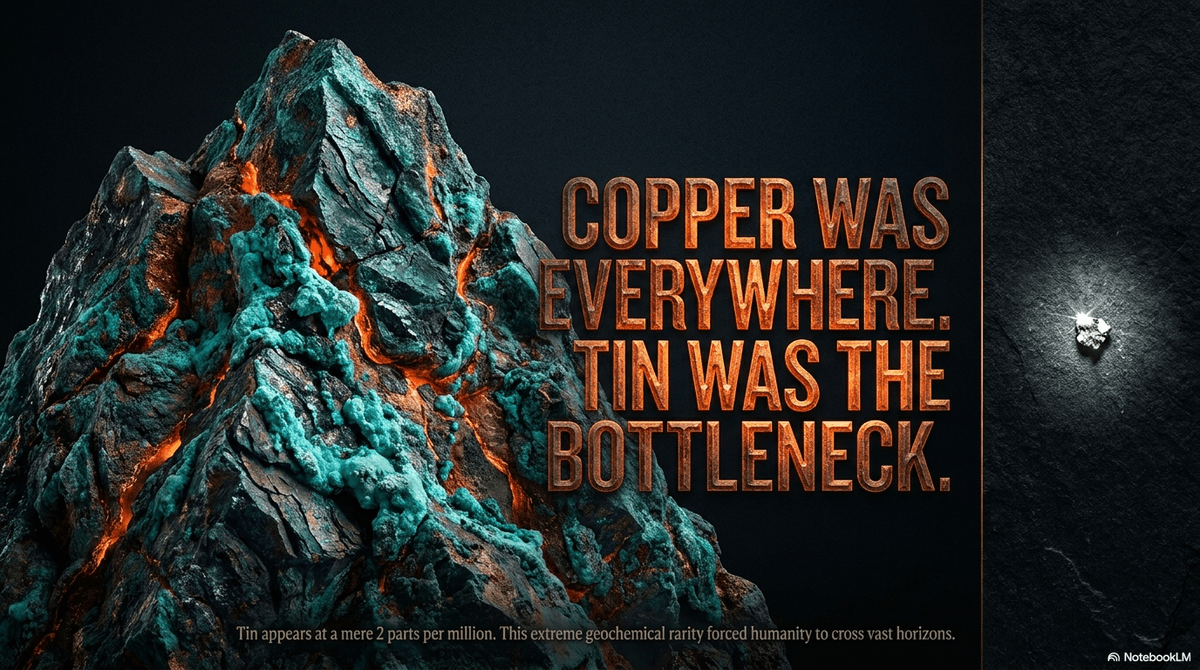
Nature, though, placed a considerable hurdle in the way of all this progress. Copper is found in the Earth's crust at a concentration of roughly 70 parts per million. Tin, by contrast, is an elusive ghost, appearing at a mere 2 parts per million. This geochemical disparity meant that while many cultures could find copper close to home, almost no one lived near a source of tin.
In the early stages of the Bronze Age, smiths experimented with arsenical copper, using arsenic as a hardening agent in place of tin. The practice didn't last. The toxic fumes released during smelting likely caused chronic illness and neurological damage in smiths who worked with it over years, and some scholars have wondered whether this is where the archetype of the "lame smith" god - Hephaestus among the Greeks, Wayland among the Norse - actually comes from. The shift to tin bronze, in other words, wasn't only a matter of quality. It was a matter of survival.
The Cornish connection and the Atlantic trade
For more than two centuries, the source of the tin found in the Eastern Mediterranean was one of archaeology's great open questions. We knew the Mycenaean kings and Egyptian pharaohs had it in quantity. We knew the Levant had no tin mines of its own. What we didn't know was where all that metal had actually come from.
That question has finally been answered, and the answer lies thousands of miles to the west. A 2025 study published in Antiquity by Dr. Alan Williams and Dr. Benjamin Roberts of Durham University used lead and tin isotope analysis, along with trace element and indium signatures, to trace tin ingots recovered from shipwrecks off the coast of Israel and France back to a single, surprising source region. Tin ingots from three ancient shipwrecks off the coast of Israel and one shipwreck off the Mediterranean coast of France originated in southwest Britain. The isotope and trace-element signatures were consistent with ores from Cornwall and Devon, and not with ores from Iberia or France.
It's a striking picture once you sit with it. The richest and most accessible tin ores in Europe are found in Cornwall and Devon, even though major tin deposits also exist elsewhere in western and central Europe and in central Asia. Small farming communities across the region would have dug, washed, crushed, and smelted the abundant tin ore from alluvial deposits - loose ore eroded from hard rock veins and deposited by streams and rivers, sitting close enough to the surface that no complex hard-rock mining was needed.
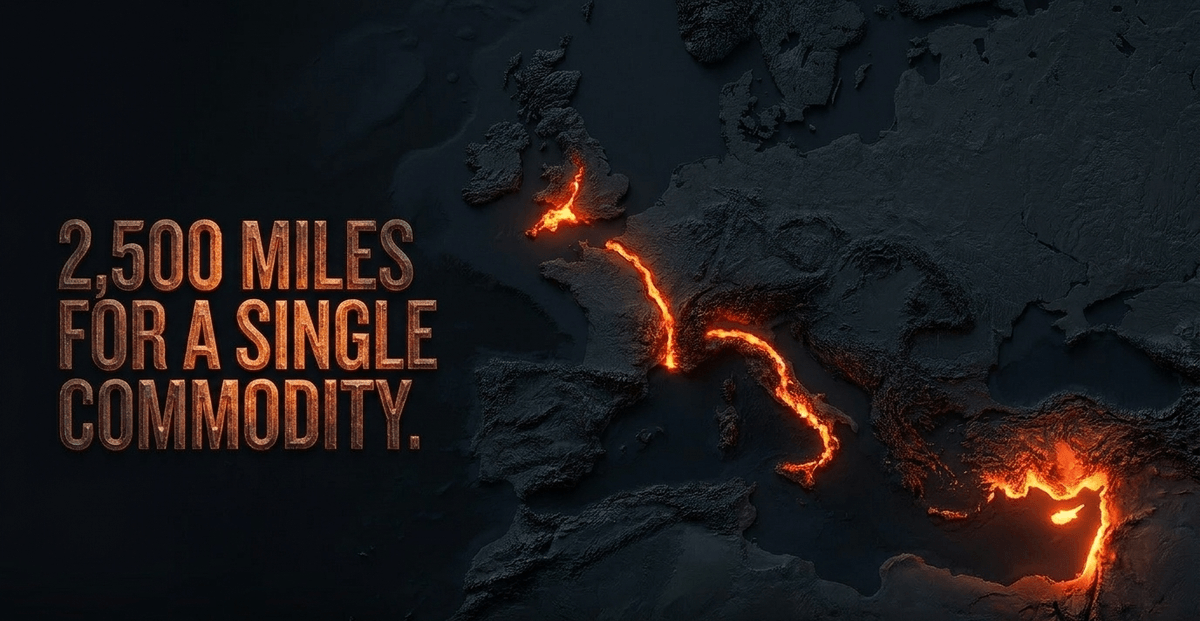
From there, the tin entered a relay that stretched across an entire continent. It's probable that traders moved the tin through France to the Mediterranean coast, where it was loaded onto ships bound for the trade networks connecting Sardinia and Cyprus to the wider Mediterranean. By the time a single ingot reached a smithy in Ugarit or Gaza, it had traveled something like 2,500 miles - a genuinely staggering distance for a Bronze Age commodity, and one that increased in value with every mile it covered.
As Dr. Williams put it when the findings were published:
"There has never been a major research project until now that has scientifically analysed the tin ores and tin artefacts in south-west Britain as well as the tin deposits in Western and Central Europe."
Researcher Benjamin Roberts has gone further, arguing that tin from southwestern Britain was a major commodity source that enabled the full transition of Eastern Mediterranean civilizations from copper to bronze use. Not everyone in the field agrees on the proportions - more on that below - but the underlying chemistry is now hard to dispute.
The eastern tin roads of Central Asia
While the western world looked to Britain, the empires of the East looked to the mountains of Central Asia. This eastern supply line mattered just as much, and it has its own, equally dramatic, scientific backstory.
For decades, the tin cargo of the Uluburun shipwreck - which sank off the Turkish coast around 1300 BC carrying one of the richest Bronze Age cargoes ever recovered - was assumed to have Near Eastern origins. A landmark 2022 study using tin isotope analysis overturned that assumption. Researchers found that ores from Central Asia, specifically Uzbekistan and Tajikistan, were used to produce one-third of the Uluburun tin ingots, while the remaining two-thirds derived from the Taurus Mountains of Turkey. That Central Asian third traced back to ore deposits over 3,000 kilometers east of the ship's final resting place.
The scale of the cargo itself is worth pausing on. With a tin-to-copper ratio of roughly 1:9, the Uluburun cargo could have yielded around 11 metric tons of high-quality bronze - enough to equip nearly 5,000 soldiers. That's not a curiosity cabinet of trade goods. That's a small nation's arsenal, sitting in the hold of a single ship.
The Central Asian sourcing has since been debated - a 2023 paper in Frontiers in Earth Science argued that the specific Mushiston deposit in Tajikistan couldn't be confirmed as a match, even while accepting a Central Asian origin more broadly. Science, like trade, rarely settles into tidy consensus. But the broader picture holds: at least 28 ancient tin mines have been documented in Kazakhstan, with further deposits scattered through Uzbekistan, Tajikistan, and Afghanistan, and this network fed a very different set of customers than the Cornish trade did.
The Middle Assyrian Empire, centered in what is now northern Iraq, built real power on this eastern route. By controlling the routes coming through the city of Ashur, the Assyrians maintained something close to a monopoly on Central Asian tin reaching Mesopotamia - a position that let them weather political storms that devastated their neighbors.
What the Uluburun evidence really shows, once you step back from the geochemistry, is that no single narrative fits. The scale of Late Bronze Age connectivity relied as much on small regional communities as on any hegemonic institution controlling the trade from above. This was not a single road. It was a mesh of overlapping, competing, and occasionally redundant supply lines - which, as we'll see, is exactly what made its eventual failure so catastrophic.

Copper sources and the anchors of trade
If tin was the elusive prize, copper was the heavy anchor of the network. Cyprus was so central to Bronze Age copper production that the island gave the metal its Latin name, cuprum, itself derived from the Greek Kypros. Cypriot mines supplied the bulk of the copper reaching the Eastern Mediterranean, though they were far from alone.
The Great Orme mine in north Wales saw a major production boom, distributing copper across a network that reached from Brittany to Sweden. In the Balkans and the Italian Alps, regions like Trentino became primary suppliers for continental Europe. And there are more speculative theories still circling the edges of the field - provocative but unproven suggestions that copper missing from ancient mines on the south shore of Lake Superior, in what is now the United States, might somehow have entered European circulation. Most archaeologists treat the "Atlantic crossing" theory as fringe. What it does usefully illustrate, even so, is the scale of the "missing metal" problem researchers still wrestle with when trying to account for the true volume of Bronze Age production.
The environmental cost of the metal age
The human cost of this trade was considerable, but the environmental cost was staggering in its own right. Smelting copper and tin required temperatures above 1,000 degrees Celsius, achievable only with charcoal, and producing a single tonne of bronze is estimated to have consumed somewhere between 10 and 15 tonnes of timber.
As demand for metal grew across the second millennium BC, vast stretches of forest in Cyprus, the Levant, and Central Europe were cut down to feed the furnaces. This deforestation likely contributed to soil erosion and localized climatic shifts - changes that, centuries later, would help set the stage for the very collapse that ended the Bronze Age trade altogether. It's a pattern worth sitting with: the industry that built the age also quietly undercut it.
The first global supply chain crisis
By around 1200 BC, the world was more tightly connected than it would be again until the Roman era, or arguably until the Age of Discovery. That interconnectedness was a double-edged sword. Late Bronze Age trade systems were, in the words historians now favor, "hyper-coherent" - so tightly wired together that a failure at one node could send a shock through the entire network.
Historian Eric Cline, whose book on the period remains the standard account for general readers, has described the end of the era as a "perfect storm" rather than a single catastrophe. It is much more likely that a concatenation of events, both human and natural - earthquake storms, droughts, rebellions, and systems collapse - coalesced to bring the age to an end, rather than any one cause acting alone. Pollen analysis from sites across the region backs this up: coring from the Sea of Galilee and the Dead Sea showed a dry event that lasted from roughly 1300 or 1200 BC down to somewhere between 1150 and 900 BC, and the same signature turns up in Syria, Cyprus, and Greece. Cline doesn't think it's a coincidence that the worst famine years line up with the arrival of the so-called Sea Peoples - it's a plausible picture of climate refugees on the move, in search of resources that had simply stopped being reliable.
Layered on top of drought and famine were internal rebellions, earthquake clusters, and the disruption of vital sea lanes by these same marauding groups. When the routes carrying tin were severed - whether by war, by the collapse of coastal cities, or simply by the breakdown of trust between trading partners separated by thousands of kilometers - the Bronze Age economy did not slow down. It stopped.
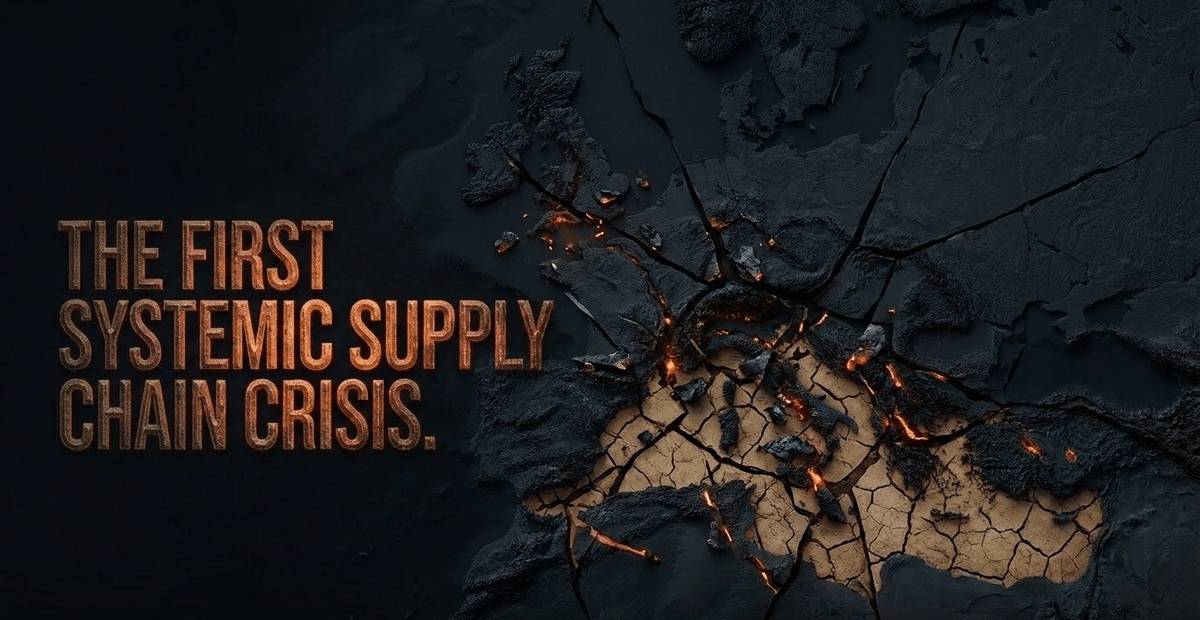
Without tin, there was no bronze. Without bronze, there were no tools for the harvest and no weapons for defense. This was arguably the world's first systemic supply chain crisis, and its effects were total rather than partial. You can watch it happen in the archaeological record itself: the transition from the Uluburun wreck, laden with tons of raw ingots bound for palace workshops, to the Cape Gelidonya wreck barely a century later - a vessel carrying mostly recycled scrap metal - tells a story of a world quietly running out of new material. The elite palace economies of the Mycenaeans and Hittites crumbled, and what replaced them has often been called, not unfairly, a grimmer, harder, and far more local world.
The transition to the Iron Age
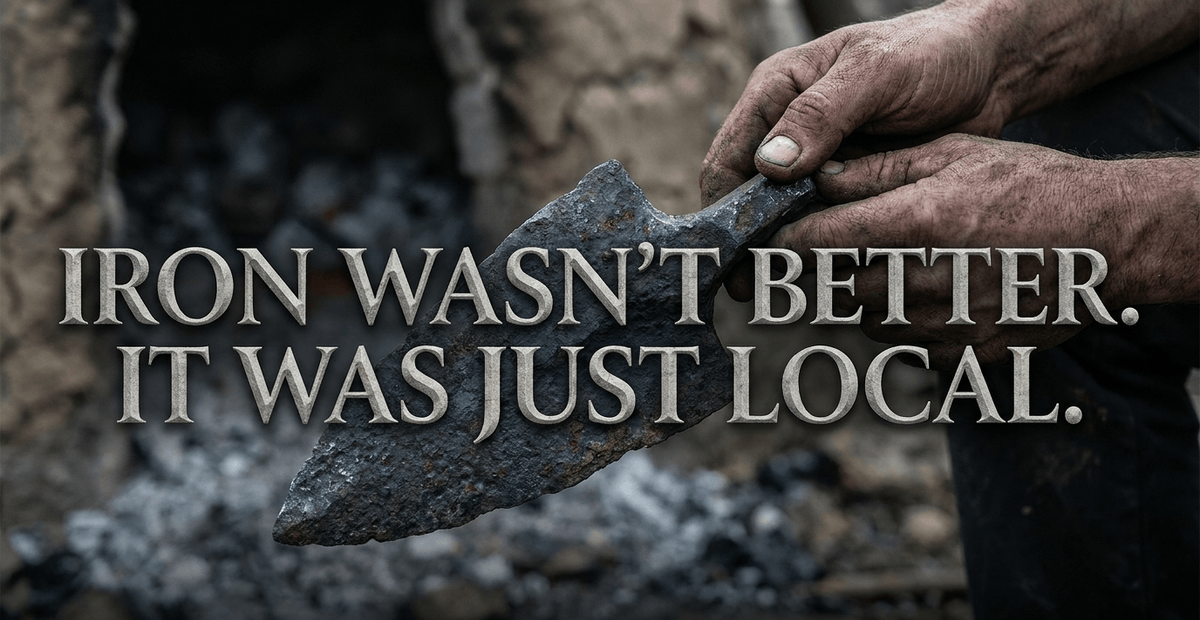
The collapse of the bronze trade forced a technological reckoning. Iron was not, at first, a "better" metal - early smelted iron was frequently softer and harder to work than good-quality bronze. But iron ore had one overwhelming advantage: it was everywhere. It did not require a 4,000-kilometer supply chain, a fleet of ships, or the cooperation of a dozen kingdoms to acquire. It simply needed to be dug up nearby.
The shift to iron, in that light, wasn't really a leap forward driven by superior technology. It was an adaptation to a world where global trade had failed, and where local self-sufficiency had suddenly become a matter of survival rather than choice.
What the Bronze Age still has to tell us
Reflecting on these ancient ruins, it's hard not to see the parallels to our own reliance on rare earth minerals, lithium, and fossil fuels concentrated in a handful of politically sensitive regions. The Bronze Age is a reminder that globalization is not a modern invention, and it is not a permanent state of affairs either. It is a fragile equilibrium, held together by the constant, unglamorous movement of raw material across borders that could - and eventually did - close.
When those routes vanish, the fall can be as swift as it is quiet, leaving behind nothing but dusty pits in the Cornish earth and cargo scattered across the floor of the Mediterranean to tell the story of a world that once was. Readers curious about how these same shipwreck excavations are reshaping our understanding of ancient maritime trade more broadly may find it worth exploring the wider archaeology of the Late Bronze Age Mediterranean, where isotope science continues to rewrite chapters historians assumed were closed for good.
Share now









Key takeaways
- Bronze is typically an alloy of 90% copper and 10% tin, producing a metal harder and more corrosion-resistant than pure copper.
- Copper occurs at roughly 70 parts per million in the Earth's crust, while tin occurs at only about 2 parts per million, making tin the era's critical bottleneck.
- A 2025 Durham University study (published in Antiquity) used lead, tin, and indium isotope analysis to prove that tin ingots from Bronze Age shipwrecks off Israel and France originated in Cornwall and Devon, southwest Britain.
- British tin traveled roughly 2,500 miles from Cornish streams to Eastern Mediterranean smithies - one of the longest documented trade routes of the ancient world.
- A 2022 tin isotope study of the Uluburun shipwreck found that one-third of its tin ingots originated in Uzbekistan and Tajikistan, with the remaining two-thirds from Turkey's Taurus Mountains.
- The Uluburun cargo alone could have produced roughly 11 metric tons of bronze - enough to equip nearly 5,000 soldiers.
- At least 28 ancient tin mines have been documented in Kazakhstan, part of a broader Central Asian supply network feeding Mesopotamian empires like Assyria.
- Cyprus supplied much of the Mediterranean's copper and gave the metal its name; other major copper sources included the Great Orme mine in Wales and Trentino in the Italian Alps.
- Producing one tonne of bronze required an estimated 10 to 15 tonnes of timber for charcoal, driving significant deforestation across the Mediterranean and Europe.
- Historian Eric Cline describes the Late Bronze Age Collapse (circa 1200 BC) as a "perfect storm" of drought, earthquakes, rebellion, and disrupted trade - not a single cause.
- Pollen and sediment cores from Israel, Syria, Cyprus, and Greece confirm a prolonged regional drought spanning roughly 1300/1200 BC to 1150-900 BC.
- The shift to the Iron Age was driven less by iron's superiority and more by its local availability, offering self-sufficiency once long-distance tin trade collapsed.
Sources
- Durham University https://www.durham.ac.uk/news-events/latest-news/2025/05/britains-long-distance-tin-trade-transformed-the-bronze-age/
- Antiquity Journal (Cambridge Core) https://www.cambridge.org/core/journals/antiquity/article/from-lands-end-to-the-levant-did-britains-tin-sources-transform-the-bronze-age-in-europe-and-the-mediterranean/2330F3B6498B210DA61B89026A1F38EA
- Science Advances (Uluburun tin isotope study) https://www.science.org/doi/10.1126/sciadv.abq3766
- ScienceNews https://www.sciencenews.org/article/british-tin-bronze-age-civilizations
- HISTORY.com (Eric Cline, Bronze Age Collapse) https://www.history.com/articles/bronze-age-collapse-causes
- Published 2026-08-04 11:39
- Modified 2026-08-04 11:39

-
Redaction


