

-
 PRO
PRO -
 Redaction
The sacred hearth: how fire shaped humanity
Discover how the hearth shaped human evolution, from Neanderthal fire-making to sacred rituals, ecosystem engineering, and the origins of language and society.
Long before there were villages, languages carved into clay, or laws etched into stone, there was a small circle of light holding back the dark. The flicker of a flame does more than provide warmth - it anchors the human story. For hundreds of thousands of years, the hearth has been the quiet witness to the most profound shifts in our biological and social architecture. It was never merely a tool for survival. It was a nexus where the raw became cooked, the solitary became communal, and instinct slowly gave way to culture. To understand the ritual of the hearth is to understand the very forge in which humanity was shaped.
What follows is not a single discovery but a long, layered story - one written in ash, charcoal, and the faint chemical fingerprints left behind in cave sediments. Archaeologists have been piecing it together for decades, and a few recent finds have pushed parts of that timeline back further than almost anyone expected.

The deep chronology of controlled fire
The journey toward fire mastery wasn't a sudden epiphany. It was a slow, almost geological shift in hominin behaviour, unfolding over hundreds of millennia.
The earliest traces are tantalising rather than conclusive. Microscopic evidence of burned bone and ash at sites such as Wonderwerk Cave in South Africa suggests Homo erectus was already interacting with fire as far back as roughly one million years ago. This early relationship was almost certainly opportunistic - harvesting embers from wildfires sparked by lightning or volcanic activity, then nursing them along rather than creating them from scratch.

The leap from tending fire to making fire is where the story turns genuinely revolutionary - and it happened earlier, and in a less expected place, than researchers long assumed. A 2025 study published in Nature describes a site near Barnham, in Suffolk, eastern England, where archaeologists found baked clay, fire-cracked flint handaxes, and fragments of iron pyrite dating to around 400,000 years ago. Iron pyrite doesn't occur naturally there, which means someone carried it in - almost certainly to strike against flint and throw sparks onto dry tinder.
As Nick Ashton of the British Museum, one of the study's authors, put it, this is the earliest evidence of making fire not just in Britain or Europe, but in fact anywhere else in the world. The likely makers were early Neanderthals: a roughly contemporaneous skull from nearby Swanscombe shares features with Neanderthal fossils from Spain's Sima de los Huesos site, and researchers believe the Barnham fire-builders belonged to that same emerging population. It's a striking image - Neanderthals in a damp English woodland, four hundred millennia ago, learning to summon fire on demand rather than waiting for the sky to provide it.

That breakthrough, however, didn't immediately translate into the kind of permanent domestic hearth most of us picture when we think of "home." That development came roughly a hundred thousand years later, in a different corner of the world entirely.
In Qesem Cave, around eight miles east of Tel Aviv, archaeologists led by Tel Aviv University's Ran Barkai and Avi Gopher uncovered what is widely considered the oldest known structured, repeatedly used hearth: a large central fireplace, roughly four square metres across, dating to approximately 300,000 years ago. Unlike the scattered ash patches of earlier eras, this hearth shows two superimposed layers of use, each made up of multiple burning episodes - evidence that the same spot was returned to again and again, season after season, for cooking and gathering. It marks, in a very real sense, the moment fire stopped being a wild visitor and became a household fixture.

The identity of the people who tended that fire remains genuinely uncertain - researchers describe them as belonging to a hominin lineage with traits bridging Homo erectus, early Homo sapiens, and Neanderthals. If that kind of mystery intrigues you, it's worth reading more about what Neanderthal burial practices and ancient pathogens reveal about early human populations, since the people of Qesem Cave were living through some of the same evolutionary currents.
The hearth as a biological catalyst
One cannot discuss the social life of the hearth without addressing the quiet physiological revolution it triggered - one that, in a sense, built the very brain capable of telling this story.
Cooking was perhaps the single most significant dietary shift in the history of the genus Homo. By heating meat, tubers, and other plant foods, early humans broke down tough proteins and fibres before they ever reached the stomach. Food became easier to chew, easier to digest, and yielded far more usable energy for the same amount of effort.

This is the core of the so-called expensive tissue hypothesis. Digestion is metabolically costly - the gut is a demanding, constantly working organ. As cooking reduced that cost, the body could redirect freed-up calories toward an organ that is, calorie for calorie, the most expensive of all: the brain. The physical evidence lines up neatly with this idea. Homo erectus shows smaller teeth, weaker jaw muscles, and a shorter intestinal tract compared with earlier hominins - changes consistent with a diet that was, at least in part, already cooked.
It's a humbling thought: the rapid expansion of the human cranium - the neural hardware behind language, planning, and culture - may owe an enormous debt to something as simple as a roasted root vegetable. If you're curious about the wider picture of ancient diets, not just what fire made possible but what isotope analysis and fossilised food remains reveal about how our ancestors actually survived, the evidence behind what early humans really ate is its own fascinating thread.

Fostering the first social networks
Before the hearth, sunset effectively ended the productive day. Darkness brought danger, and danger demanded vigilance, not conversation. Fire changed that equation completely.
By carving out a pocket of light and warmth after dark, fire extended the useful day by several hours - hours in which the pressing demands of foraging, hunting, and defence eased, and something new could take their place. Anthropologist Polly Wiessner's well-known research among the Ju/'hoansi of the Kalahari offers a vivid window into what those hours might have looked and felt like. She found that daytime conversation tended to be practical: economic complaints, gossip, criticism, the business of getting through the day. After dark, around the fire, the tone shifted dramatically toward stories - myths, memories of distant relatives, tales of encounters with strangers and animals, accounts of the supernatural.

It's easy to see why this matters so much for human evolution. Storytelling around a fire isn't just entertainment - it's a way of transmitting:
- shared history and group identity
- information about distant places, people, and dangers
- social norms, often coded into myth
- emotional bonds, through shared laughter, awe, or grief
This kind of nightly ritual would have demanded, and rewarded, increasingly sophisticated language. It also required cooperation of a very practical kind. Someone had to gather fuel. Someone had to tend the flames through the night. Someone had to protect the fire from rain, wind, or theft by a rival group. None of that happens without a basic division of labour and a baseline of mutual trust - the social glue that, over time, helped hold prehistoric communities together.
There's also a wider, almost continental-scale pattern worth noting. By around 400,000 years ago - the same broad window as the Barnham discovery - evidence for habitual fire use becomes far more widespread across both Africa and western Eurasia, appearing at multiple sites more or less simultaneously. Researchers debate exactly what this means: it may reflect different hominin populations independently crossing the same technological threshold once certain cognitive or social capacities were in place, or it may point to genuine networks of contact and shared knowledge stretching across vast distances. Either explanation is remarkable in its own way.

Ritual and the sacred flame
As the hearth became a permanent fixture of daily life, it began - gradually, almost inevitably - to take on a meaning that went beyond the practical. Where there is fire, ash, and gathering, ritual tends to follow.
A striking recent example comes from Tadım Mound, near Elazığ in eastern Turkey. There, archaeologists working under the Elazığ Archaeology and Ethnography Museum uncovered two roughly 6,000-year-old hearths, each carved with bull motifs at both ends - so-called "double-headed" hearths - dating to between about 4000 and 3000 BCE. These weren't simple cooking pits. They were found within a temple complex that also included stone altars, offering podiums, and an altar stone bearing cut marks consistent with ritual sacrifice. Cooking, gathering, and worship, it seems, were not separate activities here but threads of the same fabric.

This pattern - the hearth as sacred centre - echoes across cultures and millennia in ways that are genuinely striking once you start looking for them. If ancient peoples were also encoding cosmological knowledge into their monuments, as explored in how prehistoric cultures tracked the sky through sacred alignments, it's not hard to imagine the hearth fire as their most immediate, intimate connection to that same sense of cosmic order - a small sun kept alive indoors.
In ancient Greece, the hearth was the domain of Hestia, goddess of the home and, by extension, of the state itself. Every household maintained its own hearth fire, and the communal hearth of a city - its prytaneion - was treated as a kind of civic soul, a place of refuge where even a stranger could claim protection.
Celtic tradition tells a similarly resonant story. The hearth at Tara, seat of the high kings of Ireland, was treated as the symbolic heart of the nation. According to tradition, during the festival of Samhain, all other fires across the land were extinguished, and a single new flame was kindled at Tara - from which every household fire was then relit. It's a ritual that does double duty: practically, a kind of communal "reset"; symbolically, it ties every hearth in the land back to a single shared source, reaffirming unity through fire itself.
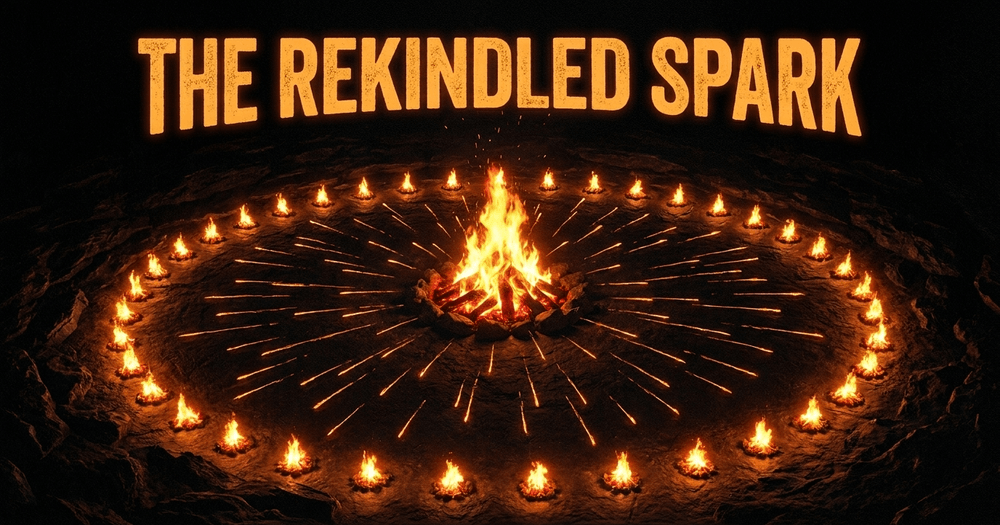
Even today, threads of this "hearth cult" persist in various spiritual and folk traditions, where the home fire - or its modern equivalent, a candle, a stove, a fireplace - continues to represent the continuity of the family and the sanctity of domestic space. The journey from a smoky ash pit to a decorated altar reflects something that hasn't really changed: our enduring need for a literal and figurative centre, a place that provides both warmth for the body and a sense of belonging.
Environmental engineering and spatial management
The influence of the hearth didn't stop at the cave mouth. Long before agriculture, early humans were already reshaping the landscapes around them, and fire was their primary tool.
A 2021 study published in Science Advances documented dense clusters of stone artefacts on the northern shores of Lake Malawi in eastern Africa, dating back as far as 92,000 years. Around the same time, sediment cores from the lake bed show a sharp spike in charcoal deposits, followed by a marked decline in plant diversity - exactly the signature you'd expect if people were repeatedly burning vegetation to stop forest regrowth. Lead author Jessica Thompson, an anthropologist at Yale, described it as the earliest evidence she'd seen of humans fundamentally transforming an ecosystem with fire. The result, researchers believe, was the open bushland that still characterises the region today - landscape engineering on a scale that predates farming by tens of thousands of years.

Fire management wasn't only about transforming the world outside. Within the cave itself, early humans were managing space with what can only be described as careful planning. At Lazaret Cave in southeastern France, occupied around 170,000 to 150,000 years ago, researchers led by Yafit Kedar and Ran Barkai built a computer model simulating how smoke would disperse through the cave depending on where the hearth was placed.
Their model suggested that, in winter, the least smoky option overall would have been to build the fire at the very back of the cave, letting smoke drift out along the ceiling. But that isn't where the actual hearth sat. Instead, it was placed roughly in the centre of the cave, about thirteen metres from the entrance - in a spot the simulations identified as the best overall balance: close enough to provide heat and light across the main activity areas, including a meat-smoking zone near the fire and a sleeping area toward the rear, while keeping smoke exposure within a tolerable range throughout the space. As Kedar and Barkai concluded, early humans were able to choose the perfect location for their hearth - a result that speaks to real planning and accumulated experience, not trial and error alone.

The enduring legacy of the fire pit
The story of the hearth doesn't end with deep prehistory - it stretches in an unbroken line right up to the present, and some of the most evocative evidence comes from much later periods, when fire users were facing the harshest conditions our species has ever endured.
In the gypsum dunefields of White Sands National Park, New Mexico, an unusual quirk of geology has preserved hundreds of ancient "hearth mounds." When fires were built directly on the gypsum sand, the heat converted it into a hardened, plaster-like crust that resists erosion far better than the surrounding dune. Inside these crusts, archaeologists have found preserved charcoal, burned bone, and pollen, offering a remarkable record of repeated fire use stretching back thousands of years. Remote-sensing surveys suggest the dunefield may hold many more such sites still buried beneath the sand, much of the area never having been walked by an archaeologist at all.
Further east, in Ukraine, a study published in the journal Geoarchaeology examined three hearths at the Korman' 9 site on the banks of the Dnister river, dating to the depths of the Last Glacial Maximum - roughly 23,000 to 21,000 years ago, a period when European temperatures regularly plunged below freezing for months on end. Using microscopic and chemical analysis of the hearth sediments, researchers from the University of Vienna and the University of Algarve found that these fires had reached temperatures over 1,112°F (600°C), fuelled primarily by spruce wood, with possible supplementary use of bone and fat.

"Fire was not just about keeping warm; it was also essential for cooking, making tools and for social gatherings."
- Philip R. Nigst, University of Vienna
Even at the coldest, hungriest moment of the Ice Age, fire remained at the centre of human life - not merely a survival tool, but the organising principle around which an entire daily and seasonal rhythm was built.
From ancient embers to modern hearths
It's tempting to think of all this as belonging to a world utterly disconnected from our own - to a cast of characters (Neanderthals, Homo erectus, anonymous "early humans") so distant they barely feel like family. But the through-line is hard to miss once you start looking for it.
Fire allowed our ancestors to colonise environments that would otherwise have been lethal, to extend the productive day, to cook food that fuelled bigger brains, and - perhaps most importantly - to create something we might simply call "the we." In the circle of a hearth's glow, the individual became part of a group. The rituals of the fire taught early humans how to share, how to listen, and how to imagine futures and pasts that existed only in words.
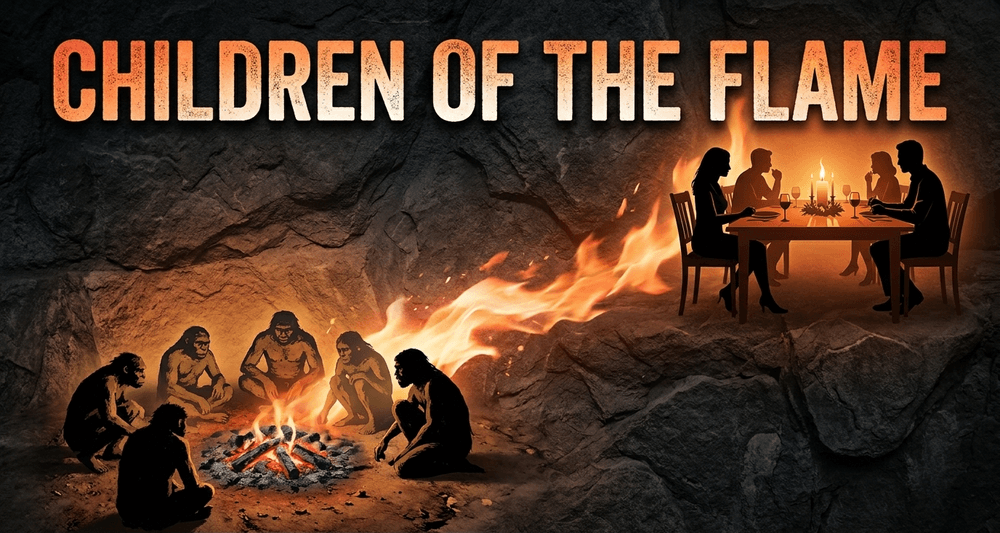
The modern dinner table, the backyard fire pit, the candle on a windowsill, the woodstove that gathers a family on a winter evening - these aren't unrelated customs we happen to share with our ancestors. They are, in a very real sense, the same custom, worn smooth and reshaped over hundreds of thousands of years, but recognisable still. We are, quite literally, the children of the flame.
Frequently asked questions
When did humans first start using fire? The earliest evidence of hominins interacting with fire dates to roughly one million years ago, based on burned bone and ash found at sites such as Wonderwerk Cave in South Africa. This early use was likely opportunistic - harvesting and tending wildfires rather than creating new ones.
What is the oldest known hearth? The oldest known structured, repeatedly used hearth was found at Qesem Cave in Israel and dates to approximately 300,000 years ago. The oldest known evidence of deliberate fire-making, meanwhile, comes from Barnham in Suffolk, England, dating to around 400,000 years ago.
How did fire change human evolution? Cooking made food easier to digest and far more calorie-rich, reducing the energy the body needed to spend on digestion. According to the expensive tissue hypothesis, those freed-up calories were redirected toward brain growth - one of the key drivers behind the expansion of the human cranium.
Why did ancient cultures treat the hearth as sacred? As fire became a permanent feature of daily life, the hearth naturally became the focal point of the home and, often, of communal identity. From Hestia's hearth in ancient Greece to the royal hearth at Tara in Ireland, fire came to symbolise unity, protection, and the continuity of family and community.
Share now









Key takeaways
- The earliest known evidence of hominins interacting with controlled fire dates to roughly 1 million years ago, based on burned bone and ash at sites such as Wonderwerk Cave, South Africa.
- At Barnham, Suffolk, England, archaeologists found the oldest confirmed evidence of deliberate fire-making - around 400, 000 years old - likely created by early Neanderthals using iron pyrite and flint.
- Qesem Cave in Israel contains the oldest known structured, repeatedly used hearth, dated to approximately 300,000 years ago.
- Cooking food significantly increased caloric availability, supporting the expensive tissue hypothesis, which links a smaller, less costly digestive system to a larger brain in early Homo.
- By around 400,000 years ago, habitual fire use had become widespread across both Africa and western Eurasia, hinting at either independent technological breakthroughs or early networks of cultural contact.
- A 2022 study of Lazaret Cave, France, found that early humans living there roughly 170,000 to 150,000 years ago placed their central hearth in a carefully calculated location balancing warmth, light, and smoke exposure.
- Researchers have found evidence that humans were intentionally reshaping ecosystems with fire as far back as 92,000 years ago near Lake Malawi in East Africa.
- At Tadım Mound in Turkey, archaeologists uncovered ~6,000-year-old "double-headed" hearths decorated with bull motifs, found within a temple complex featuring altars and ritual offerings.
- In ancient Greece the hearth was sacred to Hestia, goddess of the home, while in Celtic Ireland the royal hearth at Tara was ritually extinguished and rekindled during Samhain.
- Hearths excavated at Korman' 9 in Ukraine show that Ice Age hunter-gatherers built fires reaching over 1,112°F (600°C) during the coldest phase of the Last Glacial Maximum.
Sources
- Nature https://www.nature.com/articles/d41586-025-04059-4
- National Geographic https://www.nationalgeographic.com/adventure/article/140129-oldest-hearth-israel-cave-new-human-species-discovery-archaeology-science
- ScienceDaily https://www.sciencedaily.com/releases/2022/02/220201074539.htm
- Yale News https://news.yale.edu/2021/05/05/study-offers-earliest-evidence-humans-changing-ecosystems-fire
- University of Vienna https://www.univie.ac.at/en/news/detail/sophisticated-pyrotechnology-in-the-ice-age-this-is-how-humans-made-fire-tens-of-thousands-of-years-ago
- Published 2026-06-13 22:07
- Modified 2026-06-13 22:07

-
Redaction