


-
 Redaction
Sacred oaks: inside the ancient Slavic World Tree
Discover why the ancient oak was the Slavic World Tree, linking Perun's high heavens, the human world of Jawia and Veles's dark underworld realm below.
To understand the ancient Slavic worldview, you have to set aside the modern habit of seeing a tree as simple biology - roots, bark, leaves, nothing more. For the early Slavic tribes scattered across the forests of Eastern and Central Europe, the oak was never just a plant. It was the scaffolding of existence itself, the physical form that held the universe together. Scholars call this the Axis Mundi, or World Tree - a vertical map of the cosmos that fused the spiritual and the physical into one continuous structure.
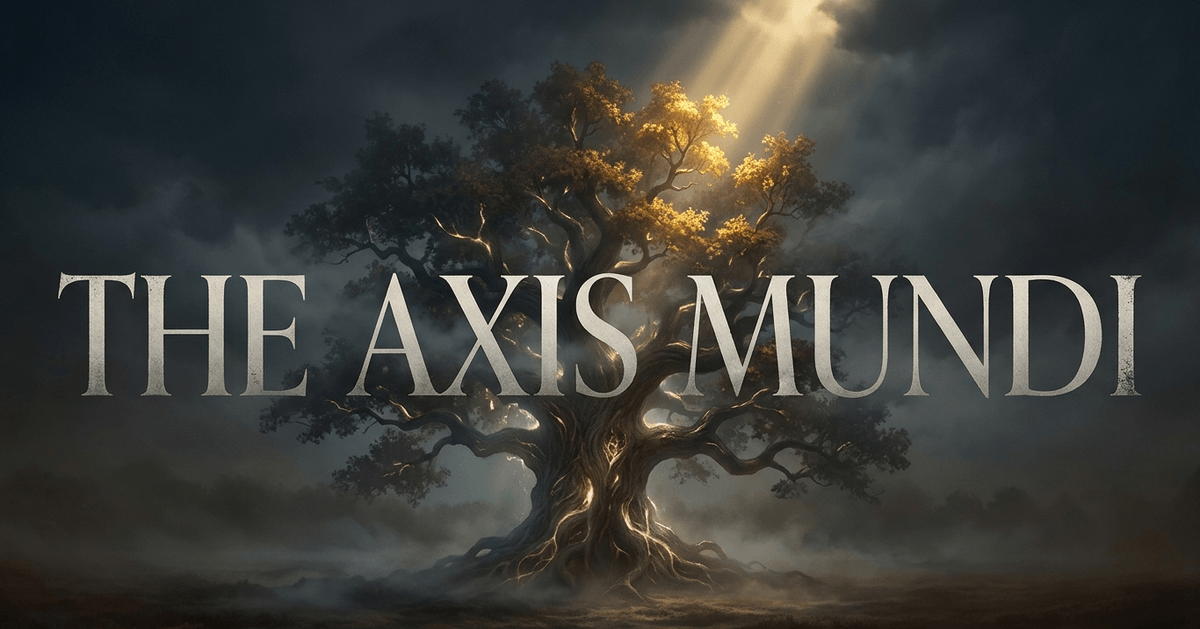
Imagine walking into a sacred grove a thousand years ago. You would not have seen only wood and leaf litter. You would have seen a living bridge. The Slavic World Tree connected the gods above the clouds, the mortals on the soil, and the spirits beneath the ground, keeping all three in constant, and often uneasy, conversation. This belief ran so deep that it shaped tribal law, healing practices, and even where a village chose to settle.
The oak earned this role for reasons that were as practical as they were poetic: its size, its extraordinary lifespan, and - most tellingly - its habit of attracting lightning. When the heavens reached down to touch the earth, the Slavs believed, they did it through the crown of an oak. It stood as a pillar of stability in an otherwise unpredictable world, a living witness that outlasted generations.
I should note upfront that almost everything we know about this cosmology comes from later reconstruction - Christian chroniclers writing with obvious hostility, and centuries of folklore collected long after the old religion had gone underground. There is no surviving pagan Slavic text that lays out the three realms in the tidy way modern retellings often suggest. What we have is a mosaic: fragments of chronicle, place names, folk songs, and physical remains, all pieced together by later scholars. That doesn't make the picture false. It just means we should hold it the way an archaeologist holds a reconstructed pot - confident in the overall shape, humble about the exact pattern on every shard.

Why the oak, and not another tree
It's worth pausing on this before descending into the three realms, because the choice of oak was never arbitrary. Slavic settlements tended to cluster near old-growth stands, and the oak simply outperformed its neighbours on every measure that mattered to an early agricultural people. It could live for centuries, sometimes close to a thousand years, long enough to anchor the memory of a community across many generations. Its wood was dense and durable, prized for building and for the ships that carried Slavic traders down the great rivers. Its acorns, in lean years, could be ground and eaten. And its height and isolation in open country made it, quite literally, a lightning rod - the tallest object for miles, and so the object most often touched by the sky.
That last trait did more than any other to cement the oak's sacred status. A tree that survives repeated strikes and keeps growing is a tree that looks like it has made peace with the god of thunder, or perhaps earned his favour outright. Other Indo-European peoples reached the same conclusion independently: the Baltic thunder god Perkūnas, close linguistic and mythological kin to Perun, was likewise tied to the oak, as was the Germanic Donar, or Thor, whose own sacred oak near modern Hesse was felled by the missionary Boniface in the eighth century as a direct challenge to pagan belief. The pattern is too consistent across unrelated regions to be coincidence - it points to something closer to a shared, very old, way of reading the natural world.
Prawia: the celestial crown of the gods
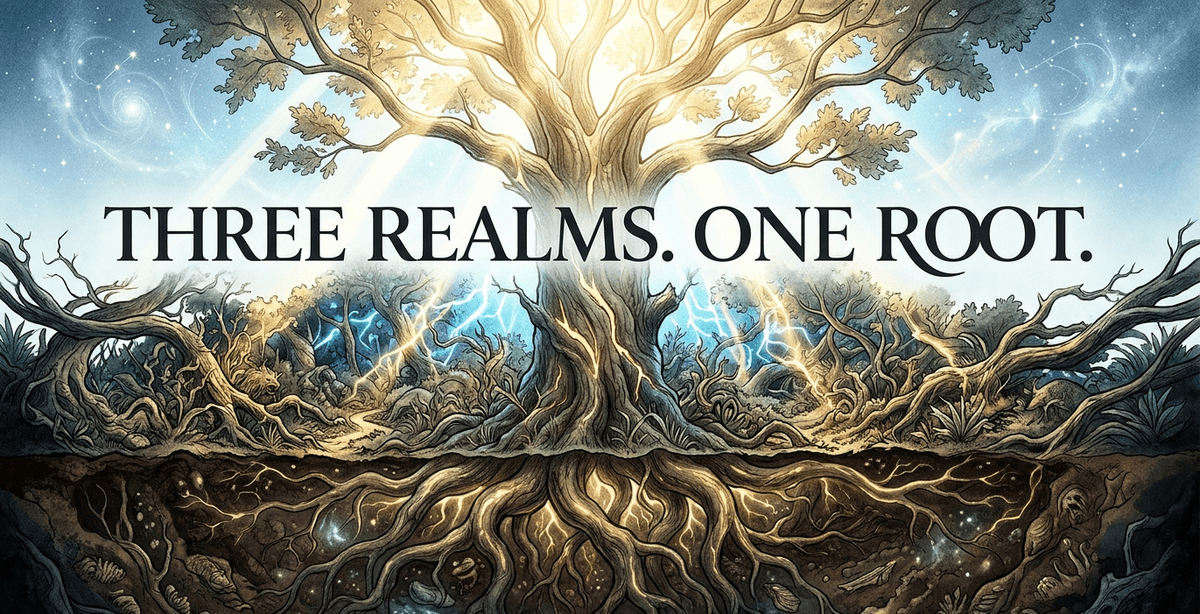
At the very top of the tree sits Prawia, the realm of the heavens - the highest branches, where the air thins and the light turns clean and pure. This is the seat of the ruling gods and the celestial bodies that mark the turning of the seasons. Its most prominent resident is Perun, god of thunder, lightning, and war.
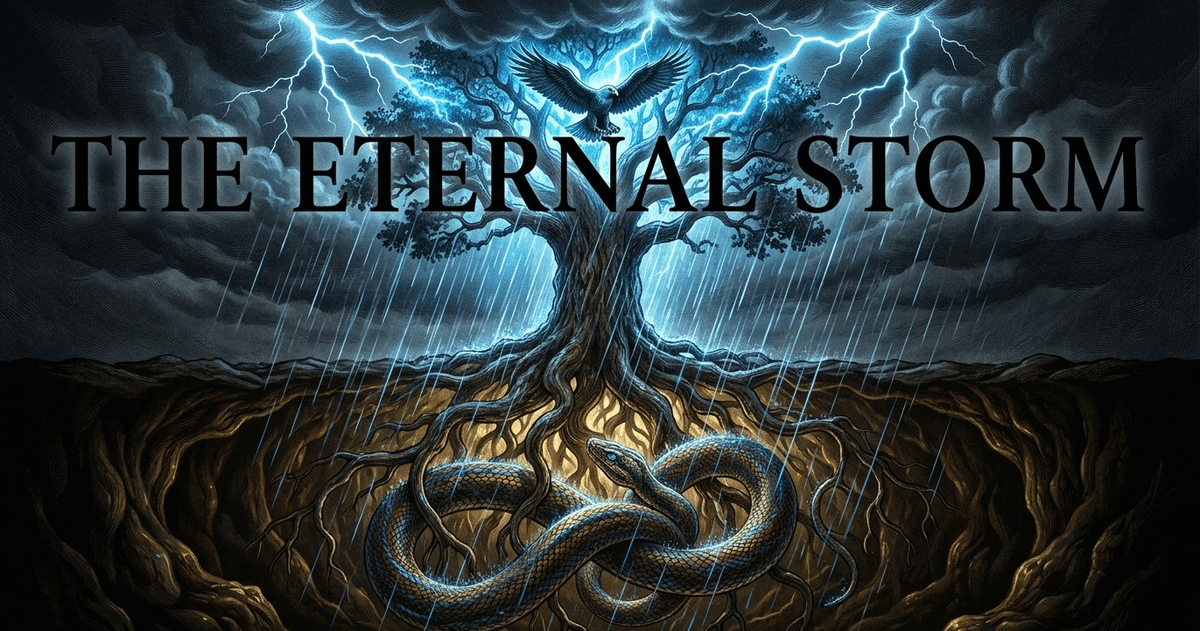
Perun is often pictured as an eagle perched on the tree's highest branch, watching the horizon for any threat to cosmic order. That imagery isn't incidental. Oaks really are struck by lightning more often than most other trees, and the Slavs read this as the god making his power visible. A lightning-struck oak was treated as marked, chosen - proof that Perun had reached down and touched the lower worlds directly.
The name Prawia itself carries a hint of what the realm meant to its worshippers. It shares a root with pravo - law, or what is right - suggesting this upper tier was thought of as the wellspring of moral and cosmic order rather than a paradise in the Christian sense. It's worth being precise here: Prawia was not "heaven" as later folklore sometimes flattens it into. It was less a reward for the virtuous and more the seat from which the gods oversaw everything below, the source of the justice that Perun was charged with enforcing. Some reconstructions go further, suggesting Prawia also held the unborn - souls waiting their turn to descend into Jawia and take on a mortal life, which would make the whole tree not just a static map but a kind of circulatory system for the soul itself.
Perun rarely stood alone at the summit. Many reconstructions place beside him Mokosh, the great mother goddess associated with earth, weaving, and the fate of women, sometimes described as his consort. Their relationship, along with Perun's rivalry with Veles below, forms one of the few recurring domestic dramas that survive in fragments of folk song - proof that even the loftiest of the gods were imagined with very human entanglements.
Jawia: the terrestrial trunk of the living
Below the crown lies Jawia, the middle world - the trunk, and with it the whole tangle of human, animal, and plant life that fills the earth. This is the realm of here and now, where families were raised, tribes grew, and survival was a daily negotiation rather than a settled fact.
If Prawia represents the ideal and the eternal, Jawia is the realm of the tangible and the difficult. The trunk carries the weight of the crown above and resists the wind that would otherwise topple the whole structure, and in Slavic thought, the health of a community mirrored the health of the sacred oak standing at its centre. Early ethnographers who studied this cosmology also noted something darker: Jawia was often remembered as a hard place - cold forests, real danger, none of the untroubled ease sometimes attributed to the underworld realm of Nawia. Life at the trunk of the tree was lived, not merely endured in comfort.
Jawia also spreads horizontally in a way the other two realms don't. While the tree itself grows on a single vertical axis, the human world was understood to stretch across the four cardinal directions - north, south, east, and west. Put the three vertical levels together with these four horizontal points and you arrive at the number seven, which in Slavic tradition signalled totality: a complete, finished universe. Jawia is where these two axes cross, which may be why it reads as the busiest and most complicated of the three realms - it's the only one where gods, spirits, and human beings are all working the same ground at once.
It's this crowdedness that gives Jawia its particular emotional texture in the surviving folklore. The gods did not rule Jawia the way an absentee landlord rules an estate; they were thought to walk through it, argue in it, and occasionally suffer in it alongside mortals. That closeness is part of why the Perun-Veles conflict, discussed further below, plays out so vividly at ground level - in storms, in floods, in the scorched trunks of struck oaks - rather than remaining a distant affair among the clouds.
Nawia: the deep roots and the underworld
Descend beneath the soil and you reach Nawia, the world of the roots - dark, damp, and largely hidden from daily life, home to the spirits of the dead. It would be a mistake to read this as a place of punishment. Some reconstructions describe Nawia as verdant even in winter, a realm bound up with fertility and cyclical renewal rather than suffering - closer to a resting place and a reservoir of ancestral memory than to anything resembling a Christian hell. A handful of folk sources even picture it as a wide green pasture ringed by water, where souls could rest before choosing whether to be reborn into Jawia or to rise toward Prawia - a cycle that, if the reconstruction holds, would make the World Tree not a one-way ladder but a loop.
Nawia is ruled by Veles (sometimes Weles), god of the underworld, magic, oaths, and wealth. Where Perun sits as an eagle in the branches, Veles is imagined coiled among the roots as a serpent or dragon - a pairing that sets up one of the more compelling dualities in Slavic myth. The roots draw nutrients from the dark earth just as ancestral memory nourishes the living, and the two gods, despite their rivalry, depend on each other completely. Without Veles's roots, Perun's tree falls. Without Perun's rain, Veles's roots wither. Local folklore often frames storms themselves as the visible trace of this ongoing tension - Veles trying to climb toward the heavens, or slipping back among the roots to dodge Perun's lightning. Neither god wins outright, and neither is meant to. The balance between them is what keeps the whole system running.
Veles was, in practice, probably the more intimately worshipped of the two gods for much of the ordinary population. Lowland farmers and herders, whose livelihoods depended on cattle, soil, and the unpredictable turns of fortune that magic was thought to influence, are recorded as venerating him with a mixture of respect and outright fear that sometimes outstripped their devotion to Perun. Where Perun's oak stood tall and rigid, Veles's associated tree was the willow - bending rather than resisting, a fitting emblem for a god of shape-shifting and hidden currents.
Without Veles, there is no rain. Without Perun, there is no order.
The oak as a natural temple and judicial court
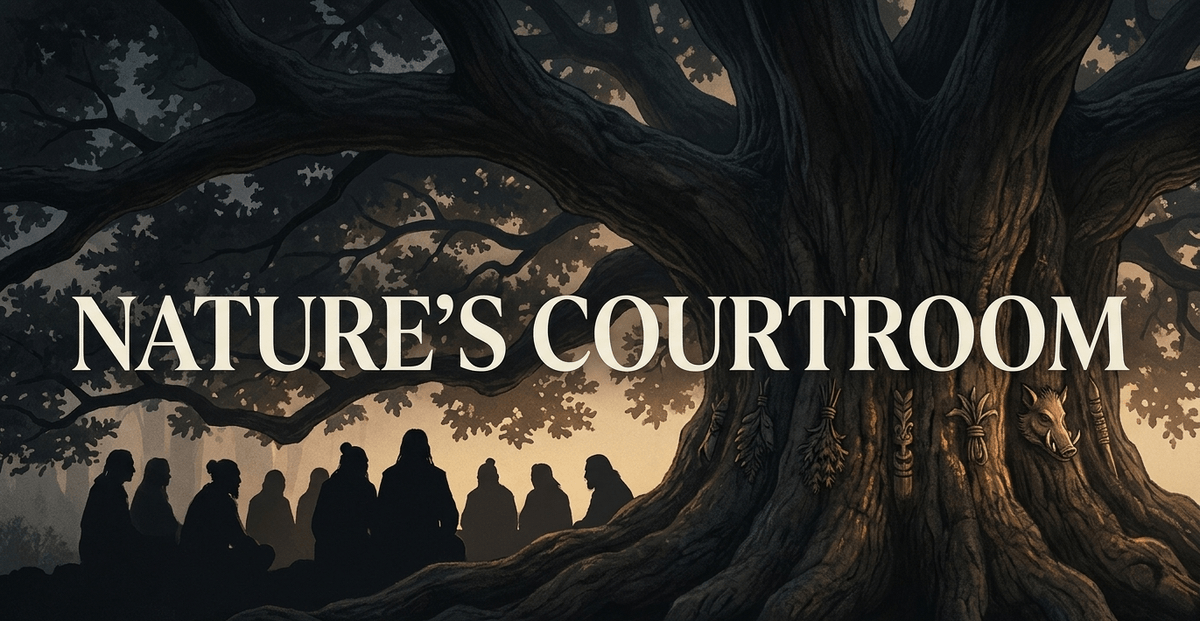
Long before stone cathedrals or wooden churches appeared in these lands, the Slavs found their sense of the sacred in open-air groves. Particularly old and massive oaks were treated as natural temples - not just places of prayer, but genuine civic centres. Villages were frequently built near these groves, which were protected by strict taboos against harm.
One of the more fascinating dimensions of this practice was its role in law. Trials were regularly held in the shade of a sacred oak, on the belief that no one would dare lie in the tree's presence - and by extension, under the watchful eye of Perun. Swearing an oath beneath an oak was considered the most binding promise a person could make. This wasn't a purely local custom, either: chronicled treaties between early Rus' princes and the Byzantine Empire describe envoys swearing by their weapons and by Perun himself, a formula so serious that breaking it was understood to invite the god's direct retribution.
The same trees also served as neutral ground for diplomacy. Tribal councils and treaty ceremonies took place at the base of the trunk, and there was a long-standing convention that even feuding parties were forbidden from shedding blood near a sacred oak. The tree functioned as a kind of sanctuary, where the ordinary rules of tribal conflict gave way to the peace of the gods - and breaking that peace was treated as a spiritual offence with consequences for the whole village.
This pattern of oak-groves-as-courts isn't only inferred from folklore. The twelfth-century chronicler Helmold of Bosau, a Saxon priest writing around 1168 to 1172 about the Polabian Slavs of what is now northern Germany, described travelling through Wagria and encountering a grove of very old oaks dedicated to the god Prove, ringed by a wooden fence with two gates and entered only by a priest and those bringing offerings. According to his account, the local duke and the people of the region gathered there for judgment - a detail that lines up strikingly well with the oral tradition of oak-groves doubling as courts of law, and one of the clearest firsthand European descriptions of a Slavic sacred grove in active use before it was destroyed.
Rituals of sacrifice and the quest for healing
Interactions with the sacred oak were physical and immediate, not purely symbolic. People brought their most pressing problems directly to the tree. Offerings of bread, coin, or livestock were left at the base - gifts meant to appease Veles for favours involving herds and harvests, or to honour Perun for protection in war. Chronicles from Kievan Rus' also describe grander state rituals: bulls and roosters sacrificed at hilltop shrines, ritual fires kept burning beneath sacred oaks, and communal feasts held in Perun's honour, particularly ahead of military campaigns and around the height of summer.
Healing practices built around the oak followed a similarly literal logic. If someone suffered from a persistent illness, strands of their hair or threads from their clothing might be hammered into the bark. The reasoning was straightforward: a tree with this much strength and longevity could absorb the sickness and trap it in its rough exterior, freeing the sufferer of its weight.
For those seeking wisdom or renewed vitality, the approach was more direct still. People would sit for long stretches with their backs against the trunk, believing they could draw strength from the pulse of the tree itself - vigour from the trunk of Jawia, insight from the roots of Nawia below. Read generously, this wasn't mere superstition. It functioned as a form of communal meditation, one that reinforced the sense of a living bond between human beings and the natural world around them.
Archaeological evidence: boar jaws and sunken giants
Oral tradition carried most of Slavic mythology down to us, but archaeology has supplied some startling physical confirmation of the oak cult. In 1908, and again in 1975 and 1984, divers and dredging crews recovered ancient oak trunks from the bottom of the Dnieper and Desna rivers with boar jaws deliberately driven into the wood in deliberate, patterned arrangements. The trees themselves have been dated to roughly the eighth through tenth centuries, meaning they were placed in the water in the final stretch of Slavic paganism before Christianisation took hold.
The boar connection matters here. The animal was closely associated with strength and, by extension, with Perun, and wild boar tusks turn up repeatedly in burial mounds across the Dnieper region and in the Kiev necropolis, in graves both modest and rich. Researchers who have studied these submerged oaks believe they functioned as ritual pillars, prepared with sacrifices and later toppled or deliberately placed in the water, perhaps during floods or as part of a ceremonial closing of a sacred site. It's also been observed that many pagan sanctuaries in this region cluster near river crossings and the difficult, dangerous stretches of the Dnieper rapids - suggesting these oaks may have marked points where travellers paused to ask the gods for safe passage before or after the most hazardous legs of a journey.
Whatever the precise mechanism, these finds move the World Tree cult out of the realm of pure story and into the realm of physical, dateable practice. The scale of the eventual break with this tradition is itself telling: when Prince Vladimir of Kiev converted to Christianity in 988, chronicles describe his idol of Perun being bound to a horse's tail, dragged to the Dnieper, and thrown in, with men posted along the banks to push it back into the current if it tried to wash ashore - a strange, almost superstitious precaution from a ruler supposedly done with the old gods, and a sign of how much power still clung to the symbol even in the act of destroying it.
Written sources add another layer. Helmold's chronicle, already mentioned above, describes the fenced grove dedicated to Prove among the Wagrian Slavs, entered only by priests and those bringing sacrifices. Accounts like this - however coloured by the missionary's disapproval - show just how organised the grove cult was before Christianisation swept through the region.
The Zapis tradition: a living legacy in the Balkans
Remarkably, the sacred oak never fully disappeared. In Serbia, the tradition of the Zapis - literally "inscription" - remains a living cultural force, with roots that Serbian religious historian Veselin Čajkanović traced directly back to the pre-Christian temple cult described above. A Zapis is a sacred tree, most often an oak (though elms, hornbeams, yews, and lindens are sometimes chosen instead), marked with a cross carved into its bark by an Orthodox priest during a rite of consecration. It serves as a communal holy place, especially valuable in villages that never had a church building of their own - during centuries of Ottoman rule, some Zapis oaks effectively functioned as open-air churches, hosting the liturgy beneath their branches when no formal building was permitted.
The ritual calendar around these trees still runs today. Once a year, typically in spring or summer, a village holds a zavetina - an oath day tied to the settlement's patron saint - where the priest reads a prayer beneath the tree, a fresh cross is cut into the same spot on the bark, the tree is circled three times, and the cut is anointed with wine.
It is considered a serious transgression to break a branch, pick a leaf, or fell a Zapis outright - not folklore alone, but a living taboo with real consequences.
The reverence surrounding these trees has practical, modern teeth. Road projects in Serbia have been rerouted, at real expense, because a local community refused to let a Zapis be moved or cut down - a pattern documented closely enough that entire local research initiatives, like the citizen-led TreeGems project in Šumadija, now exist specifically to catalogue and protect these surviving oaks before they're lost to development or simple old age. One of Serbia's most storied Zapis oaks, the Takovski Grm ("Takovo bush"), is remembered as the spot where the Second Serbian Uprising of 1815 was declared - a reminder that these trees were never purely religious monuments. They were also where communities gathered to decide what came next.
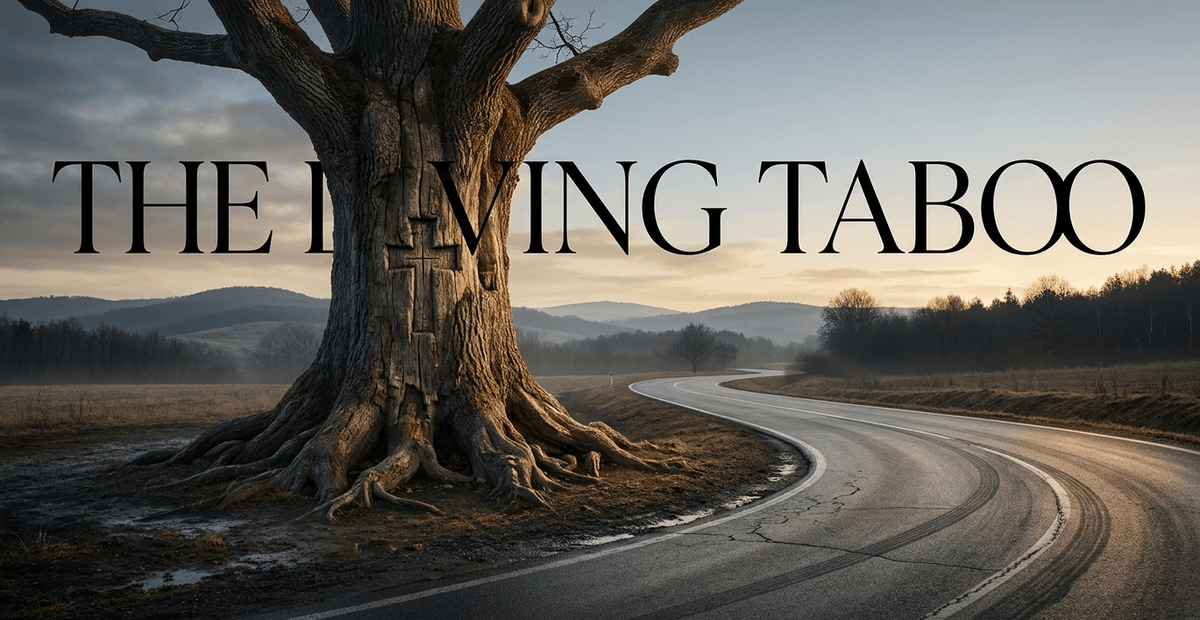
This continuity says something about why the World Tree endured as long as it did. It wasn't just a myth about a distant pantheon. It was a working method for relating to the environment - a reminder that the ground beneath a village's feet was never separate from its highest ideals or its deepest history.

Share now









Key takeaways
- The Slavic World Tree is most often identified as a sacred oak, serving as the axis mundi connecting three cosmic realms: Prawia, Jawia, and Nawia.
- Perun, the thunder god, was pictured as an eagle in the crown of the tree; Veles, god of the underworld and magic, was pictured as a serpent or dragon coiled among the roots.
- Oaks are struck by lightning more often than most trees - a phenomenon the ancient Slavs read as visible evidence of Perun's power.
- The number seven - three vertical realms plus four horizontal directions - symbolised totality and a complete universe in Slavic tradition.
- In 1908, 1975, and 1984, archaeologists recovered ancient oak trunks from the Dnieper and Desna rivers with boar jaws deliberately embedded in the wood, dated to roughly the 8th-10th centuries.
- Sacred oak groves functioned as legal and diplomatic centres, where oaths were considered unbreakable and shedding blood was strictly forbidden.
- The 12th-century chronicler Helmold of Bosau documented a fenced sacred grove dedicated to the god Prove among the Polabian Slavs, used for weekly judgment gatherings with the local duke.
- Healing rituals involved hammering strands of a sick person's hair or clothing into an oak's bark, believing the tree could absorb the illness.
- In 988, when Prince Vladimir of Kiev adopted Christianity, chronicles describe his idol of Perun being dragged to the Dnieper and thrown in, with men posted to stop it washing ashore.
- In Serbia, the Zapis tradition - sacred trees marked with a carved cross during an annual zavetina rite - survives today, protected by strong communal taboos.
- Some Serbian road construction projects have been rerouted specifically to avoid disturbing a Zapis tree, and the Takovski Grm oak marks the site of the 1815 Second Serbian Uprising.
- Comparable World Tree cosmologies appear across the wider Indo-European family, including Norse Yggdrasil and the Baltic thunder god Perkūnas, who was likewise linked to the sacred oak.
Sources
- Zapis (Wikipedia) https://en.wikipedia.org/wiki/Zapis
- Sacred Oaks of Serbia, International Oak Society https://www.internationaloaksociety.org/content/sacred-oaks-serbia
- Perun's Oak, Slovene.Online https://slovene.online/beliefs-of-slavs/perun-oak-part-4/
- Prawia/Prav, Jawia/Yav, and Nawia/Nav - The Three Realms of Slavic Mythology, Brendan Noble https://brendan-noble.com/prawia-prav-jawia-yav-and-nawia-nav-the-three-realms-of-slavic-mythology/
- Perun, EBSCO Research Starters https://www.ebsco.com/research-starters/religion-and-philosophy/perun
- Published 2026-08-02 10:14
- Modified 2026-08-02 10:14

-
Redaction