






-
 Redaction
Who owns the moon? An introduction to space law
Who owns the Moon? Space law says no one, but private space miners and rival nations are changing that. Here's what the legal frameworks actually say
Who owns the moon? An introduction to space law
The notion of owning a piece of the cosmos - perhaps a tranquil crater on the Moon or a distant asteroid rich in minerals - sparks the imagination. Yet when we turn our gaze to Earth's closest celestial neighbor, the question of ownership quickly becomes a complex and fascinating journey into the realm of international law. It's not a question answered by a simple deed or property line, but by decades of diplomatic effort and evolving legal frameworks designed to govern humanity's reach beyond our planet.
The short, clear answer, echoing through the halls of international jurisprudence, is that no country or individual owns the Moon. This foundational principle is upheld by the landmark 1967 Outer Space Treaty - and yet, as private companies begin eyeing the Moon's resources with serious intent, the question of what we can do up there is becoming more urgent and contested than ever.

The Outer Space Treaty: humanity's cosmic constitution
Imagine the excitement and trepidation of the mid-20th century as humanity first ventured beyond Earth's atmosphere. The Cold War was in full swing, and the space race was an intense arena of geopolitical competition. Recognizing the immense potential for both cooperation and conflict, the international community understood the urgent need for a framework to manage activities in this new frontier.
The result was the Outer Space Treaty (OST) - formally known as the "Treaty on Principles Governing the Activities of States in the Exploration and Use of Outer Space, including the Moon and Other Celestial Bodies." Opened for signature on January 27, 1967 and entering into force on October 10, 1967, it has since become the cornerstone of international space law, routinely referred to as the "constitutional rule of space law."
"Outer space, including the Moon and other celestial bodies, is not subject to national appropriation by claim of sovereignty, by means of use or occupation, or by any other means." - Article II, Outer Space Treaty, 1967
At its heart, the OST establishes several principles that continue to guide space activities today.

Key principles of the Outer Space Treaty
Non-appropriation. This is perhaps the most fundamental principle regarding ownership. Article II of the OST explicitly states that outer space, including the Moon and other celestial bodies, is "not subject to national appropriation by claim of sovereignty, by means of use or occupation, or by any other means." No nation can plant a flag and declare the Moon its territory. The Moon, in essence, belongs to no single nation.
Benefit of all humankind. The treaty mandates that the exploration and use of outer space "shall be carried out for the benefit and in the interests of all countries and shall be the province of all mankind." This aspirational goal underscores a collective responsibility - space should serve humanity as a whole, not a privileged few.
Freedom of exploration and use. While prohibiting appropriation, the OST also champions universal access. Outer space is "free for exploration and use by all States" on a basis of equality, ensuring no single nation can restrict another's ability to explore or conduct scientific research.
Peaceful purposes. A crucial tenet born from Cold War anxieties, the treaty dictates that the Moon and other celestial bodies "shall be used exclusively for peaceful purposes." This explicitly prohibits military bases, weapons testing, or military maneuvers on any celestial body.
State responsibility. Nations are held accountable for their actions in space, whether those activities are carried out by government agencies or private companies. This liability principle encourages safe and responsible practices.
Astronauts as envoys. In a beautifully idealistic provision, astronauts are to be regarded as "envoys of mankind" - ambassadors for all of humanity in the vastness of space, not merely representatives of their home nations.
As of October 2025, 118 nations are parties to the Outer Space Treaty, with another 20 as signatories - a remarkable consensus that includes every major spacefaring power on Earth.

The Moon Treaty: an ambitious but less adopted framework
Building on the OST's foundation, the international community made another significant attempt with the Agreement Governing the Activities of States on the Moon and Other Celestial Bodies, more commonly known as the Moon Treaty. Adopted by the UN General Assembly in 1979 and entering into force in July 1984, it aimed to address ambiguities about resource utilization on celestial bodies.
The Moon Treaty went further than its predecessor in several key ways:
- Common heritage of mankind. Article 11 explicitly declared the Moon and its natural resources as the "common heritage of mankind" - implying that these resources should be managed for the benefit of all, with particular attention to developing countries.
- Extended non-appropriation. Neither the surface nor the subsurface of the Moon, nor any of its natural resources, "shall become property of any State, international intergovernmental or non-governmental organization, national organization or non-governmental entity or of any natural person." This sought to close loopholes the OST left open for private or corporate claims.
- International regime. The treaty proposed establishing an "international regime" to govern the exploitation of natural resources when such exploitation became feasible, ensuring equitable sharing of benefits.
- Peaceful purposes. Like the OST, the Moon Treaty bans all military use of celestial bodies.
Despite these progressive provisions, the Moon Treaty failed to gain the traction it needed. It has never been ratified by any nation that conducts self-launched human spaceflight - meaning the United States, Russia, and China are all absent from its list of parties. As of 2024, only 17 states are parties to the agreement. It's often cited as the cautionary tale of what happens when a space treaty gets too far ahead of the nations most capable of enforcing it.
Private property claims and resource utilization: a legal gray area
While the Outer Space Treaty clearly prohibits national appropriation, it is deliberately open-textured when it comes to private use. That ambiguity has opened the door to decades of debate - and some genuinely creative legal arguments.
Over the years, individuals and organizations have tried to "sell" lunar deeds and claim portions of the Moon's surface. These claims carry no legal standing under existing international frameworks. Legal scholars and governments are broadly in agreement: such deeds are null and void.
But the real frontier isn't lunar real estate. It's resources.

The potential for vast quantities of water ice, helium-3, titanium, and rare earth minerals on the Moon and asteroids has transformed what was once a philosophical debate into a pressing commercial one. Companies like ispace, Astrobotic, Firefly Aerospace, and Intuitive Machines have already flown or are planning lunar missions. The Moon is no longer just a scientific destination - it's being eyed as an economic one.
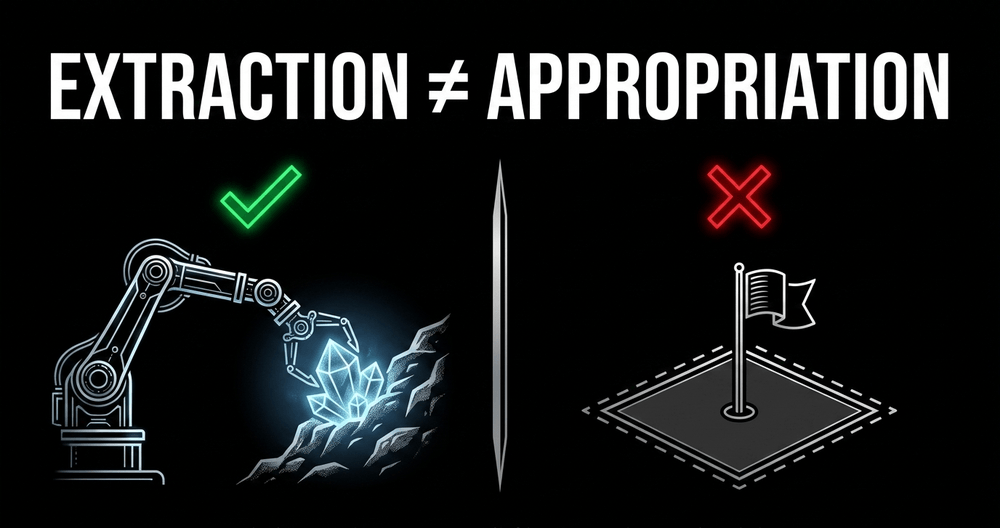
In 2015, the United States took a landmark step with the U.S. Commercial Space Launch Competitiveness Act (CSLCA). This legislation affirmed that U.S. citizens may extract and utilize space resources, explicitly stating that doing so "does not inherently constitute national appropriation" under Article II of the OST. The logic draws on an analogy that has become central to space resource law: just as fishing in international waters is legal even though no nation owns the ocean, mining resources from the Moon doesn't require owning the Moon.
The U.S. wasn't alone for long. Luxembourg passed its own space resources law in 2017 - and notably, allows non-Luxembourg companies to obtain licenses under its framework, making it a popular option for international commercial ventures. The UAE followed in 2019, Japan in 2021, Brazil in 2024, and Italy enacted its law as recently as June 2025. Six nations now have domestic legislation recognizing rights over extracted space resources. Critics argue this patchwork of national laws creates de facto appropriation through the back door. Proponents say it gives private investors the legal certainty they need to fund missions at all.
It's a genuinely unresolved debate - and the Moon's south pole, with its confirmed deposits of water ice, is where the tension is most likely to come to a head. For more on the race to reach those resources, see the ongoing lunar rush and what's at stake.
The Artemis Accords: charting a new path for lunar collaboration
In 2020, NASA and the U.S. Department of State launched the Artemis Accords - a set of principles designed to guide civil space exploration in the 21st century, with a particular focus on the Moon, Mars, and other celestial bodies. They are not a replacement for the OST, but rather a practical, principle-based framework layered on top of it.
What makes the Artemis Accords unusual is their structure. They're non-binding bilateral agreements between the United States and individual signatory nations - not a multilateral treaty negotiated through the UN. This makes them more agile and easier to join than a formal treaty, but also means they lack enforcement mechanisms of their own.
Their core principles include:
- Space resources. The Accords affirm that resource extraction "can and should be executed in a manner that complies with the Outer Space Treaty" and "does not inherently constitute national appropriation." This directly extends the philosophy of the 2015 U.S. legislation to an international framework.
- Transparency. Signatories commit to sharing scientific data openly.
- Interoperability. Common systems and standards are encouraged to make collaboration easier.
- Emergency assistance. Nations commit to helping astronauts in distress, regardless of their national origin.
- Protecting heritage sites. Apollo landing sites and other historically significant locations are recognized as deserving protection.
- Orbital debris mitigation. Signatories commit to responsible end-of-life disposal of spacecraft and limiting new debris generation.
- Deconfliction of activities. Signatories agree to prevent harmful interference with each other's operations, with safety zones established around active projects.

The momentum behind the Accords has been striking. What began with eight founding nations on October 13, 2020 - Australia, Canada, Italy, Japan, Luxembourg, the United Arab Emirates, the United Kingdom, and the United States - has grown into a global coalition. As of May 7, 2026, 67 nations have signed the Artemis Accords, following a new wave of signatories including Latvia, Jordan, Morocco, Malta, Ireland, and Paraguay. The signatories now span every continent except Antarctica, with Europe leading in numbers.

It's worth noting, however, who is not in this coalition. Neither Russia nor China has signed the Artemis Accords. Russia has long objected to the framework as too U.S.-centric. China, meanwhile, is developing its own lunar program in partnership with Russia, aiming for human lunar landings by 2030 and a jointly built International Lunar Research Station by 2035. This geopolitical divide - one coalition following the Artemis Accords, another operating outside it - is one of the defining tensions in contemporary space governance.
The UN working group: toward a global framework
Outside the Artemis Accords process, quieter but significant work is happening at the United Nations. The Committee on the Peaceful Uses of Outer Space (COPUOS) established a Working Group on the Legal Aspects of Space Resource Activities, and in March 2025, the group released an initial draft of recommended principles for space resource activities.
These draft principles represent a different approach from the Artemis Accords. Rather than treating the right to extract resources as flowing automatically from the OST's freedom of use, the UN working group is moving toward what some legal scholars have called a "conditional legitimacy" model - where the legitimacy of extraction depends on compliance with multilateral norms, including sustainable practices and benefit-sharing. The working group is expected to submit its final report by 2027.
Whether these principles will attract meaningful buy-in from major spacefaring nations remains to be seen. But their existence signals that the broader international community is not content to let the Artemis Accords and a patchwork of national laws fill the governance vacuum alone.
The future of lunar governance and exploration
The question of "who owns the Moon" might seem settled by the OST's non-appropriation principle. But the nuances of resource utilization, the ambitions of private companies, and the geopolitical contest between spacefaring powers continue to press hard against the edges of a legal framework designed nearly sixty years ago.
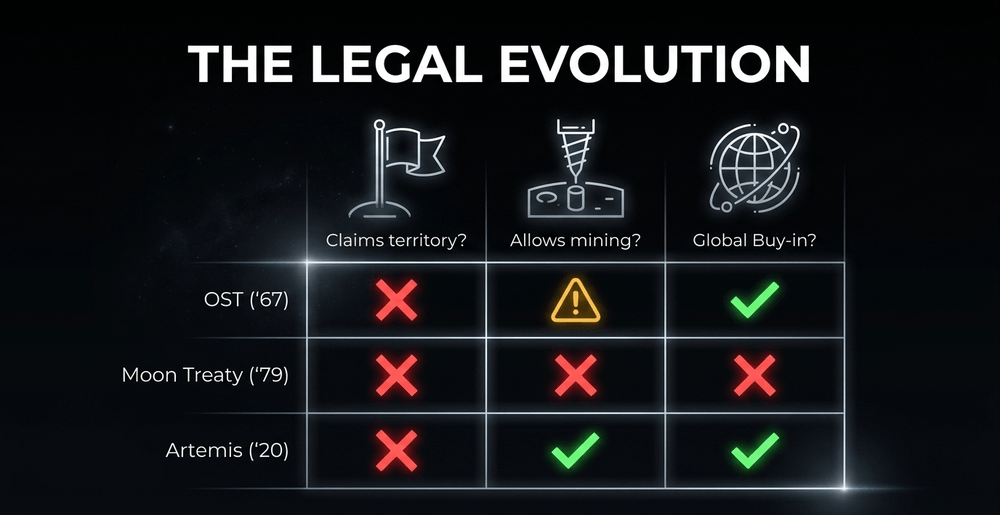
The Moon Treaty's near-total failure to attract ratification from major space powers shows that ambitious international governance only works when the most powerful actors see it in their interest to participate. The Artemis Accords' rapid growth in signatories suggests that a pragmatic, principle-based approach can build real momentum - but the absence of Russia and China reveals its limits as a truly global framework.
What seems increasingly clear is that the coming decade will test these frameworks in ways their authors never anticipated. More than 250 lunar missions from at least six countries and numerous private companies have been announced for the next decade. Australia's lunar rover is already planned for 2026. Companies like AstroForge and ispace are actively developing asteroid and lunar mining capabilities. The Moon's south pole, with its water ice that could be converted into rocket propellant, is becoming a destination that multiple actors are racing toward simultaneously.
The legal and diplomatic infrastructure needed to manage that reality - preventing dangerous conflicts over prime resource sites, protecting heritage locations, ensuring smaller nations aren't simply excluded from the benefits - is still very much a work in progress.

As we gaze up at the Moon, it's worth remembering that its future is not just a scientific or commercial question. It is fundamentally a question about what kind of civilization humanity chooses to be - whether we can extend the principles of cooperation and shared benefit that underpin our best international institutions into the ultimate frontier, or whether the cosmos simply becomes another arena for the same old competitions. The legal frameworks now being written and negotiated will shape that answer for generations to come.
Share now









Key takeaways
- No country or individual legally owns the Moon. The 1967 Outer Space Treaty (OST), now ratified by 118 nations, is the cornerstone of international space law and explicitly prohibits national appropriation of any celestial body.
- Article II of the OST states that outer space "is not subject to national appropriation by claim of sovereignty, by means of use or occupation, or by any other means" - making territorial claims on the Moon illegal under international law.
- The OST's core principles include non-appropriation, benefit of all humankind, freedom of exploration, peaceful purposes, and state responsibility for both governmental and private space activities.
- Astronauts are legally recognized as "envoys of mankind" under the OST - a provision that transcends national identity and elevates their status as ambassadors for all of humanity.
- The 1979 Moon Treaty declared the Moon's natural resources the "common heritage of mankind," but has been ratified by only 17 nations as of 2024 - none of them major spacefaring powers (the U.S., Russia, and China are all absent).
- Private property claims on the Moon have no legal standing under existing international frameworks. "Lunar deeds" sold by private individuals or companies are considered null and void by legal scholars and governments.
- The U.S. Commercial Space Launch Competitiveness Act (2015) established that U.S. citizens may own and sell extracted space resources - drawing an analogy to fishing rights in international waters, where use is permitted even though ownership of the ocean is not. Six nations (the U.S., Luxembourg, UAE, Japan, Brazil, and Italy) now have similar domestic legislation.
- The Artemis Accords, launched in 2020, are a non-binding set of principles for civil space exploration grounded in the OST. As of May 7, 2026, 67 countries have signed - representing every continent except Antarctica.
- Russia and China have not signed the Artemis Accords. China aims for human lunar landings by 2030 and plans a joint International Lunar Research Station with Russia by 2035 - outside the Artemis framework, creating a significant geopolitical divide in space governance.
- The UN COPUOS Working Group on Space Resource Activities released draft recommended principles in 2025 and is expected to deliver a final report by 2027, moving toward a multilateral governance framework that ties the legitimacy of resource extraction to compliance with international norms.
Sources
- United Nations Office for Outer Space Affairs (UNOOSA) - Outer Space Treaty https://www.unoosa.org/oosa/en/ourwork/spacelaw/treaties/introouterspacetreaty.html
- NASA - Artemis Accords https://www.nasa.gov/artemis-accords/
- U.S. Department of State - Artemis Accords Signatories https://www.state.gov/bureau-of-oceans-and-international-environmental-and-scientific-affairs/artemis-accords
- Arms Control Association - The Outer Space Treaty at a Glance https://www.armscontrol.org/factsheets/outer-space-treaty-glance
- The Conversation - Moon mining is getting closer to reality: why we need global rules https://theconversation.com/moon-mining-is-getting-closer-to-reality-why-we-need-global-rules-for-extracting-space-resources-259343
- Published 2026-06-19 22:31
- Modified 2026-06-19 22:31

-
Redaction