






-
 Redaction
Satellites are changing Earth's atmosphere
Satellites burn up and seed Earth's atmosphere with aluminum oxide. Scientists warn of ozone depletion, climate shifts and our fast-disappearing dark skies.
Step outside on a clear, moonless night, give your eyes ten minutes to adjust, and look up. Wait long enough and you'll see one: a steady point of light gliding smoothly across the stars, often brighter than anything else up there, gone within a couple of minutes. A decade ago, that sight made people stop and point. Today it's almost background noise - because what you've likely just watched is one of more than 14,000 active satellites now circling Earth, with dozens more crossing overhead on any given night.
What's far harder to see is what happens when those satellites die. Every one of them eventually comes home - not gently, but in a flash of heat that turns solid aluminum into fine dust and scatters it through layers of atmosphere that took billions of years to settle into balance. That process is now happening often enough, and at a scale large enough, that atmospheric chemists, ozone researchers, and astronomers have all, independently, arrived at the same uneasy conclusion: orbit isn't empty anymore, and what comes down from it doesn't simply vanish.
This is the story of the satellite boom's quietest consequence: what it's doing to the air above our heads.
How did we get here so fast?
Numbers tell this story better than almost anything else. In 2019, roughly 2,000 active satellites orbited Earth. Today that figure has passed 14,000 - and by some live trackers, it's already nudging past 14,500. To put that growth in perspective: more spacecraft have reached orbit in the past four years than in the entire seven decades of spaceflight that came before them.
SpaceX's Starlink constellation is responsible for most of that surge. More than 10,600 Starlink satellites are currently operational, out of a fleet the company has regulatory approval to grow to 42,000.

And SpaceX is far from alone. Amazon's Project Kuiper is steadily filling out its planned network of more than 3,000 satellites, OneWeb continues to expand its own constellation, and China has approved two enormous projects of its own - the Guowang and Qianfan constellations, together licensed for tens of thousands more satellites. Stack every publicly filed plan together, and credible estimates put the total number of satellites that could be in orbit by 2040 somewhere north of 60,000.
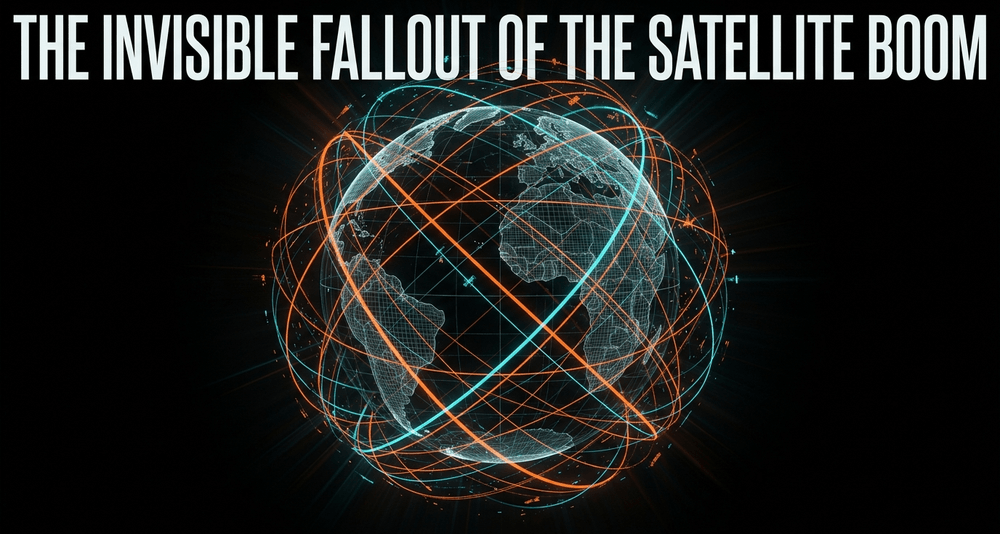
None of this happens slowly. 2025 set a new record for orbital launches worldwide - more than 300 of them, the vast majority carrying batches of small satellites rather than a single large spacecraft. At the current pace, a defunct satellite re-enters the atmosphere roughly every one to two days. Each of those re-entries is, on its own, a tiny and unremarkable event. Collectively, they add up to something the atmosphere has never experienced before.
From spacecraft to stardust
Here's the part that surprises most people: a satellite burning up on re-entry isn't a failure of the system. It's the system working exactly as designed.
For years, the standard plan for a dead satellite has been to let it fall, heat up, and disintegrate in the upper atmosphere rather than survive long enough to hit the ground. From a debris-management point of view, that's a genuine success - it keeps chunks of metal from raining down on cities. But "disintegrate" doesn't mean "disappear." It means converted.
When a satellite plunges through the mesosphere - the layer of atmosphere roughly 50 to 85 kilometers up - friction with the air heats its aluminum structure to thousands of degrees. The metal doesn't just melt; it vaporizes, then almost instantly reacts with oxygen to form aluminum oxide, a fine ceramic dust. A widely cited estimate suggests that a typical 250-kilogram satellite, built from roughly 30 percent aluminum, generates somewhere around 30 kilograms of these nanoparticles during its final plunge.
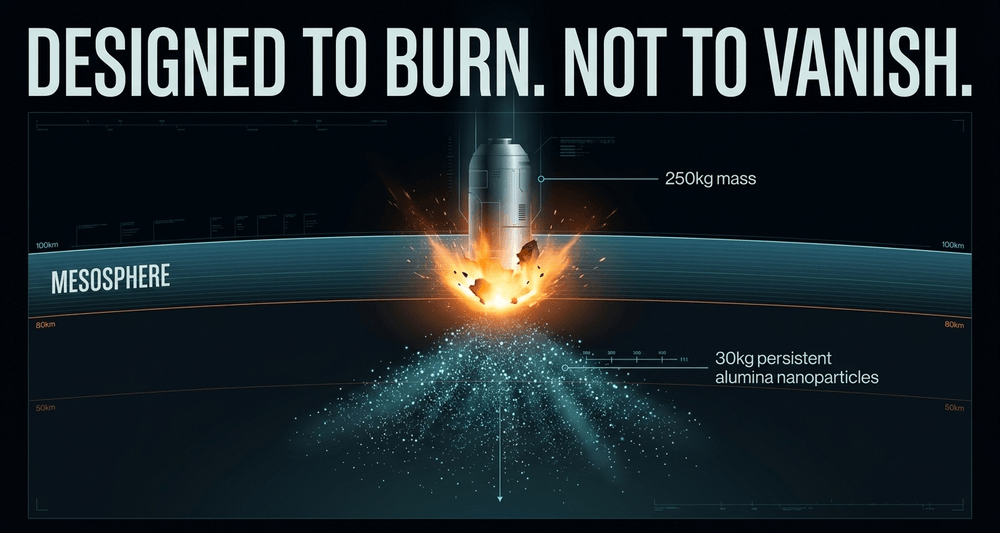
Thirty kilograms per satellite doesn't sound like much on its own. But multiply it by thousands of re-entries a year - a figure projected to climb toward tens of thousands within the next decade - and the picture changes completely. If you're curious about just how quickly objects can fall out of orbit once their working life ends, it's worth reading about how solar activity can dramatically accelerate that descent; the sun's own cycles have become an unexpected variable in how fast this dust accumulates.
A new kind of dust settling over us
For a long time, this was mostly theoretical - a worrying extrapolation rather than a direct measurement. That changed when a NASA-NOAA research flight sampled the stratosphere using an instrument sensitive enough to analyze individual particles one at a time.
What it found was striking. Alongside the usual background of meteoric "space dust," researchers identified particles carrying an entire inventory of industrial metals - silver, iron, lead, magnesium, titanium, beryllium, chromium, nickel, zinc, and lithium - bearing the chemical signatures of spacecraft alloys rather than space rocks. Roughly one in ten of the large aerosol particles sampled in the stratosphere already carried this kind of metallic fingerprint, a proportion researchers warned could climb toward half as the satellite population keeps growing.

Then, in a landmark step, researchers at Germany's Leibniz Institute for Atmospheric Physics used a highly sensitive resonance fluorescence lidar system to do something that had never been done before: trace one specific satellite re-entry to a detectable pollution plume in the atmosphere, in real time. It was the moment a model became an observation - the kind of result that tends to focus minds across an entire research field.
Ozone's newest - and strangest - adversary
To understand why aluminum oxide matters so much, it helps to remember a genuinely good story: the ozone layer's recovery. The Montreal Protocol, signed in 1987, phased out the chlorofluorocarbons that had torn a hole in the ozone layer over Antarctica. Decades of careful monitoring have shown that recovery is real, if slow. It's one of the few times humanity has identified a global atmospheric problem, agreed on a fix, and actually watched it work.
Which is exactly what makes this new finding so unwelcome. Aluminum oxide turns out to be an extremely efficient catalyst for the same chlorine-driven reaction that destroys ozone - and unlike the substances targeted by the Montreal Protocol, it isn't consumed in the process. Each particle can go on splitting ozone molecules more or less indefinitely, for as long as it stays suspended in the stratosphere.
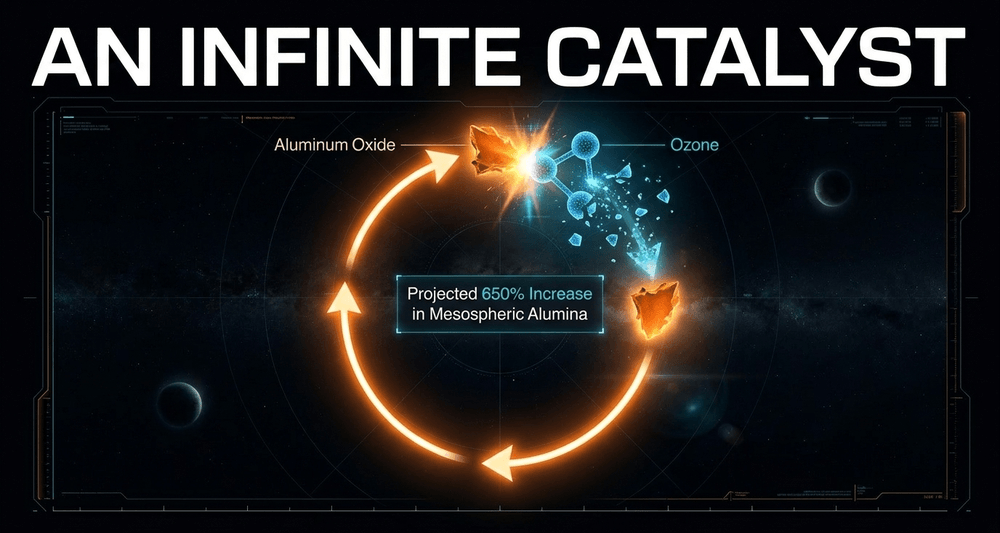
The numbers researchers have modeled are sobering. In 2022, satellite re-entries pumped an estimated 17 metric tons of aluminum oxide into the mesosphere - already enough to raise atmospheric aluminum levels by roughly 29.5 percent above the natural background. If megaconstellation buildouts proceed as currently planned, that figure could climb toward 360 metric tons a year - a roughly 650 percent increase in ozone-damaging aluminum oxides within a few decades. And because these particles can take up to 30 years to drift down from the mesosphere into the ozone-rich stratosphere, the pollution generated today is really a preview of conditions still to come.
It's worth holding two things in mind at once here, because the picture is genuinely more nuanced than "rockets are destroying the ozone layer." Kerosene-fueled rockets like the Falcon 9 don't emit chlorine directly, and one recent projection suggests that all rocket launches combined will deplete global ozone by only around 0.02 percent by 2029 - a tiny fraction of the roughly 2 percent attributed to the substances the Montreal Protocol targeted. The aluminum oxide problem is fundamentally a re-entry problem, not strictly a launch problem, and the science around it is still actively developing. What isn't in doubt is the direction of travel, or the fact that the volumes involved will only grow as more satellites go up - and, eventually, come back down.
Black carbon: the climate wildcard nobody priced in
Aluminum oxide isn't the only pollutant accumulating up there. The other major one is black carbon - soot - produced by kerosene-fueled rocket engines during launch, and released again when rocket bodies and satellites burn up on re-entry.
A major 2026 study published in Earth's Future, led by researchers at University College London, found that black carbon from rocket launches and re-entries behaves very differently from the soot coming out of a car exhaust or a coal plant. Ground-level soot gets rained out of the atmosphere within days or weeks. Soot injected directly into the stratosphere has no such escape route - it can linger there for years, and gram for gram, it carries roughly 500 times the climate impact of soot from surface-level sources.
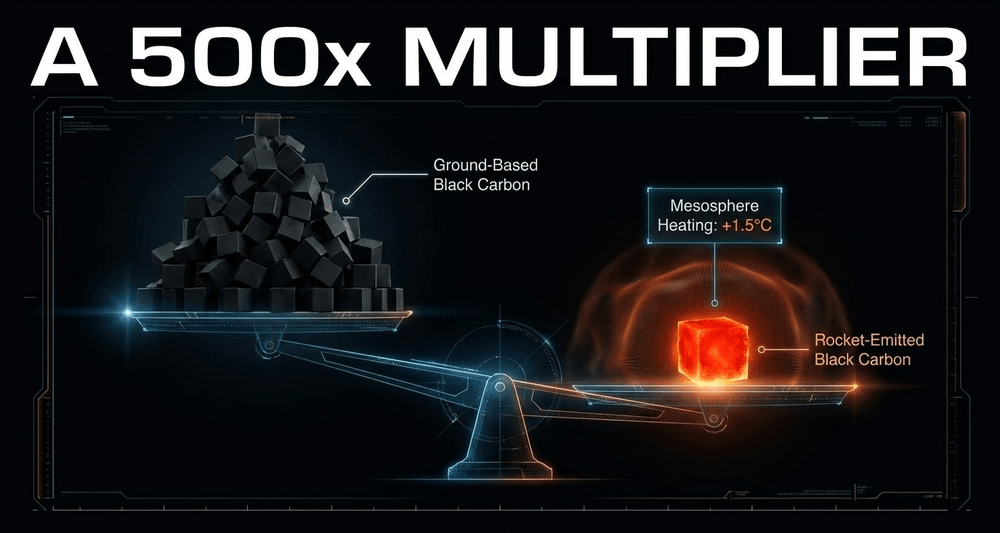
The same study found that megaconstellation-related launches and re-entries accounted for about 35 percent of the space sector's total climate impact in 2020, and projected that share to climb to 42 percent by 2029 - a shift driven almost entirely by the explosive growth in launch cadence over just a few years. By the end of the decade, the space industry as a whole could be releasing somewhere around 870 tons of soot into the upper atmosphere annually.
As the study's lead researcher, Professor Eloise Marais of UCL Geography, described it, the space industry's pollution amounts to "a small-scale, unregulated geoengineering experiment" - one whose long-term consequences remain genuinely uncertain. There's an ironic wrinkle here, too: some of these particles, including re-entry-generated alumina with an estimated atmospheric lifetime of one to two years, appear to have a net cooling effect, reflecting a sliver of sunlight back to space. That might sound like an accidental silver lining against the backdrop of global warming, but researchers are quick to caution against reading it that way. An unplanned, unregulated dimming of the atmosphere isn't climate policy, and accidentally nudging the planet's energy balance is not the same as doing so on purpose. If you want to understand why even small changes to how much sunlight reaches - or doesn't reach - the surface matter so much, Earth's albedo effect is the underlying mechanism at work, and it's a delicate balance to disturb.
When megaconstellations crowd the cosmos
Everything described so far happens at altitudes most of us will never visit, in concentrations no human will ever taste or smell. The next consequence, though, is one anyone can see for themselves - and one that's already reshaping how we explore the universe.
For professional astronomers, a satellite streaking across a long-exposure image isn't a curiosity. It's lost data - sometimes a wiped-out detection of something that will never appear in that exact configuration again. A December 2025 study published in Nature modeled what happens if the satellite constellations already proposed are actually completed. The results: roughly one-third of Hubble Space Telescope images would end up contaminated by satellite trails, while newer wide-field space telescopes - including NASA's SPHEREx, Europe's planned ARRAKIHS mission, and China's Xuntian observatory - would see more than 96 percent of their exposures affected, with anywhere from roughly half a dozen to nearly a hundred satellite trails crossing a single image.
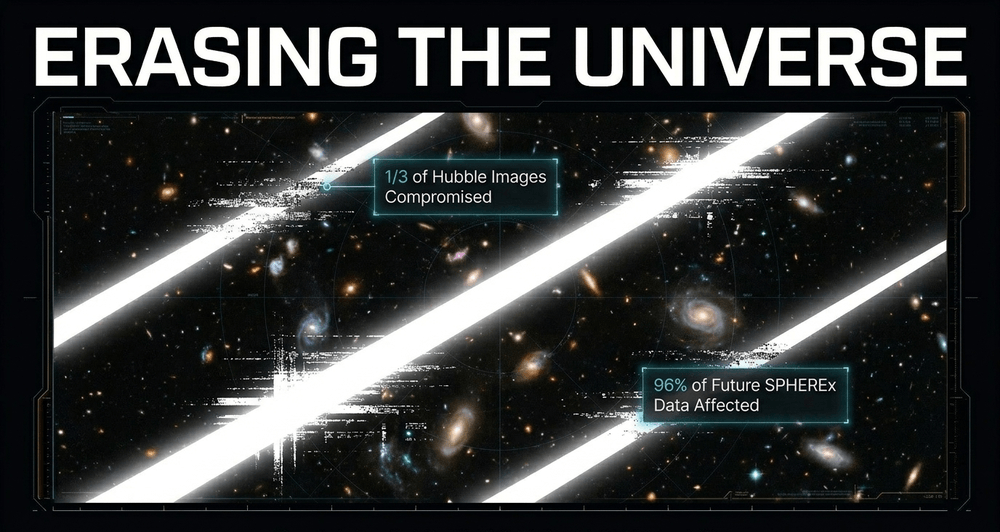
Ground-based observatories face the same problem from below. The Vera C. Rubin Observatory, built specifically to survey the entire sky and catch faint, fast-moving objects like near-Earth asteroids, is especially exposed - bright satellite streaks can mimic or mask exactly the kind of transient signals it's designed to find. The observatory will still do extraordinary science, but the risk of subtle, systematic errors creeping into its data grows with every new constellation that launches. Latitudes around 50 degrees north and south - a band that happens to include much of Europe, Canada, and the northern United States - bear the brunt of it, since satellites there stay sunlit for longer stretches of the night.
The night sky as living heritage
There's a dimension to all of this that rarely makes it into technical papers, and it deserves more attention than it usually gets: what the night sky means to the people who have read it longest.
For tens of thousands of years, Indigenous communities around the world have observed, mapped, and passed down detailed knowledge of the night sky - knowledge woven inseparably into understandings of land, water, season, and community. One of the most remarkable examples is the Emu in the Sky, an Aboriginal Australian "dark constellation" - not a pattern of bright stars, but a shape formed by the dark dust lanes of the Milky Way itself. As artificial satellites scatter sunlight across the sky through the night, these subtle dark-sky features become measurably fainter, eroding a form of knowledge that depends on contrast and darkness to exist at all. For a sense of just how sophisticated these ancient sky-reading traditions were, it's worth exploring how other ancient cultures encoded astronomical knowledge into their monuments and calendars.
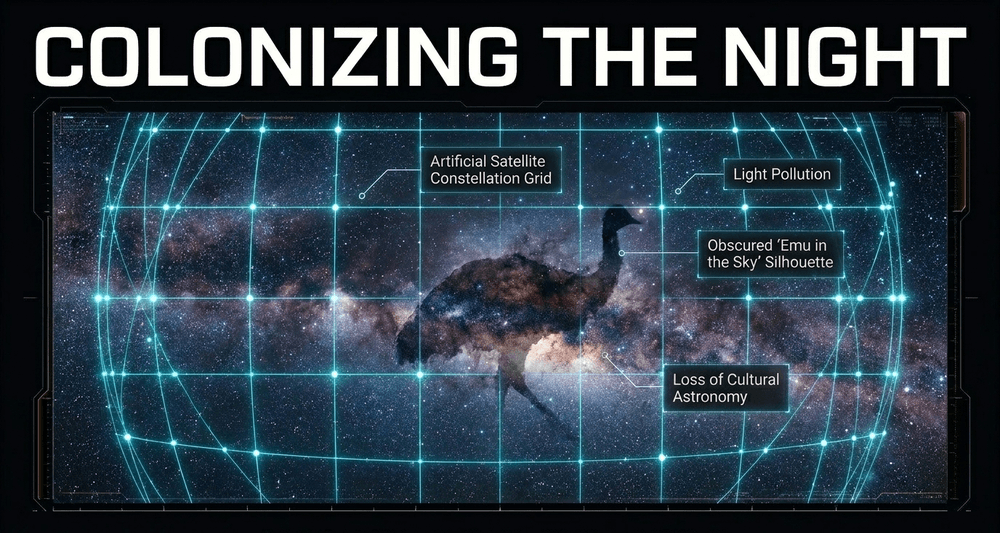
Many Indigenous communities describe the loss of dark skies as a form of ongoing colonialism - a shared resource being used up without anyone asking permission. The United Nations Declaration on the Rights of Indigenous Peoples recognizes a right to maintain and develop cultural heritage and traditional knowledge. Whether that protection extends to an unobstructed view of the night sky is, for now, a question nobody with regulatory authority has had to formally answer - largely because nobody has been required to ask it.
Proposals that would make all of this much bigger
If the current trajectory feels like a lot, consider what's already sitting in regulatory inboxes.
In early 2026, SpaceX filed an application with the FCC to launch and operate up to one million satellites as part of what it calls an "Orbital Data Center" system - solar-powered spacecraft intended to provide computing capacity for artificial intelligence applications, operating in orbits between 500 and 2,000 kilometers. Around the same time, California-based startup Reflect Orbital outlined plans for a constellation of up to 50,000 orbiting mirrors, designed to redirect sunlight back to Earth's surface on demand - effectively selling "sunlight after dark."
Major astronomical organizations have responded with unusual urgency. The Royal Astronomical Society, the European Southern Observatory, and the International Astronomical Union have all submitted formal objections to one or both proposals, warning that even a fraction of either constellation could fundamentally alter how the night sky looks from anywhere on Earth - not just for professional telescopes, but for anyone who steps outside after dark.
Who's actually steering this?
Here's the uncomfortable truth underlying everything above: there is currently no international framework that limits how many satellites can be launched based on their cumulative impact on the atmosphere, the ozone layer, or the night sky. Space law, as it exists today, focuses overwhelmingly on collision avoidance and national liability - questions of whose satellite hit what, not questions of what all of this, together, is doing to the planet.
If anything, the regulatory trend in early 2026 moved in the opposite direction. The U.S. Federal Aviation Administration withdrew a proposed rule that would have required rocket upper stages to be deorbited within 25 years of completing their mission, citing a need for further study. The FCC, meanwhile, continues to enforce its own five-year deorbit requirement for satellites under its jurisdiction - but in August 2025 it also opened a process to "streamline" its environmental review procedures, proposing that space-based operations be excluded from review entirely on the grounds that they're "extraterritorial activities" with no effects inside U.S. jurisdiction.
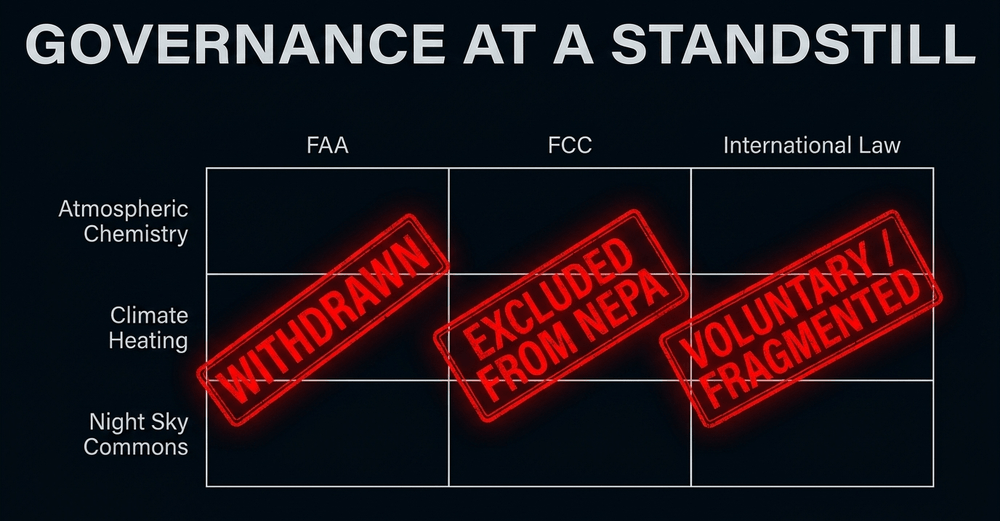
The argument, in plain terms, is that because satellites operate in space, they can't affect Earth's environment. The American Astronomical Society's light pollution working group, COMPASSE, pushed back directly, pointing out that the atmospheric and observational effects of satellite constellations are measurable on U.S. soil, at U.S.-funded observatories, using U.S. taxpayer-funded instruments - which is about as squarely "inside U.S. jurisdiction" as an effect can get.
Internationally, the picture is similarly patchwork. The European Space Agency has taken arguably the most proactive position with its Zero Debris Charter, a voluntary commitment to generate no new debris from ESA missions by 2030, built around "design-for-demise" principles - though its binding force extends only to ESA's own programs. The IAU's Centre for the Protection of the Dark and Quiet Sky coordinates international discussion on the issue, and at a recent session of the UN's Committee on the Peaceful Uses of Outer Space, twenty member states raised concerns about satellite interference and cultural heritage - a notable level of diplomatic attention for a topic that, until recently, barely registered. Researchers involved in the UCL study have framed it bluntly: rocket launches inject pollutants directly into one of the few genuinely pristine environments left on the planet, and almost nobody is currently required to account for that.

Can this be fixed?
None of this is an argument against satellites themselves. Global internet access, weather forecasting, climate monitoring, and disaster response coordination are real, substantial public goods, and megaconstellations have made all of them more capable and more accessible. The honest question isn't whether we should have satellites - it's how many, built from what, disposed of how, and overseen by whom.
There are reasons for cautious optimism on the technical side. SpaceX has experimented with darker satellite coatings and deployable sun shades specifically to reduce reflectivity and limit astronomical interference. Materials scientists are researching alternatives to aluminum that would produce less ozone-reactive byproducts on re-entry, and advocacy groups are pushing for binding brightness standards to be built directly into satellite licensing requirements - the same way emissions standards are built into car manufacturing.
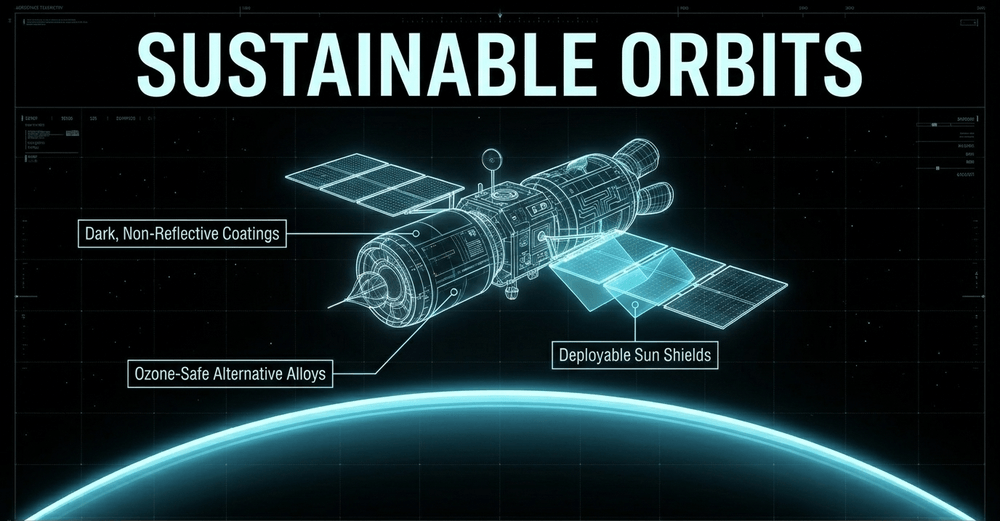
What's missing isn't ideas. It's pace. The gap between what companies can launch this year and what regulators can meaningfully evaluate this decade is widening, not narrowing - and an atmosphere that took billions of years to find its current balance is, in effect, being treated as an unlimited and self-cleaning resource. As researchers behind the UCL study have stressed, an accidental cooling effect from reduced sunlight might sound like welcome news set against global warming, but treating an unplanned side effect of telecommunications infrastructure as climate policy would be exactly the wrong lesson to draw from any of this.
Common questions about satellite pollution
How many satellites are actually in orbit right now? More than 14,000 active satellites are currently operating, with Starlink alone accounting for over 10,600 of them. Tens of thousands more are planned by operators including Amazon, OneWeb, and China's state-backed constellations, with credible projections putting the total above 60,000 by 2040.
Do satellites really pollute the atmosphere when they burn up? Yes. Satellites designed to "demise" on re-entry vaporize their aluminum structures in the mesosphere, converting solid metal into aluminum oxide nanoparticles. NASA and NOAA research flights have directly sampled the stratosphere and found particles carrying this and other metallic signatures from spacecraft re-entry.
Is this actually affecting the ozone layer? It's expected to, increasingly. Aluminum oxide acts as a long-lived catalyst for ozone-destroying chemical reactions. Current re-entry rates have already measurably increased atmospheric aluminum levels, and researchers project the ozone-depleting potential of these particles could rise by several hundred percent within a few decades if current launch trends continue.
Will the night sky keep getting brighter? Almost certainly, at least in the near term. Even without the largest proposed constellations, satellite numbers are projected to keep climbing sharply through the 2030s, and proposals like SpaceX's orbital data centers and Reflect Orbital's sunlight-reflecting mirrors could add hundreds of thousands of additional bright objects if approved.
Is anyone regulating this? Only partially. The FCC enforces a five-year deorbit rule for satellites under its jurisdiction, and the European Space Agency has its own voluntary Zero Debris Charter. But there's no binding international treaty that limits satellite numbers based on cumulative atmospheric or astronomical impact, and recent U.S. regulatory moves have generally reduced environmental review rather than expanded it.
The view from here
Go back outside, on that same clear night, and look up one more time. The point of light you tracked earlier is probably gone by now, over the horizon, on its way to wherever its orbit takes it next. In a few years, it'll come back down - converted, in a matter of seconds, into something that will spend up to three decades drifting through the same sky you're standing under.
That's the strange, almost vertiginous thing about this story: the most consequential part of it is also the hardest to perceive. No one will smell the aluminum oxide. No one will feel the extra fraction of a degree in the mesosphere, or notice the soot that doesn't wash out for years. The night sky will simply get a little brighter, the dark constellations a little fainter, the ozone layer's recovery a little more complicated - one re-entry at a time, every day or two, indefinitely.
None of that means the story is fixed in place. It means the window for shaping how it unfolds is open right now, while the numbers are still in the thousands rather than the millions, and while the science describing all of this is still being written rather than looked back on. The atmosphere has absorbed a great deal from us already, mostly without being asked. This time, at least, we know what's coming before it arrives - and that might be the most valuable thing of all.
Share now









Key takeaways
- More than 14,000 active satellites currently orbit Earth, up from roughly 2,000 in 2019 - some live trackers already put the figure past 14,500.
- SpaceX's Starlink constellation alone accounts for over 10,600 active satellites, out of a fleet approved to grow to 42,000.
- Combined plans from Amazon, OneWeb, China's Guowang and Qianfan constellations, and others could push the total number of satellites in orbit past 60,000 by 2040.
- A typical 250-kilogram satellite generates around 30 kilograms of aluminum oxide nanoparticles when it burns up, mostly in the mesosphere, 50-85 km above Earth.
- In 2022, re-entering satellites raised atmospheric aluminum levels by 29.5% above natural background, injecting an estimated 17 metric tons of aluminum oxide into the mesosphere.
- If megaconstellation growth continues as planned, annual aluminum oxide injection could reach 360 metric tons - a roughly 650% increase - with particles persisting up to 30 years before reaching the stratosphere.
- A 2026 UCL-led study in Earth's Future found that black carbon from rocket launches and re-entries has roughly 500 times the climate impact, gram for gram, of soot from ground-level sources.
- Megaconstellation-related pollution's share of the space sector's total climate impact is projected to rise from 35% in 2020 to 42% by 2029.
- NOAA research suggests accumulating alumina could warm parts of the mesosphere by up to 1.5°C and disrupt polar vortex dynamics.
- A December 2025 study in Nature found that full constellation buildout could contaminate about a third of Hubble Space Telescope images and affect more than 96% of exposures from future observatories like SPHEREx.
Sources
- UCL / Earth's Future - Radiative Forcing and Ozone Depletion of a Decade of Satellite Megaconstellation Missions (2026) https://agupubs.onlinelibrary.wiley.com/doi/10.1029/2025EF007229
- NOAA Chemical Sciences Laboratory - Within 15 years, plummeting satellites could release enough aluminum to alter winds, temps in the stratosphere https://csl.noaa.gov/news/2025/427_0428.html
- Scientific American - Satellite Mega Constellations Could Jeopardize Ozone-Hole Recovery https://www.scientificamerican.com/article/satellite-mega-constellations-could-jeopardize-ozone-hole-recovery/
- Inside Climate News - Commercial space race prompts thorny question: who owns the sky? https://www.insideclimatenews.org/news/13062026/commercial-space-race-prompts-thorny-question-who-owns-the-sky/
- IAU Centre for the Protection of the Dark and Quiet Sky from Satellite Constellation Interference https://cps.iau.org/
- Published 2026-06-16 22:10
- Modified 2026-06-16 22:10

-
Redaction