

-
 PRO
PRO -
 Redaction
What our ancestors really ate: The evidence
Stable isotope analysis and coprolite studies reveal how ancient humans survived through scavenging, hunting, and complex plant food processing.
Modern archaeology has moved beyond the simple cataloging of stone tools and pottery shards. Today, researchers increasingly reconstruct the diets of our ancestors through multiple lines of internal evidence. Several complementary methods now dominate this field: the analysis of coprolites (fossilized feces) for direct, short-term snapshots of meals; stable isotope analysis of skeletal remains for long-term dietary patterns; and emerging techniques including dental calculus analysis, ancient proteomics, and environmental DNA. Together, these approaches reveal that human survival involved a complex interplay of scavenging, gathering, hunting, selective food processing, and adaptation to diverse environments.
Insights from paleofeces
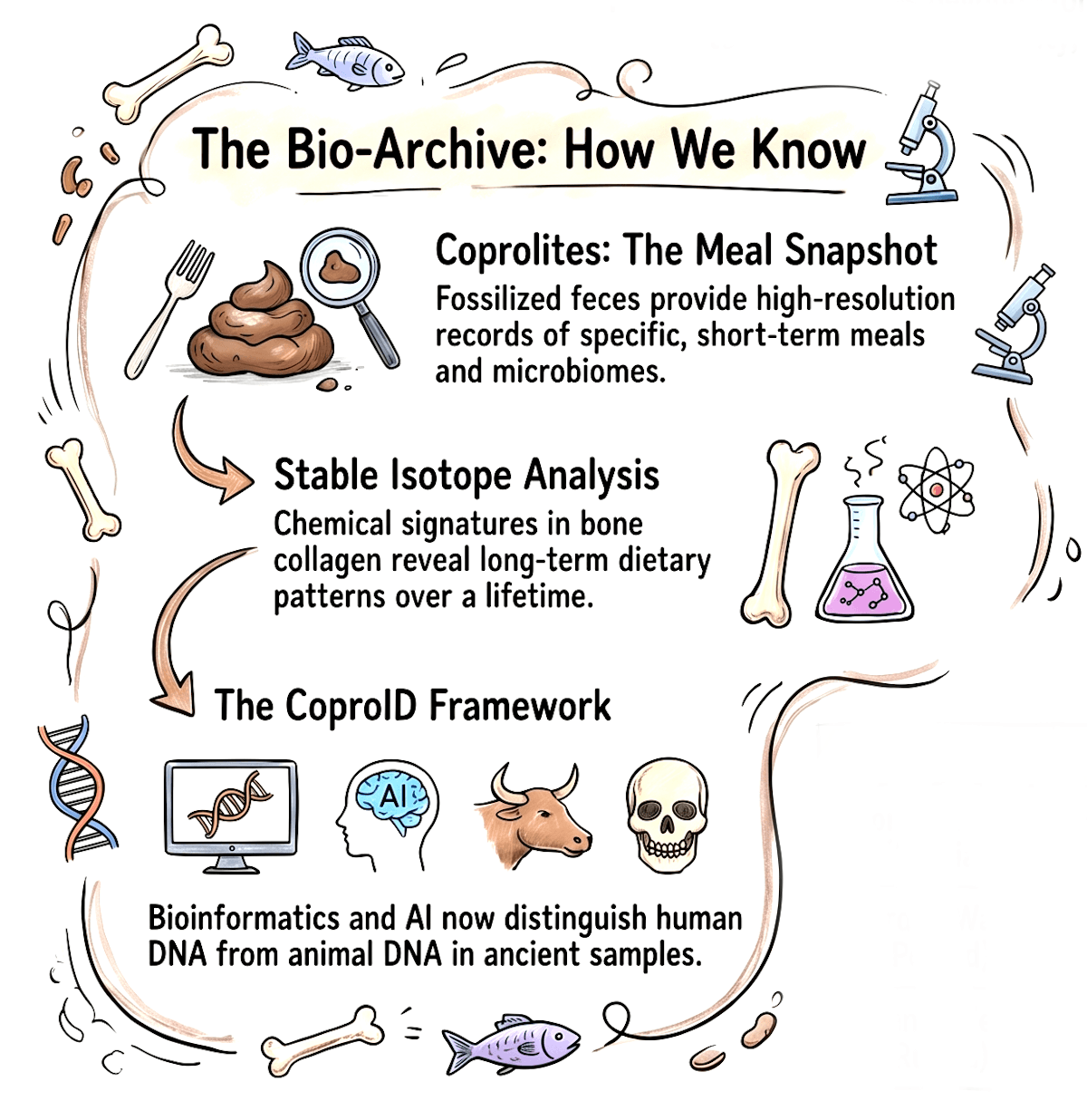
Coprolites provide a high-resolution record of individual meals. Unlike bone chemistry, which averages diet over years, a coprolite captures undigested residues from a relatively short period. Analysts examine macroscopic remains - such as seeds, fish scales, and bone fragments - as well as microscopic evidence including pollen, parasites, and starch granules. Chemical methods further identify plant cuticles and proteins.
A key methodological advance is the CoproID bioinformatics framework, published in 2020. It uses shotgun metagenomic DNA sequencing combined with machine learning to distinguish human paleofeces from canine ones (which can appear morphologically similar) and from non-fecal sediments. By integrating ancient host DNA with microbiome composition, CoproID enables more accurate reconstructions of the human microbiome and the specific plant and animal taxa consumed.
Coprolite studies from diverse contexts - including the Ocampo Caves in Mexico and Neolithic Swiss lake-dwelling sites - have expanded understanding of ancient plant processing and fiber intake. Pre-agricultural populations routinely consumed a remarkable diversity of flora, including roots, seeds, and leafy plants processed through grinding and heating.
Advancements in isotope analysis
While coprolites offer detailed snapshots, stable isotope analysis of bone collagen provides a broader, lifetime-scale narrative. Measurements of carbon (δ¹³C) and nitrogen (δ¹⁵N) isotopes help differentiate between marine and terrestrial resources, between plants using C₃ versus C₄ photosynthetic pathways, and indicate the relative contribution of animal protein.
Recent technological refinements include high-resolution mass spectrometry techniques such as Electrospray-Orbitrap (ESI-Orbitrap), which allow multi-isotopologue analysis on small sample sizes. Compound-Specific Isotope Analysis of Amino Acids (CSIA-AA) further disentangles complex dietary and metabolic signals that bulk analysis may obscure. These tools are increasingly combined with machine learning to improve dietary reconstructions and trace population movements.
Isotopic analysis of tooth enamel bioapatite adds another dimension: because enamel forms during childhood, it records the diet of early life rather than adulthood. Comparing enamel and bone collagen values from the same individual can therefore reveal dietary changes across a lifetime - including weaning age, migration, and social transition.
Dental calculus: the frozen dietary record
One of the most productive developments in recent paleodietary research is the systematic analysis of dental calculus - hardened mineralized plaque that accumulates on tooth surfaces during life. Unlike most organic materials, dental calculus mineralizes rapidly and can survive for hundreds of thousands of years, preserving a remarkable archive of dietary evidence that other methods cannot access.
Calculus routinely incorporates plant microfossils such as starch granules and phytoliths, ancient DNA from consumed plants and animals, lipids from cooked foods, and proteins including those from milk. Pioneering research by Christina Warinner and colleagues demonstrated that a single tooth can yield evidence for dozens of consumed plant and animal species.
This method revealed, for example, that certain medieval European populations consumed significant quantities of dairy and fish - evidence preserved in tooth calculus long after all food remains had disappeared from the archaeological record. In deeper prehistory, calculus from Neanderthals at sites such as El Sidrón in Spain yielded ancient DNA and plant microfossils confirming consumption of mushrooms, bark compounds, and diverse plant materials alongside animal prey - directly challenging earlier assumptions of an exclusively meat-based diet.
Ancient proteins and environmental DNA
Alongside isotope methods, palaeoproteomics - the recovery and analysis of ancient proteins - is transforming knowledge of prehistoric diet and species exploitation. The technique known as ZooMS (Zooarchaeology by Mass Spectrometry) identifies animal species from collagen peptide "fingerprints" preserved in bone fragments too small or morphologically ambiguous for conventional identification. This approach has proven particularly valuable at sites where bone assemblages are highly fragmented, enabling researchers to reconstruct the full range of species consumed with unprecedented precision.
Protein analysis has also been applied to residues on ceramic vessels and grinding stones, identifying dairy products, blood residues, and plant processing at sites across Europe, Africa, and Asia. Studies have recovered milk proteins from dental calculus in prehistoric individuals, demonstrating that the analytical toolkit now extends beyond what bones and seeds alone can tell us.
Environmental DNA (eDNA) extracted from sediment layers at archaeological sites further complements these approaches. By recovering genetic material shed by plants, animals, fungi, and humans into the surrounding environment, eDNA analysis reconstructs the broader ecological context of a site - including which species were seasonally available and potentially exploited - even in the absence of macroscopic remains.
Stability and change in the archaeological record
Recent studies highlight both remarkable stability and periods of dietary fluidity.
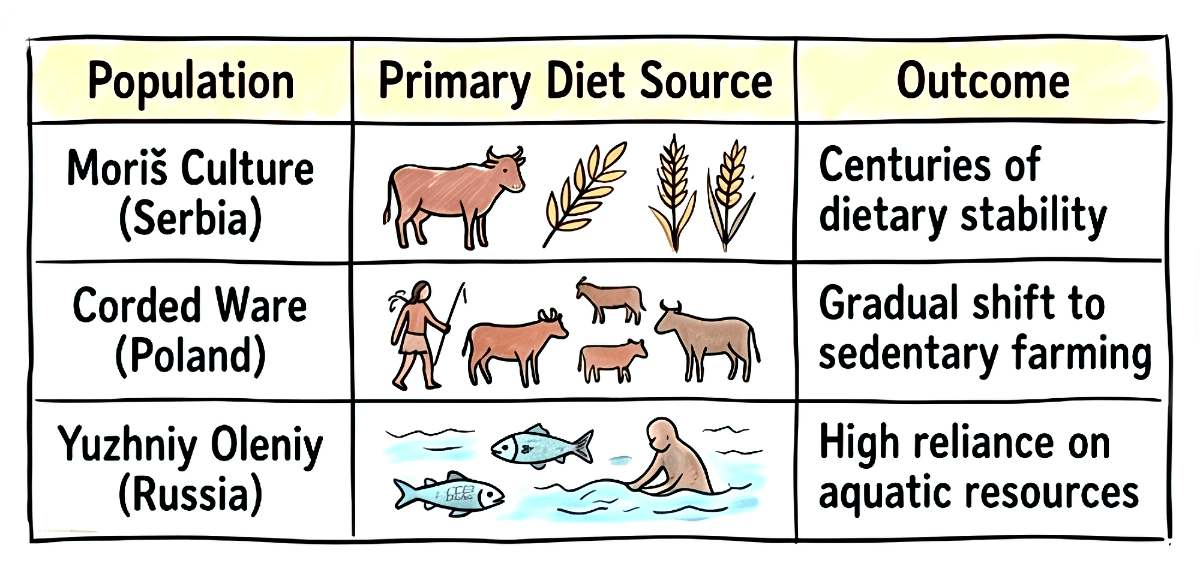
Research on the Moriš culture in the Middle Bronze Age of Serbia (approximately 2100-1550 BCE, within the broader cultural timeframe of ~2700-1500 BCE) analyzed stable carbon and nitrogen isotopes from human and animal bone collagen. Data from multiple cemeteries show a consistent reliance on livestock - primarily cattle, sheep, goats, and horses - supplemented by domestic C₃ plants. This dietary stability persisted for centuries, suggesting a resilient and sustainable agro-pastoral system that adapted to environmental and social changes without major shifts in core food sources.
In contrast, isotopic studies from prehistoric north-central Poland reveal more dynamic transitions. Early Corded Ware communities (around 2800 BCE) initially herded animals in forested areas or wet river valleys, producing isotopic signatures distinct from those of local sedentary farmers who used open grasslands. Over time, their diets became more similar to those of the established farming populations. By the Early Bronze Age, variations in nitrogen isotope values indicate that some individuals had greater access to animal protein, pointing to emerging social hierarchies and unequal resource distribution.
Survival strategies and environmental mastery
Human evolutionary success often stemmed from dietary flexibility. Our ancestors are increasingly understood as a "broad-spectrum" species, capable of exploiting diverse resources to buffer against seasonal shortages and environmental variability.
Multi-proxy isotope analysis (including bulk collagen, enamel bioapatite, and CSIA-AA) at the Mesolithic cemetery of Yuzhniy Oleniy Ostrov (Lake Onega region, north-western Russia) examined remains from around 60 individuals. Despite its inland location, the data reveal an unusually high reliance on freshwater resources from the Lake Onega system, with lower contributions from terrestrial game than might be expected. This underscores the importance of aquatic resources in certain hunter-gatherer-fisher economies.
Scavenging and the use of fire
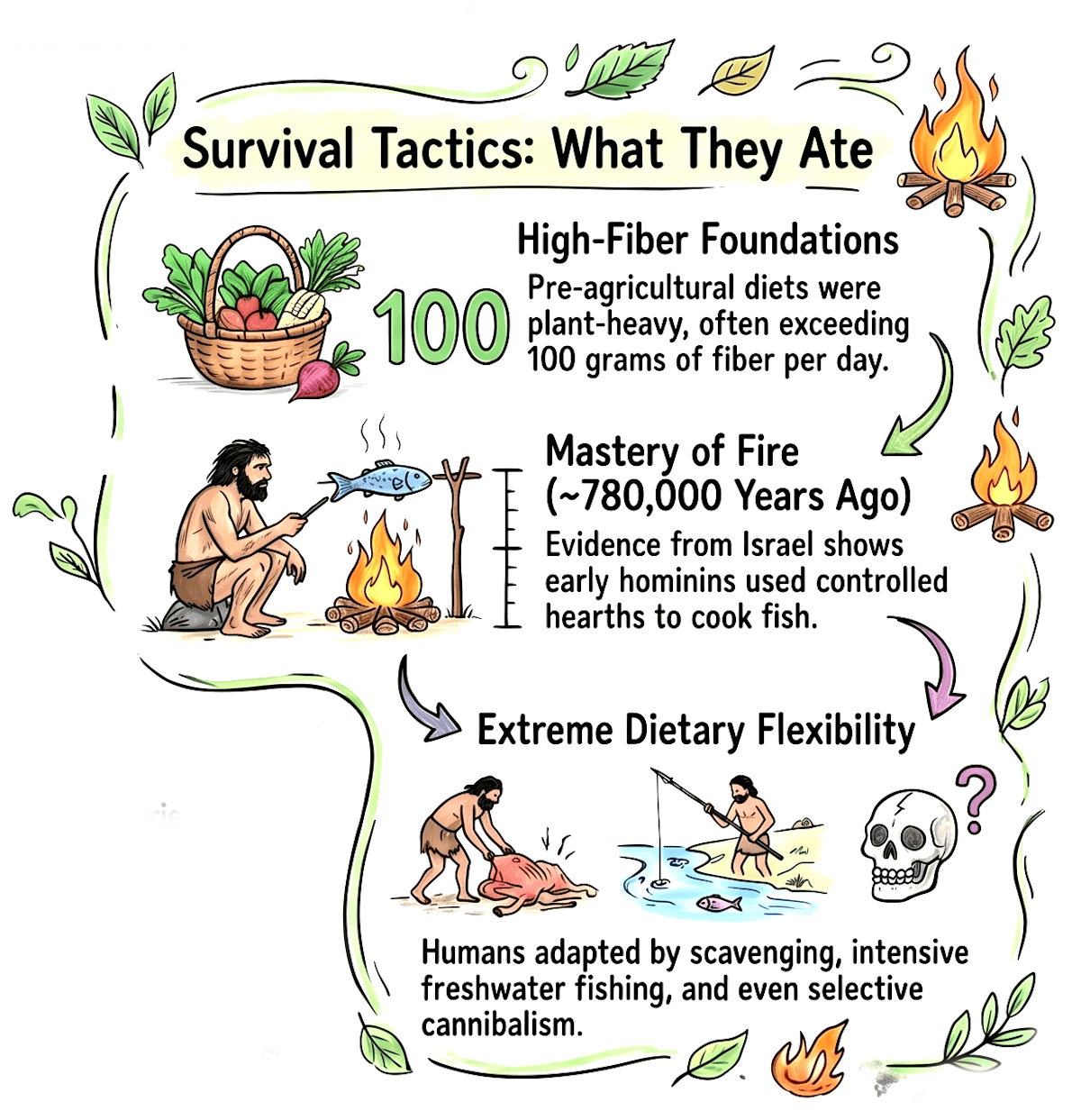
Scavenging of animal carcasses likely represented a significant, low-risk strategy for obtaining high-calorie marrow and meat. Biological adaptations such as high stomach acidity and endurance walking supported this opportunistic behavior. While scavenging complemented hunting throughout much of human evolution, its precise role continues to be refined through ecological modeling and archaeological evidence.
Mastery of fire dramatically expanded the human dietary niche. At Gesher Benot Ya'aqov in Israel (~780,000 years ago), evidence includes charcoal - primarily from driftwood gathered along the ancient lakeshore - associated with controlled hearth activity. Taphonomic and crystallographic analyses of fish remains (primarily two species of large cyprinids, Luciobarbus longiceps and Carasobarbus canis) show they were exposed to controlled low temperatures (below 500°C), consistent with deliberate cooking, probably in a hearth or earth-oven setting. This represents some of the earliest reliable evidence of hominins using fire to improve nutrient bioavailability and detoxify foods.
A landmark case: Ötzi the Iceman
Among the most thoroughly studied prehistoric individuals, Ötzi the Tyrolean Iceman (approximately 3300 BCE) offers an extraordinary window into Copper Age diet. Analysis of his stomach contents - preserved by rapid glacial freezing - revealed a final meal consumed roughly 30-60 minutes before his death: red deer, ibex, einkorn wheat, and wild plants including bracken fern. Fat analysis indicated a deliberate consumption of wild animal fat alongside lean meat, suggesting a strategic approach to caloric intake suited to high-altitude travel. Isotopic analysis of his tissues confirmed a diet high in animal protein, consistent with an alpine community that combined herding with wild-game hunting. Ötzi remains a landmark case demonstrating how exceptional preservation can validate and contextualize the methods applied to less-intact archaeological populations.
The dark side of survival
Dietary and taphonomic analyses also reveal harsher realities. A study of Neanderthal remains from the Troisième caverne of Goyet in Belgium (dated ~41,000-45,500 years ago) identified butchery marks on bones of at least six individuals - primarily adult or adolescent females and younger male individuals from non-local groups. The modifications (including marrow extraction) closely resemble those found on animal prey bones from the same assemblage. Current analyses suggest selective exocannibalism that may have been predatory or competitive in nature - possibly linked to territorial tensions between groups - rather than purely ritualistic or desperation-driven. Notably, isotopic evidence confirms these individuals originated from a different region, and this cannibalism occurred during a period when early modern humans had already begun occupying neighboring areas of Northern Europe.
The plant-based foundation
Far from being exclusive carnivores, prehistoric humans intensively processed plant foods long before agriculture. Microscopic analysis of starch residues and plant fragments on tools, combined with coprolite data from sites worldwide - including the Ocampo Caves in Mexico and various African contexts - demonstrates grinding, heating, and detoxification of diverse flora. Pre-agricultural diets were often exceptionally high in fiber, sometimes exceeding 100 grams per day in analyzed samples.
Research on underground storage organs (USOs) such as tubers, corms, and bulbs suggests these were critical to hominin brain evolution: calorie-dense and available year-round with the aid of simple digging tools, they may have provided the reliable carbohydrate base that supported expanding brain tissue. Gathering and plant processing thus formed not merely a supplement to hunting, but a fundamental and energetically central component of the human evolutionary diet.
Reconstructing diet at the population level
The integration of all these methods - isotopes, coprolites, dental calculus, proteomics, eDNA, and taphonomy - is enabling researchers to move beyond individual case studies toward population-level dietary reconstructions. Large bioarchaeological datasets now allow statistical comparisons across sites, time periods, and social groups, revealing gradients of access to food resources that map onto emerging social inequalities.
Studies from Neolithic and Bronze Age Europe consistently show that elite burials cluster at higher trophic levels, indicating greater animal protein intake, while evidence from less-furnished burial contexts suggests restricted access to high-quality protein sources. This dietary inequality - encoded in the very chemistry of human bone - is increasingly recognized as one of the earliest measurable signatures of social stratification in the archaeological record.
Share now









Key takeaways
- Coprolite analysis combines macroscopic, microscopic, and chemical methods to identify dietary components such as seeds, starch granules, plant cuticles, and proteins.
- The CoproID method (2020) uses shotgun metagenomic DNA sequencing and machine learning to reliably distinguish human from canine paleofeces and non-fecal sediments, by integrating ancient host DNA with microbiome composition.
- Stable isotope analysis of carbon (δ¹³C) and nitrogen (δ¹⁵N) in bone collagen is a primary proxy for reconstructing marine vs. terrestrial diets, C₃ vs. C₄ plant consumption, and trophic level (animal protein intake).
- Isotopic data from the Moriš culture in Serbia (2100-1550 BCE) indicate long-term dietary stability centered primarily on livestock - cattle, sheep, goats, and horses - supplemented by domestic C₃ plants, over several centuries of the Middle Bronze Age.
- Evidence from the Troisième caverne at Goyet, Belgium (~41,000-45,500 years ago) documents selective butchery and probable exocannibalism of at least six non-local Neanderthals - predominantly adult or adolescent females and younger male individuals - with bone modifications consistent with nutritional processing.
- Multi-proxy isotope studies at Yuzhniy Oleniy Ostrov show a strong reliance on freshwater resources from Lake Onega in a Mesolithic inland context.
- At Gesher Benot Ya'aqov (~780,000 years ago), hominins used controlled fire to cook two species of large cyprinid fish (Luciobarbus longiceps and Carasobarbus canis), providing some of the earliest reliable evidence of culinary technology; charcoal at the site derives primarily from driftwood gathered along the ancient lakeshore.
- Scavenging was an important complementary strategy to hunting, supported by ecological and physiological adaptations.
Sources
- nih.gov https://pmc.ncbi.nlm.nih.gov/articles/PMC7169968/
- tudelft.nl https://research.tudelft.nl/en/publications/neolithic-human-diet-based-on-studies-of-coprolites-from-the-swif-2/
- frontiersin.org https://www.frontiersin.org/journals/ecology-and-evolution/articles/10.3389/fevo.2021.797370/full
- ncl.ac.uk https://research.ncl.ac.uk/americas/aboutourproject/palaeodietandpalaeoecology/
- ppcteotihuacan.org http://ppcteotihuacan.org/en/analyses/osteological-remains/paleodiet-isotope-analysis/
- nih.gov https://pmc.ncbi.nlm.nih.gov/articles/PMC12280021/
- nih.gov https://pubmed.ncbi.nlm.nih.gov/41499428/
- Published 2026-04-22 15:58
- Modified 2026-06-11 13:36

-
Redaction