






-
 Redaction
Why startup momentum matters more than speed
Velocity is a vanity metric without mass behind it. Learn how retention curves, the Sean Ellis test, and organic pull reveal true product-market momentum.
The dangerous obsession with speed in startup culture
In the high-stakes environment of venture-backed startups, there is a pervasive obsession with speed. We celebrate the "rocketship" and the "blitzscaler." We track weekly active user growth with religious fervor and prioritize the "move fast and break things" ethos. This fixation, though, almost always focuses on the wrong physical property. In the mechanics of business, velocity - the simple measure of speed in a specific direction - is a vanity metric if it lacks the structural integrity of momentum.
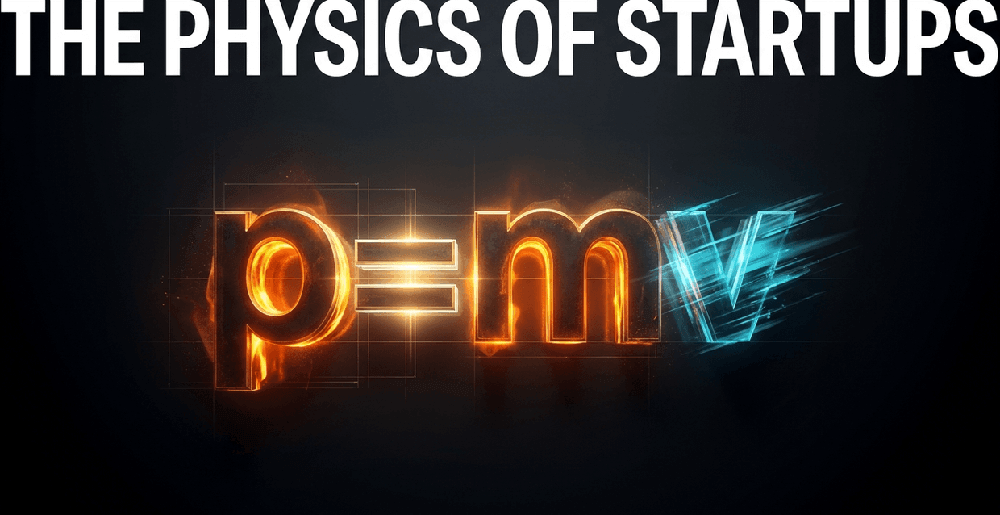
Product-market fit (PMF) is frequently described as the holy grail of entrepreneurship. It is the moment when the friction of the market disappears and is replaced by an irresistible pull. Yet many founders mistake the artificial speed of a paid marketing campaign or a viral stunt for true PMF. To understand why some companies become enduring giants while others vanish after a spectacular rise, we need to look at the physics of the market. Momentum (p = mv) requires both velocity and mass. In the startup world, "mass" is the depth of the problem you are solving and the density of the value you provide. Without it, you are simply a light object moving fast - easily deflected by the slightest obstacle.
According to Marc Andreessen, who popularized the term in a 2007 blog post titled "The Only Thing That Matters," product-market fit means being in a good market with a product that can satisfy that market. This definition sounds deceptively simple. In practice, it represents a violent shift in the company's lifecycle. Before PMF, you are pushing a boulder uphill. After PMF, you are chasing that same boulder as it rolls down the other side. If you are still pushing, you do not have it. If the market is not pulling the product out of you, velocity is irrelevant.
Defining the architecture of product-market fit
To build a case for momentum over velocity, we must first establish the structural components of PMF. Andy Rachleff - co-founder of Benchmark Capital and CEO of Wealthfront - is widely credited with coining the term, having developed the underlying concept from the ideas of Sequoia Capital's Don Valentine, who described looking for companies where the market "pulls the product out of their hands." Rachleff later formalized this as the "value hypothesis": a precise articulation of what you are building, who will use it, and why the business model will work.
The value hypothesis has three components: the what (what you are building), the who (who will use it), and the how (how the business model will generate revenue). Critically, Rachleff argues that most founders make the mistake of iterating on the wrong variable. They keep changing the product when they should instead be searching for a different customer segment that is desperate for what they already built. You do not pivot the product first. You pivot the audience.
Market pull is the primary indicator of a successful value hypothesis. When a product achieves resonance, the internal operations of a company often struggle to keep up with demand. Andreessen describes this as a flood of signups that you cannot even explain - a pull so powerful it creates the mass required for momentum. Every unit of velocity you gain is backed by a substantial base of delighted users who provide the structural weight to keep the company moving forward.
Problem-solution alignment is the second pillar. It is not enough to have a "unique" product; it must be a product that people desperately want. Rachleff framed it sharply: "If the customer doesn't scream, you don't have product-market fit." He argued this specifically in the context of enterprise trials - if a customer does not fight to keep using your product at the end of a free trial period, they are not desperate enough. Without this emotional and functional resonance, any growth you achieve is forced growth, which lacks the compounding nature of true market momentum.

Why momentum is more important than velocity
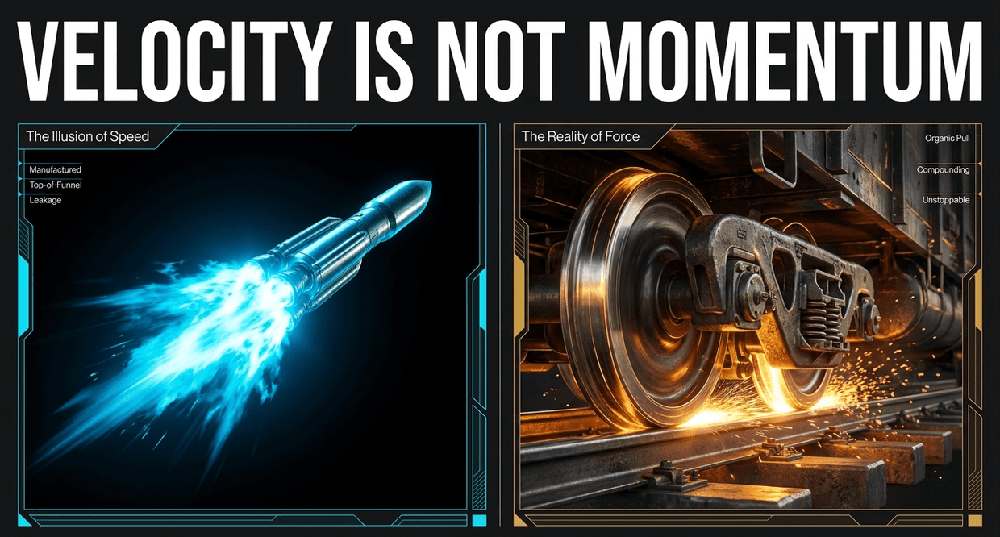
In physics, momentum is a measure of how difficult it is to stop a moving object. A freight train moving at ten miles per hour has significantly more momentum than a bullet moving at a thousand miles per hour. In the corporate ecosystem, the "bullet" is the startup that spends millions on customer acquisition to achieve high velocity but has no retention. The "freight train" is the company with deep organic pull and compounding retention. Even if the train starts slow, its mass makes it an unstoppable force.
The illusion of velocity
Velocity is easy to manufacture. With enough venture capital, any founder can buy users, social media mentions, and top-of-funnel traffic. This creates the illusion of growth. You see the numbers go up and the board is pleased. But if those users are not sticking around, velocity is not creating momentum - it is a leakage problem.
Alex Schultz, who served as Facebook's VP of Growth and later became Meta's Chief Marketing Officer and VP of Analytics, put it plainly: "The number one problem I've seen for startups is they don't actually have product-market fit when they think they do." The numbers look right. The dashboard is green. But the foundation is hollow.
High initial velocity without retention is like a rocket engine firing in a vacuum with no guidance system. You might be moving fast, but you are not going anywhere meaningful. True momentum is self-reinforcing - a compounding loop where each new customer brings in more than one additional customer through word of mouth. This is the flywheel effect. A flywheel is difficult to start (low initial velocity), but once it has mass and is spinning, it becomes very hard to stop.
Slack is the textbook illustration. When researcher Hiten Shah surveyed 731 Slack users, 51% said they would be "very disappointed" without the product - well above the threshold that signals real momentum. At the time, Slack had fewer than half a million paying users. That single data point told the market everything about the trajectory ahead.

The danger of premature scaling
One of the most lethal mistakes a startup can make is confusing early velocity with momentum and scaling prematurely. Scaling is the act of pouring gasoline on a fire. If the fire is small but hot (true PMF), the gasoline creates a sun. If the fire is just a pile of damp wood held together by a blowtorch (artificial growth), the gasoline creates a mess.
Rachleff was explicit about the trap: pursuing growth before value is a death sentence. When you scale before you have momentum, you are optimizing for a leaky bucket. You increase your burn rate, hire hundreds of employees, and build complex infrastructure for a product that has not actually solved a problem people desperately need solved.
Data from the Startup Genome Project - a study of more than 3,200 high-growth technology startups - found that approximately 70% of startups in the dataset had scaled prematurely along at least one dimension (customer, product, team, business model, or funding). Among high-growth internet startups specifically, the figure rises to 74%. None of the startups that scaled prematurely passed the 100,000 user mark. And 93% of prematurely scaled startups never broke the $100,000 revenue-per-month threshold. They moved fast. They just did not have the weight to survive the friction.
CB Insights, analyzing the post-mortems of over 430 VC-backed companies that shut down since 2023, reached a compatible conclusion: poor product-market fit was cited as a primary cause of failure in 43% of cases. "Ran out of capital" topped the list at 70% - but as the researchers noted, that is almost always the final cause of death, not the root problem. The more telling causes reveal why the capital dried up in the first place.
Retention as the definitive proof of momentum
If you want to know if a company has momentum, ignore their total user count. Look at the retention curve. In the physics of PMF, retention is the gravity that holds the system together. A bad retention curve never flattens. It decays continuously, eventually trending toward zero. This indicates that the velocity was artificial - the "mass" of the product was insufficient to keep users in orbit.
Schultz put the core principle directly: "Retention is the single most important thing for growth. If you end up with a retention curve that asymptotes to a line parallel to the x-axis, you have a viable business, and you have product-market fit for some subset of the market."
True momentum is characterized by a retention curve that flattens. If you acquire 100 users and 40 of them are still active after six months - and that number holds at 40 for months seven, eight, and nine - you have found the base of your momentum. That 40% represents the core mass of your business. These are the people who find your product indispensable. Once you have a flat retention curve, you can safely apply more velocity, knowing the momentum will compound rather than dissipate.
The shape of the curve matters more than any single retention number. A typical early-stage SaaS startup should target 40-60% monthly retention for its first cohorts. In social media, that number climbs considerably higher - Schultz has noted that if the first batch of users on a social platform are not retaining at around 80%, you are not building a massive network. Context is everything. The goal is not to hit an arbitrary percentage - it is to find the point at which your curve stops falling.

Key metrics and indicators of true momentum
The transition from velocity to momentum can be quantified. Investors and founders use a specific set of diagnostic tools to determine whether the growth they are seeing is sustainable.
The Sean Ellis test (the 40% rule): This is a qualitative measure of indispensability. You ask users: "How would you feel if you could no longer use this product?" If more than 40% answer "very disappointed," you have the mass required for momentum. Ellis - who led early growth at Dropbox, LogMeIn, and Eventbrite - developed this methodology after benchmarking over 100 startups and consistently found that those clearing the 40% threshold achieved sustainable growth while those below it stalled. The question is deliberately framed around disappointment rather than satisfaction, because disappointment reveals necessity. People will say they "like" dozens of products they would never actually miss.
The Superhuman story is a masterclass in applying this framework. When founder Rahul Vohra first ran the Ellis survey, only 22% of users would have been "very disappointed" without the product - well below the threshold. Instead of scaling anyway, he segmented the responses. The "very disappointed" group had a specific profile: they lived in their email, valued speed above everything, and relied on keyboard shortcuts constantly. Vohra then focused exclusively on what made that segment love the product, systematically removing the friction that was holding others back. Nine months later, the score had climbed significantly above 40%.
Customer retention rate: For B2B SaaS companies, current benchmarks show a good annual churn rate is below 5%. The 2025 Recurly Churn Report puts average B2B SaaS monthly churn at 3.5%, with top performers below 2% monthly. At 2% monthly churn, the average customer lifetime is roughly 50 months. At 5% monthly, that collapses to 20 months. Enterprise-focused businesses typically see lower annual churn - often 1-2% - while SMB-focused products contend with higher attrition due to shorter contract terms and lower switching costs. More important than any single figure is the shape of the retention cohort - it must stabilize, not decay.

Organic growth and word of mouth: Rachleff argues that exponential organic growth is the best test of word of mouth - and word of mouth is the only reliable indicator that people genuinely love what you built. If your k-factor (the number of new users each existing user invites) is greater than one, your momentum is self-sustaining. You are not paying for the movement. The market is providing the energy.
Time to value (TTV): This measures how quickly a user reaches their "aha moment" - the point at which the product's core value becomes undeniable. Products with high momentum usually have a very short TTV. The value is so obvious and the solution so needed that users realize the benefit in minutes, not weeks.
Net Promoter Score (NPS): While sometimes criticized as oversimplified - and NPS creator Fred Reichheld himself has warned against its overuse as a standalone metric - a high NPS (typically above 50 is considered strong) serves as a useful proxy for the word-of-mouth pull that Andreessen describes. Its value lies not in a single snapshot but in the trend over time.
Burn multiple: Popularized by David Sacks of Craft Ventures, the burn multiple measures how much capital a startup burns for every dollar of new ARR it generates. A burn multiple below 1.5x signals the market is pulling your product. Above 5x and you are almost certainly pushing it. Current 2025 benchmarks put a burn multiple under 1.0x in "exceptional" territory - a signal that organic demand is doing the heavy lifting so capital can go further.
Net Revenue Retention (NRR): NRR measures how much revenue you retain and expand from existing customers, net of churn and downgrades. According to multiple 2025 SaaS benchmark reports, median NRR for venture-backed B2B SaaS sits at around 101-106%. The rule of thumb: NRR below 100% kills most Series A conversations because it signals a leaky bucket, not a flywheel. Best-in-class companies achieve NRR above 120-130%, meaning their existing customer base grows revenue year-over-year without any new customer acquisition at all. Companies with the highest NRR report median growth rates that are 83% higher than the overall population median - proof that momentum compounds.

The scientific model of the PMF journey
Building a company is not an act of willpower. It is a scientific journey of proving hypotheses. PMF is the first and most crucial hypothesis - and it is fundamentally probabilistic. You are running experiments to find resonance: getting on the same wavelength as your customer.
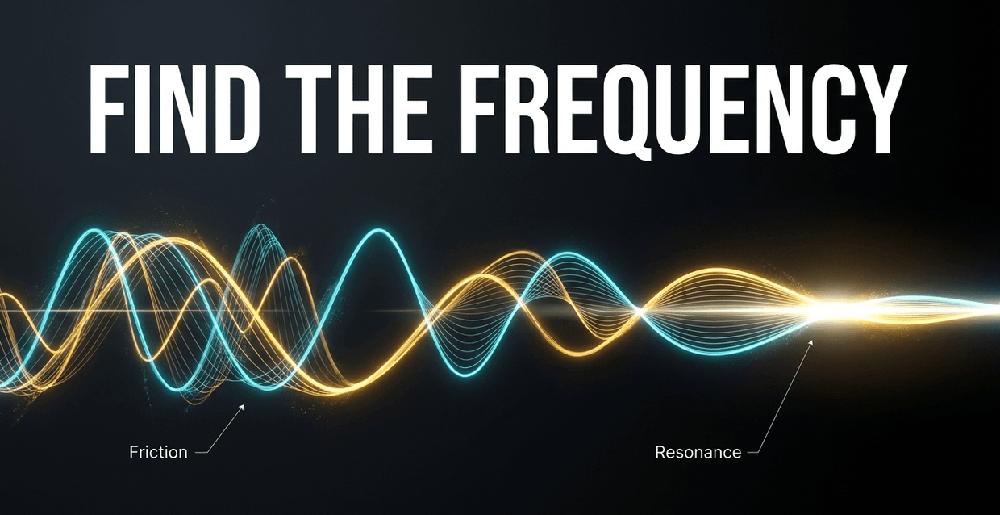
Resonance is a phenomenon from physics where a system oscillates with greater amplitude at specific frequencies. In business, this happens when your product's features perfectly match the frequency of the market's needs. If you are off-pitch, you get silence or friction. You pivot - adjusting your frequency - until you hit the note that makes the market vibrate. Once you hit that resonance, momentum becomes effortless.
But it is vital to remember that PMF is not a one-time milestone. It is a continuous journey. Markets evolve, competitors enter, and technologies shift. A product that had perfect momentum in 2020 might have zero momentum today if it has not adapted. The ongoing obligation is to constantly re-validate your value hypothesis. This is especially true in the current AI-accelerated cycle, where competitive dynamics and user expectations are shifting faster than any previous technology wave.
The structural permanence of PMF is shrinking. Jason Lemkin, the SaaS investor, has observed that companies that once had PMF can fall out of it - and that the durability window is getting tighter. First Round Capital's research into B2B startups reinforces this: "Repeatability is the holy grail on the hunt for product-market fit." The goal is not a single moment of validation. It is a repeatable system for finding it again as the market changes around you.
Only 11% of startups that raised seed funding since 2020 have successfully reached the next funding stage by mid-2025. That is a sobering filter. Consistent user acquisition without genuine market fit - without real momentum - leads nowhere that matters.
Practical steps for achieving sustainable momentum
For a founder, the path to momentum requires a disciplined sequence. You cannot skip the "mass" phase and jump straight to the "velocity" phase. Sean Ellis's Startup Pyramid provides a useful framework.
- Validate user gratification: Before you spend a dollar on ads, ensure the core product delivers a genuinely delightful experience to a small group of users. This is where you find your mass. Segment them tightly - focus on users who match the profile of someone who would be "very disappointed" without the product. A minimum of 40 respondents gives you directionally reliable Ellis test data.
- Identify the value proposition: Clearly articulate the single thing that makes your users scream for the product. If you have five value propositions, you have zero. Momentum requires a focused force. Rachleff is unambiguous: the worst thing you can do at this stage is try to be all things to all people.
- Eliminate conversion friction: Once you have the value, remove everything that stops a user from experiencing it quickly. Shorten your time to value. The faster users reach the "aha moment," the more mass accumulates around your product. Wealthfront's early team learned this directly - they initially built a feature recommending the optimal savings threshold to keep in a bank account. Users ignored it. Removing it actually accelerated adoption, because it was friction masquerading as helpfulness.
- Scale customer acquisition: Only after the first three steps are solid should you push for high velocity. At this stage, your growth is backed by proven mass - the result is unstoppable momentum rather than expensive churn.
The key question to ask at each step is whether your organic growth is compounding on its own. If you stop spending on acquisition tomorrow, does your user base still grow? If the answer is no, you do not have momentum. You have a paid illusion.
For a related perspective on how corporate structures shape the competitive landscape in which startups operate, the dynamics of vertical integration and supply chain control are increasingly relevant to any founder thinking about defensibility at scale.

What changes when momentum is real
The experience of genuine PMF is qualitatively different from forced growth. It shows up in operational signals as much as in metrics. Customer support tickets transform from complaints into feature requests. Enterprise sales cycles collapse because buyers already know they want the product. Churn almost disappears for your core segment. Engineers start hearing about competitor wins not from the sales team, but from users who switched.
You will also notice it in what you stop having to do. You stop having to justify the product's existence in every sales meeting. You stop fighting for press coverage. You stop A/B testing headlines to squeeze another 0.2% conversion rate from cold traffic. The market does the work. That is the physical experience of momentum.
Marc Andreessen described this feeling vividly: you can always feel when product-market fit is happening. Customers are buying the product just as fast as you can make it. Money is piling up in the company checking account. You are hiring sales and customer success staff as fast as you can find them. Reporters are calling because they have heard about the hot new thing. You start getting acquisition inquiries from companies you have never heard of.
That is not luck. That is physics.

The final takeaway: momentum is a choice
In the current market, capital is no longer as cheap as it once was. The era of growth at any cost - which was essentially velocity at any cost - is over. Investors are now looking for companies that demonstrate the physics of a real business: high retention, organic pull, and sustainable unit economics. The median CAC payback period for private SaaS companies has extended to roughly 20-23 months in 2025 - a significant deterioration from the historical benchmark of 12-14 months. Payback periods above 18 months are increasingly a deal-breaker at Series A, regardless of how fast a company is growing.
Velocity is a headline. Momentum is a bottom line.
Your task as a founder is not to see how fast you can go today. It is to see how hard you are to stop tomorrow. Stop chasing the rocketship and start building the flywheel. Focus on the mass of the problem you solve and the density of the value you provide. When you align a great product with a hungry market, the physics of momentum will take care of the rest.
As Steve Blank writes in The Four Steps to the Epiphany: "In a startup, it doesn't matter if you're 100 percent right 100 percent of the time. What matters is having forward momentum and a tight fact-based data/metrics feedback loop to help you quickly recognize and reverse any incorrect decisions." Do not let the desire for speed lead you off a cliff. Build for momentum. The velocity will follow as a natural byproduct of your market resonance.
The companies that will lead the market a decade from now will not be the ones that grew the fastest last quarter. They will be the ones that built the most momentum over the long run - starting with a product people genuinely cannot imagine living without.
Share now









Key takeaways
- Product-market fit (PMF) was coined by Andy Rachleff (co-founder of Benchmark Capital), drawing on ideas from Don Valentine of Sequoia Capital. Marc Andreessen popularized the term in a 2007 blog post titled "The Only Thing That Matters," where he defined it as "being in a good market with a product that can satisfy that market."
- Velocity vs. momentum: Velocity is easily manufactured with paid acquisition; momentum requires "mass" - the depth of the problem solved and the density of the value provided. Only momentum compounds sustainably.
- The Sean Ellis test (40% rule): After benchmarking over 100 startups, Sean Ellis found that if 40% or more of active users say they would be "very disappointed" without the product, the company has very likely achieved PMF. Below 40%, sustainable growth is rare.
- Superhuman case study: When Rahul Vohra first applied the Ellis test to Superhuman, only 22% of users would have been "very disappointed." By segmenting responses and focusing exclusively on the "very disappointed" cohort's needs, the score climbed above 40% - enabling a confident, large-scale launch.
- Premature scaling is the leading structural cause of startup failure: The Startup Genome Project studied over 3,200 high-growth technology startups and found that 70% scaled prematurely along at least one dimension. Among internet startups specifically, 74% failed due to premature scaling, none of the prematurely scaled companies passed the 100,000-user mark, and 93% never broke $100,000 in monthly revenue.
- Poor PMF is the root cause of capital failure: CB Insights, analyzing 430+ VC-backed companies that shut down since 2023, found poor product-market fit cited in 43% of failures. "Ran out of cash" topped the list at 70% - but is almost always the final cause, not the root problem.
- Retention is the definitive proof of momentum. Alex Schultz, Meta's Chief Marketing Officer and former VP of Growth, stated that "retention is the single most important thing for growth" and that a retention curve that flattens - asymptoting to a line parallel to the x-axis - is the clearest signal of true PMF.
- B2B SaaS benchmarks (2025): Median monthly churn for B2B SaaS is 3.5%, with top performers below 2% monthly. Median Net Revenue Retention (NRR) sits at roughly 101-106%. NRR below 100% is typically disqualifying at Series A, signaling a leaky bucket rather than a compounding flywheel. Companies with the highest NRR report median growth rates 83% higher than the overall population median.
- Burn multiple (popularized by David Sacks of Craft Ventures): a burn multiple below 1.0x is exceptional; below 1.5x signals the market is pulling your product; above 5x signals you are pushing it - a strong indicator of absent or false PMF.
- PMF is not a one-time event. Markets evolve, competitors emerge, and technologies shift. Only 11% of startups that raised seed funding since 2020 have successfully reached the next funding stage by mid-2025 - a brutal filter that rewards only those who sustain genuine market resonance.
Sources
- Marc Andreessen - "The Only Thing That Matters" (PMArchive) https://pmarchive.com/guide_to_startups_part4.html
- Startup Genome Project - Premature Scaling Report https://startupgenome.com/insights/a-deep-dive-into-the-anatomy-of-premature-scaling
- CB Insights - Why Startups Fail: Top 9 Reasons https://www.cbinsights.com/research/report/startup-failure-reasons-top/
- Andy Rachleff on Product-Market Fit (Redpoint Ventures recap) https://medium.com/redpoint-ventures/redpoint-office-hours-recap-product-market-fit-with-andy-rachleff-ae96e79b0ca8
- Rahul Vohra - The Superhuman Product/Market Fit Engine https://coda.io/@rahulvohra/superhuman-product-market-fit-engine
- Published 2026-06-18 15:31
- Modified 2026-06-18 15:31

-
Redaction