
-
 Redaction
US inflation hits a 3-year high in May 2026
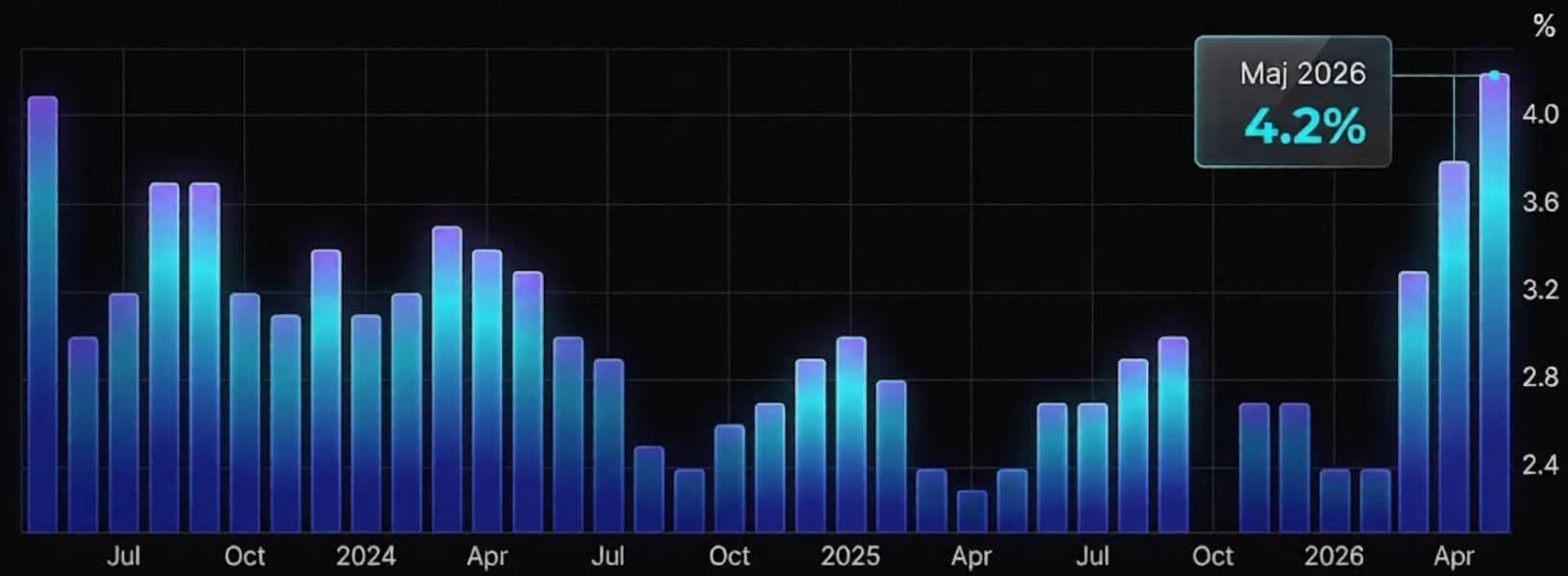
US inflation hit 4.2% in May 2026 - 3-year high. Discover what's driving the surge in energy, food, and shelter costs, plus what the Federal Reserve does next.
What is driving inflation so high in 2026?
The surge to 4.2% headline CPI in May 2026 is the product of at least four distinct forces striking the economy simultaneously: an energy shock of historical scale, a tariff-driven goods squeeze that predates the geopolitical crisis, food cost acceleration tied to supply chain fractures, and a shelter market that shows no sign of meaningful relief. Each of these would be significant on its own. Together, they have produced an inflationary environment not seen since April 2023.
The 2026 Iran conflict and the energy shock
The single most consequential driver of inflation in 2026 is the military conflict between the United States, Israel, and Iran that began on February 28, 2026. The conflict disrupted oil and refined product flows through the Strait of Hormuz - a narrow passage through which roughly 20% of the world's maritime oil trade normally moves and through which approximately 20 million barrels per day passed in 2024.
Iran's closure of the Strait following the outbreak of hostilities triggered what the International Energy Agency described as "the largest supply disruption in the history of the global oil market." A conditional ceasefire was declared on April 8, 2026, but shipping traffic through the Strait has remained well below pre-war levels, leaving oil prices elevated even as direct hostilities reduced in intensity.
The market impact has been severe and fast-moving:
- Gasoline prices surged 40.5% year-over-year in May 2026, accelerating sharply from a 28.4% gain in April
- Fuel oil jumped 58.9% compared to the same month last year
- Energy costs overall climbed 23.5% annually, accounting for over 60% of the monthly CPI increase
For context: WTI crude oil was trading at approximately $67 per barrel on February 27, the day before hostilities began. By mid-May it had climbed past $102 per barrel - a gain of more than 50% in fewer than three months.
Research published by the Federal Reserve Bank of Dallas estimates that under a scenario where the Strait closure lasts one quarter before oil exports gradually resume, US headline inflation would be pushed up by approximately 0.6 percentage points in 2026, with core inflation rising an additional 0.2 points. In the most adverse scenario - a 20% global oil supply shortfall sustained for three quarters - the Dallas Fed's model projects WTI crude reaching $167 per barrel, with headline inflation climbing by as much as 1.8 percentage points.
Goldman Sachs economists raised their December 2026 PCE inflation forecast to 3.1% in their baseline scenario, estimating Brent crude averaging between $105 and $115 per barrel in the near term before declining later in the year.
"Most of the impact of the war on U.S. inflation will come from higher oil prices," Goldman Sachs economists noted, adding that a 10% increase in oil prices typically raises headline PCE inflation by roughly 0.2 percentage points.
Goldman Sachs analysts also flagged fertilizer supply disruptions caused by the Gulf conflict as a secondary pressure on food prices, estimating these could boost food prices by approximately 1.5% over the course of the year, raising headline inflation by roughly 0.1 percentage points.

Tariffs: the pre-existing condition
The energy shock landed on an economy already grappling with a self-inflicted inflationary layer.
US tariffs implemented in 2025 - the most significant since the 1940s, averaging 10-13% depending on product category - had already driven up the cost of imported goods well before the first missile was fired. Federal Reserve researchers published analysis in 2026 showing that these tariffs had boosted core goods PCE prices by an estimated 3.1% through February 2026, accounting for the entirety of the excess inflation in the core goods category relative to pre-pandemic norms. The Tax Foundation estimated that the tariff regime amounted to an average tax increase of $1,000 per US household in 2025, with roughly $700 expected per household in 2026 even as some tariffs lapse or are modified.
This matters for a specific reason. Tariff-driven inflation behaves differently from energy price shocks. Energy prices can reverse quickly if supply disruptions resolve. Tariff effects, once embedded in consumer prices, tend to persist - businesses that repriced upward don't simply roll back markups when the immediate pressure eases.
"We think that most of the tariff-driven inflation has run its course. That said, supply chain pressures are building from the Iran war. That should lead to firmer core goods inflation in the second half of 2026, all else equal," Bank of America Global Research noted in a June 2026 analysis.
Supply chain friction - still unresolved
Energy costs and tariffs are not acting alone. Supply chain bottlenecks - never fully unwound since earlier periods of global disruption - continue driving up input costs across manufacturing, agriculture, and retail. Critical component shortages and elevated freight costs are still feeding through to consumer prices in categories from electronics to household goods.
The Iran conflict has compounded this by disrupting shipping routes in the Persian Gulf, adding fresh layers of uncertainty for businesses reliant on imported materials and extending the inflationary pressure on core goods prices well into the second half of 2026.
Shelter and food: the household squeeze
Beyond energy, two categories that shape everyday living costs are both accelerating:
- Shelter costs rose 3.4% year-over-year in May 2026, up from 3.3% in April. This category carries the heaviest weighting in the CPI basket, reflecting both rental costs and owners' equivalent rent
- Food inflation jumped to 3.1%, sharply up from 2.3% the prior month, with food away from home rising faster than groceries
The trajectory of food costs is not expected to improve quickly. Goldman Sachs estimates fertilizer supply disruptions stemming from the Gulf conflict could lift food prices by approximately 1.5% over the year.
Electricity and the AI factor
A less-discussed but increasingly visible inflationary pressure is the cost of electricity, which has risen approximately 6% year-over-year - outpacing the overall inflation rate in a category that hits households directly.
A significant driver is the explosive growth of AI data center infrastructure. In 2025 alone, utility companies requested a record-breaking $31 billion in rate hikes - more than double the $15 billion sought in 2024. In the first quarter of 2026 alone, utilities had already requested an additional $9.4 billion in increases. Retail electricity prices rose 7% in 2025 as part of a nearly 40% climb since 2021 - the fastest period of electricity price growth on record.
The demand from data centers is "really inflationary," Moody's chief economist Mark Zandi noted in June 2026 analysis. The infrastructure underpinning the current AI buildout is raising electricity demand in ways that compound every other inflationary pressure in the household budget.
Labor market dynamics
A resilient labor market, with unemployment sitting near 4.3-4.4% as of mid-2026, continues to support consumer spending - which in turn sustains demand-side inflationary pressure. US non-farm payrolls rose by 172,000 in May 2026, comfortably exceeding expectations. While strong employment is positive for workers, wage growth that outpaces productivity gains filters into business cost structures and ultimately into consumer prices, particularly in services.
Core inflation: a more nuanced picture
While headline inflation captures public attention, economists and the Federal Reserve focus heavily on core inflation - which strips out volatile food and energy prices and provides a cleaner signal of underlying price trends.
Core CPI rose to 2.9% year-over-year in May 2026, the highest since September 2025, up from 2.8% in April. Month-over-month, core prices increased 0.2% - notably slower than the 0.4% pace seen in April, suggesting some moderation at the margins. But the annual figure is what the Fed is watching most closely.
Key drivers of core inflation:
- Transportation services: +4.1% year-over-year
- Apparel: +4.8%
- Medical care services: +3.6%
- Shelter: +3.4%
Used cars and trucks declined 2.0%, and medical care commodities fell 1.8%, providing modest offsets. Core commodities as a whole posted a marginal monthly decline.
What makes policymakers uncomfortable is not the headline number - it is that core inflation is rising even as energy does most of the work on the headline figure. It signals that price pressures are not simply a fuel-price story they are becoming more broadly embedded in the services economy, where disinflation moves slowly and is harder to achieve.
"Americans are getting squeezed financially by inflation that's back at a 3-year high. The frustration for many Americans is that so many of the basics are up in price right now - gas, food, electricity, and medical care are all clear pain points that are above 3% inflation." - Heather Long, chief economist, Navy Federal Credit Union
The Federal Reserve's difficult position
Rates on hold - for now
The Federal Reserve has kept its target federal funds rate at 3.50%-3.75% through three consecutive FOMC meetings in 2026 - January, March, and April - and a June hold is widely expected. Market pricing assigns roughly a 96-98% probability to no change at the June 16-17 meeting.
This is a notably different posture from where the Fed stood entering 2026. Rate cuts projected for the year have been effectively shelved. The combination of energy-driven inflation, tariff pass-through, AI-fueled electricity costs, and a tight labor market has kept policymakers in wait-and-see mode.
What has changed most recently is the direction of the risk conversation. April 2026 FOMC minutes confirmed that a majority of officials believe some policy firming would likely become appropriate if inflation continues to run persistently above 2%. The CME FedWatch Tool now shows a growing probability of a rate hike by late 2026 or early 2027 - a sharp reversal from the rate-cut expectations that defined the start of the year.
A new chair, a new calculation
The institutional context has shifted significantly. Jerome Powell's term as Fed Chair ended on May 16, 2026, with Kevin Warsh - confirmed by the Senate in a 54-45 vote on May 13, 2026 - taking over as the 17th Fed Chair. The vote was the closest in the modern era for a Fed Chair, almost entirely along party lines.
Warsh is not a new face at the central bank. During his first stint as a Fed Governor from 2006 to 2011, he navigated the 2008 financial crisis alongside Chair Ben Bernanke. Since leaving the Fed, he has been a vocal critic of central bank policy, at various points calling for lower rates and arguing for more structural reform. He was Trump's nominee in part because he had argued there was room to cut. But that case has become harder to make with CPI at 4.2%.
Markets had already repriced the rate path on January 30, 2026, when Warsh's nomination was announced. Gold dropped 11.4% in a single trading session - from a record peak of $5,594 per ounce to $4,745 - as rate cut expectations collapsed and the US dollar rallied.
The political dynamics add a further layer of complexity. At the April 2026 FOMC meeting, four of the 12 voting members dissented - the most divided the committee has been since 1992. Notably, former Chair Powell is remaining on the Fed board, retaining a vote on rate policy. Warsh will need to build consensus in an institution that is genuinely split on the path forward.
The inflation-growth trade-off
The Fed's dual mandate - maximum employment and price stability - has rarely been more tensioned. Raising rates aggressively to choke off inflation risks slowing economic growth and potentially triggering labor market deterioration that the central bank would also find unacceptable. Holding rates where they are risks allowing inflation to become entrenched in consumer expectations - a scenario that history shows is very costly to reverse.
The challenge for new Chair Warsh is to establish credibility on inflation without tipping an economy already absorbing an energy shock into an unnecessary slowdown.
He has publicly promised to use his own judgment on rate policy, independent of White House pressure. Whether that independence holds - and how markets interpret early FOMC communications under his leadership - will be closely watched.
How inflation is affecting households and businesses
Purchasing power under pressure
For American households, the numbers translate directly into daily financial stress. When gasoline is up over 40%, shelter costs are rising 3.4%, food is accelerating, and electricity bills are climbing roughly 6%, the effective purchasing power of a median income erodes meaningfully - even when wages are growing. Lower-income households, who spend a larger share of their income on energy and food, bear a disproportionate burden.
The practical effects are visible:
- Reduced savings rates as discretionary income is absorbed by necessities
- Increased credit card reliance to bridge month-to-month budget gaps
- Delayed major purchases - from vehicles to home appliances - as consumers tighten spending
The New York-Newark-Jersey City metro area records the highest regional inflation in the country at 5.1%, reflecting acute housing and energy cost pressures. But the inflationary squeeze is nationwide in character, even if its intensity varies by geography.
"Inflation is painfully high. Half the inflation is gradually coming down, but the other half is raging." - Mark Zandi, chief economist, Moody's Analytics
The burden on businesses
Companies are navigating a similarly difficult environment. Higher costs for energy, raw materials, and labor are compressing profit margins, particularly for:
- Small and medium-sized enterprises, which have less pricing power and thinner financial buffers than large corporations
- Transportation and logistics firms, directly exposed to fuel price swings
- Food and hospitality businesses, facing simultaneous pressure from ingredient costs and wage expectations
- Manufacturers and retailers reliant on imported goods, absorbing both tariff costs and supply chain uncertainty
Many businesses are passing costs through to consumers where possible - which itself perpetuates inflation. Others are absorbing margin compression and deferring investment, creating a longer-term drag on productivity and growth.
Broader economic and market implications
Investor confidence and currency effects
Sustained inflation introduces uncertainty into investment planning. When price stability cannot be assumed, real returns on fixed-income assets become harder to calculate, equity valuations get repriced, and currency volatility can emerge.
The growing probability of a Fed rate hike by late 2026 or early 2027 - something almost unthinkable at the start of the year - has added a new layer of uncertainty for investors. Rate hike expectations typically strengthen the dollar, weigh on emerging markets, and compress equity multiples, particularly in rate-sensitive sectors.
Morgan Stanley has flagged that investors may need to price in a world where regional conflict and strategic competition are persistent market features, not episodic disruptions. That structural shift has implications for asset allocation that extend well beyond 2026.
Fiscal policy's role
Monetary policy does not operate in isolation. Government spending decisions, taxation, and debt management can either amplify or dampen inflationary pressures.
With US defense outlays likely rising in response to the 2026 conflict - Morgan Stanley flagged this as a potential source of upward pressure on long-term bond yields - fiscal and monetary authorities face a genuine coordination challenge. Both tools are being pulled in competing directions in an environment where neither has much margin for error.
What to watch next
Several data points and developments will shape the inflation trajectory through the rest of 2026:
- July 14 CPI release - the next major headline reading and a key input to the Fed's subsequent policy decisions
- The status of the Strait of Hormuz - the single variable with the largest potential impact on energy prices, even after the April ceasefire technically reduced hostility intensity
- FOMC communications under new Chair Warsh - particularly whether forward guidance language shifts at or after the June 16-17 meeting, and how the committee addresses the growing rate hike discussion
- Wage growth data - whether labor cost pressures are accelerating or stabilizing
- Core goods vs. services divergence - whether core inflation is being sustained by services (structurally stickier) or goods (potentially more transitory as tariff pass-through moderates)
- The tariff trajectory - whether Congress acts to extend, modify, or allow provisions to lapse as some elements of the tariff regime approach expiration
Whether the current episode proves transitory - primarily a geopolitical supply shock that eventually resolves - or marks a more structural shift in the US price environment is the defining question for economists and policymakers heading into the second half of 2026. The answer will depend on decisions made in boardrooms, central banks, and conflict zones over the coming months.
Share now









Key takeaways
- US CPI rose 4.2% year-over-year in May 2026, the highest level since April 2023 and the third consecutive monthly acceleration in headline inflation. Month-over-month, consumer prices rose 0.5%.
- Energy prices surged 23.5% annually in May 2026, accounting for over 60% of the monthly CPI increase - the direct result of the 2026 conflict disrupting oil flows through the Strait of Hormuz.
- Gasoline prices soared 40.5% year-over-year, and fuel oil climbed 58.9% - the steepest energy-component increases since the post-pandemic surge of 2022.
- WTI crude oil rose from approximately $67 per barrel on February 27, 2026 (the day before the conflict began) to over $102 per barrel by mid-May - a gain of more than 50% in fewer than three months.
- The Federal Reserve has held its target rate at 3.50%-3.75% through three consecutive FOMC meetings in 2026, with markets pricing a 96-98% probability of no change at the June 16-17 meeting. Growing market probability of a rate hike by late 2026 or early 2027 marks a sharp reversal from the rate-cut expectations that opened the year.
- Core CPI rose 2.9% year-over-year in May 2026, the highest since September 2025, signaling that price pressures are broadening beyond energy into shelter, transportation services, and apparel.
- Federal Reserve Bank of Dallas research estimates that in the most adverse scenario - a 20% global oil supply shortfall lasting three quarters - WTI crude could reach $167 per barrel, pushing Q4/Q4 headline inflation higher by as much as 1.8 percentage points.
- Kevin Warsh was confirmed as Federal Reserve Chair on May 13, 2026, in a 54-45 Senate vote - the closest confirmation in the modern era - replacing Jerome Powell whose term had expired.
- Shelter costs rose 3.4% and food inflation accelerated to 3.1% year-over-year in May 2026, compounding the household cost-of-living squeeze well beyond energy.
- US tariffs implemented in 2025 - the highest average tariff rate since the 1940s - are estimated by Federal Reserve researchers to have boosted core goods PCE prices by 3.1% through February 2026, adding an independent inflationary layer on top of the energy shock. The Tax Foundation estimates the tariff regime cost the average US household $700 in 2026 after some provisions lapsed.
Sources
- Bureau of Labor Statistics - Consumer Price Index Summary, May 2026 https://www.bls.gov/news.release/cpi.nr0.htm
- Federal Reserve Bank of Dallas - Implications of the Iran War for U.S. Inflation https://www.dallasfed.org/research/economics/2026/0417
- CEPR VoxEU - Quantifying the impact of the Iran war on US inflation https://cepr.org/voxeu/columns/quantifying-impact-iran-war-us-inflation
- Goldman Sachs via AOL Finance - Iran War Could Push Inflation Higher This Year https://www.aol.com/articles/iran-war-could-push-inflation-204700527.html
- Mitrade - Fed Interest Rate Decision 2026: Powell Is Out, Warsh Is In https://www.mitrade.com/au/insights/others/cfd-trading/fed-interest-rate-decision-2026
- Published 2026-06-12 05:32
- Modified 2026-06-12 05:32

-
Redaction