

-
 Redaction
The art of the exit: mastering sell discipline
Master the sell side of investing with trailing stops, exit rules, and behavioral bias checks used by institutional traders to protect your portfolio capital.
Why selling is harder than buying
Most investors spend ninety percent of their time searching for the next great opportunity. They obsess over entry points, fundamental analysis, and the thrill of the hunt. But the professional trader knows that while the entry puts you in the game, the exit determines whether you leave with a profit or a permanent loss of capital. The art of the exit is not merely a technical skill - it is a psychological battle against deeply ingrained evolutionary biases. Designing a sell discipline that protects capital requires an objective framework that functions as a circuit breaker for human emotion.
Investing is inherently emotional because it involves the preservation and growth of one's survival resources. When market conditions shift, the primitive parts of the brain take over, often producing the 'buy high, sell low' phenomenon that plagues retail accounts. This happens because our brains are naturally wired for investment losses, making objective decision-making incredibly difficult under pressure. According to Prospect Theory, developed by Kahneman and Tversky, humans suffer from loss aversion - the pain of a financial loss is felt approximately twice as strongly as the joy of an equivalent gain. Consequently, investors often sell winning positions too early to lock in a sense of pride, while holding onto losing positions far too long in a desperate hope they will return to breakeven.

Behavioral biases: the silent killers of portfolio returns
To build a robust sell discipline, one must first identify the psychological traps that trigger irrational selling or dangerous holding. Beyond loss aversion, the Disposition Effect remains one of the most persistent hurdles. It is the tendency to liquidate winners to realize gains while stubbornly clinging to losers. Research by Frazzini examining US mutual fund data found that gains are realized at a rate 21% higher than losses across all funds - and for the bottom-performing funds, that figure jumps to 72% higher. This is not because individual investors are uniquely irrational. It is because professionals have institutionalized processes that force them to confront bad news and admit errors before they become catastrophic.
Herd mentality - or the Fear of Missing Out (FOMO) - represents the opposite side of the coin. During a market parabolic move, FOMO drives investors to ignore their exit rules in favor of chasing more gains. Conversely, during a panic, the herd rushes for the exit simultaneously, often at the exact moment when the risk-reward ratio has become most favorable for buyers. Following the crowd ensures that an investor is always behind the curve.

Another critical bias is anchoring. This occurs when an investor fixates on a specific number - the original purchase price, a previous all-time high, a round number with no analytical significance. The market does not care what price you paid for a security. By anchoring to an arbitrary historical figure, the investor fails to react to current conditions or fundamental shifts in the investment thesis. Decisions become based on what was, rather than what is.
Overconfidence bias deserves its own seat at the table. When a run of successful trades creates an inflated sense of skill, investors begin to overtrade, reduce their stop-loss discipline, and take on concentrated positions that violate their own risk parameters. The result is increased transaction costs, reduced diversification, and an eventual reckoning that the market is not, in fact, obliging them personally. Studies consistently identify overconfidence as one of the primary drivers of poor long-term returns among active retail participants.

Pre-defined exit rules: the foundation of capital protection
Institutional-grade sell disciplines rely on removing the 'middle of the night' decision-making process. The most effective way to protect capital is to pre-commit to exit rules at the exact moment of entry. By defining the conditions under which a security will be sold before money is actually at risk, the investor utilizes the prefrontal cortex rather than the amygdala.
One highly effective approach is to define and quantify the specific thesis behind a buy decision. If the reason for the purchase was a specific earnings growth rate, a management change, or a technological edge, the reversal of that specific factor must trigger an immediate sale. Mawer Investment Management provides a textbook example of this discipline in practice. Their sell framework is the mirror image of their buy criteria - built around three pillars: wealth creation, management quality, and discount to intrinsic value. If a holding no longer creates wealth, if management integrity wavers, or if the price exceeds intrinsic value, the position is liquidated. No deliberation. No emotional override.
"The best time to think about selling a stock is when you're buying it." - This principle, echoed across institutional trading desks for decades, captures what most retail investors never implement.
Checklists and trigger points act as cognitive speed bumps. They force a pause in emotional thinking, requiring the investor to justify why a position should remain in the portfolio. This level of structure is precisely why quantitative investment strategies often outperform discretionary ones during periods of high stress - they rely on statistical models and code that lack the capacity for fear.

The mechanics of the stop-loss: from theory to practice
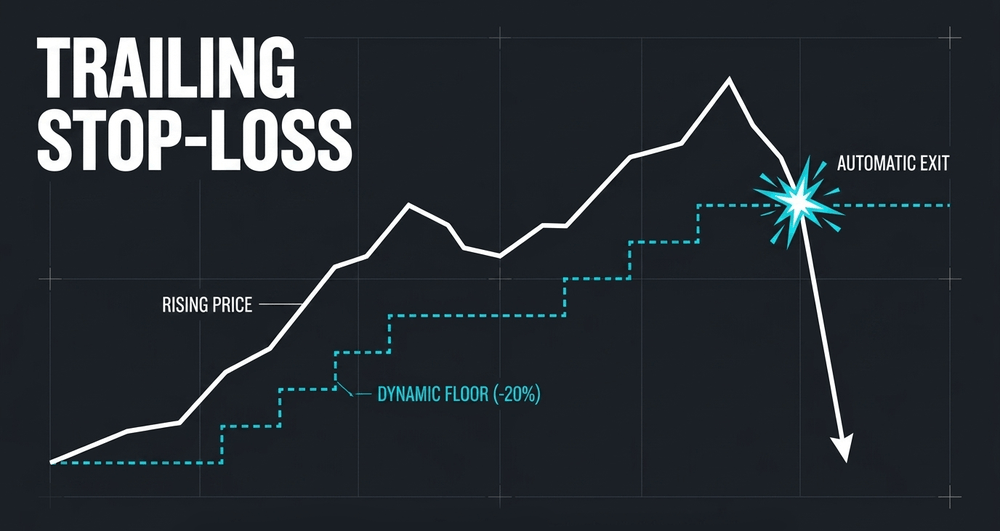
Technical sell orders provide the physical infrastructure for a sell discipline. Among these, the trailing stop-loss is perhaps the most powerful tool for the modern investor. Unlike a fixed stop-loss, which remains at a static price point, a trailing stop-loss adjusts upward as the security's price rises. This allows an investor to capture the upside of a trend while automatically tightening the exit point to protect realized profits.
The research on this is unusually consistent. Three independent studies covering different markets and time periods converge on the same optimal zone: a trailing stop of 15% to 20% produces superior risk-adjusted returns. The Snorrason and Yusupov study found that a 20% threshold produced the highest average quarterly return at 1.71%, while 15% produced the highest cumulative return of 73.91% over an eleven-year period spanning two major market crises. More recent analysis using ETF data from 2001 to 2021 confirmed that thresholds calibrated to 1.0-1.5 standard deviations of historical volatility - which typically correspond to that same 15-20% range - delivered significantly higher excess returns than narrow stops.

The three main technical order types each carry distinct trade-offs:
- Trailing stop-loss: Adjusts dynamically with the price, offering a moving floor. It outperformed fixed stop losses in nearly all tested market conditions and is the preferred vehicle for trend-following strategies.
- Stop-limit orders: Trigger a limit order when the stop price is reached. They provide control over the execution price but carry the risk of not being filled if the market gaps down quickly - a critical vulnerability in fast-moving or illiquid names.
- Sell stop orders: These become market orders once triggered. They guarantee execution but not price, which can lead to significant slippage during volatile conditions.
It is worth noting that optimal thresholds are not universal. Higher-volatility assets - small-cap biotech, emerging market equities, or cryptocurrencies - require wider stops to avoid being shaken out by normal market noise. More stable ETFs or blue-chip equities can utilize tighter thresholds. However, stops set below 10% consistently lead to lower overall returns, driven by increased transaction costs and the frequency of being forced out of positions prematurely.
A more sophisticated approach used by institutional desks is the ATR-based stop - calibrated to the Average True Range of a specific security. Rather than applying a fixed percentage universally, an ATR-based stop sets the exit distance as a multiple of the stock's actual daily volatility. A 2x or 3x ATR trailing stop adjusts automatically when a stock becomes more volatile, widening the stop to avoid premature triggers, and tightening it when volatility compresses. This method captures the spirit of the 15-20% rule while adapting to the individual behavior of each position.
Profit-taking strategies: how to harvest the crop
Knowing when to take a loss is about survival. Knowing when to take a profit is about performance. A structured profit-taking strategy prevents the common mistake of watching a 50% gain evaporate back to breakeven - a scenario that is both financially and psychologically devastating.
Scaling out is one of the most effective methods available. It involves selling portions of a position at different price targets. A multi-level approach might involve selling 25% of the position at an initial target, 50% at a secondary target, and allowing the final 25% to run with a trailing stop. This ensures that meaningful profit is captured at each level while still maintaining exposure to a potential extended move.
Percentage-based exits are simpler but equally effective. An investor may decide to sell half of a position once it has doubled, effectively playing with the house's money on the remaining half. Others use technical analysis tools - resistance levels, momentum indicators like the Relative Strength Index, or moving average crossovers - to identify when a security has become overextended and is vulnerable to a pullback.
Manual profit-taking is also valid when market conditions shift fundamentally, provided it is based on a reassessment of expected value rather than a whim. The danger is in conflating gut instinct with analysis. Experienced traders distinguish between the two by writing down their rationale before acting. If the reasoning holds up in writing, it holds up in execution.

Risk management and the 25% rule
An exit strategy is only one component of the broader risk management ecosystem. Position sizing is the ultimate defense against ruin. Many veteran traders adhere to a rule of never risking more than 1% to 2% of total account capital on any single trade. If a stop-loss is triggered, the impact on the overall portfolio is contained and survivable. This 'live to fight another day' philosophy is what separates long-term survivors from those who blow up their accounts during a single bad streak.
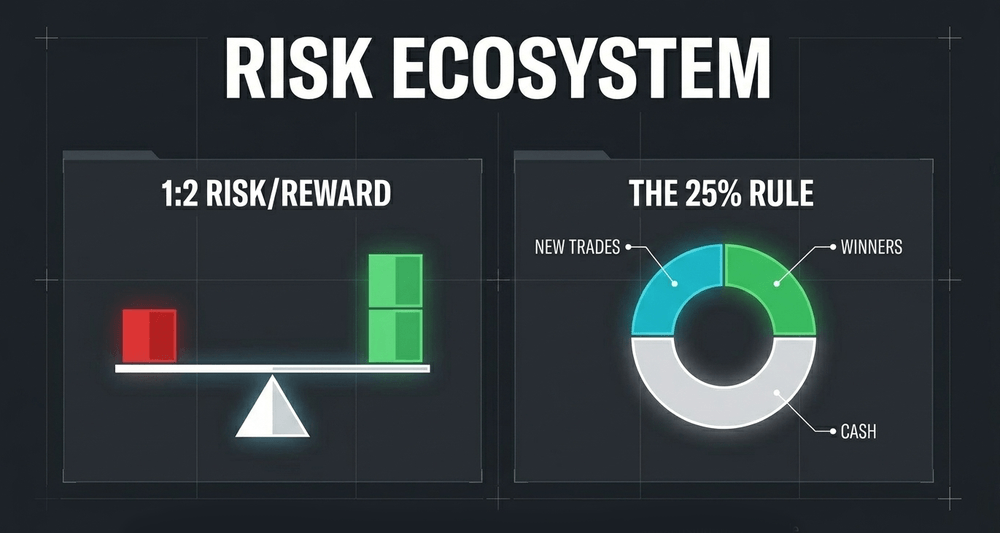
The risk-reward ratio must always favor the investor. Targeting a minimum 1:2 ratio - where the potential profit is at least twice the potential loss - allows an investor to be wrong more than half the time and still remain profitable. That arithmetic is not optional; it is the structural foundation of a sustainable strategy.
Strategic capital allocation can be managed through the 25% Rule. In this framework:
- 25% of capital is reserved for new trades and fresh opportunities
- 25% is allocated for managing and adding to existing winners
- 50% is maintained as an untouched safety net - dry powder for when the market offers a genuine discount
This approach ensures the portfolio is never over-leveraged, and that the investor retains the capacity to act decisively when exceptional opportunities arise. Regret-averse investors who abandon this kind of structured framework pay a measurable price - research indicates they experience 7-12% lower annualized returns compared to disciplined counterparts, with 38% delaying the sale of underperforming assets due to emotional hesitation.
Institutional vs. individual disciplines: lessons from the pros
Academic research using data from the Plan Sponsor Network (PSN) compared mutual funds operating under different sell disciplines across both a bull market and a subsequent bear market. The six disciplines tested were: Down from Cost, Up from Cost, Target Price, Valuation Level, Fundamental Deterioration, and Opportunity Cost. The findings were clear: the Target Price discipline was associated with the highest average monthly returns during the overall study period.
In bear markets, however, more mechanistic disciplines like Valuation Level tend to perform better. These rules force investors to realize losses early, while discretionary investors tend to freeze in a declining market. Early loss realization feels counterintuitive in the moment. Over time, it is what keeps portfolios intact.
Institutional investors are often cited as more sophisticated than individual counterparts. But the performance gap is less about intelligence and more about structure. Institutions maintain formal investment policy statements, dedicated risk committees, and pre-approved sell triggers. They have compliance departments. They have investment committees that require written justification to hold a deteriorating position. Individual investors have none of these scaffolds - which makes building personal versions of them not just useful, but essential.
Implementing your own sell discipline
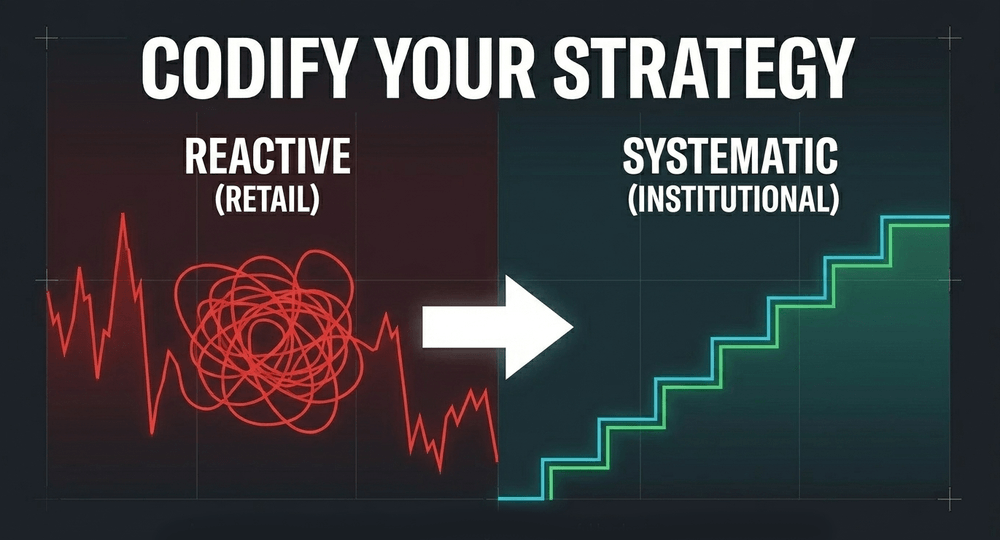
Moving from a reactive investor to a disciplined professional begins with an honest assessment of your own psychological triggers. Are you prone to FOMO? Do you find it impossible to admit a mistake? Do you check the portfolio obsessively when markets are volatile, or do you avoid looking entirely? The answers shape which safeguards you need most urgently.
The practical steps are straightforward, even if the execution is not:
- Write down your exit criteria before you buy. Define the exact conditions. If the share price drops X%, sell. If the CEO departs, sell. If earnings growth falls below a specified threshold for two consecutive quarters, sell. Specificity is everything - vague rules get rationalized away under pressure.
- Use automation. Set trailing stops or limit orders the moment the trade is executed. Do not wait for the market to open the following day. The window between a position going against you and the moment you place a stop is where most losses become catastrophic.
- Perform regular portfolio rebalancing. This forces you to sell outperformers and reinvest in underperformers, maintaining your target asset allocation and preventing a single winner from over-concentrating your risk. Morningstar's analysis has demonstrated that when two assets have identical long-term total returns, a disciplined rebalancing approach consistently produces higher profits - purely through the systematic buy-low, sell-high mechanism.
- Adopt volatility targeting. If the volatility of a specific position drifts outside its historical band, reduce the position size. Elevated volatility is frequently a precursor to a trend reversal, and holding full size into it is unnecessary risk.
- Review your sell decisions, not just your buy decisions. Most investors keep records of what they bought and when. Few track why they sold, and whether that decision was correct in hindsight. A sell journal - entries, exits, thesis, outcome - is one of the most powerful tools available for compressing the learning curve.
Working with a financial advisor can also provide a valuable external voice of reason. An advisor functions as a fiduciary buffer, preventing rash decisions during periods of turbulence and offering a perspective untainted by the emotional attachment that builds over years of holding a position.
The bottom line on capital protection
Protecting capital is not about avoiding all losses. It is about ensuring that no single loss is large enough to remove you from the game. The art of the exit is a systematic commitment to rationality in an irrational environment. By combining trailing stops, pre-defined trigger points, and a clear-eyed understanding of behavioral biases, you transform the act of selling from a stressful burden into a deliberate, repeatable process.
The market is a continuous stream of data and price action. A well-designed sell discipline allows you to navigate that stream without being swept away by the currents of fear and greed. It ensures that your portfolio reflects your long-term goals rather than your short-term emotional state. In the world of investing, the best defense is not just a good offense - it is a disciplined exit, executed without hesitation.
Share now









Key takeaways
- Loss aversion causes investors to feel the pain of losses approximately twice as intensely as the pleasure of equivalent gains (Kahneman & Tversky, Prospect Theory).
- The Disposition Effect is measurable even among professional fund managers: research by Frazzini found that mutual funds realize gains at a rate 21% higher than losses; for bottom-performing funds, that figure rises to 72% higher.
- Regret-averse investors experience 7-12% lower annualized returns compared to disciplined investors, and 38% delay selling underperforming assets due to emotional hesitation.
- Three independent research studies covering different markets and time periods converge on the same optimal trailing stop zone: 15-20% produces the best risk-adjusted returns.
- A 20% trailing stop produced the highest average quarterly return (1.71%) in the Snorrason & Yusupov study; a 15% trailing stop produced the highest cumulative return (73.91%) over an eleven-year period spanning two major market crises.
- Trailing stops calibrated to 1.0-1.5 standard deviations of historical volatility consistently deliver significantly higher excess returns than narrow thresholds, based on ETF data from 2001 to 2021.
- Stops set below 10% consistently produce lower overall returns due to increased transaction costs and premature exits triggered by normal market noise.
- The Target Price sell discipline was associated with the highest average monthly returns in multi-year academic studies comparing six institutional sell strategies using Plan Sponsor Network (PSN) data.
- In bear markets, more mechanistic disciplines such as Valuation Level outperform discretionary approaches, forcing investors to realize losses early before they compound.
- Effective risk management involves limiting single-trade exposure to 1-2% of total account capital, combined with a minimum 1:2 risk-reward ratio that keeps the strategy profitable even with a sub-50% win rate.
Sources
- Quant Investing - Best trailing stop-loss settings research https://www.quant-investing.com/blog/best-trailing-stop-loss-settings-to-maximize-your-returns
- Portfolio Management Research - Effectiveness of trailing stop-loss strategies for individual investors (2023) https://www.pm-research.com/content/iijindinv/14/1/29
- University at Albany Honors Archive - Effectiveness of sell discipline strategies in institutional investing (Faugère et al.) https://scholarsarchive.library.albany.edu/cgi/viewcontent.cgi?article=1013&context=honorscollege_business
- Mawer Investment Management - Sell discipline and overcoming behavioral biases (podcast) https://mawer.com/the-art-of-boring/podcast/from-buy-to-bye-sell-discipline-and-overcoming-behavioral-biases-ep159
- Altoo AG - The discipline gap: why portfolios drift from strategy https://altoo.io/the-discipline-gap-why-family-office-portfolios-drift-from-strategy/
- Published 2026-06-11 15:52
- Modified 2026-06-11 18:07

-
Redaction