
-
 PRO
PRO -
 Redaction
Why helium is the world's most fragile resource
Helium can never be recovered once it escapes into the atmosphere. Explore why global supply keeps breaking, from cryogenic leaks to Qatar's disrupted output.
The vanishing asset
Helium is the only commodity on Earth that, once consumed or released into open air, is gone for good. Gold can be melted and recast. Water cycles endlessly through the atmosphere and back down again. Helium does neither. As the second-lightest element on the periodic table, it carries a combination of properties no substitute can match: it is chemically inert, has the smallest atomic radius of any stable gas, and boils at -268.93 degrees Celsius, just a few degrees above absolute zero. Those same properties that make helium indispensable to modern high-tech industry are exactly what make it the most fugitive resource humans depend on.
The geological process that creates helium is slow almost beyond comprehension. It forms through the alpha decay of heavy elements such as uranium and thorium buried in the Earth's crust, a process that unfolds over millions of years. Most of it never reaches a well at all - it simply diffuses upward and escapes into the atmosphere, since Earth's gravity is too weak to hold an atom this light. Humans only capture helium when it happens to become trapped beneath a cap rock, almost always alongside natural gas deposits. There is no factory that manufactures helium. What exists underground is what exists, full stop.
For most of the past two decades, global output has failed to keep pace with demand. Analysts tracking the market have identified a series of distinct shortage cycles since 2006 - informally numbered "Helium 1.0" through "Helium 5.0" - each set off by a different failure point: a plant outage, a delayed expansion project, a fire at a processing facility, and now, in 2026, an act of war. By some industry estimates, the market spent roughly half of the years between 2006 and 2022 in outright deficit. This was never simply a pricing problem. It is a physical reality dictated by the difficulty of containing a gas that slips through almost any solid barrier, drawn from a shrinking handful of locations on the planet.
The mechanisms of inevitable escape
To understand why the helium supply chain is so brittle, it helps to zoom in to the atomic scale. Helium atoms are roughly seven times lighter than air, and their tiny radius lets them migrate through materials that would stop larger molecules like nitrogen or oxygen cold. This phenomenon - helium permeation - means total containment is a theoretical ideal, not a practical one, even inside the most sophisticated engineering environments built by humans. Well-built cryogenic containers still lose helium at a measurable rate every month under ideal conditions. No gasket, weld, or fitting is small enough to hold every atom in.
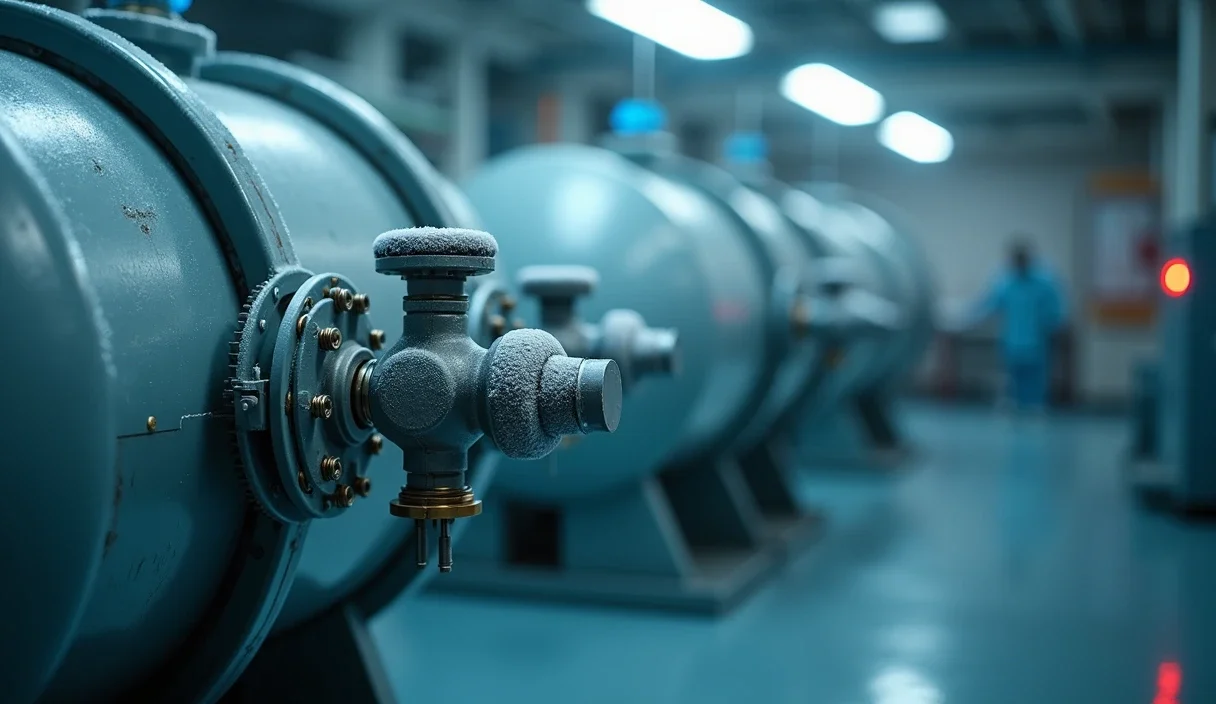
The logistical challenge compounds from there, because helium has to be kept near absolute zero to stay liquid for transport. That requires high-vacuum insulation and continuous refrigeration. Any break in the cooling cycle triggers "boil-off," where liquid expands into gas, pressure builds, and the gas has to be vented to keep the container from failing. Industry consultants say stranded shipments can lose the bulk of their volume within five to seven weeks if refrigeration is interrupted. In a global supply chain that leans on a limited fleet of specialized cryogenic ISO containers - the kind capable of holding liquid helium at -268.9°C for roughly five to seven weeks before meaningful losses set in - any delay in shipping lanes becomes a permanent loss of product, not a deferred delivery.

Impact on medical and research infrastructure
Healthcare is the single largest consumer of liquid helium, mainly because of Magnetic Resonance Imaging machines. These systems rely on superconducting magnets that must stay near absolute zero to function at all. A conventional whole-body MRI system has historically required something in the range of 1,500 to 2,000 liters of liquid helium at installation, and even idle machines lose a percentage of that helium every month to natural boil-off. For a midsize hospital, topping up those supplies has cost tens of thousands of dollars a year - a figure that climbs sharply whenever the global market tightens.
The research world feels the squeeze just as hard, arguably harder. University labs running nuclear magnetic resonance spectrometers and other superconducting equipment have repeatedly had to ration or pause projects when regional supply contracts. Because helium underpins so much research in superconductivity and low-temperature physics, a shortage isn't an inconvenience - it's a direct threat to the pace of scientific progress. As Professor Kevin Gardner of the CUNY Advanced Science Research Center put it, once cryogenic systems run dry, "they end up releasing the helium into the atmosphere, and off it goes into outer space."
"They end up releasing the helium into the atmosphere, and off it goes into outer space." - Professor Kevin Gardner, CUNY Advanced Science Research Center
Economic volatility and supply chain concentration
The helium market runs on extreme concentration and very little transparency. A handful of countries - fewer than ten - account for essentially all commercially traded volume, and the United States and Qatar together have typically supplied somewhere between three-quarters and 85 percent of global output. That concentration creates a level of geopolitical risk that is now impossible to ignore. When a producing facility in either country suffers a technical failure, a shipping blockade, or physical damage, global prices move almost immediately, because there is no meaningful buffer stock left anywhere to absorb the shock.
That vulnerability stopped being theoretical on March 2, 2026. Iranian drone and missile strikes, part of a broader retaliatory campaign following US and Israeli military action against Iran that began on February 28, hit Qatar's Ras Laffan Industrial City - the single largest concentration of helium production infrastructure on the planet - and closed the Strait of Hormuz to most Western commercial shipping. QatarEnergy declared force majeure the same week. Ras Laffan had been producing roughly 63 million cubic meters of helium a year, close to a third of estimated global output of around 190 million cubic meters, and industry estimates put the loss at somewhere between 30 and 38 percent of world supply. QatarEnergy's chief executive, Saad al-Kaabi, has said the company may need to keep force majeure in place on some contracts for up to five years, and has stated plainly that production cannot restart until hostilities end.
The logistics side of the crisis turned out to be almost as damaging as the production loss itself. With the Strait of Hormuz closed to Western carriers, roughly 200 specialized cryogenic containers holding liquid helium were left stranded in Qatar with no clear route out - and those containers can only hold their cargo in liquid form for something like 35 to 48 days before losses become severe. Major shipping lines including Maersk, MSC, Hapag-Lloyd, and CMA CGM rerouted vessels around the Cape of Good Hope, adding 10 to 14 days of transit time and roughly a million dollars in extra fuel costs per voyage - time that liquid helium simply does not have. Distributors across the United States responded by invoking their own force majeure clauses, rationing allocations, prioritizing hospital customers, and layering surcharges onto existing contracts. Spot prices reportedly doubled within a few months of the disruption beginning, and contract renegotiations in 2026 have been coming in 20 to 40 percent above expiring terms.
This shock landed on a market that had already lost its shock absorber. For nearly a century, the United States government managed the Federal Helium Reserve, a strategic stockpile held roughly 3,000 feet underground in the Bush Dome, a natural geologic formation near Amarillo, Texas. At its peak the reserve held more than 40 billion cubic feet of helium and supplied a meaningful share of domestic demand for decades. Congress mandated its sale through the Helium Privatization Act of 1996 and, more decisively, the Helium Stewardship Act of 2013. Public bidding closed in January 2024, Messer's roughly $423 million bid won, and the Bureau of Land Management completed the handover in June 2024, transferring $460 million in total proceeds to the US Treasury by December of that year. The sale removed the closest thing the market had to a buffer against exactly the kind of geopolitical disruption that followed just fourteen months later.
Helium pricing has trended upward for two decades, with a compound annual growth rate estimated in the high single digits even before 2026. By early 2025, spot prices in some markets had already reached roughly $97,000 per metric ton in the United States and over $114,000 in parts of Europe - increases of several hundred percent from a decade earlier - and the 2026 disruption pushed things further still. In semiconductor manufacturing, where helium is used as a process gas to cool components and maintain ultra-pure environments during plasma etching and lithography, there are few workable substitutes given the precision modern chip fabrication demands. Chipmakers including TSMC have reportedly paid two to four times normal prices to maintain buffer inventories of at least a month's supply, and firms like Seagate and Western Digital, two of the largest producers of helium-filled hard drives, had already allocated 2026 production and implemented price increases well before the Qatar disruption fully played out. For manufacturers, venting helium isn't just an environmental footnote anymore - it's a direct financial loss that can run into millions of dollars over a facility's lifecycle.
Industrial applications and the search for alternatives
Beyond medicine and electronics, helium is critical to aerospace. It pressurizes rocket fuel tanks, since its low weight and inertness let it displace fuel without reacting or adding meaningful mass. It's also the primary tracer gas used for leak detection, prized because its small atomic size lets it reveal microscopic flaws in everything from medical devices to vacuum systems. That utility is also its curse: once a leak is found, the tracer gas almost never comes back.
Finding workable alternatives runs into hard physical limits. In some gas chromatography applications, nitrogen or hydrogen can substitute for helium, but hydrogen's flammability and nitrogen's larger molecular size cap their usefulness for precision work. In the balloon industry, hydrogen actually provides more lift than helium, but safety rules in most regions prohibit its use at public events, leaving lifting applications almost entirely dependent on a gas now reserved first for hospitals and chip fabs.
Medical imaging has made the most visible progress toward breaking its helium dependence. Manufacturers including Siemens Healthineers and GE HealthCare have introduced sealed, low-helium and near-helium-free 1.5T MRI platforms that use cryocoolers to recondense boiled-off gas internally, cutting helium requirements from roughly 1,500 liters down to a fraction of a liter in some designs, and eliminating the emergency quench pipe that older systems required. Early clinical reviews of these sealed-magnet systems suggest they perform adequately across many standard imaging protocols, though large-scale, independent validation against conventional 1.5T and 3T scanners is still relatively limited. For hospital administrators, the appeal is simple: a scanner that barely touches the helium market is a scanner insulated from the next supply shock.

The rise of on-site recovery and recycling
Short of eliminating the need for helium altogether, the most effective response to its fugitive nature is on-site recovery. Technologies including cryogenic distillation, membrane separation, and pressure swing adsorption let users capture vented gas and purify it for reuse, and the results can be substantial. Research institutions running fleets of NMR spectrometers have reported recycling rates approaching 90 percent after installing recovery infrastructure, and leading-edge semiconductor fabs using extreme ultraviolet lithography now typically reclaim somewhere between 70 and 95 percent of the helium that passes through their tools, depending on equipment age. Since the 2026 disruption began, industry reporting suggests some fabs and research labs have pushed recovery rates closer to 90 percent as a direct response to constrained supply.
Membrane technology looks particularly promising for large-scale use. Systems built on materials such as polybenzimidazole (PBI) can separate helium from natural gas or waste streams at a fraction of the energy cost of traditional cryogenic methods. These systems still demand a serious upfront investment, though, and for many smaller institutions the choice comes down to paying elevated spot-market prices for new helium or sinking capital into a recovery plant that may take years to pay for itself. As helium prices keep climbing, and as 2026 has shown just how fast supply can vanish, the economics of recovery are tilting in favor of buyers who once viewed it as an unnecessary expense.

Share now









Key takeaways
- Helium is the only commodity on Earth that is truly non-renewable once released into open air - it escapes Earth's gravity entirely and is lost to space.
- Helium forms over millions of years through the alpha decay of uranium and thorium in the Earth's crust, and is only harvested when it happens to be trapped alongside natural gas deposits.
- The helium market spent roughly half of the years between 2006 and 2022 in supply deficit, cycling through distinct shortage episodes informally dubbed "Helium 1.0" through "Helium 5.0" by industry analysts.
- The United States and Qatar together have typically supplied 75 to 85 percent of global helium output, making the market highly concentrated and geopolitically exposed.
- Iranian strikes on Qatar's Ras Laffan complex on March 2, 2026, combined with the closure of the Strait of Hormuz, removed an estimated 30 to 38 percent of global helium supply, with QatarEnergy warning force majeure could remain in effect for up to five years.
- Roughly 200 specialized cryogenic containers of liquid helium were stranded in Qatar after the 2026 strikes, each capable of holding cargo for only 35 to 48 days before losses become severe.
- Spot helium prices reportedly doubled within months of the 2026 disruption, with 2026 contract renegotiations coming in 20 to 40 percent higher than expiring terms.
- The U.S. Federal Helium Reserve near Amarillo, Texas - once the world's only sovereign helium stockpile - was sold to Messer for roughly $423 million in a deal finalized in June 2024, removing a key buffer against supply shocks.
- Leading-edge semiconductor fabs using EUV lithography now reclaim 70 to 95 percent of the helium they use, while some research labs report recovery rates approaching 90 percent.
- New helium-free and near-helium-free MRI platforms have cut liquid helium requirements from roughly 1,500 liters to under one liter per scanner using sealed, cryocooler-based designs.
- Helium is chemically inert, has the smallest atomic radius of any stable gas, and one of the lowest boiling points of any known substance (-268.93°C), making it irreplaceable in cryogenics, semiconductor manufacturing, and leak detection.
- Emerging producers in Saskatchewan (Canada), South Africa, Tanzania, Montana, and Colorado are ramping up new helium sources, but greenfield exploration-to-production timelines typically run seven to ten years.
Sources
- Bureau of Land Management (Federal Helium System sale) https://www.blm.gov/press-release/blm-completes-sale-federal-helium-system
- AGBI (Qatari LNG shutdown and global helium supply risk) https://www.agbi.com/industry/2026/03/qatari-lng-shutdown-puts-11-of-global-helium-supply-at-risk/
- C&EN (ACS) https://cen.acs.org/business/specialty-chemicals/Helium-supplies-tight-worse/104/web/2026/05
- Wikipedia (National Helium Reserve) https://en.wikipedia.org/wiki/National_Helium_Reserve
- Siemens Healthineers (DryCool Technology) https://www.siemens-healthineers.com/magnetic-resonance-imaging/technologies-and-innovations/drycool-technology
- Published 2026-07-31 09:27
- Modified 2026-07-31 09:27

-
Redaction