

-
 Redaction
Currency pegs: mechanics, pressure and failure
Only 14% of currency pegs since 1800 have survived. Learn the mechanics, the impossible trinity, and warning signs that a fixed exchange rate will break.
Currency pegs are the ultimate expression of a central bank's commitment to stability, but they are often built on a foundation of sand. In the world of international finance, a currency peg - or fixed exchange rate system - is a policy where a nation's monetary authority ties the value of its currency to a foreign anchor, such as the U.S. dollar, or a commodity like gold. For a developing economy, this provides an immediate borrowed credibility. By hitching its wagon to a stable, global reserve currency, a nation can suppress inflation, simplify cross-border trade, and offer a predictable environment for foreign direct investment.
However, this stability comes at a steep price: the surrender of monetary autonomy.
Today, more than 66 countries continue to peg their domestic units to the U.S. dollar. From the financial hubs of Hong Kong to the oil-rich deserts of Saudi Arabia, the peg is viewed as a vital tool for economic survival. Yet the history of finance is littered with the wreckage of failed pegs. Analysis of over 300 currency arrangements since 1800 shows that only 14% of these systems have survived. Understanding the anatomy of these regimes requires looking past the surface-level stability and into the mechanical pressures that inevitably build up within the central bank's balance sheet.

A brief history of the peg: From gold to dollar
The concept of anchoring a currency is not new. For much of the 19th and early 20th centuries, major economies operated under the gold standard, where each unit of currency was directly convertible into a fixed quantity of gold. It was rigid, deflationary, and politically brutal - but it held.
The modern era of pegging began in earnest after World War II. In 1944, 44 Allied nations met in Bretton Woods, New Hampshire, to design a new global monetary system. The result was the Bretton Woods Agreement, under which the U.S. dollar was pegged to gold at $35 per ounce, and every other participating country pegged its currency to the dollar. This made the U.S. dollar the anchor of global finance for nearly three decades.
The system held until the pressures of the Vietnam War, rising domestic inflation, and mounting U.S. trade deficits made the gold peg unsustainable. On August 15, 1971, President Nixon ended dollar-to-gold convertibility in what became known as the Nixon Shock. By 1973, the Bretton Woods system had effectively collapsed, and freely floating exchange rates became the new global norm for major economies. What survived was a fragmented landscape of smaller, regional pegs - dozens of which would go on to fail spectacularly.

Mechanics of a currency peg: The central bank as the market maker
When a central bank establishes a peg, it essentially steps into the market as the buyer or seller of last resort at a predetermined price. This is not a passive stance; it is relentless, daily combat against market forces. For example, the United Arab Emirates dirham (AED) has been held at a rate of 3.67 to 1 U.S. dollar for decades. To maintain this, the central bank must be prepared to intervene instantly.
Intervention and reserve management
If the domestic currency experiences upward pressure - perhaps due to a surge in export revenue or foreign investment - the central bank must sell its own currency and buy foreign reserves. This increases the supply of the domestic unit, preventing it from appreciating beyond the target.
Conversely, if the currency weakens due to capital flight or a trade deficit, the bank must do the opposite: sell its foreign currency reserves to buy back the domestic currency. This creates artificial demand, propping up the price.
This mechanism relies entirely on the depth of a nation's war chest.
"Without massive foreign currency reserves, the central bank is a general without an army."
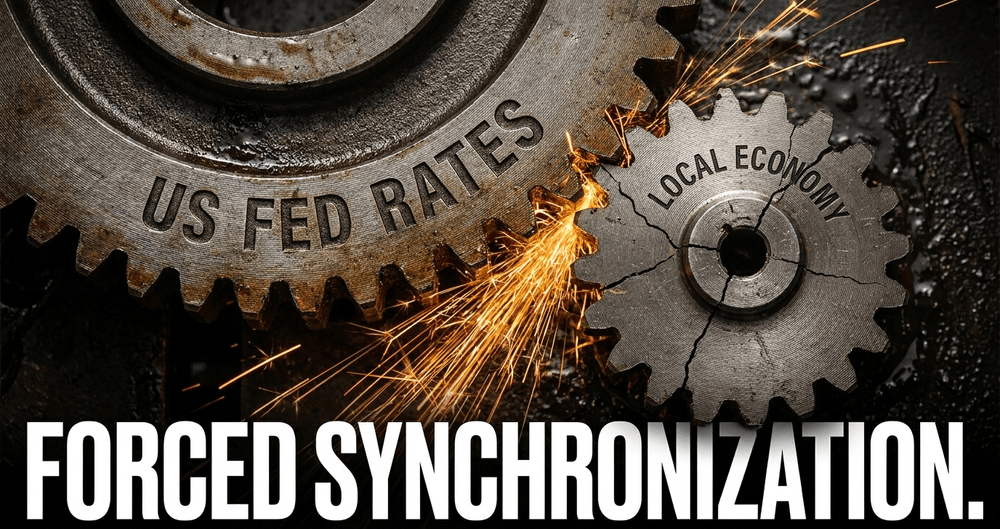
If the market senses that reserves are dwindling, the peg becomes a target for every speculator on the planet. Furthermore, maintaining a peg often requires the synchronization of interest rates. If the U.S. Federal Reserve raises rates, a country pegged to the dollar must often follow suit, regardless of whether its domestic economy is actually ready for higher borrowing costs.

Taxonomy of fixed exchange rate regimes
Not all pegs are created equal. They exist on a spectrum of rigidity, ranging from hard anchors to flexible crawling arrangements. Choosing the right structure is a matter of balancing credibility against the need for a relief valve during economic shocks.
- Hard pegs: These are uncompromising. The Saudi Riyal has been pegged at 3.75 to the dollar since 1986. These systems require total commitment and massive reserves to survive decades of market fluctuations. Between 2015 and 2016, when oil prices collapsed below $30 per barrel, SAMA burned through more than $150 billion in reserves in 20 months to hold the line - and the peg survived.
- Soft pegs: These offer a buffer zone. The central bank allows the currency to fluctuate within a narrow band. China's Renminbi has historically utilized this approach, providing the government with a degree of control while allowing some market signals to filter through.
- Crawling pegs: In economies with persistently high inflation, such as Vietnam, a crawling peg is used. The rate is adjusted periodically in small increments to reflect the divergence between domestic and foreign price levels, preventing the currency from becoming dangerously overvalued.
- Basket pegs: Rather than tying its fate to one country, a nation might peg to a weighted average of several currencies. The Kuwaiti dinar uses an undisclosed basket to protect against the volatility of any single foreign unit.
- Currency boards: This is the most extreme form of a hard peg. Every unit of domestic currency in circulation must be 100% backed by foreign reserves. It removes the central bank's ability to print money to fund government deficits, providing the highest level of institutional credibility. Hong Kong has operated under exactly this system since 1983, pegging the HKD to the dollar at around 7.80 - surviving the 1997 Asian crisis, the 2008 financial crisis, and the Covid-19 shock.

The impossible trinity and the pressure of the trilemma
In macroeconomics, the Impossible Trinity - or the Policy Trilemma - is the iron law that eventually breaks most pegs. The theory, developed by economists Robert Mundell and Marcus Fleming in the early 1960s, states that a country cannot simultaneously have a fixed exchange rate, free capital movement, and an independent monetary policy. It can only pick two.
Most modern economies want free capital movement to attract investment. If they also want a fixed exchange rate, they must import the monetary policy of the anchor country.
This is where the pain begins. If the U.S. Fed is tightening while the domestic economy is in recession, the pegged country is forced to tighten as well - potentially turning a mild downturn into a depression. This divergence of economic cycles is a primary source of pressure. When the pain of high interest rates becomes politically or socially unbearable, the will to maintain the peg evaporates.

Hong Kong provides a live demonstration of this dynamic. In 2022, as the Federal Reserve aggressively hiked rates to combat inflation, the Hong Kong Monetary Authority (HKMA) was forced to follow, even though Hong Kong's own economy was under stress. Studies published in 2025 found that during this episode, the market-implied probability of peg survival dropped to approximately 50% - a sobering figure for what is considered one of the world's most credible currency arrangements.
Why pegs fail: The mechanics of collapse
Currency pegs do not usually fade away; they explode. The failure point is typically reached when the market realizes the central bank is naked - meaning it lacks the reserves or the political stomach to continue the defense.
Speculative attacks and the Krugman model
Paul Krugman's 1979 work on speculative attacks showed that crises are often the rational outcome of inconsistent policies. If a government runs large fiscal deficits and forces the central bank to fund them, the bank's foreign reserves will slowly bleed away as it tries to maintain the peg. Speculators, seeing the inevitable exhaustion of reserves, will launch a coordinated attack, selling the currency in massive volumes.
This forces the central bank to spend its last remaining reserves in a matter of days - sometimes hours. Once the reserves are gone, the peg is abandoned, and the currency devalues sharply.
Banking system fragility
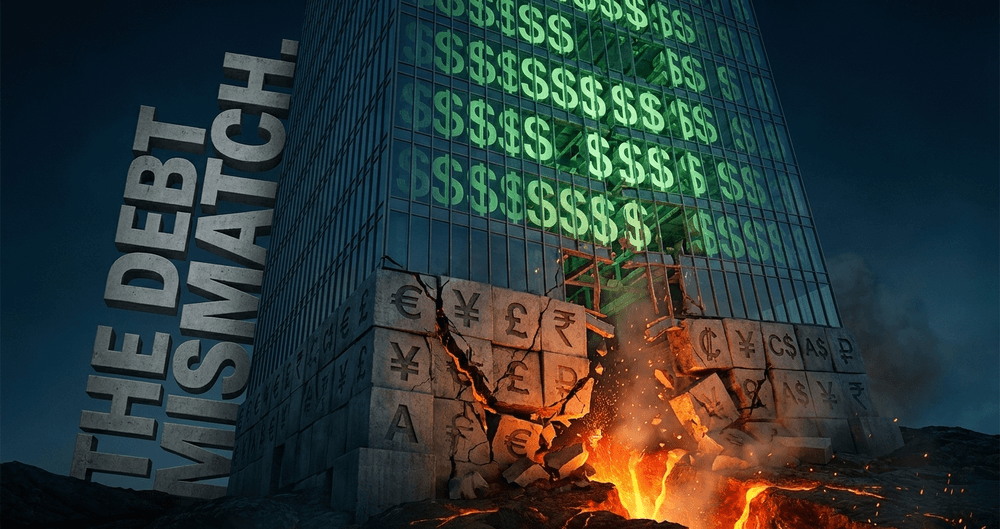
Third-generation models of currency crises focus on the mismatch in the banking sector. In many pegged regimes, local companies and banks borrow in U.S. dollars because interest rates are lower, but their revenue is in the domestic currency. This works fine as long as the peg holds.
The moment the peg breaks, the cost of servicing that dollar debt skyrockets. This can lead to a systemic collapse of the entire financial sector, turning a currency crisis into a full-scale national insolvency. It is not a theoretical risk. It is precisely what happened across Southeast Asia in 1997 and to Argentina's banking system in 2001.

Historical wreckage: From Black Wednesday to Sri Lanka
The history of the 20th and 21st centuries provides a grim catalog of peg failures. Each case follows a recognizable pattern: overvaluation accumulates, reserves erode, credibility cracks, then the market finishes the job.
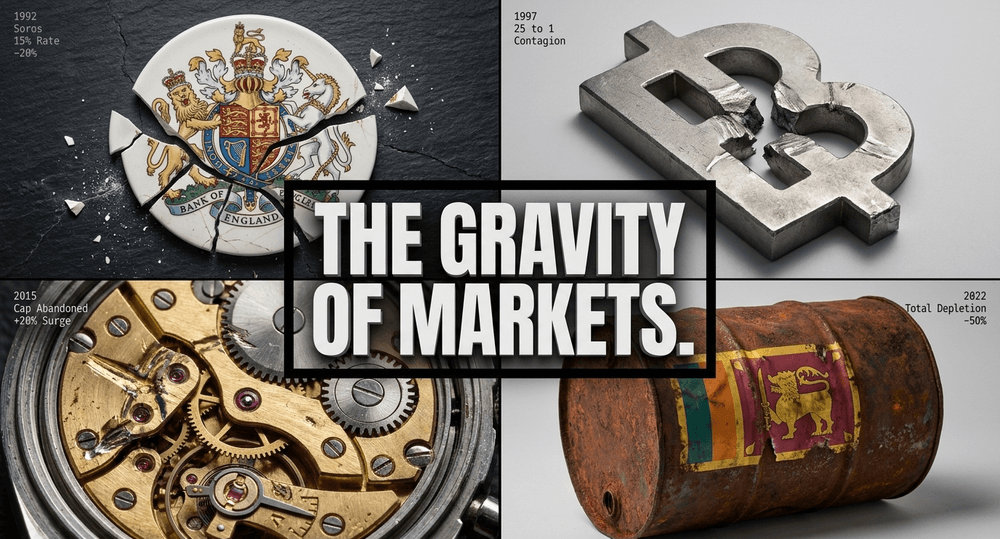
Black Wednesday (September 16, 1992): The United Kingdom's attempt to peg the pound to the Deutsche Mark inside the European Exchange Rate Mechanism ended in disaster. The UK had joined the ERM at what most economists considered too high a rate. George Soros and his Quantum Fund built a $10 billion short position against sterling, betting the peg was unsustainable. Despite the Bank of England raising interest rates to 15% in a single day and spending an estimated £27 billion in foreign exchange reserves, the government capitulated. The pound fell 15% against the Deutsche Mark and 25% against the dollar. The UK Treasury's net loss from the defense was £3.3 billion. Soros made approximately £1 billion in a single day, earning the lasting title of the man who broke the Bank of England.
The Asian financial crisis (1997): Thailand's rigid peg of 25 Baht to the dollar had encouraged years of excessive foreign borrowing. When the peg snapped, it triggered a contagion that swept through Indonesia, South Korea, and Malaysia. The Baht lost half its value in months. The currency mismatch in the banking sector - exactly the dynamic Krugman had modeled - turned a currency crisis into a regional economic catastrophe.
Argentina (2001): In 1991, Argentina established a currency board, pegging the peso 1:1 to the U.S. dollar to crush hyperinflation. For several years it worked. Then the dollar began to appreciate significantly, making Argentine exports expensive and uncompetitive. Fiscal deficits mounted, and the country began borrowing heavily to close the gap. By November 2001, Argentina's sovereign debt had reached $93 billion. Spreads between U.S. Treasury bonds and Argentine government debt climbed to 5,000 basis points. The peso collapsed, the currency board was abandoned, and by mid-2002 the exchange rate had depreciated to nearly four pesos per dollar. Unemployment reached 22.5% and poverty soared to 57.5%.
The Swiss franc shock (January 15, 2015): Not all failures are devaluations. The Swiss National Bank (SNB) had introduced a cap of 1.20 Swiss francs per euro in September 2011 to protect exporters from the surging safe-haven franc. For more than three years the cap held. Then, facing the prospect of the European Central Bank launching a massive quantitative easing program that would flood the market with euros, the SNB decided the cost of maintaining the floor was no longer justified. It abandoned the cap without a single word of advance warning - just days after its own vice-chairman had publicly stated it would remain the cornerstone of SNB policy. The franc surged almost 20% in a single session. The Swiss benchmark stock index fell more than 10%. Major U.S. forex broker FXCM reported client losses that generated approximately $225 million in negative equity balances. In the first half of 2015 alone, the SNB reported losses of CHF 52 billion on its foreign currency holdings.
Sri Lanka (2022): A modern tragedy. A total depletion of foreign reserves meant the country could no longer defend its currency or pay for essential imports, including fuel and medicine. The rupee collapsed by roughly 50%, leading to widespread social unrest and the eventual ouster of the government.
Share now









Key takeaways
- A currency peg - or fixed exchange rate system - ties a domestic currency's value to a foreign currency, a basket of currencies, or a commodity like gold.
- Over 66 nations currently peg their currencies to the U.S. dollar to stabilize trade, suppress inflation, and attract foreign investment.
- Analysis of more than 300 currency pegs since 1800 shows a survival rate of only 14%, with the median lifespan of failed pegs at just 8 to 10 years.
- The Impossible Trinity (Mundell-Fleming trilemma) states that a country cannot simultaneously maintain a fixed exchange rate, free capital movement, and an independent monetary policy - it can only achieve two of the three.
- Speculative attacks occur when investors identify a central bank's reserves as insufficient to defend the rate - making the collapse a self-fulfilling prophecy.
- On Black Wednesday (September 16, 1992), the UK spent an estimated £27 billion in foreign exchange reserves attempting to defend the pound within the ERM, sustaining a net loss of £3.3 billion before capitulating. George Soros made approximately £1 billion in a single day.
- In the Asian financial crisis (1997), Thailand's dollar peg encouraged excessive foreign-currency borrowing; when it collapsed, the baht lost roughly half its value in months, with contagion spreading across the region.
- When Argentina's 1:1 peso-dollar currency board collapsed in 2001, the peso depreciated to nearly four pesos per dollar by mid-2002, unemployment reached 22.5%, and poverty exceeded 57%.
- The Swiss National Bank's surprise abandonment of its 1.20 franc-per-euro cap on January 15, 2015, caused the franc to surge nearly 20% instantly, inflicting approximately CHF 52 billion in losses on the SNB's own balance sheet in the first half of 2015 alone.
- A currency crisis accompanied by a banking crisis - a twin crisis - produces an average GDP contraction of around 6.5%, with losses often permanent rather than temporary.
Sources
- World Economic Forum https://www.weforum.org/stories/2024/07/what-stablecoins-can-learn-from-historys-currency-pegs/
- Federal Reserve History (Nixon Shock / Bretton Woods) https://www.federalreservehistory.org/essays/gold-convertibility-ends
- San Francisco Fed (Argentina crisis) https://www.frbsf.org/research-and-insights/publications/economic-letter/2002/10/learning-from-argentina-crisis/
- CoinLaw - Currency Devaluation Statistics https://coinlaw.io/currency-devaluation-incidents-statistics/
- Wikipedia - Impossible Trinity https://en.wikipedia.org/wiki/Impossible_trinity
- Published 2026-07-26 23:57
- Modified 2026-07-27 00:01

-
Redaction