






-
 PRO
PRO -
 Redaction
Why copper supply cannot keep up with demand
Global copper demand will outpace supply by 10 million metric tons by 2040. Here's why this shortage threatens the entire energy transition.
The global economy is racing to rewire itself. Solar panels are multiplying across deserts, EV charging stations are appearing in car parks, and AI data centers are consuming electricity at a rate that would have seemed implausible a decade ago. Every single one of these systems runs on copper - and the world is quietly running out of runway to mine enough of it.
Copper is not a niche industrial input. It is, as resource analysts now routinely describe it, the metal that makes the modern world move. And the math of how much we need versus how much we can realistically extract has become one of the most consequential - and least discussed - problems in the entire energy transition.
This article breaks down the demand surge, the supply constraints, the geopolitical risks, and what it all means for the timeline of global decarbonization.
Why copper is the real bottleneck of the energy transition
When people think about critical minerals, lithium and cobalt tend to dominate the conversation. But copper underpins all of them. It is the conductor in lithium battery systems, the winding in cobalt-containing EV motors, and the cable in every solar and wind installation on earth.
Global copper demand is currently projected to reach approximately 42 million metric tons (mt) by 2040 - a 50% increase from 2025 levels, when demand stood at 28 million metric tons. By 2050, refined copper demand is expected to surpass 37 million mt annually under conservative IEA scenarios. Critically, this is not driven by general economic growth in the traditional sense. It is driven by a structural transformation in how humanity generates, transmits, and uses energy.
According to the International Energy Agency's Net Zero Emissions by 2050 Scenario, nearly 50% of all copper demand will be dedicated to clean energy technologies by 2040. That single statistic reframes copper from a commodity into a climate-critical strategic resource.
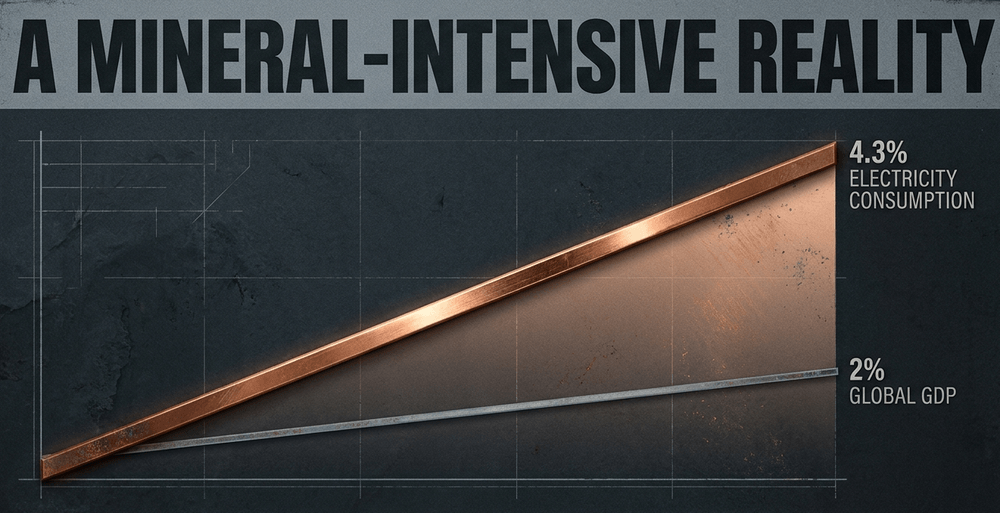
The electricity consumption picture makes the pressure even clearer. Global electricity demand is projected to increase by almost 50% by 2040 - and meeting that demand would require adding the equivalent of roughly 330 Hoover Dams of generation capacity every single year between now and then. Every percentage point of growth in the electrified economy requires a disproportionate increase in copper tonnage. Without a massive scaling of supply, copper will not be an enabler of the green transition. It will be its primary constraint.
The electric vehicle boom is a copper demand explosion
No sector illustrates the copper intensity of decarbonization more vividly than transportation.
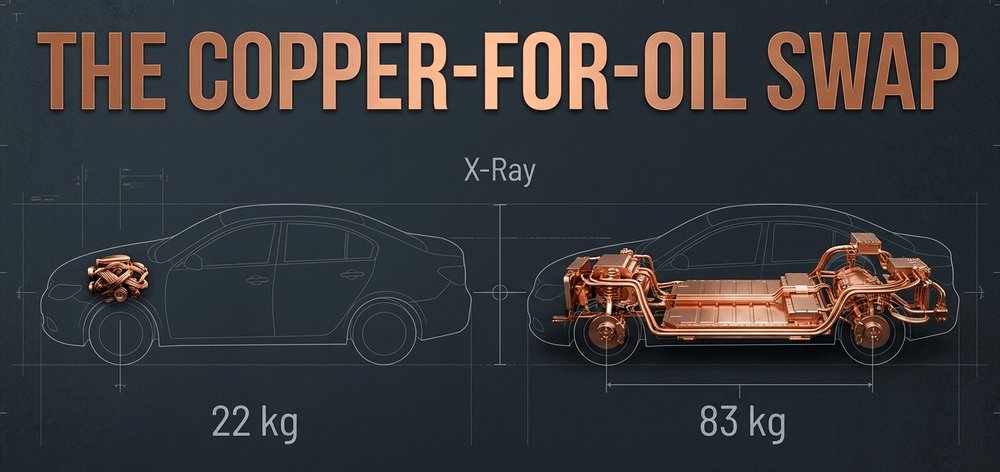
A standard small internal combustion engine (ICE) vehicle contains roughly 22-25 kg of copper. A full battery electric vehicle (BEV) contains an average of 83 kg - a roughly 277% increase in copper intensity per vehicle. A single EV can contain up to a mile of copper wiring, distributed across motor windings (where dense coils of high-purity copper generate the electromagnetic fields that drive the vehicle), battery anodes (where copper foil serves as the current collector in lithium-ion cells), inverters and power electronics (which manage high-voltage power through robust busbars and connectors), and the charging infrastructure itself, including the stations and the grid cables connecting them.
By 2040, passenger EVs alone are projected to consume over 3.7 million mt of copper annually. Benchmark Minerals Intelligence estimates EV sector copper demand will rise from 1.3 million tonnes in 2025 to 2.3 million tonnes by 2030 alone. Expand the lens to commercial transport, and the scale becomes harder to comprehend. An electric bus uses between 11 and 16 times more copper than a standard passenger car. As municipal fleets worldwide commit to electrification - and as these vehicles require more frequent, higher-capacity charging cycles - the strain on primary copper markets will intensify sharply.
Worth noting: S&P Global projects the ICE vehicle fleet will peak in 2026, after which electrification-driven copper demand curves only steepen.
Renewable energy needs far more copper than fossil fuels
The transition from centralized fossil fuel generation to distributed renewable energy is, at its core, a massive increase in material intensity per unit of electricity produced.
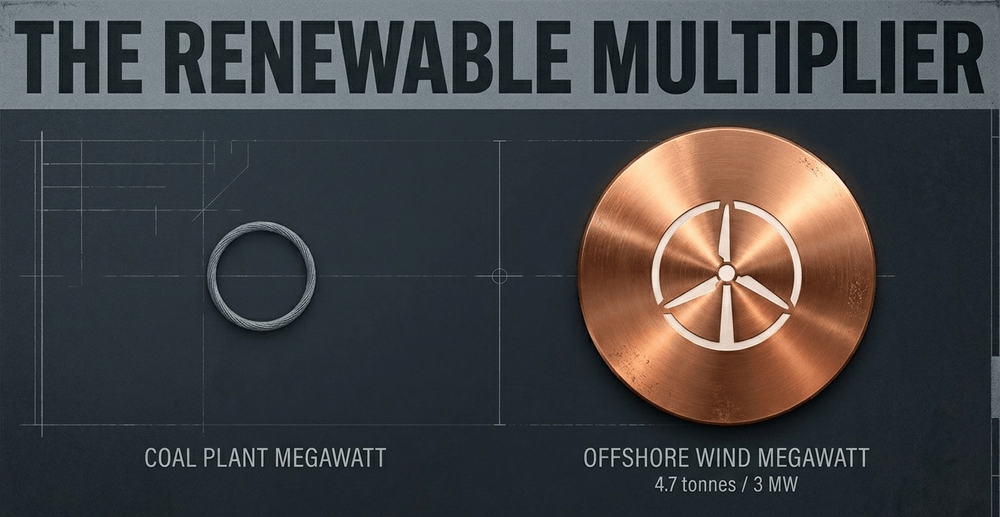
Renewable systems require, on average, five to six times more copper than traditional coal or gas plants per megawatt of installed capacity. The reasons are structural: lower energy density means more equipment is needed to capture the same amount of energy, and the decentralized geography of renewable sources requires far more transmission infrastructure to deliver power to where it is consumed.
Wind power illustrates this clearly. A single 3 MW wind turbine can contain up to 4.7 tonnes of copper. Offshore installations are even more intensive, requiring more than double the copper of onshore farms due to the extensive undersea cabling required to bring electricity to shore.
Solar follows a similar pattern. Constructing a 1 MW solar plant requires between 3.1 and 4.5 tonnes of copper for busbars, wiring, and inverter components alone.
Beyond generation, the modernization of global electrical grids presents a demand surge of its own. Integrating variable renewable energy requires thousands of miles of new transmission and distribution lines - infrastructure that is almost entirely copper-dependent. Grid upgrades and power transmission are expected to drive more than 60% of copper demand growth through 2030, according to Goldman Sachs Research. As the world attempts to connect remote wind farms in Scotland or solar deserts in North Africa to urban load centers, the "balance of system" copper requirements are becoming as significant as the generation assets themselves.
The AI and data center surge: an emerging copper megaforce
A new and rapidly accelerating demand vector has arrived in the form of digital infrastructure. The explosion of artificial intelligence and cloud computing has turned data centers into massive copper sinks - and the industry is only beginning to grasp the scale of what is coming.
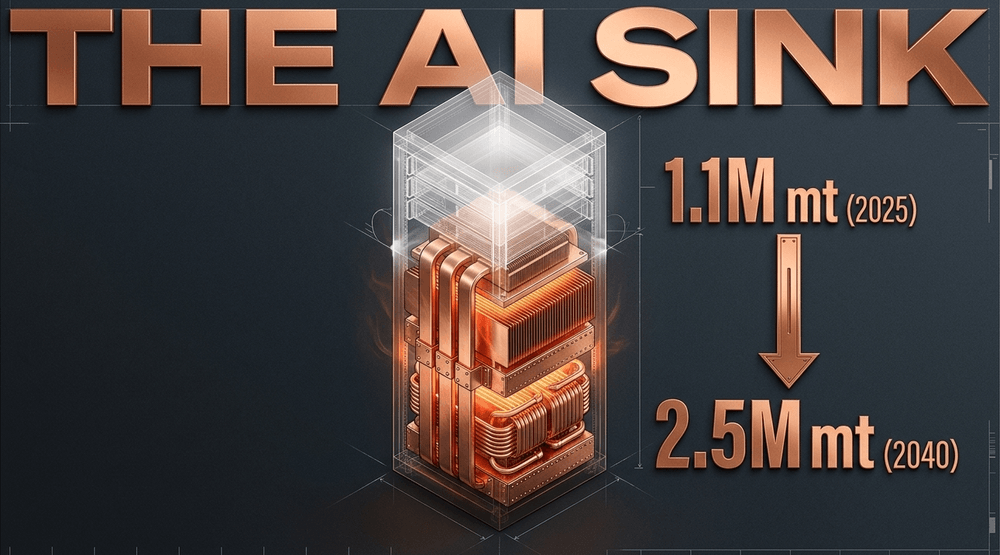
A conventional data center requires 5,000 to 15,000 tonnes of copper. A hyperscale AI facility requires up to 50,000 tonnes, with copper intensity ranging from 27 to 66 tonnes per megawatt. S&P Global projects copper demand from data centers will rise from 1.1 million mt in 2025 to 2.5 million mt by 2040. AI training centers are particularly intensive: by 2030, AI-specific facilities are expected to account for 58% of all data center copper demand. This is driven by the need for high-density power delivery networks and sophisticated cooling systems capable of managing the thermal loads of next-generation GPU clusters.
Total installed data center capacity is expected to reach 550 gigawatts by 2040 - a fivefold increase from earlier in this decade. In this context, copper is not simply a conductor. It is a critical component of thermal management and power stability in infrastructure that the global economy is increasingly dependent on.
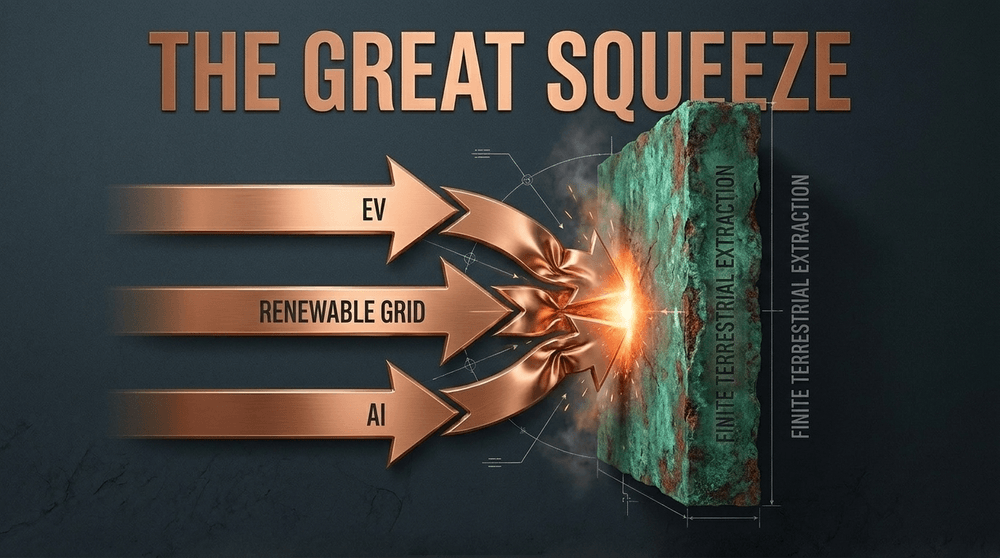
What makes this demand vector particularly challenging is that it is compounding on top of EV and renewable growth, not replacing it. The electrification of transport, the build-out of renewable generation, and the AI infrastructure boom are all competing for the same constrained supply of copper simultaneously.
The defense dimension: an overlooked vector
There is a fourth demand driver that rarely appears in mainstream energy transition analysis: military rearmament.
Global defence spending reached $2.7 trillion in 2024, growing by 9.4% in real terms. That money buys copper - in quantity. Shell casings, missile guidance systems, fighter aircraft wiring, naval vessel cabling, and electronic warfare systems all require substantial copper inputs.
Analysts at Societe Generale estimate that if global military spending as a share of GDP rises from current levels toward Cold War-era levels of around 4%, it would add roughly 170,000 additional tonnes of copper demand annually. Military copper usage already accounted for an estimated 2.186 million metric tons in 2021 - nearly 9% of global refined copper production at the time - and has been growing. The US Department of Defense, for example, has dramatically increased annual production targets for 155-millimeter artillery shells, each of which contains copper as a core component.
In a market that is already structurally tight, this increment is not trivial. And it is almost entirely absent from the standard demand models used by energy transition analysts.
The supply-demand gap: a 10 million metric ton shortfall by 2040
The most alarming dimension of the copper market is the widening gulf between projected demand and available supply.
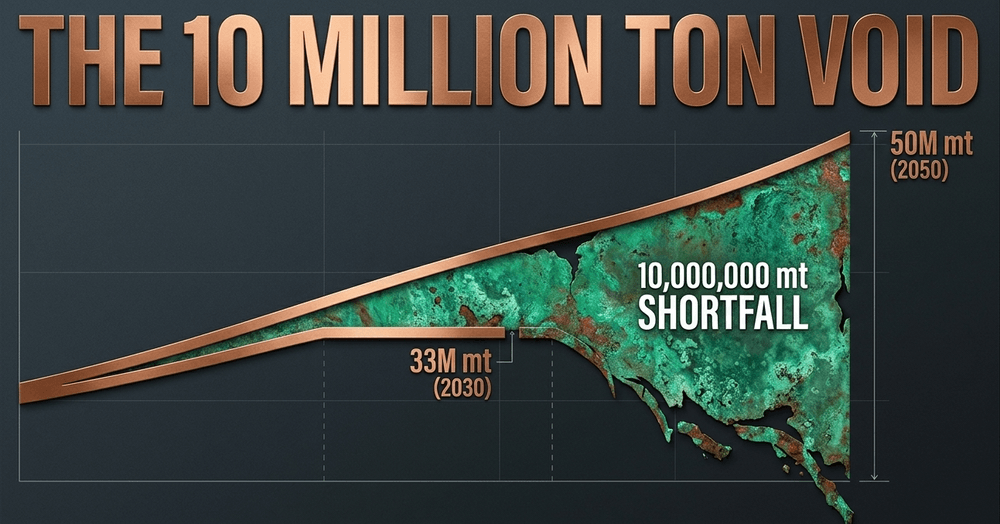
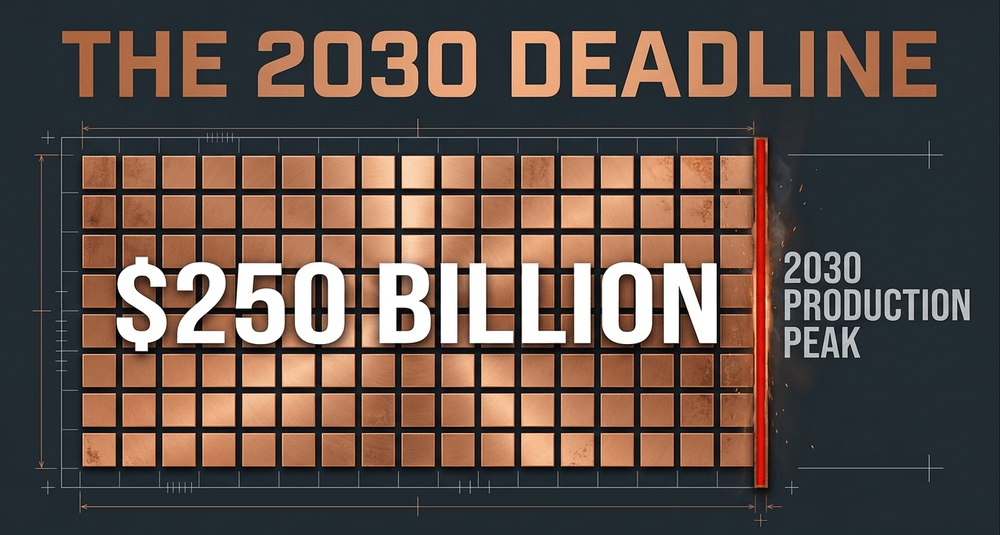
S&P Global's Copper in the Age of AI study forecasts a shortfall of 10 million mt by 2040 - representing a 25% deficit relative to demand. Global copper production is projected to peak at approximately 33 million mt in 2030 and then enter a steady decline unless significant new investment is mobilised. The IEA's Global Critical Minerals Outlook projects mined copper output declining to less than 19 million mt by 2035 without major new project development - even under optimistic assumptions, a 20% supply deficit persists by 2035.
Meeting projected 2030 demand alone would require an estimated $250 billion in investment and the opening of at least 80 new large-scale mining projects. Wood Mackenzie puts the capital requirement at over $210 billion by 2035. The industry faces compounding structural headwinds that make this target extraordinarily difficult to achieve:
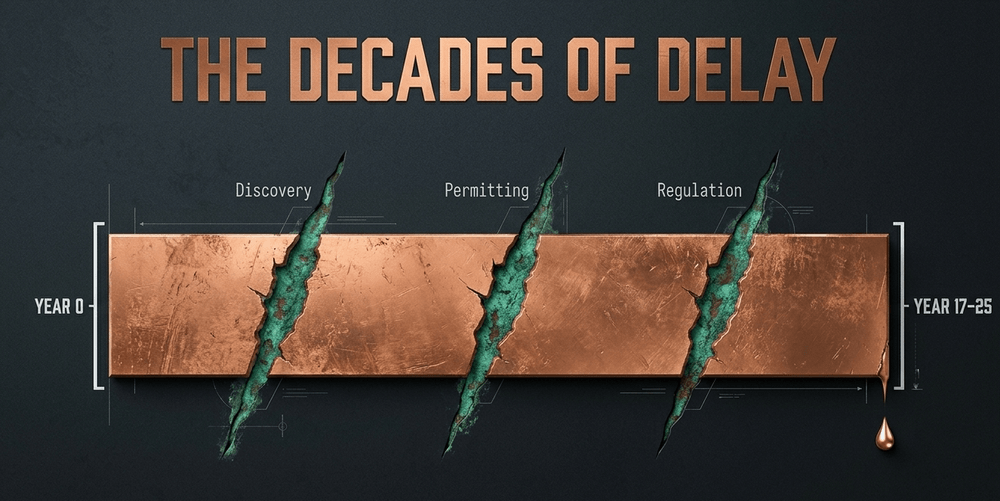
- Extraordinarily long lead times. The average timeline from discovery of a copper deposit to first production now spans 17 to 25 years, driven by increasingly complex permitting processes, environmental impact assessments, and regulatory hurdles.
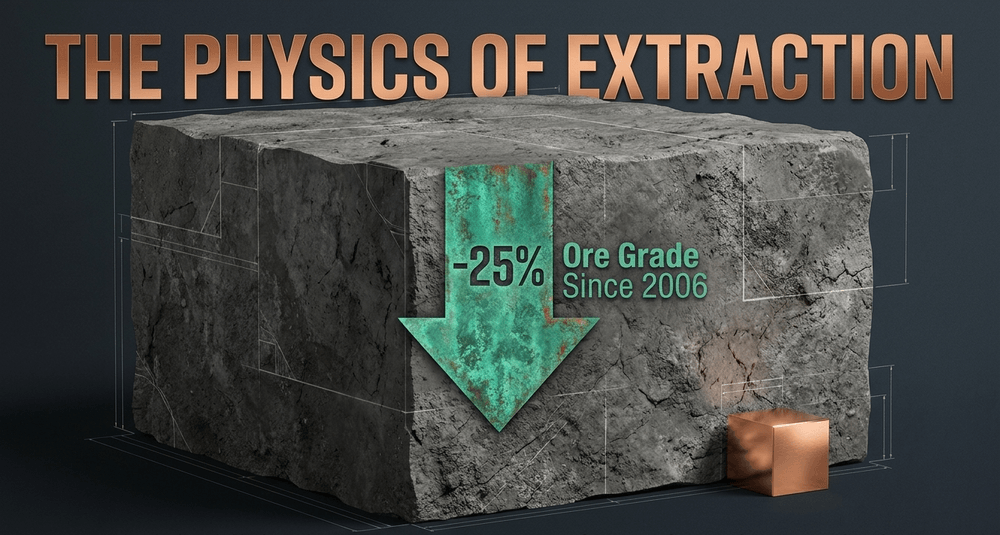
- Declining ore grades. Average copper ore grades have declined by roughly 40% since 1991 - from approximately 1.5% in the early 1990s to around 0.6-0.7% today. Miners must now move, crush, and process significantly more rock to extract the same amount of metal. At current grades, approximately 167 tonnes of ore must be processed to yield one tonne of refined copper, compared to just 67 tonnes at historical grades.
- Chronic underinvestment. The mining industry has seen years of capital restraint, with very few major new deposits identified and advanced to development stage. Only 14 new copper deposits have been discovered in the past decade, compared to 225 in the previous 23 years.
- Operational disruptions. Supply shocks from major mines - including temporary closures at Kamoa-Kakula in the DRC and Grasberg in Indonesia - have already tightened the near-term market. Jefferies projects an average annual supply deficit of 491,000 tonnes through 2030, with a slower-than-expected recovery at Grasberg contributing materially to that gap.
"The world must mine more copper between now and 2050 than has been produced in all of human history - just to maintain a business-as-usual trajectory. When the green transition is added to the equation, the task appears nearly impossible."
- Robert Friedland, founder of Ivanhoe Mines
The price data reflects this structural reality. The LME copper price broke above $13,000 per metric ton for the first time in history in early January 2026, and hit an intraday record of $14,527.50/t on January 29 - the largest single-day rise since 2008. COMEX copper subsequently reached a new all-time high of $6.71 per pound on May 13, 2026, capping a gain of over 40% in twelve months. Goldman Sachs projects the LME copper price will reach $15,000 per tonne by 2035. This is not a temporary market blip. It is a structural reality of the physical economy underpinning the energy transition.
Declining ore grades: the physics of scarcity
The ore grade problem deserves its own examination, because it is a physical constraint that no amount of investment can simply overcome.
BHP's Escondida mine - the world's largest copper operation - began production in the 1990s with a head grade of around 2.5% to 3% copper. By 2024, despite constant processing improvements and billions in capital expenditure, the concentrator feed grade had fallen to 1.03%. That same mine is expected to see output fall by around 300,000 tonnes by the end of the decade.
Across the global industry, the pattern is consistent. The average copper head grade in 2022 was 0.52% - down significantly since the early 2010s. Chilean mines specifically have dropped below 0.9% average grade, according to the USGS 2024 Copper Commodity Summary, necessitating substantial increases in processing capacity and energy consumption to maintain output levels.
As the most accessible, highest-grade deposits are exhausted, miners are forced deeper and into lower-quality ore bodies. The energy and water required to process each tonne of metal increases. The tailings pile grows. The cost per unit rises. Energy costs now account for between 25% and 40% of total copper mining operating expenses. These are not problems that technological innovation can fully reverse - they are expressions of a finite resource base being progressively drawn down.
McKinsey notes that the volume of ore sent to concentrators has risen 44% over the past decade, and would need to grow by another 44% by 2031 just to meet energy transition demand.
The permitting bottleneck: why time is the real scarcity
Capital is necessary but not sufficient. The more binding constraint may be time.
The average timeline from discovery of a copper deposit to first commercial production is now between 17 and 25 years. This figure has extended significantly over recent decades, driven by more complex environmental assessments, community consultation requirements, and multi-jurisdictional permitting frameworks. The World Bank's 2024 Mining for Climate Change Mitigation report notes that permitting processes for major copper projects now average 7 to 12 years, compared to 4 to 6 years historically. Even projects that begin development today will not be producing meaningful volumes before the early 2040s.
This creates a fundamental mismatch. The copper deficit projected for 2035 to 2040 requires decisions and capital commitments that should have been made in the 2010s. The industry is playing catch-up against a clock that cannot be reset by political will alone.
Permitting reform in key jurisdictions - particularly in the United States, Australia, Canada, and across the EU - is increasingly recognized as a prerequisite for closing the gap. But regulatory frameworks have proven resistant to rapid change. Chile, notably, enacted pro-business licensing reforms in July 2025 that improved approval timelines for mining projects in the country - a step in the right direction, but far from sufficient at global scale.
Environmental and social costs of expanding copper mining
There is a painful irony embedded in the green transition: the minerals required to reduce carbon emissions often come with significant local environmental costs of their own.
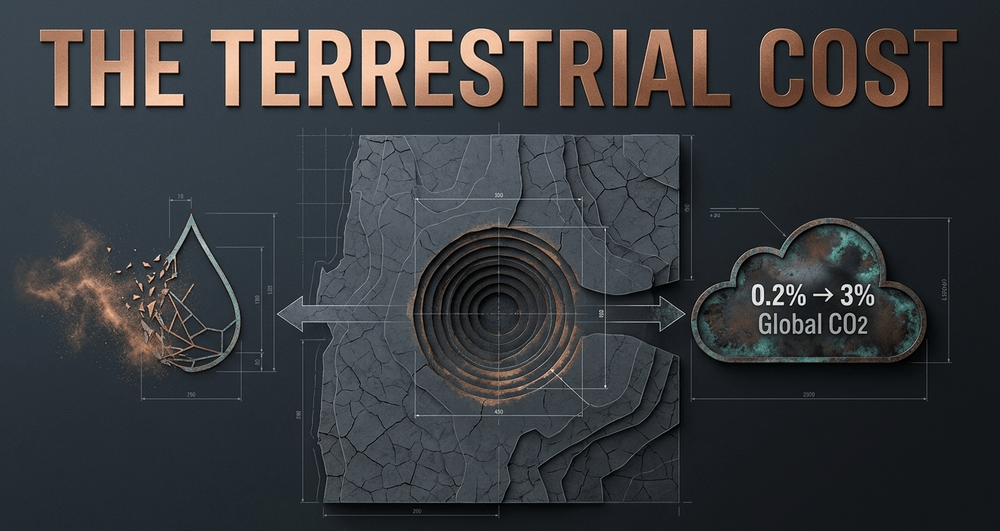
Copper mining is predominantly an open-pit operation. For every one tonne of copper extracted, roughly 99 tonnes of waste material are produced - creating enormous tailings management challenges and risks of soil contamination, habitat destruction, and water table disruption.
Water scarcity presents a particularly acute problem. Much of the world's copper is located in water-stressed regions, most notably Chile's Atacama Desert, where mines such as Escondida and Chuquicamata compete directly with local agriculture and indigenous communities for water resources that are already at the limit of sustainable use. Mining processes can require more than 500 litres of water per tonne of ore processed.
The emissions picture is also concerning at scale. The smelting and refining process currently accounts for approximately 0.2% of global CO2 emissions. Under a high-demand scenario, this figure could rise materially - a significant cost to a process intended to reduce emissions.
Social and human rights concerns add another layer of complexity. In the Democratic Republic of the Congo, which holds some of the world's largest copper reserves alongside the massive Kamoa-Kakula development, regulatory instability and documented governance challenges have complicated investment and operations. Managing these tensions will require a level of transparency and community engagement that the industry has historically struggled to deliver consistently.
Recycling can help, but it cannot close the gap
When the copper supply discussion arises in policy circles, recycling is often presented as the primary solution. The reality is more complicated.
Copper is 100% recyclable without loss of its physical properties. In 2023, secondary refined copper made up 4.5 million tonnes - nearly 20% of total output. Recycling copper also reduces CO2 emissions from production by up to 85% compared to primary smelting - a meaningful environmental benefit. The United States is the world's top exporter of copper scrap and waste, followed by Germany and Japan.
S&P Global expects recycled copper scrap to more than double from around 4 million mt today to 10 million mt by 2040. McKinsey's 2025 report Chasing the Lost Copper identifies a 3.6 million mt supply shortfall by 2035 that improved recycling could help narrow. And the IEA has noted that scaling up recycling could reduce new mining capacity needs by up to 35% for copper by 2050.
But there are inherent physical limits to recycling in a growing market. Copper-based products - transformers, building wiring, grid infrastructure - have lifespans of 30 to 50 years. The copper installed in today's energy buildout is effectively locked away and unavailable for recycling for decades. A peer-reviewed analysis in the journal Resources, Conservation and Recycling found less than a 7.5% probability that total copper demand will be sufficiently met by additional recycling capacity alone to reduce primary copper production before 2050. Even under the most optimistic recycling scenarios, dozens of new copper mines would need to open to replace the anticipated decreases in production from existing operations.
As the World Bank has noted: even a 100% end-of-life recycling rate for metals would not be enough to meet the growing demand for clean energy technologies. Primary mining remains the irreplaceable foundation of the copper supply chain for the foreseeable future.
New recycling facilities like Aurubis's $800 million plant in Richmond, Georgia - which opened in 2025 with capacity to process 180,000 mt of complex copper scrap annually - point toward what scale is possible. But a handful of new facilities does not move the needle against a 10 million mt structural deficit.

Geopolitical concentration: the hidden systemic risk
The geography of copper is not just a supply problem. It is a geopolitical vulnerability.
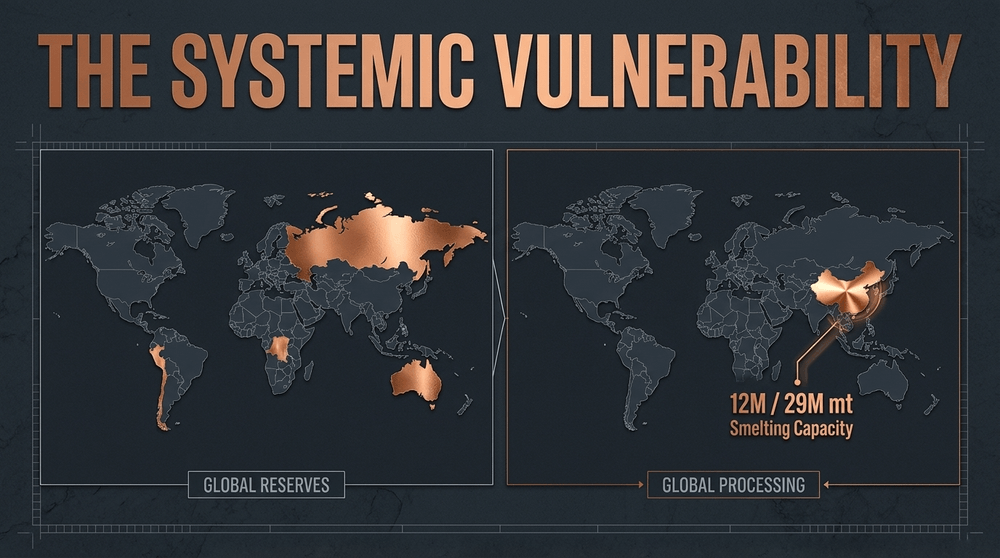
Over half of the world's known copper reserves are concentrated in just five countries: Chile, Australia, Peru, the Democratic Republic of the Congo, and Russia. Chile alone accounts for over 25% of global copper output. This level of concentration creates exposure to political instability, resource nationalism, and supply chain disruption that Western economies are only beginning to take seriously.
The processing side of the chain is even more concentrated. China produced 14 million tonnes of refined copper in 2025 - approximately 48% of global smelting output, and five times more than the second-ranked refiner. China also controls roughly 40% of global smelting capacity while simultaneously importing the majority of the world's copper concentrates. This dual role creates a critical bottleneck: even when raw materials are available, refined copper supply can be constrained by processing limitations or policy decisions in a single jurisdiction.
The risk is not hypothetical. In May 2026, China banned sulfuric acid exports - a critical input for copper extraction - with Goldman Sachs estimating up to 200,000 tonnes of Chilean copper production at risk as a result, since Chile had sourced roughly one-third of its sulfuric acid from China in 2025. Supply chain vulnerabilities can cascade through the system far from their point of origin.
"In a world that is simultaneously electrifying, digitalizing, and militarizing, copper has become a strategic bottleneck."
- Jonas Theyssens, KBC Asset Management
Western governments are beginning to view copper through the lens of national security rather than commodity trade. The United States classified copper as a critical metal in 2025 and initiated a Section 232 national security investigation into copper imports. US lawmakers have introduced legislation to create a $2.5 billion critical minerals stockpile. Australia has earmarked strategic reserves for key minerals. In 2024, U.S. refined copper consumption totaled 1.6 million metric tons, but domestic production covered only 890,000 metric tons - leaving nearly half of U.S. demand dependent on imports.
But reversing decades of industrial concentration is a slow and expensive process. Domestic projects like Resolution Copper in Arizona could eventually supply a meaningful share of U.S. needs, but full production is not anticipated before the mid-2030s at the earliest.
What happens when supply chains fracture
The risks described above are not speculative. The copper market is already showing signs of structural fragmentation that go beyond normal commodity price cycles.
Treatment and refining charges - the fees smelters charge to process copper concentrate into refined metal - have fallen to zero or negative territory in some annual benchmark agreements. This signals that smelting capacity now exceeds the availability of mined concentrate. It is a direct consequence of underinvestment in new mine development over the past decade. When smelters run short of feedstock, the entire downstream chain of wire, cable, motor, and battery manufacturing tightens with it.
The US-China trade dynamic has added a further layer of complexity. A 50% tariff imposed in mid-2025 on semi-finished copper products triggered a surge in pre-positioning of copper inventory in US warehouses - COMEX stocks rising from below 100,000 mt to over 500,000 mt within months - while LME stocks fell sharply. The result is a bifurcated global market where physical copper does not flow freely to where it is needed. Regional price premiums are becoming structural rather than temporary arbitrage opportunities.
This fragmentation is precisely the outcome that a tightening physical supply situation produces. As the supply-demand balance deteriorates toward 2030, the incentive for strategic behavior - stockpiling, export controls, preferential bilateral deals - will only increase.
What needs to happen - and how fast
The copper challenge is not without solutions. But the solutions require speed, capital, and political will at a scale that has not yet been demonstrated.
On the supply side, the most urgent priorities are:
- Accelerating permitting reform in key producing and processing nations to compress the 17-25 year discovery-to-production timeline
- Mobilising the $250 billion or more in capital investment needed to bring at least 80 new large-scale mining projects into production
- Advancing extraction technologies capable of economically processing lower-grade ores that are currently unviable
- Diversifying smelting and refining capacity away from its current geographic concentration, with Western governments providing direct financial support to maintain existing allied smelters that are now operating at or below breakeven
On the demand side, efficiency gains in copper use - thinner wiring gauges, improved motor designs, reduced copper intensity in battery systems, and material substitution where feasible (notably aluminium in some transmission and distribution applications) - can help moderate the growth curve without sacrificing electrification targets.
On the circular economy side, building the infrastructure for higher copper recovery rates at end-of-life will become increasingly important through the 2030s as the installed base of copper-intensive products grows. But that supply only becomes available as products installed today reach retirement age - a lag of 30 to 50 years that means recycling is a long-term structural contributor, not a near-term fix.
None of these levers is sufficient on its own. The copper challenge is a system-level problem that requires a system-level response.
The bottom line: copper is the metric for whether the energy transition can succeed
As Daniel Yergin of S&P Global has framed it, what is at stake is whether copper remains an enabler of progress or becomes a definitive bottleneck to growth and innovation.
"Here, in short, is the quandary: copper is the great enabler of electrification, but the accelerating pace of electrification is an increasing challenge for copper," Yergin said when releasing S&P Global's 2026 study. "Economic demand, grid expansion, renewable generation, AI computation, digital industries, electric vehicles and defense are scaling all at once - and supply is not on track to keep pace."
The trajectory points toward constraint unless the industry, governments, and capital markets coordinate around a level of ambition that matches the scale of the problem. The green transition is real, the investment is accelerating, and the technology is maturing - but none of it can be deployed without sufficient copper to build the infrastructure it runs on.
The energy transition will not be stopped by a shortage of political will or a lack of solar panels. It may well be slowed, delayed, or made dramatically more expensive by a shortage of a reddish-brown metal that most people never think about.
That is the invisible bottleneck. And it is becoming visible faster than the world is ready for.
Share now









Key takeaways
- Global copper demand is projected to reach 42 million metric tons by 2040 - a 50% increase from 2025 levels of 28 million mt - driven overwhelmingly by electrification, AI infrastructure, and defense, not general economic growth.
- A battery electric vehicle (BEV) requires approximately 83 kg of copper, which is 277% more than a standard internal combustion engine vehicle. A single EV can contain up to a mile of copper wiring.
- Renewable energy systems require five to six times more copper per megawatt of installed capacity than traditional fossil fuel or nuclear power plants.
- S&P Global forecasts a supply shortfall of 10 million metric tons by 2040, representing a 25% physical deficit relative to projected demand - even as production peaks at 33 million mt in 2030 and then declines.
- The average timeline from discovery of a new copper deposit to first commercial production is 17 to 25 years, meaning decisions to mine today will not yield metal until the early 2040s at the earliest.
- Average copper ore grades have declined approximately 40% since 1991 - from roughly 1.5% to 0.6-0.7% today - forcing miners to process around 167 tonnes of ore to yield one tonne of refined copper, compared to 67 tonnes at historical grades.
- China produced approximately 48% of global refined copper in 2025, giving it dominant control over the midstream of the global copper supply chain. Export controls or policy shifts in one country can cascade into shortages worldwide.
- AI data centers will drive copper demand from 1.1 million mt in 2025 to 2.5 million mt by 2040. A single hyperscale AI facility can require up to 50,000 tonnes of copper - more than three times a conventional data center.
- Closing the projected supply gap would require at least $250 billion in new investment and the opening of 80 or more large-scale mining projects - capital and timelines that are not currently on track.
- Copper hit an all-time high of $14,527.50 per metric ton on the LME on January 29, 2026. COMEX copper reached a record $6.71 per pound on May 13, 2026. Goldman Sachs projects the LME price will reach $15,000 per tonne by 2035.
Sources
- S&P Global - Copper in the Age of AI: The Challenges of Electrification (2026) https://www.spglobal.com/en/research-insights/special-reports/copper-in-the-age-of-ai
- IEA - Global Critical Minerals Outlook 2025 https://www.iea.org/reports/global-critical-minerals-outlook-2025/overview-of-outlook-for-key-minerals
- Goldman Sachs - Copper Prices Forecast 2026 and Long-Term Outlook https://www.goldmansachs.com/insights/articles/copper-prices-forecast-to-decline-from-record-highs-in-2026
- Columbia University SIPA - Center on Global Energy Policy: Protecting Existing US and Allied Copper Smelting Capacity https://www.energypolicy.columbia.edu/publications/protecting-existing-us-and-allied-copper-smelting-capacity/
- UNCTAD - Global Trade Update (May 2025): Focus on Critical Minerals - Copper in the New Green and Digital Economy https://unctad.org/publication/global-trade-update-may-2025-critical-minerals-copper
- Published 2026-06-19 16:17
- Modified 2026-06-19 16:17

-
Redaction