





-
 PRO
PRO -
 Redaction
Computational photography in smartphones explained
Computational photography uses AI, multi-frame stacking, and neural processing to turn smartphone cameras into imaging systems that rival professional hardware.
Historically, camera quality was directly correlated with lens size, sensor dimensions, and intricate optical engineering. Larger sensors captured more light, superior lenses minimized distortion, and higher fidelity images came from more glass and more silicon surface area. Mobile devices, constrained by form factor and cost, could not compete on these terms.
The breakthrough arrived when engineers and researchers recognized that software could compensate for hardware limitations - or even surpass them - by intelligently processing multiple frames of image data. This realization catalyzed a paradigm shift. Instead of a single instantaneous capture, computational photography involves a rapid sequence of captures, each slightly different, which are then fused and enhanced through complex algorithms. The process happens within milliseconds, largely invisible to the user, delivering a final image that is far superior to what a single frame from a small sensor could ever produce.
That shift was not inevitable. It required a specific intellectual leap: treating the camera not as a passive light recorder but as a computing device that happens to have a lens attached.
Market scale and adoption
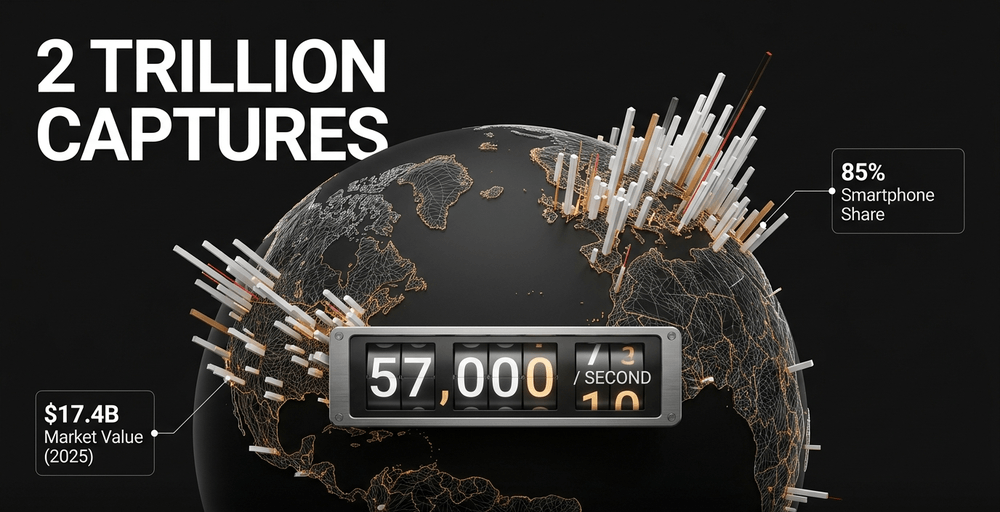
The pervasiveness of smartphone photography is not a soft trend - it is backed by hard numbers. Smartphones are now responsible for capturing an estimated 85% or more of the world's photos, a dominance that has only intensified with the proliferation of high-capability mobile cameras. By some recent estimates, as many as 1.94 trillion photos were taken worldwide in a single year, of which smartphone photography accounted for the overwhelming majority - roughly 57,000 images captured every second around the clock.
That volume of photographic activity is not driven by hardware quality alone. It is driven by software that makes nearly every shot acceptable - often better than acceptable.
Consumer priorities reflect this. Around 86% of Americans cite camera quality as a primary factor when selecting a new smartphone. Not battery life. Not display resolution. The camera - and by extension, the algorithms running behind it.
The financial scale follows accordingly. The global computational photography market was valued at approximately USD 17-23 billion in 2024-2025, depending on the research model and scope, with projections placing it well above USD 50 billion by 2032-2033. Smartphone cameras account for the largest segment - over 54% of that market - driven by multi-camera systems, AI-powered ISPs, and multi-frame processing pipelines. The software segment is growing fastest of all, a meaningful signal that value in this industry is migrating away from optics and toward algorithms.
The academic foundations
Before any of this arrived in consumer pockets, it lived in university laboratories.
Professor Shree Nayar of Columbia University's School of Engineering is among the most consequential figures in the field. In the mid-1990s, Nayar and his team began pioneering what he called computational imaging - the combination of unconventional optics with advanced image processing algorithms to produce visual information richer than any traditional camera could deliver. His specific invention of assorted pixels for high dynamic range imaging gave smartphone engineers a theoretical blueprint for HDR capture that eventually reached mass deployment. His assorted pixels approach - detailed formally in a 2002 paper and later commercialized in Quad Bayer sensors now found in Samsung and Sony devices - enables single-shot HDR without mechanical parts.
"The real world is stunning in detail. The human eye captures an approximation of it, but there are animals that do even better than we do. We wanted to explore whether we could design cameras that get closer to capturing all the details of the real visual world than traditional cameras, and better even than our eyes." - Shree Nayar, Columbia University
It is estimated that more than one billion smartphone users interact with Nayar's techniques daily. That is not marketing language. It is an accurate description of what moving computational imaging from academic journals into consumer silicon actually accomplished.
On the industry side, Professor Marc Levoy - then at Stanford, later at Google - assembled a team at Google X in 2011 known as Gcam. Their original mission was to solve the fundamental imaging problems of Google Glass, a wearable device with no room for meaningful optics. The answer they arrived at was image fusion: capture a burst of frames rapidly, align them in software, and merge them into a single higher-quality image. The hardware constraints of Glass forced the team to solve the problem computationally - and the solution turned out to generalize far beyond wearables.
Image fusion debuted in Glass in 2013. The success of the method prompted Gcam to bring the next iteration - called HDR+ - to Android's camera app for the Nexus 5 that same year, and then the Nexus 6 the following year. The Gcam team graduated to Google Research in 2015 and their work later formed the backbone of the entire Pixel camera system. Levoy went on to lead the development of HDR+, Portrait Mode, and Night Sight before leaving Google in 2020.
Core techniques and how they work
Computational photography in mobile devices is not a single feature. It is a layered stack of techniques, each addressing a different physical constraint of small sensors and compact optics.
Multi-frame stacking and burst photography
This is the foundational technique. When a user presses the shutter on a modern smartphone, the camera has typically already been capturing frames continuously. The last 5 to 15 of those frames are analyzed, the sharpest are selected via a process called lucky imaging - originally developed for astrophotography to cut through atmospheric blur - and those frames are then aligned and merged.
The noise-reduction benefit is significant and physically grounded: averaging N frames reduces random noise proportionally to the square root of N. Merge 16 frames and you theoretically cut noise by a factor of 4.
The challenge is that real-world scenes are not static. Subjects move. The camera moves. Simple pixel averaging fails immediately. Modern pipelines instead use robust merging: the frames are divided into patches, each patch is checked for alignment against a reference frame, and patches with excessive motion are downweighted or discarded rather than averaged. This selective merge preserves the noise reduction benefit in static parts of the scene while avoiding ghosting artifacts around moving subjects.

Google's HDR+ algorithm operates on 2 to 8 raw Bayer frames directly from the sensor, bypassing the standard ISP pipeline to preserve bit-depth accuracy. It deliberately underexposes each frame to preserve highlight detail, then recovers shadows during the merge. The result is an image with both highlight preservation and improved shadow detail - without the motion artifacts that a traditional long exposure would introduce. On the Pixel, this operates through Zero Shutter Lag (ZSL): the phone begins capturing frames as soon as the camera app opens, selecting the best 2 to 10 frames from the buffer when the shutter is triggered.
High dynamic range (HDR) merging
A single camera exposure is a compromise. Set it for the bright sky, and the shadowed foreground goes black. Set it for the interior scene, and the window blows out to white. Human vision handles this dynamically, constantly adjusting; a fixed exposure cannot.
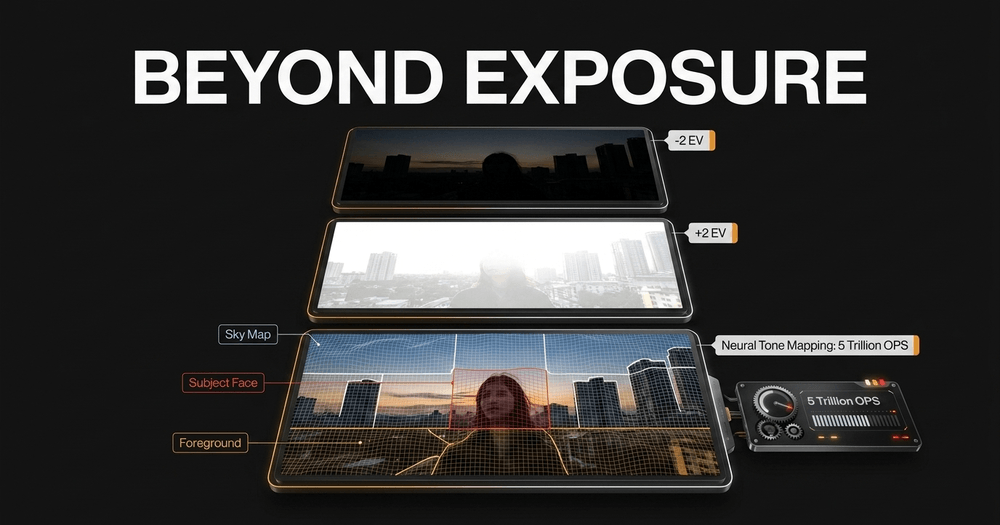
The computational solution is to capture multiple exposures - typically one underexposed, one balanced, and one overexposed - and merge them into a single output image that draws from the correct exposure for each tonal region. Nayar's work on assorted pixels enabled a variation of this in a single capture, but the multi-shot approach allows for a richer set of tonal data to work with.
Apple's Smart HDR system, running on the company's Neural Engine starting with the A12 Bionic chip, extends this further. The A12 Bionic's 8-core Neural Engine can execute 5 trillion operations per second - an 8x jump from 600 billion in its predecessor, the A11. That computational headroom allows the ISP and Neural Engine to collaborate on tone mapping, semantic segmentation (identifying faces, skies, and foreground subjects separately), and detail recovery, all within fractions of a second. Smart HDR does not simply blend exposures; it applies different tonal treatment to different regions of the image based on their content.
Night mode and low-light stacking
Low-light photography is where the gap between physics and computation is most visible. A small sensor in darkness collects very few photons per pixel per unit time. Extend the exposure, and camera shake and subject motion blur the result. Keep the exposure short, and the image is buried in noise.
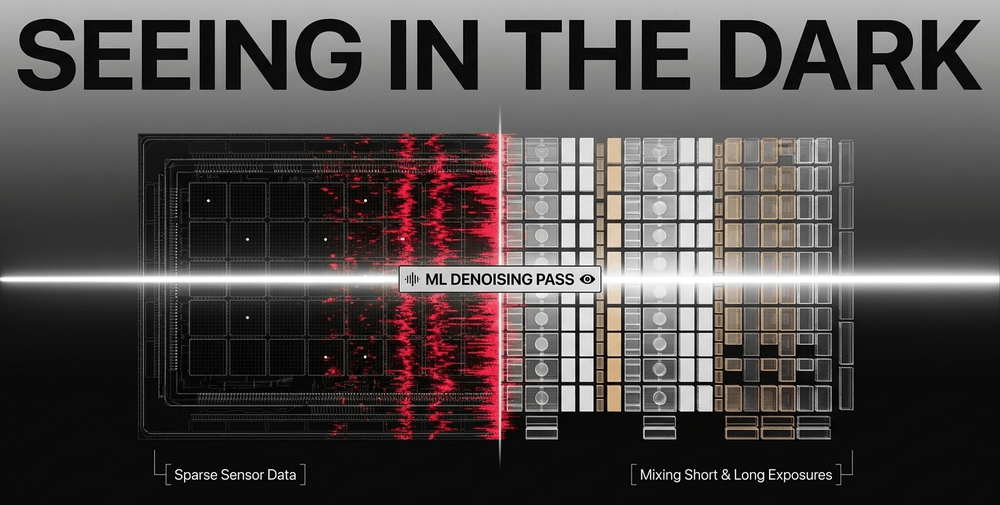
Google's Night Sight, introduced on the Pixel 3, threads this needle by combining multi-frame stacking with intelligent motion detection. The system captures a burst of frames with varying exposure durations, then mixes short, sharp frames (which freeze motion) with longer, brighter frames (which collect more light). The HDR+ with Bracketing algorithm then merges these at the raw Bayer frame level, achieving images that are bright without being blurry. A machine learning model running on the Tensor chip then performs a second pass of noise reduction on the final merged frame.
The Pixel's astrophotography mode extends this to its logical extreme: up to 15 frames at up to 16 seconds of exposure per frame - a theoretical equivalent of a 4-minute long exposure assembled from a tripod-mounted phone. The system identifies and removes hot pixels by comparing them against neighboring pixels across the frame stack, and uses AI semantic segmentation to selectively darken and denoise sky regions specifically.
Apple's Night Mode follows a related approach: multiple long exposures are captured and aligned in software, the ISP reduces sensor noise across the stack, and the Neural Engine refines detail and color in a final pass. Unlike a single long exposure on a traditional camera, the multi-frame approach minimizes motion blur while maintaining brightness.
Computational bokeh and synthetic depth of field
This is the feature that most directly addresses the optical physics gap between smartphones and interchangeable-lens cameras. A shallow depth of field - where the subject is sharp and the background is blurred - requires a large aperture. Large apertures require large lenses. Smartphone cameras, by design, have small fixed apertures with a depth of field that keeps virtually everything in focus.
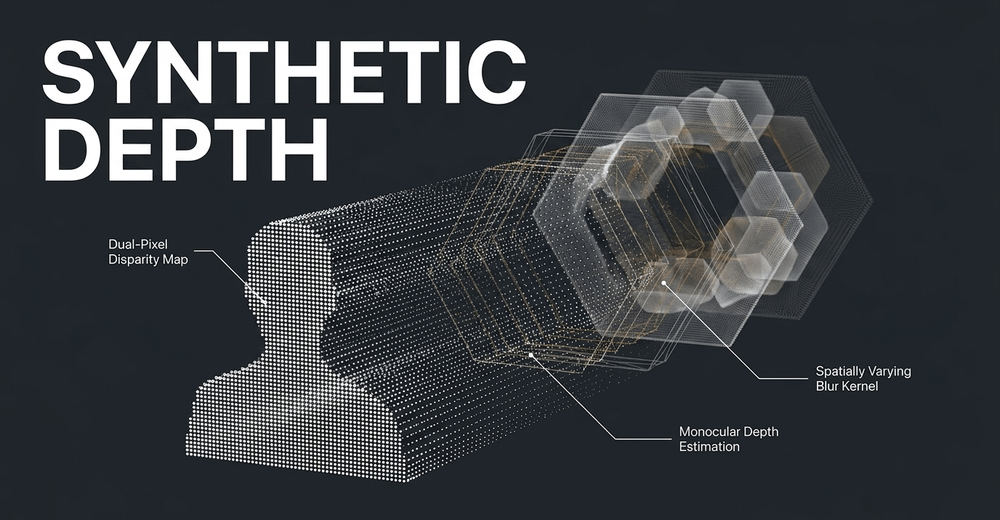
The computational solution treats this as a segmentation and rendering problem. First, the system must determine where the focal plane is - which part of the image is the subject, and how far away each pixel is from the camera. Depth estimation can come from multiple sources:
- Dual-pixel autofocus sensors, which use the left and right halves of each pixel as a tiny stereo pair to generate a disparity map
- Stereoscopic data from a second camera (telephoto or ultra-wide)
- Dedicated time-of-flight or LiDAR sensors (as used in iPhone Pro models)
- Single-image monocular depth estimation via neural networks
Once a depth map is established, a spatially varying blur kernel is applied to the background - simulating the lens blur that would have been produced by a large-aperture optical system. The quality of the result depends almost entirely on the accuracy of the segmentation: imprecise edges around hair, glasses, or semi-transparent objects remain the most visible failure mode.
Google's Portrait Mode on the Pixel 2 was an early landmark here, using the dual-pixel sensor to generate depth data from a single rear camera. Subsequent generations have added neural network refinement of the depth map, improving edge accuracy on difficult subjects like fur and flyaway hair.
Computational zoom and super resolution
Optical zoom requires either a variable focal length lens or multiple fixed focal length lenses. Both consume space. The alternative - simply cropping and upscaling a digital frame - produces blurry, detail-free results.
Google's Super Res Zoom, first deployed on the Pixel 3, avoids simple upscaling by instead merging multiple raw frames captured from slightly different sub-pixel positions. The sensor naturally experiences micro-vibrations from optical image stabilization, from slight hand movement, and from deliberate OIS motor actuation. Each frame is therefore a fractionally different sample of the scene. By merging these frames at sub-pixel accuracy, the pipeline reconstructs a higher-resolution image with genuinely recovered fine detail - not interpolated or hallucinated detail. The process simultaneously handles demosaicing and super-resolution, using the high-frequency raw Bayer data directly rather than the post-processed color image.
The modern Pixel zoom pipeline is a hybrid: optical focal length gets the camera as close as hardware allows, and computational super-resolution extends the reach further. More than 72% of premium smartphones released in recent cycles have incorporated computational photography capabilities such as bokeh effects, super-resolution, and night mode enhancements - a figure that reflects how thoroughly these techniques have moved out of flagship territory.
The hardware enabling all of this
Computational photography at this scale is not free. It requires substantial on-device processing capability, and the progression of dedicated AI and imaging silicon has been the essential enabler.
Apple's A12 Bionic (2018) was a turning point. Its 8-core Neural Engine could execute 5 trillion operations per second, compared to 600 billion in the A11. This was the world's first 7nm mobile chip, and the jump was not incremental - it was an 8x leap that fundamentally changed what was possible in real-time imaging. The A12's ISP and Neural Engine collaborate directly, with the ISP passing image data to the Neural Engine for tasks that benefit from machine learning inference - tone mapping, face detection, semantic segmentation - while conventional ISP processing handles the rest. The combination unlocked Smart HDR as a real-time capture feature rather than a post-processing step.

Google's Tensor chips, introduced with the Pixel 6, take a similar architecture but with a different emphasis: the Tensor G2 and G3 chips include a dedicated ISP tightly coupled with an ML accelerator specifically tuned for the kinds of multi-frame computational tasks that the Pixel camera depends on. Night Sight's machine learning denoising pass, for example, runs on the Tensor chip's dedicated processor rather than the general-purpose ML block.
Qualcomm's Snapdragon ISPs - the Spectra series - power a large fraction of Android flagship devices. The Snapdragon 8 Gen 2 introduced a "Cognitive ISP" using Direct Link technology to connect the Hexagon Processor directly to the Spectra ISP, enabling real-time semantic segmentation across up to eight scene layers. That means independently processed skin, hair, sky, fabric, and background - each receiving tuned noise reduction, sharpening, and color treatment simultaneously during capture.
MediaTek followed in 2025 with the Dimensity 9400e, featuring an 18-bit RAW ISP and AI-powered semantic video segmentation across 16 scene categories. The higher ISP bit depth is significant: it preserves more tonal information in the raw pipeline before any processing decisions are made, giving the downstream algorithms more data to work with.
Separately, Glass Imaging secured $20 million in Series A funding in 2025 to broaden its neural ISP technology - which removes optical aberrations from lenses and reduces noise on-device - to smartphones, drones, and wearables. The funding signals growing demand for specialized imaging pipelines built outside traditional chipset vendors.
Over 65% of smartphones currently rely on computational features to produce sharper, more vivid, and better-balanced images. The hardware to run those features is no longer confined to flagship tiers. NPUs are migrating downmarket, and the mid-range is catching up faster than the sensor race ever did.
Generative AI and the next boundary
The techniques above - multi-frame stacking, HDR merging, computational bokeh, super-resolution - all operate on real photographic data. They rearrange, merge, denoise, and sharpen, but the pixels they start with correspond to light that actually hit the sensor.
Generative AI introduces a qualitatively different operation: synthesizing pixels that were not captured. Features like Google's Magic Eraser, Photo Unblur, and the Zoom Enhance mode on the Pixel 9 series use generative models to reconstruct detail that the sensor did not record. Zoom Enhance, introduced with the Pixel 9 in 2024, uses on-device generative AI to reconstruct fine detail in zoomed or low-light regions where real sensor data is sparse or absent.
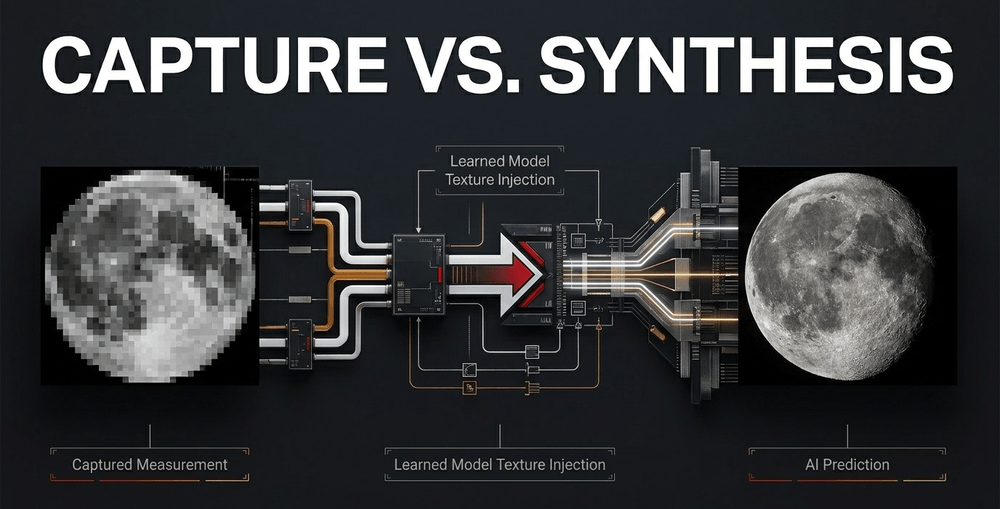
This creates a design and ethics question that the industry has not fully resolved. As one former Apple engineer framed it: removing a few pixels of noise is one thing. Reconstructing a 100x100 pixel patch of what a flower looks like, based on a learned model of flowers, is a categorically different operation. The image is no longer purely a measurement of the scene. It is partially a prediction.
The Samsung moon controversy illustrates the tension concretely. Since the Galaxy S21 series, Samsung's Scene Optimizer has been able to recognize the moon as an object and apply a deep learning-based detail enhancement engine to the captured frame. When the Scene Optimizer is active and the camera detects the moon at 25x zoom or above, it takes more than 10 images using Super Resolution technology, combines them through multi-frame processing, and then applies a neural network trained on moon imagery to enhance the remaining details. Samsung maintains that the system is not overlaying a pre-existing image, but rather using AI to enhance real captured data. Critics argue that applying a neural texture learned from reference moon images to a blurry sensor capture raises legitimate questions about what the resulting image actually depicts. Both positions contain accurate information, which is precisely what makes the question interesting from an engineering standpoint.
The broader trend is clear: computational photography is shifting from pure signal processing toward content-aware synthesis.
The authenticity question
A photograph has historically been understood as a record of light that entered a lens at a particular moment. Multi-frame stacking already complicates this: the "moment" is now a 200-millisecond window, and the final image is an aggregate of multiple captures. HDR merging extends this further. Generative fill extends it to the point where some pixels in the output have no direct correspondence to photons at all.
YouTuber and reviewer Marques Brownlee described the current state plainly: "The stuff that comes out of a smartphone camera isn't so much reality, as much as it's this computer's interpretation of what it thinks you'd like reality to look like." That framing is technically accurate and commercially honest. Whether it is a problem depends entirely on what you think a photograph is for.
For documentary purposes - journalism, forensics, legal evidence - the synthetic pixel question matters considerably. For the overwhelming majority of the 57,000 images captured every second, it matters not at all.

The field is developing two distinct tracks: consumer imaging, where perceptual quality is the metric, and verified imaging, where provenance and authenticity are the constraints. Sony completed testing of in-camera authenticity technology with the Associated Press, and by early 2024 had rolled out C2PA-compliant firmware updates to the Alpha 1, Alpha 7S III, Alpha 7 IV, and Alpha 9 III. By late 2025, Sony had extended its Camera Authenticity Solution to video content in collaboration with the BBC, embedding C2PA digital signatures and proprietary 3D depth information directly into footage at the moment of capture.
The C2PA (Coalition for Content Provenance and Authenticity) standard provides the cryptographic backbone for this: image metadata is signed at capture time, creating a verifiable chain of provenance that persists even if the file is shared or edited. The Leica M11-P, released in 2023, was the first consumer camera to build C2PA signing directly into hardware by default.
Whether this infrastructure reaches smartphones at scale is an open question. The technical path is clear. The commercial incentive is less so.
Where the trajectory leads
The underlying dynamic is straightforward: optical physics is running into diminishing returns while compute continues its historical progression. Sensor technology has not stagnated - 1-inch sensors in devices like the Xiaomi 14 Ultra push the physical limits of what fits in a phone - but the marginal gains from sensor size are narrowing while the marginal gains from better algorithms and faster NPUs are still steep.
The near-term trajectory includes several convergent developments:
- On-sensor AI - placing inference units directly on the image sensor chip rather than routing data to a separate processor, reducing latency and power consumption in the capture pipeline
- Real-time 3D reconstruction - moving from depth maps to full 3D scene representations computed during capture, enabling more physically accurate bokeh, object removal, and relighting
- Periscope and folded optics - enabling 10x true optical zoom in phone-thickness form factors, which then compound with computational super-resolution for extreme telephoto capability
- Video computational photography - extending multi-frame stacking, night mode, and super-resolution to video, which requires processing 30 or 60 frames per second rather than a single burst
- Neural ISP hardware - purpose-built imaging silicon that processes camera data through learned models at capture time rather than through hand-coded signal processing rules
The broader pattern is one that appears repeatedly in engineering history: a hardware constraint forces a software solution, the software solution generalizes, and the result ends up more capable than the hardware it was compensating for would have been. Computational photography followed exactly that arc. What started as a workaround for the limitations of a wearable device's tiny sensor has reshaped the entire imaging industry.
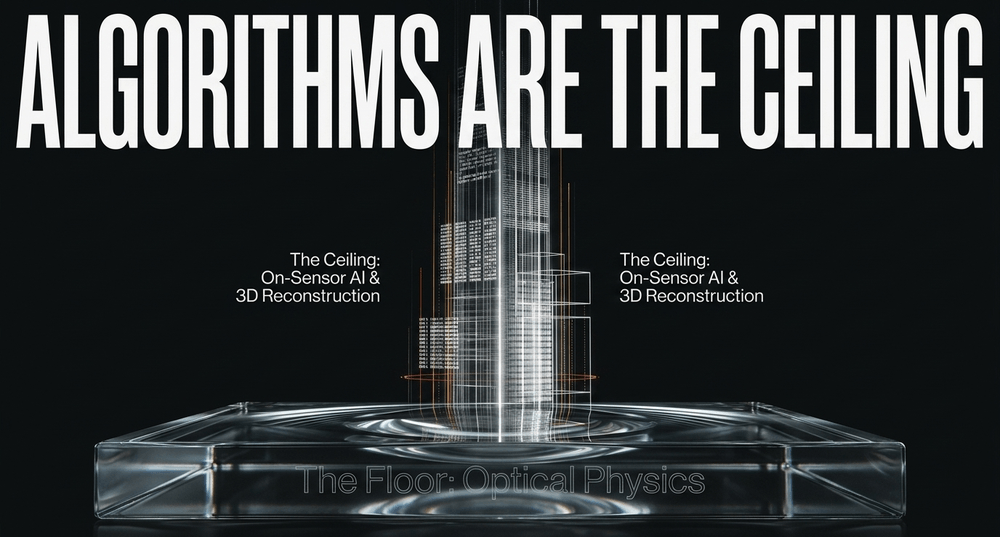
The physics of glass and silicon sets the floor. The algorithms determine the ceiling.
Share now









Key takeaways
- Smartphones were responsible for capturing an estimated 85% of the world's photos, a share that has only grown with the proliferation of high-capability mobile cameras.
- An estimated 1.8 to 2 trillion photos are taken annually on mobile devices - roughly 57,000 images every second.
- The global computational photography market was valued at USD 17.40 billion in 2025, projected to reach USD 48-60 billion by 2032-2034 depending on the research model.
- Smartphone cameras hold the largest segment of the computational photography market at 54.6% share in 2025, driven by multi-camera systems, AI-powered ISPs, and multi-frame processing pipelines.
- Around 86% of Americans cite camera quality as a primary factor when choosing a new smartphone - ahead of battery life and display resolution.
- Apple's A12 Bionic chip (2018) introduced an 8-core Neural Engine capable of 5 trillion operations per second, an 8x increase over the A11 Bionic's 600 billion - a threshold that enabled real-time Smart HDR and Portrait Mode at consumer scale.
- Google's HDR+ algorithm operates on 2 to 8 raw Bayer frames directly from the sensor, bypassing the standard ISP pipeline to preserve bit-depth accuracy and reduce noise across the merged output.
- More than 72% of premium smartphones released recently have incorporated computational photography capabilities including bokeh effects, super-resolution, and night mode.
- Google's Night Sight astrophotography mode can merge up to 15 frames at up to 16 seconds of exposure per frame - a theoretical equivalent of a 4-minute long exposure assembled from handheld captures.
- Professor Shree Nayar of Columbia University pioneered the assorted-pixels HDR technique in the mid-1990s; it is estimated that more than one billion smartphone users interact with his imaging technology daily.
Sources
- Mobile Computational Photography: A Tour (arXiv) https://arxiv.org/abs/2102.09000
- Fortune Business Insights - Computational Photography Market https://www.fortunebusinessinsights.com/computational-photography-market-114204
- Google Research - Night Sight: Seeing in the Dark on Pixel Phones https://ai.googleblog.com/2018/11/night-sight-seeing-in-dark-on-pixel.html
- Google Research - See Better and Further with Super Res Zoom on the Pixel 3 https://research.google/blog/see-better-and-further-with-super-res-zoom-on-the-pixel-3/
- Columbia Engineering - Shree K. Nayar wins Okawa Prize https://www.engineering.columbia.edu/about/news/shree-nayar-wins-okawa-prize
- Published 2026-06-18 18:34
- Modified 2026-06-18 18:34

-
Redaction