



-
 PRO
PRO -
 Redaction
How robots see: Sensors, CNNs and SLAM explained
Learn how robots use LiDAR, CNNs, and SLAM to see and navigate. A deep-dive into robotic vision sensors, AI processing and industrial applications.
The architecture of machine perception
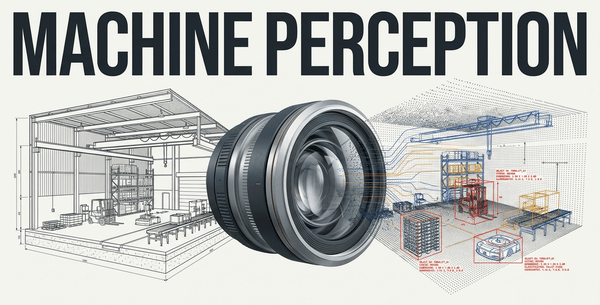
Robotic vision represents the intersection of high-fidelity hardware and sophisticated computational processing - the technical framework that transforms a static machine into a dynamic agent capable of navigating and interacting with unstructured environments. At its core, robotic vision is not merely about capturing light; it is the systematic extraction of actionable data from a physical scene.
Engineering this capability demands a rigorous understanding of optical physics, signal processing, and neural network architecture. To function effectively in the real world, a robot must solve three fundamental problems: where it is, what is around it, and how it should interact with those surroundings. Solving these problems requires a pipeline that begins with raw photon capture and ends with high-level cognitive decisions.
Today, the technology has reached a point where the bottleneck is no longer sensor resolution - it is the efficiency of the inference engines processing data at the edge.
Sensor arrays: the hardware foundation
The hardware layer serves as the primary interface between a robot and the physical world. Unlike human vision, which is constrained to a narrow optical spectrum, robotic systems utilize a diverse array of sensors to gather multi-modal data. This diversity ensures redundancy and precision across different operating environments.
Vision sensors and optical capture
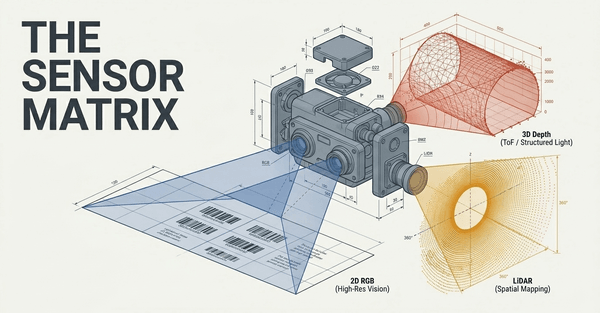
Standard cameras remain the workhorse of robotic vision. 2D cameras are used for planar tasks such as reading high-density barcodes, identifying flat patterns on a conveyor belt, or detecting simple color contrasts. These sensors produce high-resolution RGB matrices that are computationally inexpensive to process - but 2D vision lacks the depth information required for complex spatial tasks.
3D vision systems address this limitation by capturing volume and spatial positioning. These systems use several methods to generate depth data:
- Stereo vision: Two offset cameras triangulate distance by mimicking biological binocular vision.
- Structured light: A known light pattern is projected onto a surface; deformation of that pattern is measured to calculate 3D geometry.
- Time-of-flight (ToF): A light signal's round-trip travel time to an object and back is measured to determine precise distance.
Advanced 3D cameras - such as the Orbbec Gemini series showcased at CES 2026 - now deliver high-frame-rate depth mapping for mobile robots, enabling more fluid motion and faster reactions in dynamic settings.
Specialized sensing and LiDAR
Beyond visible light, robots rely on sensors that perceive the environment through entirely different physical phenomena. Infrared (IR) cameras are critical for detecting thermal signatures in low-light conditions or identifying mechanical overheating during industrial maintenance.
LiDAR (Light Detection and Ranging) stands as a vital component for large-scale spatial mapping. By emitting rapid laser pulses, LiDAR units generate 3D point clouds that represent surrounding geometry with millimeter-level precision. This technology is indispensable for autonomous vehicles and warehouse robots that require a detailed, continuously updated map of their navigation path.

Proximity and force sensing
Vision is routinely supplemented by close-range sensors. Proximity sensors - utilizing ultrasonic, capacitive, or infrared technology - detect nearby obstacles without physical contact.
Once a robot makes contact with an object, tactile sensors and force-torque sensors assume control. These components measure pressure and resistance at the joints or end-effectors, creating a feedback loop essential for collaborative robots (cobots) operating safely alongside humans. If unexpected contact is detected, the machine stops or adjusts its applied force in real time.
Sensor fusion: why no single sensor is enough
A critical but often underappreciated concept is sensor fusion - the integration of data from multiple sensor modalities into a single, coherent world model. A LiDAR unit may produce precise geometry but lacks color information; a standard camera provides rich color data but struggles with depth. By combining both, alongside ToF and inertial measurement units (IMUs), a robotic system eliminates perception dead zones and dramatically improves reliability in unstructured environments.
Modern sensor fusion architectures use probabilistic frameworks such as Kalman filtering and particle filters to reconcile conflicting data streams in real time, weighting each sensor's contribution according to its accuracy under current environmental conditions.
Data processing and AI interpretation
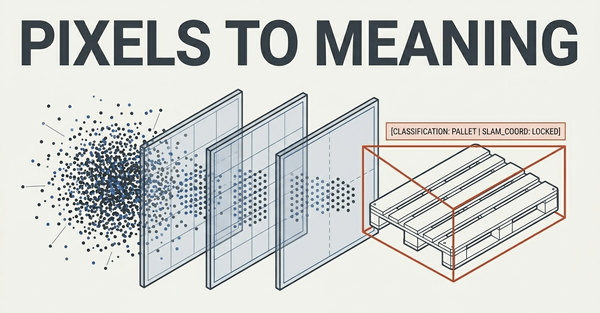
Raw sensor data is meaningless without a processing layer capable of interpreting visual signals. Deep learning provides the analytical engine for this task. The transition from raw pixels to semantic understanding involves several distinct computational stages.

Preprocessing and feature extraction
Before an image enters a neural network, it undergoes preprocessing to remove environmental noise - filtering electrical interference, normalizing contrast, and correcting lens distortion. Once the data is cleaned, feature extraction algorithms identify critical geometric markers: edges, corners, and blobs that serve as building blocks for higher-level recognition.
Convolutional neural networks (CNNs)
CNNs are the dominant architecture for image analysis in robotics. These networks apply layers of mathematical filters that detect increasingly complex patterns: initial layers detect simple edges and lines, while deeper layers recognize complex shapes - a human hand, a product label, a structural defect.
CNNs enable three critical perception functions:
- Classification: Identifying what an object is - for example, a "pallet" or a "safety cone."
- Object detection: Locating the object within the 2D or 3D frame and drawing a bounding box around it.
- Segmentation: Assigning a label to every single pixel in an image to distinguish foreground from background - vital for precise grasping and obstacle avoidance.
Modern CNN variants such as YOLO (You Only Look Once) and EfficientDet are widely deployed in industrial robotics for their ability to perform real-time inference on edge hardware without sacrificing detection accuracy.
Simultaneous localization and mapping (SLAM)
For mobile robots, vision is the primary input for SLAM. This process requires a robot to build a map of an unknown environment while simultaneously tracking its own location within that map - solving both problems at once, in real time.
By identifying consistent visual landmarks across sequential frames, the robot calculates its trajectory and continuously updates its internal spatial model. This capability allows autonomous mobile robots (AMRs) to navigate warehouses without magnetic floor strips or external beacons.
Contemporary SLAM implementations, including ORB-SLAM3 and OpenVINS, are capable of fusing visual data with IMU readings to maintain centimeter-accurate localization even in texture-poor environments where visual landmarks are sparse.
Industrial and commercial applications
The integration of high-speed vision with AI is restructuring operational workflows across multiple sectors. The precision and continuous availability of robotic vision provide a measurable advantage over manual observation.
Manufacturing and logistics
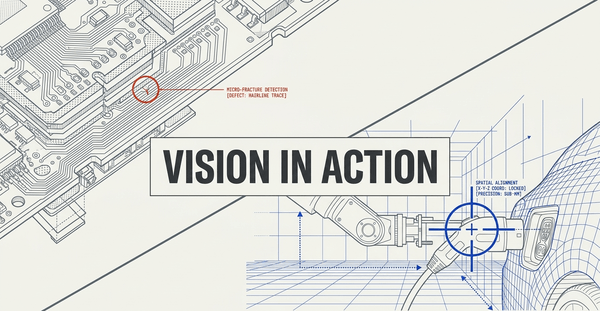
In industrial settings, vision systems are deployed for high-speed quality inspection. Cameras detect microscopic fractures in metal or identify missing components on a circuit board at speeds that far exceed human capability. In logistics, vision-guided robots handle the "pick-and-place" challenge - identifying randomly oriented items in a bin and determining the optimal grip point to move them to a shipping container.
Agriculture and healthcare
Agricultural robots use multispectral imaging to monitor crop health. By analyzing light reflection from leaf surfaces, these machines detect nutrient deficiencies or pest infestations before any symptoms become visible to the naked eye.
In healthcare, 3D vision enables surgical robots to provide surgeons with enhanced depth perception and digital overlays of internal structures, reducing the risk of accidental tissue damage during minimally invasive procedures.
Emerging use case: autonomous EV charging
A compelling recent application is the automation of electric vehicle (EV) charging. Using a combination of 3D vision and AI, a robotic arm locates the specific geometry of a vehicle's charging port and precisely inserts the plug without human assistance. The system must account for real-world variability in vehicle height, angle, and ambient lighting - a strong demonstration of the adaptability of modern vision stacks.
Retail and warehouse automation
Vision systems are increasingly deployed in retail environments for autonomous inventory management. Ceiling-mounted cameras and mobile robots equipped with RGB-D sensors continuously scan shelves, detecting misplaced products, out-of-stock conditions, and price label discrepancies - tasks that previously required dedicated human labor across long shifts.
Technical challenges and engineering constraints
Despite rapid evolution, several technical hurdles prevent fully autonomous vision deployment across all real-world environments.
Environmental variability and occlusion
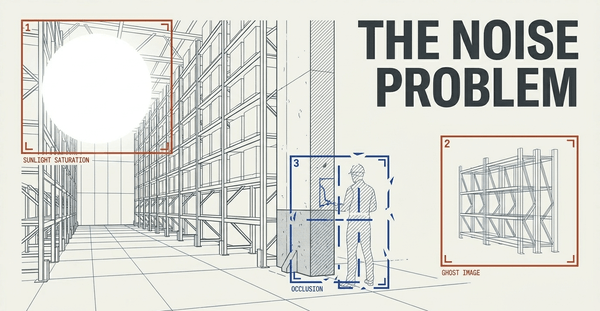
Vision systems remain highly sensitive to lighting. Direct sunlight saturates sensors; deep shadows obscure critical obstacles. Reflective surfaces - stainless steel, glass, wet floors - create ghost images or specular highlights that confuse depth-sensing algorithms.
Occlusion is an equally difficult problem. If a pedestrian is partially concealed behind a pillar, the vision system must rely on temporal data and predictive modeling to maintain an accurate tracking profile rather than purely current-frame data.
Computational and real-time demands
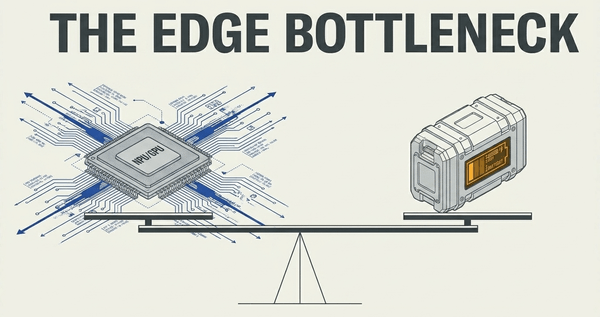
Processing high-resolution 3D data in real time requires immense computational power. In safety-critical applications, latency is directly proportional to physical risk. If a self-driving vehicle takes 200 milliseconds to process a single frame, it may travel several meters before any decision is acted upon.
Moving computation to the edge - directly on the robot's onboard hardware - is necessary, but it creates a fundamental trade-off between power consumption and processing speed. Engineers must carefully optimize neural networks to run efficiently on specialized hardware such as GPUs or NPUs without depleting the robot's power supply.
Data quality and calibration
Training robust AI models requires massive, carefully labeled datasets that reflect real-world diversity. Obtaining sufficient labeled examples for edge cases - unusual weather phenomena, rare industrial defects, novel object configurations - is a significant and ongoing logistical undertaking.
Hardware calibration is an equally persistent requirement. If a camera lens shifts by even a fraction of a millimeter due to vibration or temperature variation, all subsequent 3D calculations lose accuracy. Production systems must incorporate automated recalibration routines to maintain consistent performance over time.
Recent developments and the road ahead
The trajectory of robotic vision is moving decisively toward more generalized and self-learning systems - away from rigid, pre-programmed logic toward models that adapt to new tasks with minimal human supervision.
The rise of vision-language-action (VLA) models
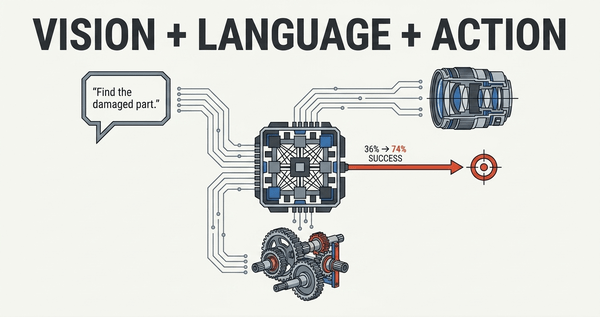
A significant architectural shift is underway with the development of VLA (Vision-Language-Action) models. These frameworks integrate visual perception with natural language understanding and physical motor control. Rather than programming a robot with specific spatial coordinates, an operator can issue a high-level command: "find the damaged part and place it in the red bin."
The VLA model interprets the visual scene, understands the linguistic context, and generates the necessary motor commands - representing a fundamental move toward more intuitive human-robot interaction. Prominent examples include Google DeepMind's RT-2 and the open-source OpenVLA framework, both of which demonstrate strong generalization across novel object-manipulation tasks.
Benchmarks in autonomous learning
Developments such as Google DeepMind's RoboCat illustrate the potential for robots to improve through self-directed experience. By training on a diverse set of demonstration data and then iteratively fine-tuning on self-generated practice attempts, RoboCat improved its task success rate from approximately 36% to 74% on novel tasks within a remarkably short timeframe.
This demonstrates that future vision systems will not be static deployments - they will continuously refine their internal models as they encounter new objects and operating environments.
Strategic industry collaborations
The ecosystem is being strengthened by partnerships between hardware manufacturers and AI software providers. At NVIDIA GTC 2026 and Embedded World 2026, companies such as e-con Systems demonstrated how edge AI can be integrated directly into multi-camera arrays to reduce inference latency. Collaborations between sensor specialists like Basler and 3D experts like Orbbec are standardizing components used in industrial automation, lowering the adoption barrier for smaller enterprises.
Neuromorphic vision sensors
An emerging hardware paradigm worth tracking is the neuromorphic or event-based camera. Unlike conventional frame-based cameras that capture every pixel at a fixed rate, event cameras record only pixels that experience a change in light intensity - and do so with microsecond temporal resolution. This results in dramatically lower data throughput and virtually eliminates motion blur, making event cameras particularly promising for high-speed robotic applications and low-power edge deployments.
Frequently asked questions
What is the difference between 2D and 3D robot vision? 2D vision captures flat, planar images suitable for color detection, barcode reading, and pattern recognition. 3D vision adds depth data, enabling a robot to understand the spatial geometry of a scene - essential for grasping, navigation, and obstacle avoidance.
How does SLAM work in robotics? SLAM (Simultaneous Localization and Mapping) allows a robot to construct a map of an unfamiliar environment while simultaneously estimating its own position within that map. It works by identifying persistent visual or geometric landmarks across successive sensor frames and using these to triangulate position and update the map in real time.
What are CNNs used for in robotic vision? Convolutional Neural Networks (CNNs) are used for object classification (identifying what something is), object detection (locating it within a frame), and image segmentation (labeling every pixel) - all in real time. They are the primary deep learning architecture powering visual intelligence in modern robotic systems.
What is a vision-language-action (VLA) model? A VLA model is a type of AI architecture that combines visual perception, natural language understanding, and physical action generation in a single framework. It enables robots to receive spoken or written instructions and translate them into physical manipulation tasks without manual coordinate programming.
What is the biggest challenge facing robotic vision today? Real-time edge inference remains the most pressing engineering constraint. Processing high-resolution, multi-modal sensor data onboard the robot - with low latency, low power consumption, and high reliability across variable environments - requires continued advances in both neural network optimization and specialized AI silicon.
Long-term outlook for the vision market
With the global robotic vision market projected to reach $4 billion by 2028, the economic incentive for further innovation is unambiguous. Engineering focus is shifting toward resilience - building systems that remain accurate and reliable despite visual noise, environmental unpredictability, and hardware degradation.
As sensor fusion techniques mature and VLA models demonstrate broader generalization, robots will increasingly operate with a level of spatial awareness that matches or exceeds biological capabilities. The ultimate goal is a seamless feedback loop in which vision, cognition, and action occur within a unified, low-latency architecture - enabling a new generation of machines capable of performing complex labor in the most demanding environments on Earth and beyond.
Share now









Key takeaways
- Robotic vision combines hardware sensors - including LiDAR, ToF cameras, and standard CMOS imagers - with deep learning algorithms to interpret environmental data and trigger physical actions.
- Sensor fusion integrates data from multiple sensor modalities (camera, LiDAR, IMU) using probabilistic frameworks such as Kalman filtering to eliminate perception dead zones and improve spatial accuracy in unstructured environments.
- Convolutional Neural Networks (CNNs) - including architectures such as YOLO and EfficientDet - are the primary deep learning framework used for real-time object classification, detection, and image segmentation in robotic systems.
- SLAM (Simultaneous Localization and Mapping) enables mobile robots to build a map of an unknown environment while tracking their own position in real time, eliminating the need for fixed infrastructure such as floor magnets or external beacons.
- Vision-Language-Action (VLA) models allow robots to receive natural language commands and translate them directly into physical manipulation tasks by bridging visual perception, language understanding, and motor control in a single architecture.
- Neuromorphic (event-based) cameras record only pixels that detect a change in light intensity, delivering microsecond temporal resolution and dramatically lower data throughput compared to conventional frame-based sensors.
- Google DeepMind's RoboCat improved task success rates from approximately 36% to 74% on novel manipulation tasks through iterative self-supervised learning - demonstrating that future vision systems will continuously refine themselves through experience.
- The global robotic vision market is projected to reach an estimated valuation of $4 billion by 2028, driven by adoption in manufacturing, logistics, agriculture, healthcare, and autonomous vehicles.
- Real-time edge inference - running high-resolution 3D perception models directly on onboard GPUs or NPUs with low latency and low power consumption - is currently the most critical engineering constraint in deploying production robotic vision systems.
Sources
- Ultralytics https://www.ultralytics.com/blog/understanding-the-integration-of-computer-vision-in-robotics
- Wandelbots https://www.wandelbots.com/blog/robot-vision-systems
- Think Robotics https://thinkrobotics.com/blogs/learn/computer-vision-in-robotics-how-robots-are-learning-to-see
- Black Coffee Robotics https://www.blackcoffeerobotics.com/blog/perception-in-robotics-from-geometry-to-generative-ai
- Robotiq https://blog.robotiq.com/top-10-challenges-for-robot-vision
- Standard Bots https://standardbots.com/blog/every-type-of-sensors-in-robotics---explained
- Published 2026-05-05 11:30
- Modified 2026-05-24 12:41

-
Redaction


