
-
 Redaction
Why clean code becomes a maintenance nightmare
Clean Code principles can silently destroy codebases. Here's why dogmatic abstraction, over-engineering and no-comment rules hurt real developer teams.
The concept of Clean Code, popularized by Robert C. Martin (widely known as "Uncle Bob") in his 2008 book of the same name, proposes code that is inherently readable, understandable, and - crucially - maintainable. For roughly two decades it's been handed to junior developers like scripture. Read it, follow it, internalize it. Many engineering teams still use it as a baseline for code review expectations.
The core ideas are sound. Names should reveal intent. Functions should do one thing. Classes should have a single reason to change. Nobody is seriously arguing against that.
But there's a gap between those principles in the abstract and what happens when they get enforced dogmatically in real codebases with real deadlines and real teams of mixed experience. That gap is where the problems live.
This isn't a hit piece on the book. It's a look at what happens when the letter of the law starts killing the spirit of it.
The trap of over-engineering
Premature abstraction is the silent killer of otherwise functional codebases. It's the design pattern applied before there's a second use case to justify it. The interface created for a class with a single implementation. The factory that builds one type of object. The repository layer sitting between your application and an ORM that already gives you everything you need.
Martin's own Clean Architecture implicitly acknowledges this tension. More than halfway through the book he admits that it falls to developers to decide where architectural boundaries belong - "you must see the future. You must guess - intelligently." That's a remarkable concession from someone who elsewhere frames these patterns as essential discipline. The guidance is real, but so is the ambiguity.
Developers who follow Clean Code strictly often build for the codebase they imagine having in two years, not the one they actually have today. The principle driving this is well-intentioned: the Open/Closed Principle, which says code should be open for extension and closed for modification. In practice, applied to a project that hasn't even found product-market fit, it produces elaborate architecture for problems that never materialize.
"The most common startup engineering failure is over-engineering. Teams build multi-tenant SaaS infrastructure before their first paying customer, event-driven microservices before they need scale, and ML pipelines before they have data."
This is where YAGNI - You Aren't Gonna Need It - should act as a counterweight. The principle, originating in Extreme Programming, says you should only implement functionality when you actually need it. The problem is that Clean Code's emphasis on anticipatory design can work directly against YAGNI in the hands of developers who've internalized the former more deeply than the latter.
The startup coding style mirrors this well: if you're building multi-tenant infrastructure before your first paying customer, you're not being disciplined - you're gold-plating your architecture on borrowed time.

Abstraction as a performance tax
Every abstraction layer has a cost. Not a one-time cost - an ongoing one. The Extract Interface refactor takes five minutes. Living with that interface takes years.
Each added layer of indirection makes it harder to reason about the code as a whole. Debugging gets harder. Pull requests grow larger. Tracing a bug back through its origin in source history becomes an archaeology project, because more files changed. Onboarding a new developer takes longer because the mental model required to understand the system's plumbing is more elaborate than the business logic it's supposed to serve.
Performance engineer Casey Muratori made this concrete in his widely-discussed "Clean Code, Horrible Performance" analysis. Using example code directly from Clean Code literature - not a constructed strawman - he demonstrated that object-oriented class hierarchies are structurally resistant to optimization compared to simpler, more direct alternatives. When performance tuning is needed, a switch statement is easy to transform. A class hierarchy representing the same logic requires untangling a web of files before any optimization becomes possible.

The core argument is direct: "The ideas underlying the 'clean code' methodology are almost all horrible for performance." Muratori's position is that abstractions designed to make developers' lives easier carry a performance cost that, at scale, becomes unacceptable. His analysis used real examples from Clean Code literature, not contrived scenarios. The ORM problem is analogous: abstractions that boost developer velocity early tend to calcify into obstacles once performance constraints emerge. The N+1 query problem isn't just a well-known gotcha - it's a structural consequence of hiding SQL behind objects. You write code that looks efficient and runs like a disaster in production.
The architectural study of over-100-module systems found that differences in architectural complexity could account for productivity drops of up to 50% between the least and most complex modules. That's not a marginal cost. That's half your team's throughput, bled out through indirection.

The real cost of excessive abstraction
The numbers around technical debt and over-engineered codebases are stark. McKinsey research found that CIOs estimate tech debt amounts to 20-40% of the value of their entire technology estate, and that 10-20% of the budget dedicated to new products is routinely diverted to resolve existing debt. Companies that actively pay it down free up engineers to spend as much as 50% more of their time on value-generating work. Research from Deloitte estimates developers spend roughly 33% of their time on technical debt maintenance, and that up to 70% of technology leaders consider it the primary cause of productivity loss.
According to Stripe's Developer Coefficient report, 42% of every developer's working week is spent dealing with technical debt and bad code, which equates to nearly $85 billion worldwide in opportunity cost lost annually.
A feature that takes two weeks in a clean, appropriately-structured codebase can take four to six weeks when built on top of significant over-engineering. Multiplied across a team, that's not a footnote in your velocity metrics. That's the reason your roadmap keeps slipping.
Technical debt is the top frustration at work for professional developers, according to 63% of respondents in the 2024 Stack Overflow Developer Survey, regardless of whether they are an individual contributor or a people manager. Some of that debt comes from shortcuts. But a meaningful portion comes from the opposite direction - from codebases engineered to be extensible for requirements that never arrived, layered with patterns that made theoretical sense but created practical chaos.

The cognitive load problem
Human working memory is narrow. Miller's Law (1956) suggests that the average person can hold about seven (plus or minus two) pieces of information in working memory, while more recent studies by Nelson Cowan (2001) suggest this number is closer to four. Software comprehension isn't exempt from this constraint.
When a function is split into twelve sub-functions to satisfy a strict interpretation of the Single Responsibility Principle, reading that function means navigating a maze. You can't hold the whole thing in your head at once. You jump to processValidatedInput(), which calls buildResultPayload(), which calls formatOutputField(), and by the time you've traced the chain three levels deep, you've lost the thread of what the original function was even supposed to do.
This is the paradox. The stated goal of extreme function decomposition is making code easier to understand. The actual result, in many codebases, is the opposite. Over-fragmentation forces readers to jump between functions constantly, hindering comprehension rather than aiding it.
Excessive design patterns and abstraction layers can make simple tasks unnecessarily complex. Using the Factory Pattern to create an object when only one type exists adds an extra step without real benefit. High cognitive complexity in code directly increases bug rates, extends onboarding time, and reduces developer confidence in making changes. Teams with significant cognitive overhead become afraid to touch things - rational behavior when the consequences of a change propagate through a dozen abstraction layers in ways that aren't immediately apparent.
The prime generator example in Clean Code itself is a good illustration. Critics have pointed out that Martin's "cleaned" version, with its excessive function granularity, is actually harder to follow than the original. The abstraction was applied so aggressively that it fragmented logic that read naturally when together.
Comments are a failure - except when they aren't
One of Clean Code's most contentious positions is on comments. Martin argues that the need to write a comment represents a failure to express intent in the code itself. The ideal is self-documenting code where names and structure make the purpose obvious.
There's truth in this. Stale comments that contradict the actual behavior of code are worse than no comments at all. A comment that says "calculate the discount" above code that no longer calculates any discount isn't documentation - it's misinformation.
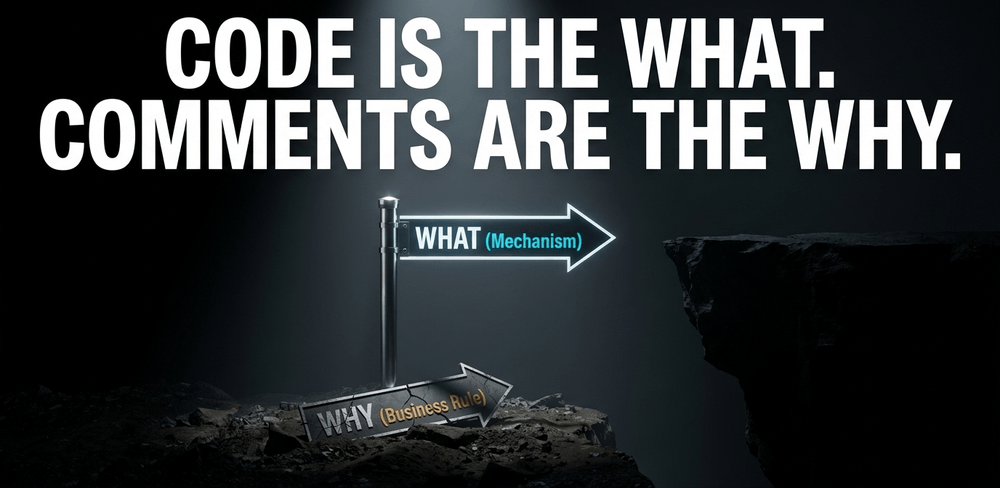
But the conclusion that comments should be minimized or avoided runs into a hard problem: self-documenting code can only explain what the code does, not why it exists. Well-named functions reveal mechanism. They don't explain the business rule that required it, the edge case discovered in production that caused this particular branch, or the regulatory constraint that prevents what would otherwise be the obvious approach.
Consider a payment processing function that appears to apply a calculation in a roundabout way. A comment explaining the relevant financial regulation is not a failure of expression. It's information the code literally cannot contain. Removing it in the name of cleanliness guarantees that the next developer who reads it "optimizes" the logic and unknowingly introduces a compliance violation.
This isn't theoretical. Research shows 78% of developers waste two or more hours daily figuring out uncommented business logic. That's a direct, measurable cost of treating comment-writing as inherently a code smell.
DRY: a principle worth misapplying
Don't Repeat Yourself is perhaps the most universally accepted principle in software development. Duplication is waste. A bug in shared logic fixed in one place stays fixed. A bug in duplicated logic gets fixed in however many places you remembered to update.
The problem is that DRY is genuinely hard to apply correctly, and under the pressure of Clean Code orthodoxy, it gets misapplied regularly.
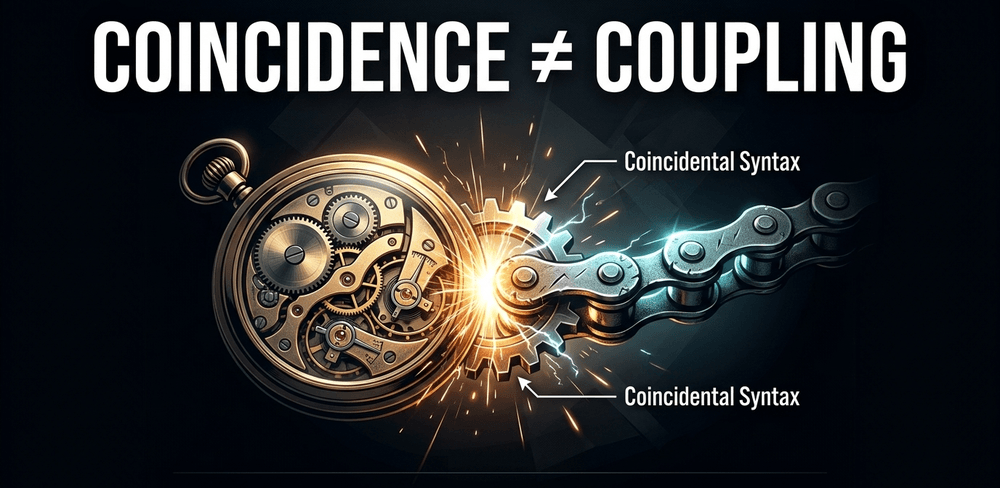
Two pieces of code that look the same are not necessarily the same thing. Identical logic in two different bounded contexts may be identical today and diverge tomorrow for valid domain-specific reasons. Aggressively deduplicating them creates an artificial coupling between concepts that should remain independent. Now when one of them changes, the other either breaks or has to be special-cased, which usually produces something uglier than the original duplication.
The React framework has been cited as an example of over-componentization taken to extremes - a pattern where the relationship between components becomes so fragmented that the architecture becomes its own maintenance problem, independent of the actual product logic.
The correct application of DRY requires judgment about whether two similar things are similar by coincidence or similar because they represent the same concept. That judgment is difficult. It requires domain knowledge and experience. Applying DRY mechanically, as a syntactic rule about identical-looking code, produces over-abstraction dressed up as principle.
The problem with "functions should be small"
Martin's prescription that functions should be small - ideally fitting on a single screen, or even shorter - is one of the more contested positions in the book.
The intuition behind it makes sense. A function that does too many things is hard to name, hard to test, and hard to understand. Agreed.
But "functions should be small" taken as a hard rule produces its own failure mode: extreme decomposition where the high-level function becomes a list of calls to other functions, each of which does a tiny thing, and reading the code means assembling those pieces in your head into a mental model of what's actually happening. You've traded one kind of complexity for another.
The critique from qntm.org (one of the more widely-shared technical takedowns of the book) makes this point clearly: the major problem is that a lot of the example code in the book is just dreadful. In chapter 3, "Functions," Martin gives a variety of advice for writing functions well - but the refactored versions fragment logic that flowed naturally when contiguous.

The Java problem
The book was written in a specific context, at a specific moment in the industry's history - and it shows. The heavy Java focus, the reliance on EJBs and AspectJ, limits the applicability for modern programming practices. Additionally, the covered concurrency topics are shallow and too low-level, especially considering the rise of first-class concurrency languages like Go and Rust.
The book primarily uses Java with Object-Oriented Programming examples, which may not adequately represent the diversity of modern programming styles. It lacks a comprehensive exploration of functional programming concepts, including immutability, referential transparency, higher-order functions, and the emphasis on avoiding side effects.
Applied literally to Python, Go, Rust, or functional languages, many recommendations don't translate - and some actively conflict with idiomatic patterns in those ecosystems. Martin's 2024 second edition attempts to address this, but reviewers have noted that his Python and Go examples read like Java in disguise - he even acknowledged it directly in the text, writing "I apologize - I am not an accomplished Golang programmer." It's a strange admission in a book that has functioned as an authority on how to write good code.
That's not a minor caveat. A generation of developers has internalized rules that were partly shaped by Java's particular constraints: verbose class structures, the OOP paradigm as default, the need for patterns that compiled languages require but scripting or functional languages handle differently. The principles aren't universally portable. Some of them are genuinely Java-specific.
Team skill gaps and the readability illusion
Clean Code orthodoxy assumes a team of experienced practitioners who share a common mental model of patterns, principles, and abstractions. In that environment, the prescribed style works. Everyone knows what a Repository pattern is, why there's a Factory here, what the Visitor is doing in that corner.
In most real teams, that assumption doesn't hold. Junior developers and mid-level engineers brought in from different backgrounds face a codebase whose complexity is architectural rather than algorithmic. The code "reads" cleanly at the surface - short functions, descriptive names, well-structured classes - but understanding why the architecture is shaped the way it is requires knowledge that isn't in the code and isn't in the comments (because comments are failures of expression).
This is the readability illusion. Code that scores well on Clean Code criteria can be, paradoxically, harder for the majority of real-world teams to maintain than code that's a bit messier but more direct.
Academic research on the subject has produced mixed results. Studies examining the actual effect of Clean Code on code understandability found that in some tasks, what practitioners called "legacy code" was faster to comprehend for certain activities than the cleanly-refactored version. The subjective sense that clean code is easier to read doesn't always survive contact with empirical measurement.

When Clean Code works - and when it doesn't
It's worth being specific about the contexts where Clean Code's prescriptions actually help, because they do exist. Small, stable, well-understood codebases with experienced teams who share a common architectural vocabulary benefit from the discipline. Greenfield projects with a clear domain model, where the principles can be applied consistently from the start rather than bolted on, often look exactly like the book describes.
Where it breaks down is anywhere the real world intrudes: mixed-experience teams, evolving requirements, performance-sensitive systems, languages other than Java, or codebases where the "right" abstraction won't become apparent until the third or fourth iteration of the feature.
Pair Clean Code with other methodologies to fill its gaps. Kent Beck's YAGNI from Extreme Programming disciplines against premature abstraction. The concept of agile methodology - iterative delivery, feedback loops, continuous refactoring - is a better frame than upfront architectural purity for most teams. Martin Fowler's Refactoring is a more practical companion: it shows when and how to apply structure, not just what the ideal structure looks like.
The goal isn't to avoid patterns. It's to earn them.

What actually works
None of this means you should write spaghetti and be proud of it. The core instincts behind Clean Code - meaningful names, avoiding duplication of concepts, keeping functions focused, deleting code you don't need - remain sound.
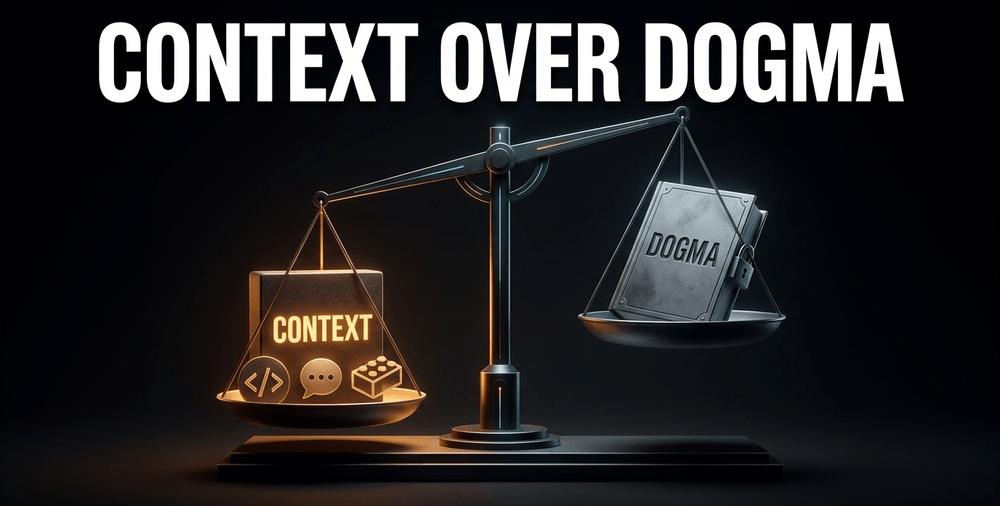
The problem isn't the principles. It's treating them as laws rather than heuristics, and applying them without accounting for context.
Practical alternatives worth considering:
- Optimize for the team reading the code, not the ideal reader - consider what your actual team members need to understand the code quickly, not what a hypothetical expert would prefer.
- Apply YAGNI ruthlessly at the start - build the simplest thing that works. Add abstraction when you have a second use case that actually requires it, not when you imagine one might exist.
- Let DRY operate at the level of concepts, not syntax - identical-looking code in different domains is often not the same thing. Resist the impulse to deduplicate before you understand why the similarity exists.
- Write the comment that explains the why - the what is in the code. The why often isn't, and the why is usually what the next developer actually needs.
- Add abstraction layers when they earn their keep - an abstraction is a loan that accrues interest. Build ones that solve a real problem you have in your specific application. Delete the ones that don't.
- Profile before you optimize, and optimize before you over-architect - performance issues from over-abstraction are real and often difficult to fix once the architecture has calcified.
A book worth reading, not worshipping
Clean Code is worth reading. Its influence on the industry has been largely positive - it brought code quality, readability, and maintainability into focus at a time when those things weren't being talked about enough. For developers starting out, many of its instincts are genuinely useful correctives against the natural tendency to write for the machine rather than the human.
But it was written for a specific context, in a specific language, at a specific moment. Its examples are often Java-centric in ways that don't generalize. Its stance on comments is too absolutist. Its emphasis on extreme decomposition produces, in practice, fragmented codebases that are harder to understand, harder to debug, and harder to optimize than their messier predecessors.
The best developers understand these principles deeply enough to know when not to apply them. A rule applied without judgment isn't craftsmanship - it's just rule-following. And rule-following is precisely what distinguishes the codebase that looks clean from the one that actually works.
Real craftsmanship means making the call that the abstraction isn't worth it here. That the comment explaining why this calculation works the way it does is worth more than the aesthetic cost of having a comment at all. That the slightly-longer function is more readable than the five functions it would become.
The goal was never Clean Code. The goal was code your team can actually work with.

Share now









Key takeaways
- Robert C. Martin's Clean Code (2008) remains one of the most influential software engineering books ever published, introducing principles now treated as near-universal standards - including small functions, meaningful naming, minimal comments, and single-responsibility design.
- Over-engineering is the most common startup failure mode - teams frequently build multi-tenant infrastructure and complex abstractions before they have product-market fit or even a paying customer, violating the YAGNI (You Aren't Gonna Need It) principle.
- Architectural complexity can cut team productivity by up to 50% between the least and most complex modules in a system, according to analysis of large multi-module codebases.
- Technical debt costs developers 42% of their working week, according to Stripe's Developer Coefficient report - equating to roughly $85 billion in lost productivity globally every year.
- Technical debt is the number one frustration for 63% of professional developers, per the 2024 Stack Overflow Developer Survey, outranking complex tech stacks and unreliable tools.
- 78% of developers waste two or more hours daily figuring out uncommented business logic - a direct counter-argument to Clean Code's position that writing a comment is a failure of code expression.
- Miller's Law (1956) puts the ceiling of human working memory at roughly seven items (plus or minus two), while more recent research by Nelson Cowan places it closer to four - a hard limit that extreme function decomposition actively works against.
- Clean Code's heavy Java and OOP bias limits its applicability across modern languages - its guidance on function length, concurrency, and abstraction does not translate cleanly to Go, Rust, Python, or functional programming paradigms.
- Casey Muratori's "Clean Code, Horrible Performance" analysis demonstrated using examples from Clean Code literature itself that object-oriented class hierarchies are structurally resistant to optimization compared to simpler, more direct code structures.
- Academic studies on code understandability show mixed results - some research found that for certain tasks, developers comprehended legacy code faster than cleanly-refactored equivalents, challenging the assumption that Clean Code principles always improve readability in practice.
Sources
- Stack Overflow https://survey.stackoverflow.co/2024/professional-developers
- Casey Muratori / Computer Enhance https://www.computerenhance.com/p/clean-code-horrible-performance
- qntm.org https://qntm.org/clean
- Ministry of Programming https://ministryofprogramming.com/blog/cognitive-load-in-software-engineering
- Stripe Developer Coefficient Report https://stripe.com/files/reports/the-developer-coefficient.pdf
- Published 2026-06-15 18:50
- Modified 2026-06-15 18:50

-
Redaction