

-
 Redaction
Math foundations of AI: from calculus to LLMs
Linear algebra, calculus, and probability drive all of AI. Explore the mathematical foundations behind neural networks, transformers, and diffusion models.
Artificial intelligence, often perceived through the lens of its impressive applications - from sophisticated natural language processing to groundbreaking scientific discoveries - is fundamentally a discipline of applied mathematics. This isn't just an academic claim; it's a cold, hard truth that underpins every algorithm, every model, and every "intelligent" decision made by an AI system. A rigorous understanding of its mathematical foundations is not merely beneficial; it is indispensable for the development of robust, efficient, and interpretable AI systems.
"Code is just implementation. Math is the foundation."
Every AI breakthrough, historically speaking, came from a mathematical insight. The sophisticated architectures deployed today - Transformers, Diffusion Models, Graph Neural Networks - are not magic. They are the culmination of deep mathematical principles executed at unprecedented scale. AI models do not think intuitively. They compute using equations, vectors, probabilities, and optimizations. That perspective helps demystify the whole field and underscores why serious practitioners need more than surface-level familiarity with the math underneath.
The mathematical pillars supporting AI
To truly grasp how AI systems function, learn, and improve, you need to explore the core mathematical disciplines that serve as its bedrock. These aren't abstract academic exercises. They are the practical tools and frameworks that enable AI to process data, recognize patterns, and make predictions. A 2024 McKinsey survey found that 78% of AI professionals regularly use linear algebra and calculus on the job, with weaknesses in these areas often leading to early-career difficulties.
Linear algebra: the language of AI
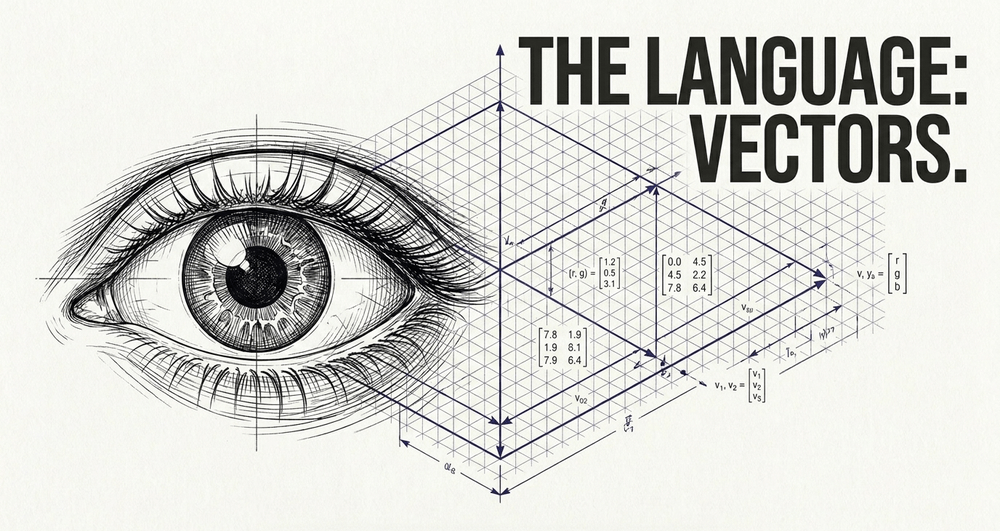
Linear algebra is not just a branch of mathematics; it is the language of AI. It provides the fundamental tools for data representation and manipulation. An AI doesn't interact with images, sounds, or text the way humans do. It processes numerical representations. Not Python. Not English. Vectors and matrices.
- Vectors are ordered lists of numbers that represent data points. An image gets transformed into a vector of pixel values. Words in natural language processing (NLP) get embedded as vectors. User preferences in a recommender system? Vectors. This universal conversion of diverse data types into numerical form is a cornerstone of modern AI.
- Matrices are collections of vectors, forming the primary structure for representing datasets. In computer vision, a grayscale image is a matrix of pixel intensity values. A dataset of customer purchases becomes a matrix where rows are customers and columns are product features.
- Matrix multiplication is central to almost all neural network operations. When data flows through a network, it's a continuous series of matrix multiplications:
output = Activation(W × input + b), whereWis the weight matrix,inputis the data vector, andbis the bias. These operations allow networks to learn complex patterns by transforming inputs across layers. - Eigenvalues and eigenvectors are crucial for understanding transformations and data variance. They underpin dimensionality reduction techniques like Principal Component Analysis (PCA), which reduces the number of features in a dataset while retaining most of the important information. PCA identifies the directions along which data varies most.
Calculus: the engine of optimization
Calculus is the mathematical framework for understanding change and optimization in AI. Without it, the ability of models to learn from errors and improve would simply not exist. It is the engine that drives training.
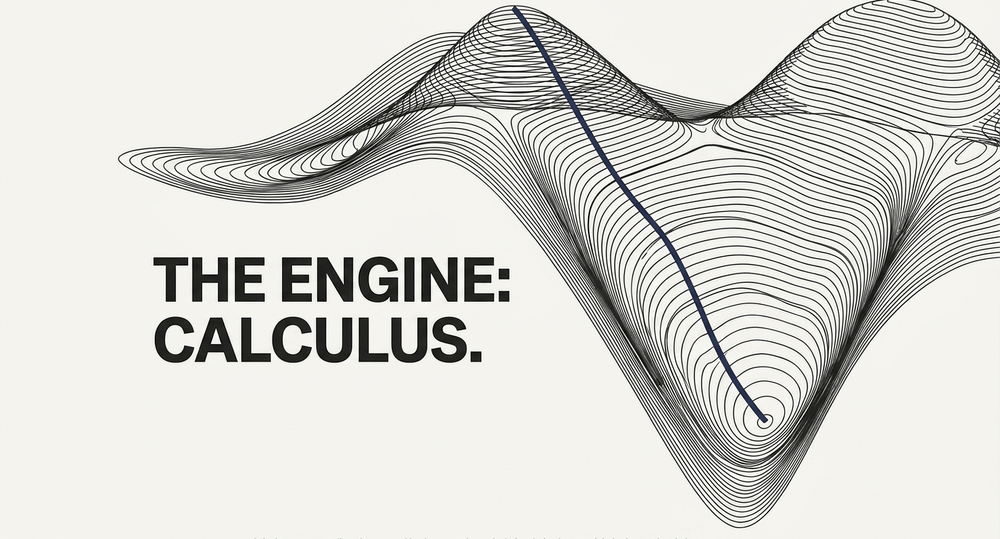
- Derivatives measure the rate of change of a function. In AI, they calculate the slope of the loss function - the quantity that measures how wrong a model's predictions are. Knowing the slope tells the system which direction to adjust parameters.
- Gradient descent is the fundamental optimization technique that leverages derivatives. It iteratively adjusts model parameters in the direction opposite to the gradient of the loss function, effectively moving downhill toward minimum error.
- Backpropagation uses the chain rule of calculus to efficiently compute the gradients of the loss function with respect to every weight in a deep network. This makes deep learning computationally feasible.
- Activation functions - sigmoid, ReLU (Rectified Linear Unit), GELU, and others - introduce non-linearity into networks, enabling them to model complex relationships that linear models cannot capture.
In practice, vanilla gradient descent has given way to more sophisticated optimizers. Adam (Adaptive Moment Estimation) combines the best of momentum-based methods with adaptive per-parameter learning rates, making it the default choice for most large-scale deep learning tasks. RMSprop addresses the decaying learning rate problem of AdaGrad by using an exponentially decaying average of squared gradients. These aren't just engineering hacks - each is a distinct mathematical formulation with its own convergence properties and tradeoffs.
Probability and statistics: modeling uncertainty and prediction
Probability and statistics provide the essential framework for modeling uncertainty, making predictions, and analyzing data. AI systems operate constantly with imperfect information.
- Statistical inference helps AI models make accurate predictions on unseen data by drawing conclusions from observed data - the core of generalization.
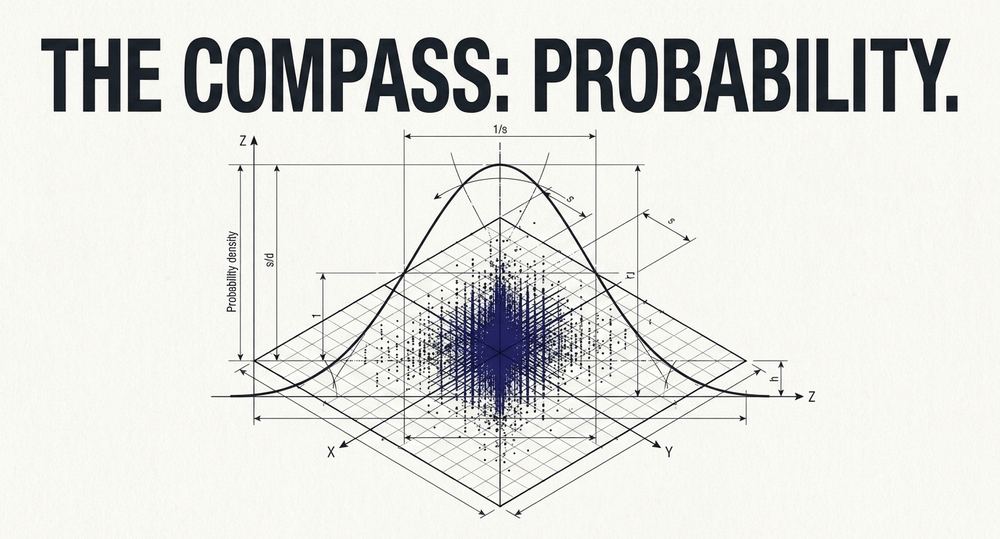
- Bayes' theorem is fundamental for updating beliefs based on evidence. In spam filtering, medical diagnosis, and NLP, Bayes' theorem calculates the probability of a hypothesis given new evidence. Every AI output can be understood as a probability distribution shaped by training data.
- The bias-variance tradeoff is one of the most practically important statistical concepts in the field:
Total Error = Bias² + Variance + Irreducible Error. This framework explains why simpler models sometimes outperform complex ones, why more data generally improves performance, and why regularization and ensemble methods work.
Optimization theory: finding the best solutions
Optimization theory focuses on finding the best parameters for AI models, typically by minimizing a loss function or maximizing a performance metric. Gradient descent is the most visible example, but the field extends into constrained optimization, convex analysis, and global optimization techniques. Understanding convergence properties - whether a training run will stabilize, oscillate, or diverge - requires real mathematical depth. You can't diagnose a broken training loop by guessing.
Information theory: measuring and encoding data
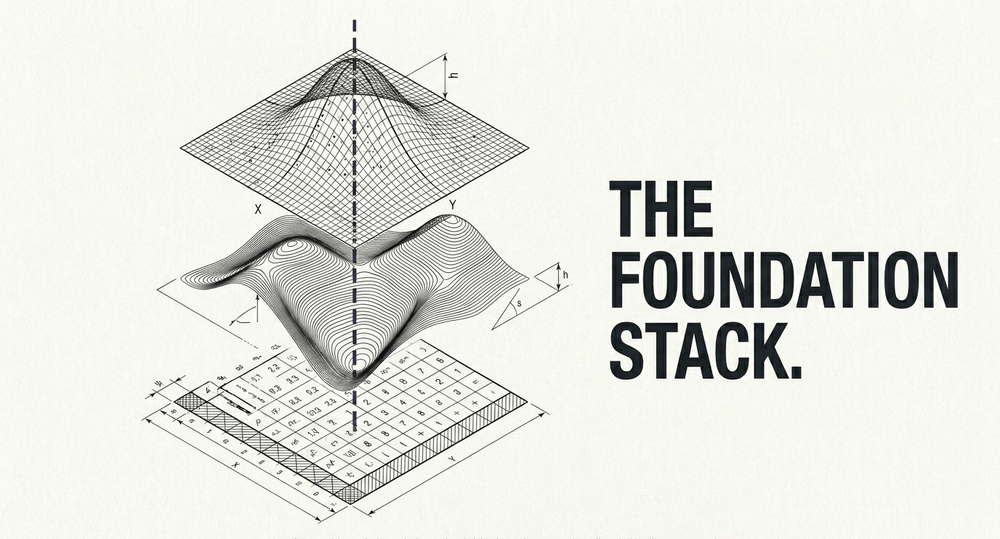
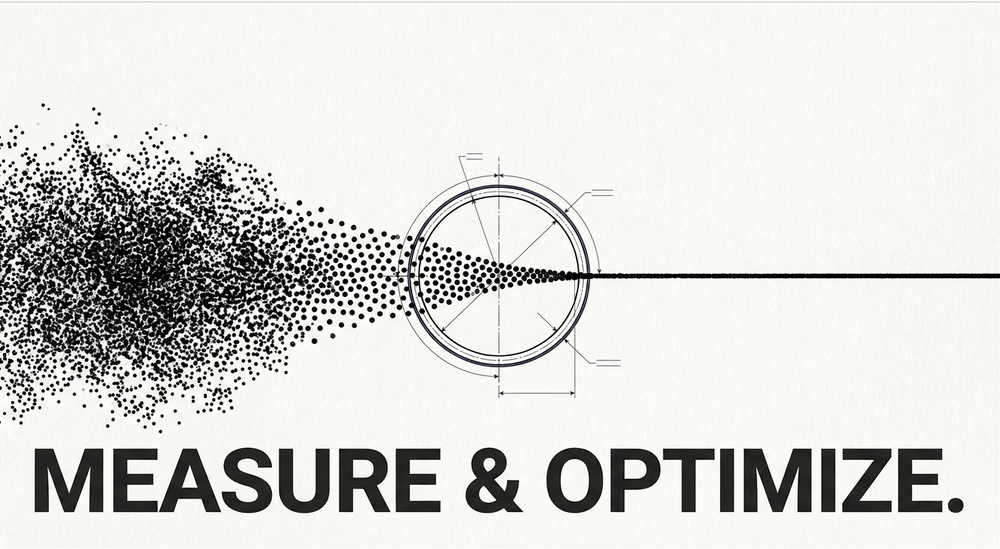
Information theory, pioneered by Claude Shannon in his landmark 1948 paper "A Mathematical Theory of Communication," deals with measuring and encoding information efficiently. Shannon introduced entropy as a precise measure of uncertainty, where higher entropy means more unpredictable outcomes. Cross-entropy - also known as log loss - emerged directly from this framework and is now a standard loss function for classification tasks. It measures the difference between predicted and actual probability distributions, penalizing confident wrong predictions more heavily than uncertain ones. The connection between Shannon's 1948 theory and modern neural network loss functions is not coincidental - it is a direct mathematical inheritance.
Discrete mathematics: algorithms and reasoning
Discrete mathematics - encompassing graph theory, logic, and combinatorics - is crucial for designing algorithms, representing relationships, and enabling logical reasoning. Graph neural networks (GNNs) rely heavily on graph theory to process data structured as networks, from molecular structures to social graphs to knowledge bases. Logic underpins symbolic AI and enables structured reasoning tasks that purely statistical approaches struggle with.
Numerical analysis: approximating solutions
Numerical analysis involves developing algorithms to approximate solutions for complex mathematical problems that have no clean analytical form. This is critical for the numerical stability and high-performance computing that modern AI demands - particularly at scale, where floating-point precision errors and gradient instability can silently corrupt training runs. Numerical methods ensure calculations remain accurate and efficient even when exact solutions are intractable.
Dimensionality reduction: simplifying complexity
Dimensionality reduction techniques simplify data by reducing the number of features while preserving important information. PCA is the classic linear example, relying on eigenvalues and eigenvectors. t-SNE and UMAP are non-linear alternatives invaluable for visualizing high-dimensional data, projecting complex structures down to two or three dimensions without destroying the local relationships that matter.
Advanced mathematical frameworks: category theory and manifold theory
More abstract mathematical concepts are gaining real traction as AI systems scale in complexity.
- Category theory provides a high-level framework for understanding abstract mathematical structures and their relationships. Its applications in AI are emerging in areas like modular network design, compositionality, and formalizing the relationships between different components or data types.
- Manifold theory and Riemannian geometry offer a unifying framework for representing, analyzing, and integrating the complexity of modern AI systems. Their relevance spans deep learning, generative modeling, and data-driven discovery, enabling a geometric understanding of high-dimensional data. The intuition is powerful: even though image data might technically live in a million-dimensional pixel space, the actual images that matter occupy a much lower-dimensional manifold within that space. Understanding that geometry is increasingly central to building better models.
Technical implementation and real-world applications
The theoretical mathematical foundations manifest directly in the architecture and training of AI models.
Neural networks and matrix operations
Neural networks are sophisticated mathematical function approximators. Their operations - both during the forward pass (making predictions) and the backward pass (learning from errors) - are predominantly a sequence of matrix operations. Input data, weights, and biases are all vectors and matrices, undergoing transformations through matrix multiplication and element-wise activation functions. There is nothing mysterious about it once you see the math.
Convolutional neural networks and convolution
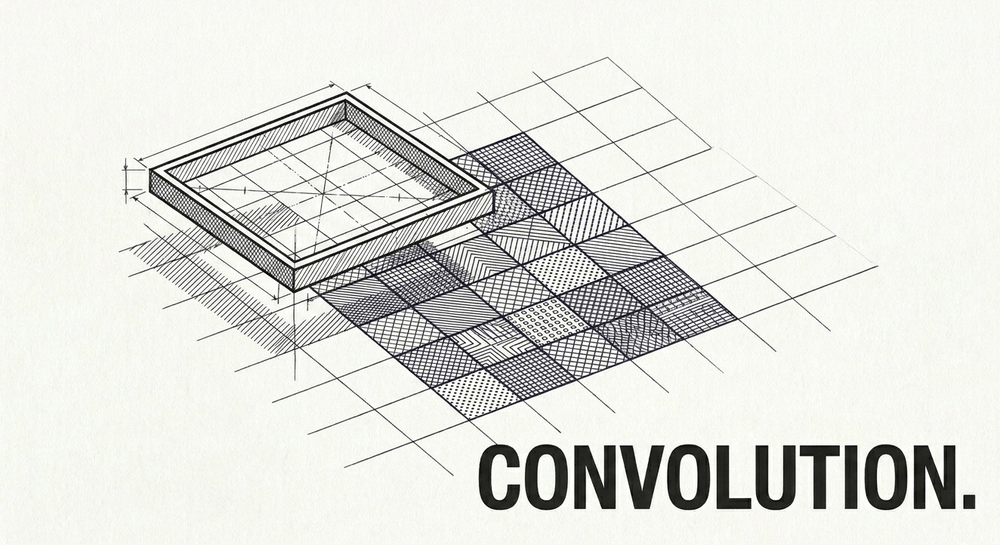
Convolutional Neural Networks (CNNs), dominant in computer vision, derive their power from a mathematical operation called convolution. This operation involves sliding a small matrix (kernel or filter) across an input matrix (image) to extract features like edges, textures, or patterns. It is a highly efficient approach to processing spatial data because it exploits translation invariance - the fact that a feature like an edge looks the same regardless of where in the image it appears.
Transformers and attention mechanisms
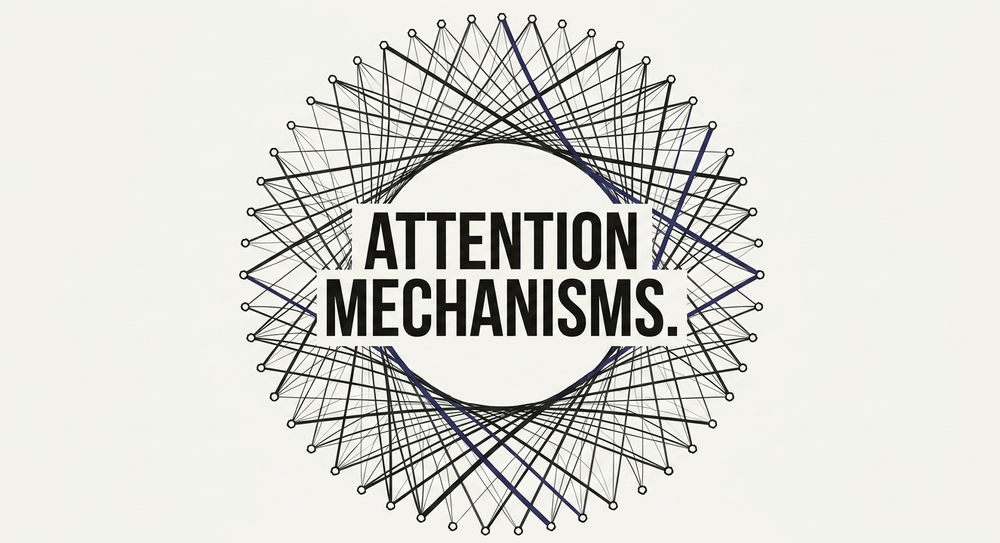
The Transformer architecture, introduced in 2017 by Vaswani et al. in the paper "Attention Is All You Need," underpins virtually all modern large language models. It relies heavily on matrix multiplication and attention mechanisms.
The core attention formula is: Attention(Q, K, V) = softmax(QK^T / √d_k) V
Here, Q (queries), K (keys), and V (values) are matrices derived from the input by learned linear projections. The dot products between queries and keys measure relevance. Dividing by the square root of the key dimension d_k prevents the dot products from getting so large that the softmax saturates. The result is a weighted sum of values, where weights reflect how relevant each part of the input is to each other part.
Multi-head attention runs this mechanism in parallel across multiple learned subspaces, capturing different types of relationships simultaneously - grammar, meaning, reference, context. It is an elegant, mathematically clean mechanism, and it scaled.
Diffusion models and stochastic differential equations
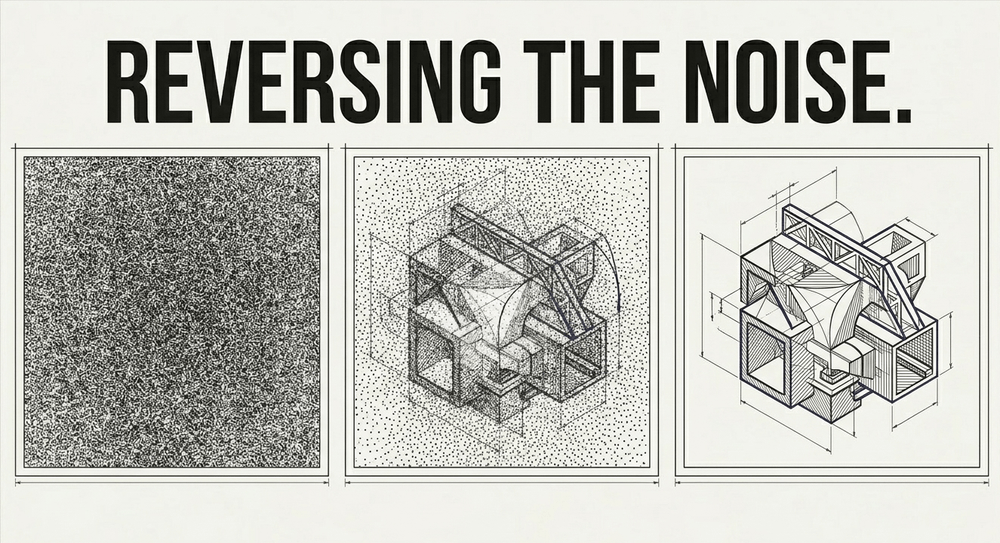
Diffusion models, which have shown remarkable success in generative AI - image generation, audio synthesis, and beyond - employ concepts from stochastic differential equations. These models learn to reverse a gradual diffusion process, transforming random noise into coherent data by iteratively denoising it. The forward process (adding noise) is mathematically well-defined, and the model learns to invert it. What looks like magic - images appearing from static - is the controlled application of stochastic calculus.
Gradient descent in action: the mathematical flow
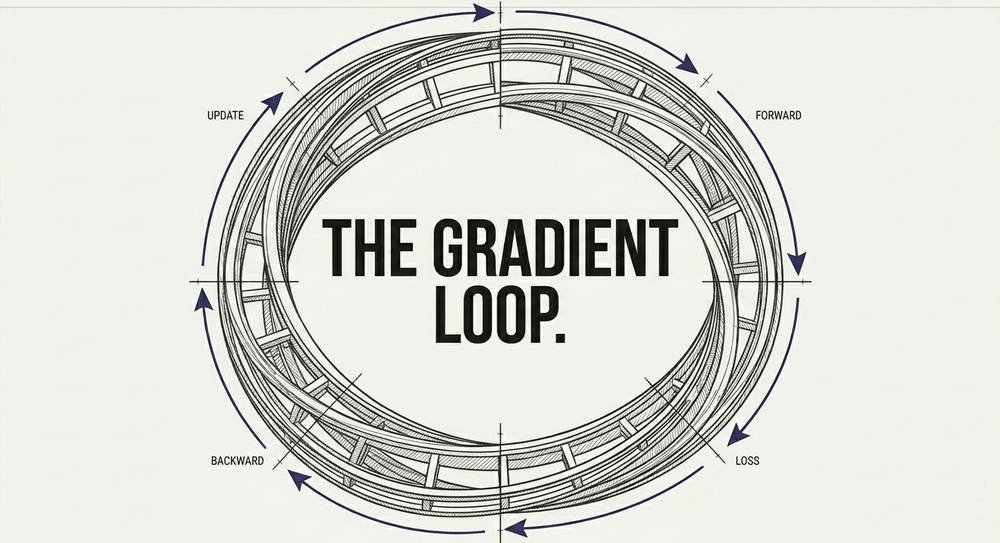
The training process of most AI models follows a precise sequence:
- Forward pass - input data is fed through the network to compute predictions.
- Loss calculation - the error between predictions and actual targets is quantified using a loss function, for example
L = (prediction - actual)²for regression, or cross-entropy for classification. - Backward pass - partial derivatives of the loss with respect to each weight (
∂L/∂W) are computed using the chain rule. This is backpropagation in action. - Weight update - weights are adjusted using the formula
W = W - α · ∂L/∂W, whereαis the learning rate. - Iteration - the entire process repeats over many epochs and data batches until the model converges.
Consider Google Image Search. It converts a query image into a feature vector, then uses cosine similarity - a linear algebra operation - to find the closest vectors among millions of indexed images. The math runs in milliseconds at global scale.
The broader academic and research landscape
The profound impact and increasing complexity of AI have spurred significant academic inquiry into its mathematical foundations. This isn't about optimizing existing algorithms in isolation - it's about building a deeper theoretical understanding for future innovation and responsible development.
Harvard CMSA workshop
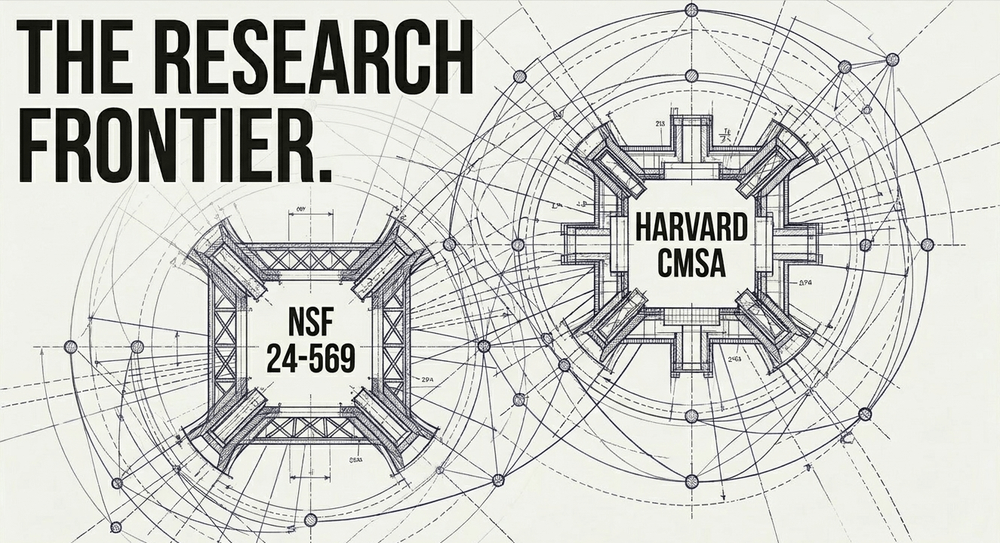
The Harvard Center of Mathematical Sciences and Applications (CMSA) hosted a workshop on "Mathematical Foundations of AI" in October 2025, bringing together researchers from MIT, Stanford, Princeton, Yale, Cornell, and the University of Pennsylvania, among others. The premise was direct: AI has achieved unprecedented empirical advances, yet theoretical understanding lags significantly behind - and that gap poses a real obstacle to improving safety and reliability. Researchers drew on functional analysis, probability theory, optimal transport, optimization, partial differential equations, information theory, geometry, statistics, and ergodic theory. That breadth of disciplines is itself a signal. No single branch of mathematics owns this problem.
NSF MFAI program
The National Science Foundation (NSF), through its 24-569: Mathematical Foundations of Artificial Intelligence (MFAI) initiative, actively supports research to establish a rigorous mathematical understanding of AI systems. The program funds interdisciplinary teams - mathematicians, statisticians, computer scientists, engineers, and social scientists - working together on the hardest theoretical questions. Individual awards range from $500,000 to $1.5 million, with up to $8.5 million per year available across the program. The focus areas include foundation models, generative models, deep learning, statistical learning, and federated learning.
The NSF's stated aim is to develop "innovative and principled design and analysis approaches for AI technology using creative yet theoretically grounded mathematical and statistical frameworks, yielding explainable and interpretable models that can enable sustainable, socially responsible, and trustworthy AI." That sentence matters. The push for interpretability and trustworthiness is mathematically grounded work, not a policy statement.
AI and the calculus of history
Recent research has explored how AI operationalizes what might be called a "calculus of history" - processing vast data streams to identify statistical regularities and emergent behaviors in human systems. This represents a shift where AI mathematics extends beyond technical systems to model societal dynamics, potentially transforming sociology, economics, and historical analysis into more predictive, computational sciences. Whether that framing excites or unsettles you, it signals how far applied mathematics now reaches.
Why this gap between math and engineering keeps biting people
There is a practical dimension to all of this that often goes unspoken in tutorials and courses. The gap between practitioners who apply AI tools and those who can genuinely innovate, debug, and extend them - that gap is almost entirely mathematical.
When a model behaves unexpectedly - producing confident wrong answers, failing to generalize, training unstably - diagnosing the problem requires looking at the math underneath. Is the loss surface poorly conditioned? Is the learning rate schedule wrong? Is there a numerical precision issue in a particular layer? Are the gradients vanishing or exploding? None of these questions can be answered by reading documentation.
The same is true of safety and reliability. The risks that researchers flag when discussing AI systems - brittleness, distributional shift, adversarial examples, overconfidence, opacity - are mathematical phenomena. You cannot meaningfully address them without mathematical grounding. That is the argument the NSF and Harvard CMSA are making institutionally. It is also just true.
The field is also moving. Architectures like the Transformer replaced their predecessors not because engineers tried more things, but because a mathematical insight - that attention mechanisms could replace recurrence entirely - proved correct at scale. The next architectural shift will come the same way. Being positioned to recognize it, let alone contribute to it, requires knowing the math.
This is also showing up in cutting-edge applied AI. Projects like Anthropic's Project Glasswing - where Claude Mythos is being used to identify vulnerabilities in critical software - are only possible because the underlying model has internalized deep statistical and optimization principles at sufficient depth to reason about code structure. The math is doing real work in the real world, at scale.
Why deeper mathematical understanding matters
"AI isn't magic. It's not even mysterious. It's mathematics. Beautiful, elegant, powerful mathematics."
While high-level AI toolkits and frameworks abstract away much of the underlying complexity, a deep mathematical foundation remains the critical differentiating factor between practitioners who merely apply AI tools and engineers and researchers who can innovate, debug, and extend them.
The breakthroughs achieved in protein folding, natural language processing, drug synthesis, and recommender systems are not coincidences. They are the direct outcomes of a powerful confluence of mathematics, statistics, engineering, and computer science, building on decades of foundational work.
As the NSF initiative frames it: deeper mathematical understanding is essential to ensuring that AI can be harnessed to meet the future needs of society and enable broad scientific discovery, while limiting the unintended consequences of a disruptive technology.
For anyone serious about contributing meaningfully to the future of AI, embracing its mathematical core is not optional. It's the difference between being a user and being a builder.
Share now









Key takeaways
- Artificial intelligence is fundamentally rooted in applied mathematics - every algorithm, model, and prediction is the product of equations, not intuition.
- Linear algebra is the language of AI: vectors, matrices, and matrix multiplication underpin all data representation, neural network operations, and techniques like PCA. A 2024 McKinsey survey found 78% of AI professionals regularly use linear algebra and calculus on the job.
- Calculus powers learning: gradient descent, backpropagation, and the chain rule are the mechanisms by which models minimize error and improve with experience.
- Probability and statistics provide the framework for modeling uncertainty - concepts like Bayes' theorem, the bias-variance tradeoff, and statistical inference are essential to how AI models generalize from training data.
- The Transformer architecture, introduced by Vaswani et al. in the 2017 paper "Attention Is All You Need," is the mathematical backbone of virtually all modern large language models. Its attention mechanism computes relevance via matrix dot products of query, key, and value matrices.
- Diffusion models - which generate images, audio, and other media - use stochastic differential equations to learn the reversal of a noise process, turning randomness into coherent output.
- Advanced mathematical frameworks including manifold theory, Riemannian geometry, and category theory are increasingly relevant as AI systems scale in complexity, providing geometric insight into high-dimensional data and model architecture.
- Information theory, pioneered by Claude Shannon in 1948, is the direct ancestor of modern cross-entropy loss functions used to train classification models today.
- The NSF Mathematical Foundations of Artificial Intelligence (MFAI) program funds awards of $500,000-$1.5 million per project, with up to $8.5 million per year, to establish rigorous theoretical and mathematical frameworks for AI.
- The Harvard CMSA "Mathematical Foundations of AI" workshop (October 2025) brought together researchers from MIT, Stanford, Princeton, Yale, Cornell and others, drawing on fields including functional analysis, optimal transport, PDEs, geometry, and ergodic theory to close the gap between AI's empirical advances and its theoretical understanding.
Sources
- NSF - Mathematical Foundations of Artificial Intelligence (MFAI) Program https://www.nsf.gov/funding/opportunities/mfai-mathematical-foundations-artificial-intelligence/nsf24-569/solicitation
- Harvard CMSA - Mathematical Foundations of AI Workshop https://cmsa.fas.harvard.edu/event/mathai/
- Vaswani et al. (2017) - Attention Is All You Need https://arxiv.org/abs/1706.03762
- Research.com - Math Skills You Need for an AI Degree (2026) https://research.com/online-degrees/artificial-intelligence/math-skills-you-need-for-an-ai-degree
- Machine Learning Mastery - From Shannon to Modern AI: A Complete Information Theory Guide https://machinelearningmastery.com/from-shannon-to-modern-ai-a-complete-information-theory-guide-for-machine-learning/
- Published 2026-06-13 19:22
- Modified 2026-06-13 19:22

-
Redaction