


-
 Redaction
Psychological mechanics of the forex market
Institutional-grade analysis of how cognitive biases and emotional volatility dictate trading outcomes beyond technical strategy in global currency markets.
The primacy of psychology in currency markets
Market participants often operate under the delusion that technical proficiency is the sole gatekeeper of profitability. They spend years mastering Fibonacci retracements, moving average crossovers, and complex Elliott Wave structures, yet they fail at the execution level. In the high-frequency, high-liquidity environment of the foreign exchange market, the delta between a winning strategy and a losing account is almost always psychological. Success in this arena requires a clinical detachment from the monetary value of a position, treating price action as a data stream rather than a personal narrative. The global currency market operates as a massive psychological battlefield where capital migrates from the impulsive to the disciplined.
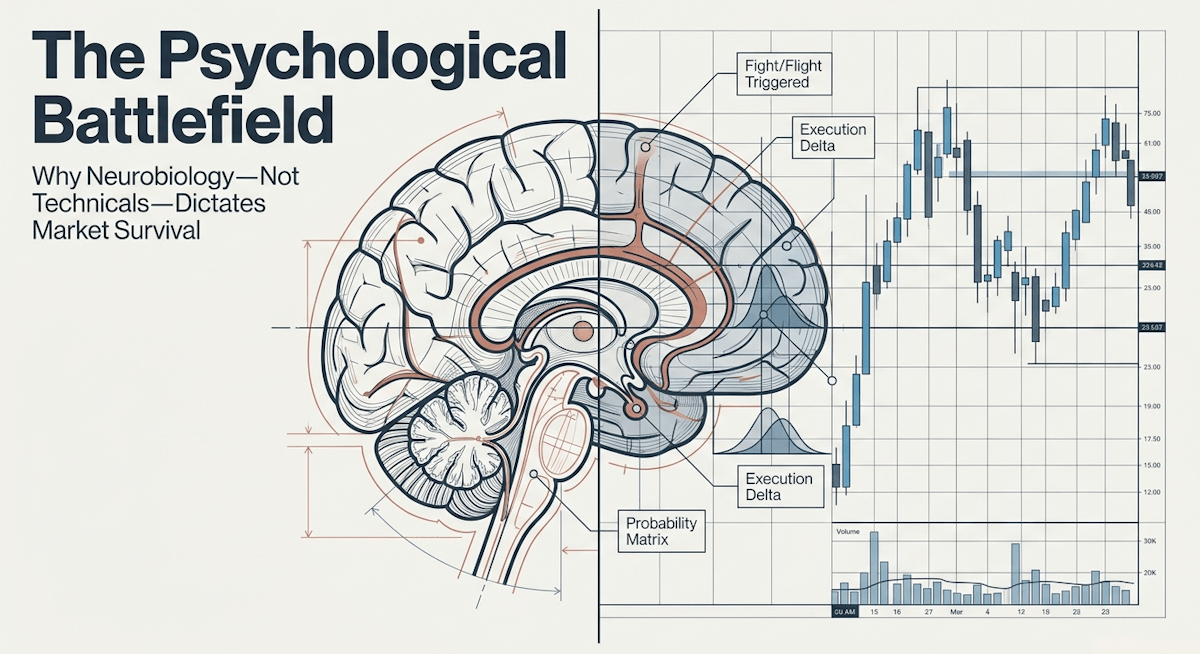
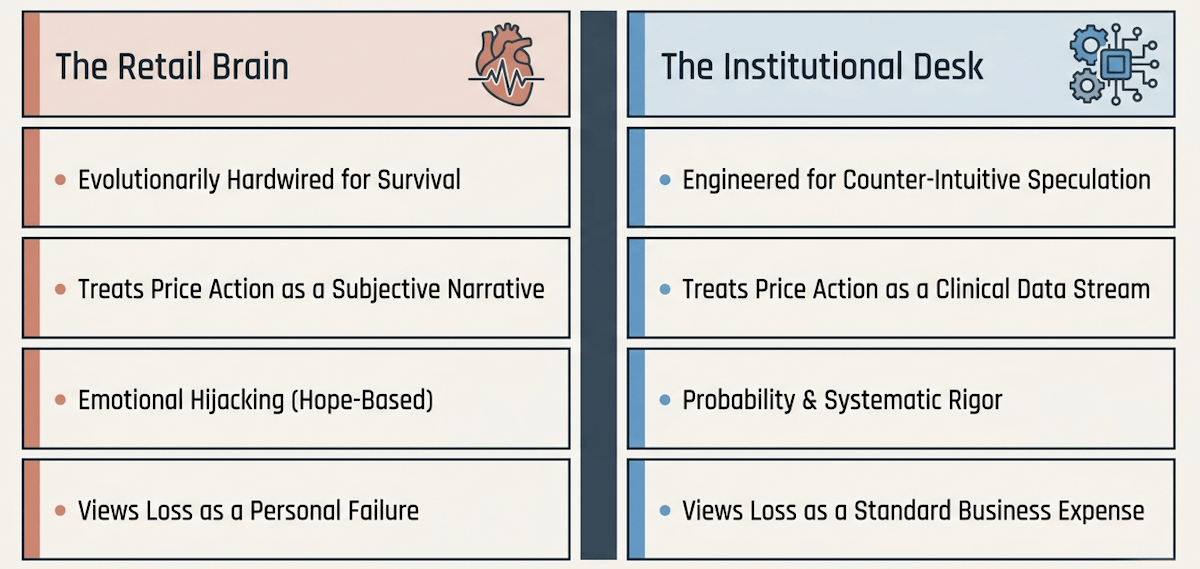
Institutional desks do not trade based on hope; they trade based on probability and systematic rigor. Retail traders, conversely, are often hijacked by their own neurobiology. The human brain is evolutionarily hardwired for survival, not for the counter-intuitive demands of professional speculation. The broader stress-response system - encompassing fight, flight, and freeze reactions - that is triggered when facing a physical threat is the same system that drives a trader to hesitate, act impulsively, or lock up entirely when a stop-loss is hit. To move from the retail mindset to an institutional-grade performance level, one must first identify and neutralize the emotional influences and cognitive biases that sabotage decision-making.
Emotional influences and the disruption of logic
The spectrum of fear and greed
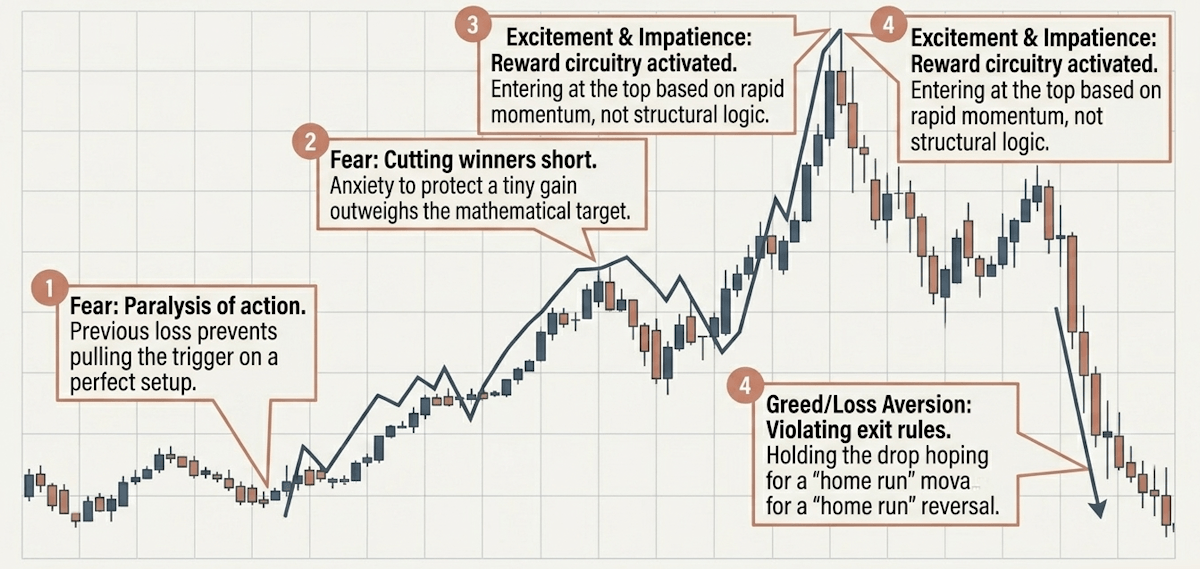
Fear is the most immediate inhibitor of execution. In the forex context, fear manifests as a paralysis of action. A trader might identify a high-probability setup that aligns perfectly with their criteria but fails to pull the trigger because of a previous loss. This hesitation results in missed opportunities, which often leads to the second phase of fear: the premature exit. When a position moves slightly into profit, the fear of losing that small gain outweighs the rational expectation of a larger target, causing the trader to cut winners short. Research into retail brokerage account outcomes consistently identifies the inability to let winners run as a primary contributor to negative expectancy.

Greed is the inverse of this dynamic. It drives the desire for excessive profits, leading to a total abandonment of risk parameters. Greed manifests as over-leveraging, where a trader takes on a position size that their account cannot mathematically support. This emotion encourages the violation of exit rules; instead of taking profit at a predetermined level, the greedy trader holds on, hoping for a 'home run' trade. This behavior ignores the volatile nature of currency pairs, which often mean-revert or reverse sharply after hitting key liquidity zones.
The volatility of excitement and frustration
Excitement and impatience act as catalysts for impulsive entry. When the market moves rapidly, the brain's reward circuitry is activated, creating an urge to participate even if no valid signal exists. This impatience often results in entering a trade at the 'top' of a move, just as professional participants are taking profits. The lack of a cooled-down, analytical approach ensures that the entry is based on price momentum rather than structural logic.
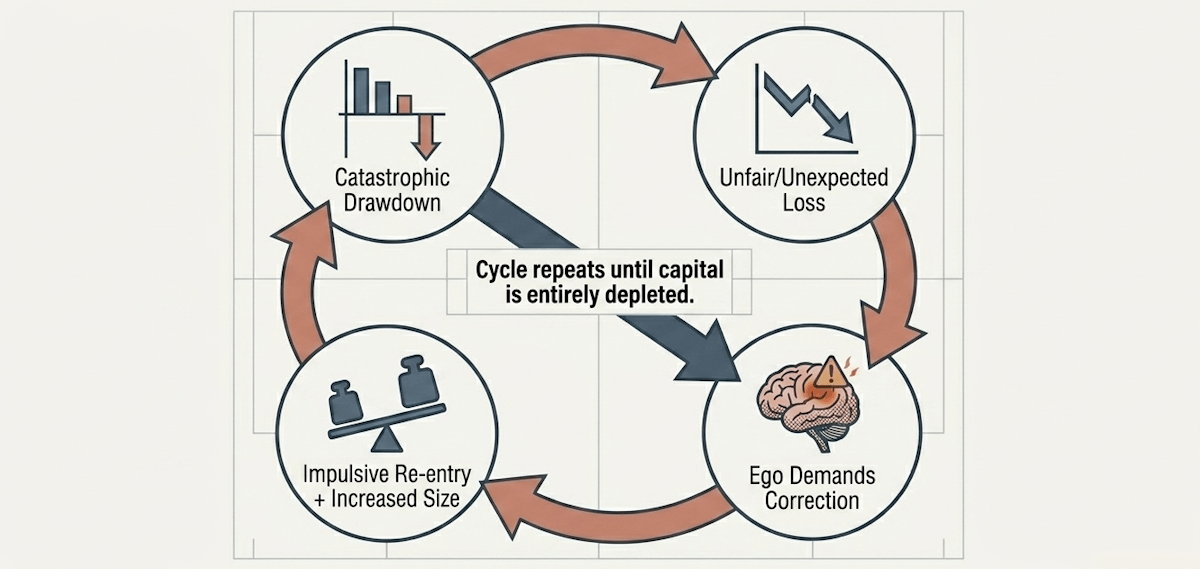
Frustration leads to the most destructive behavior in the industry: revenge trading. Following a loss, particularly one perceived as 'unfair' due to a news spike or a hunt for liquidity, the ego demands a correction. The trader immediately re-enters the market with increased size, attempting to recoup the loss. This is no longer trading; it is a desperate attempt to regain control over an uncontrollable environment. This cycle almost inevitably leads to catastrophic drawdown.
Cognitive biases and systematic errors
Overconfidence and loss aversion
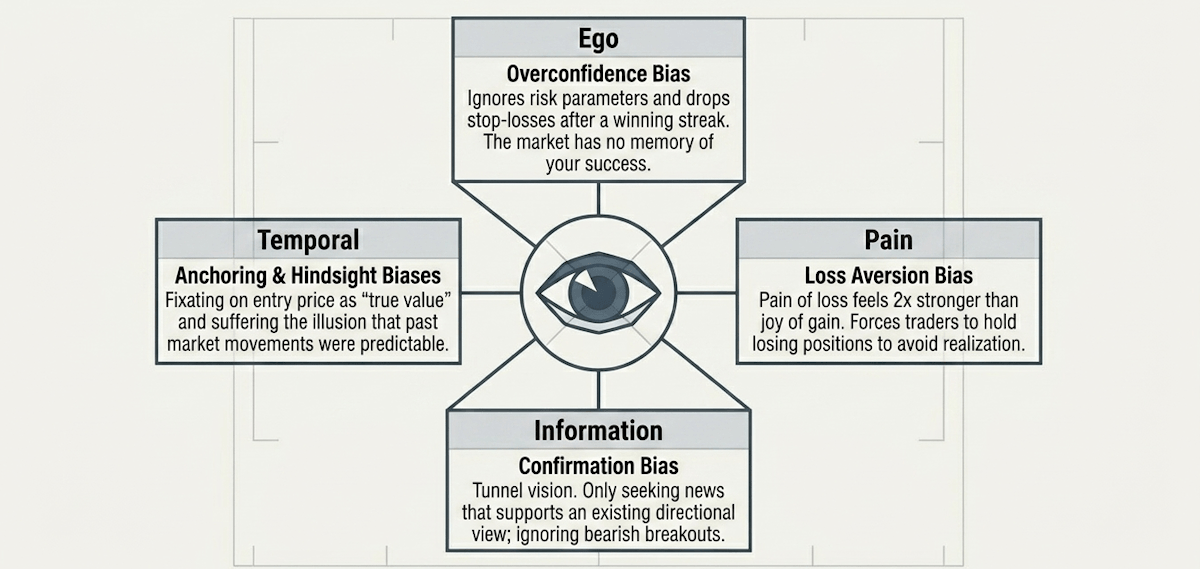
Overconfidence bias is a silent killer among intermediate traders. After a string of winning trades, the individual begins to believe they have 'cracked the code' or possess a superior predictive ability. This leads to the underestimation of risk. They stop placing stop-losses or increase their position size dramatically, only to have a single normal market correction wipe out weeks of gains. The market has no memory of your recent winning streak; it is indifferent to your perceived skill.
Loss aversion bias, documented by Kahneman and Tversky in their foundational work on Prospect Theory, explains why humans feel the pain of a loss approximately twice as intensely as the pleasure of an equivalent gain. In trading, this manifests as 'holding and hoping.' A trader will watch a position go into the red and refuse to close it, rationalizing that it will eventually come back. By avoiding the immediate pain of realizing a loss, they expose themselves to the terminal risk of a total account blow-up. Institutional traders understand that a loss is merely a business expense; retail traders view it as a personal failure.
Informational and temporal biases
Confirmation bias ensures that once a trader has a directional view - for example, being 'long' on the Euro - they will only seek out news and analysis that supports that view. They will ignore a bearish breakout or negative economic data, focusing instead on obscure indicators that justify their existing position. This tunnel vision prevents a pivot when the market structure changes.
Anchoring bias occurs when a trader fixates on a specific price point, often the entry price. If the market drops 100 pips, the trader stays anchored to the entry price as the 'true' value, failing to adjust to the new reality of the price action. Similarly, hindsight bias creates the illusion that past market movements were obvious. This leads to a false sense of security in one's predictive powers, as the brain discounts the genuine uncertainty that existed at the moment the trade was live.
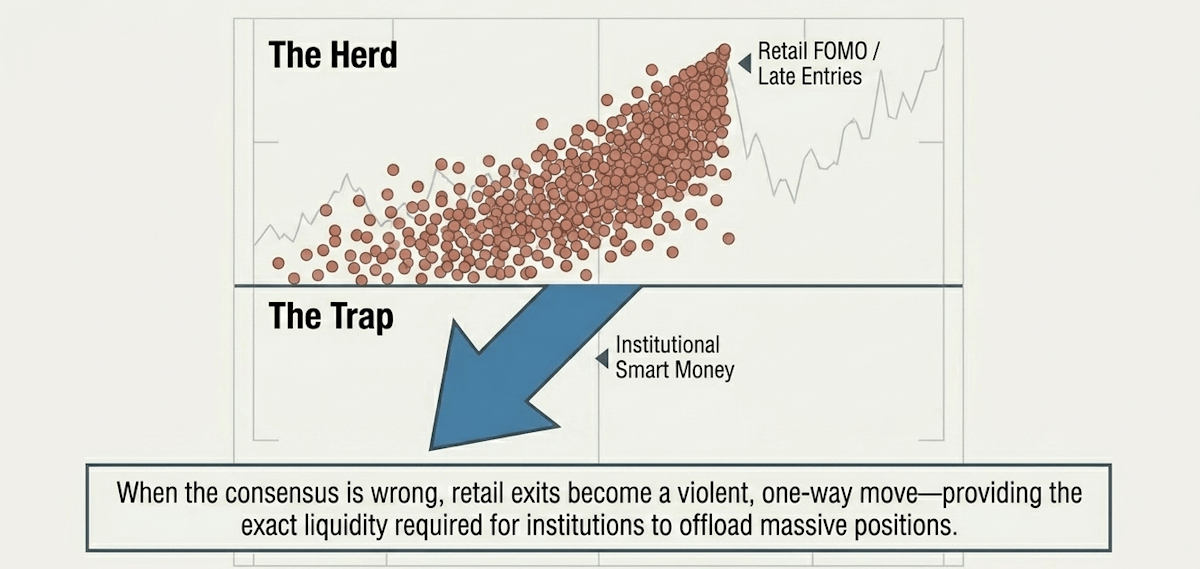
Fear of missing out (FOMO) and herd behavior are collective psychological phenomena. FOMO drives traders to enter late into a trend because they see others profiting. Herd behavior involves following the 'consensus' trade, which often leads to overcrowded positions. When the consensus is wrong, the resulting exit is a violent, one-way move that provides liquidity for the institutional 'smart money' to take the opposite side.
The neuroscience behind trading decisions
Understanding why psychological errors occur at a neurological level transforms the abstract concept of 'discipline' into something concrete and trainable.
The brain's decision-making architecture in high-stakes environments is dominated by a competition between two core systems. The prefrontal cortex governs rational analysis, impulse control, and long-term planning - it is the seat of your trading plan. The limbic system, particularly the amygdala, governs emotional responses and threat detection - it is the source of every impulsive click. When market volatility spikes, cortisol and adrenaline flood the system, effectively suppressing prefrontal activity and amplifying limbic reactivity. In neurological terms, a trader under acute stress is temporarily less intelligent than the same trader in a calm state.
The concept of neuroplasticity offers a more optimistic outlook. The neural pathways that govern impulsive behavior are not permanent fixtures; they can be reshaped through deliberate practice and consistent reinforcement of disciplined responses. Every time a trader respects their stop-loss when the instinct screams to move it, they are literally rewiring the decision-making circuitry involved. Every time they walk away from the screen after a loss rather than revenge-trading, a new behavioral groove is carved. This process is slow and non-linear, but it is the actual mechanism by which a struggling retail participant becomes a consistent operator.
Interoception - the brain's ability to perceive internal physical states - is an underutilized skill in trading psychology. Elevated heart rate, a tightening in the chest, or a dry mouth are neurological alarm signals that the stress response is being activated. Developing awareness of these physiological cues before they translate into a mouse click is one of the most practical and immediately actionable skills a trader can build. The body announces the emotional override several seconds before the hand acts on it; that gap is the intervention window.

The psychology of position sizing
Position sizing is widely discussed as a mathematical function of risk management, yet its deeper dimension is almost entirely psychological. How much you risk per trade is not just a number - it is the primary variable that determines your emotional state during that trade.
A position that represents 5% of account equity behaves fundamentally differently in the trader's mind than one representing 0.5%, even if the technical setup is identical. The larger size activates the stress response, narrows the trader's attention to the profit-and-loss figure, and makes premature exits and stop-loss manipulation far more likely. This is not a matter of character; it is simple neurobiology. The position is too large when you find yourself watching the price tick.
Professional risk parameters - commonly cited at 1-2% of capital per trade - exist not primarily to protect capital in a mathematical sense, though they accomplish this effectively. They exist because at those sizes, the emotional stakes of any single trade are low enough that the prefrontal cortex remains dominant. The trader can lose, accept it as a statistical outcome, and move on to the next setup without neurological compromise.
The concept of psychological capital runs in parallel with financial capital. A trader who sizes correctly preserves both. A trader who over-sizes may keep their account alive after a single bad trade but will have depleted the psychological reserves needed to execute the next trade with clarity. The sequence of large losses - even if individually survivable - often produces a cumulative emotional debt that no winning trade can easily repay.
Social trading psychology and the influence of public consensus
The proliferation of social trading platforms, public leaderboards, and real-time trade-sharing communities has introduced a new category of psychological pressure that did not exist in earlier market eras. The trader is no longer isolated; they operate within a visible social performance context, and this fundamentally alters behavior.
Social proof bias is intensified in trading communities. When a prominent trader in a Discord server or a highly-followed account on a financial platform declares a strong directional view, the psychological pressure to align with that view is significant - even for participants who intellectually understand the risks of herd behavior. The desire for social belonging is neurologically encoded; it competes directly with independent analysis.
Copy trading features present a related distortion. The trader who follows another's positions in real time removes their own analytical framework from the equation, which creates an uncomfortable dependency. When the copied strategy draws down - as every strategy will, periodically - the follower has no psychological framework for absorbing the loss, because they have no ownership of the process that generated the trade. The result is often a panicked exit at the worst possible moment, crystalizing a loss that the original strategy was designed to absorb and recover from.
The most psychologically dangerous trade is the one you entered because someone else told you to. External conviction cannot substitute for internal process ownership. Following a signal is mechanically simple; enduring the inevitable drawdown of that signal with composure requires a depth of understanding and personal conviction that no outsider can provide.

Strategic management of the trading mind
Structural discipline and planning
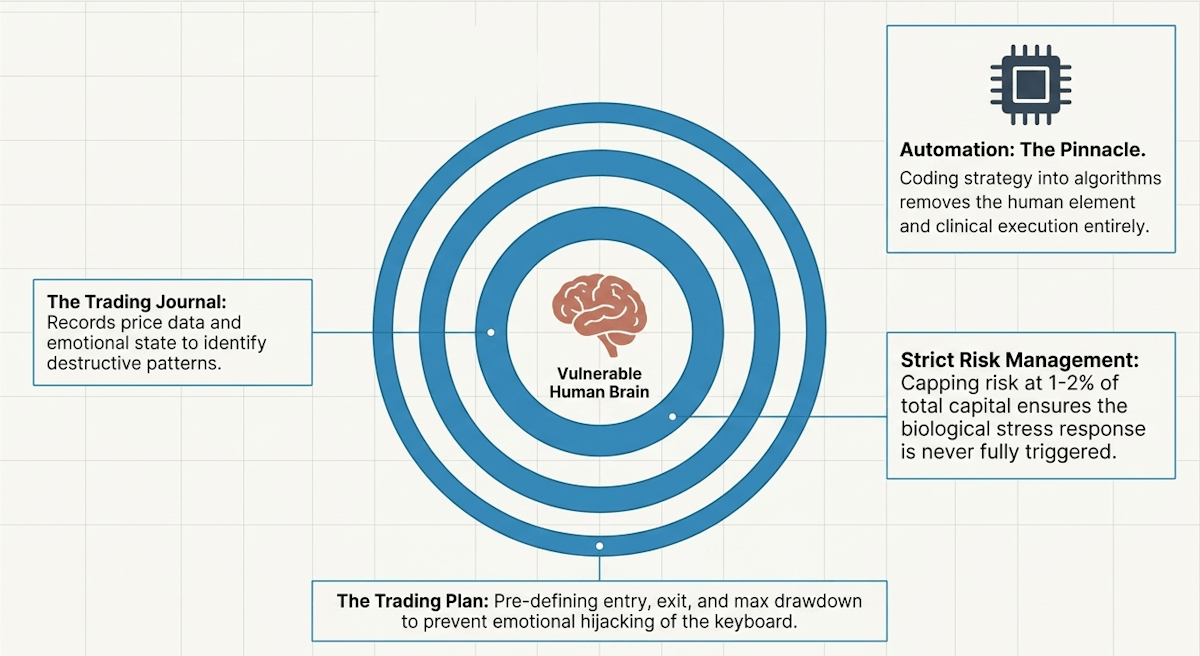
Managing these psychological pitfalls is not about 'deleting' emotions - which is biologically impossible - but about creating structures that make emotions irrelevant. The first line of defense is a solid trading plan. This document must define every variable: entry criteria, exit levels, maximum drawdown, and position sizing. When the market becomes volatile, the plan acts as an external governor, preventing the emotional brain from taking over the keyboard.
Risk management is the ultimate psychological stabilizer. By limiting risk to a small percentage of capital - the widely cited professional benchmark is 1-2% per trade - the emotional impact of any single loss is minimized. If a loss does not threaten one's lifestyle or account longevity, the stress response is never fully triggered. This allows the trader to remain objective and ready for the next setup.
Professional tools for objectivity
Maintaining a trading journal is non-negotiable for professional growth. A journal should record not just the price data, but the emotional state of the trader at the time of execution. Reviewing this data allows for the identification of patterns, such as a tendency to over-trade on Fridays or a habit of moving stop-losses under pressure. Objectivity is built through the rigorous analysis of past performance.
Automation represents the pinnacle of psychological management. By coding a strategy into an algorithm, the human element is removed from the execution phase. An automated system does not feel fear when the market gaps, nor does it feel greed when a target is hit. While the design of the system remains subject to human bias, the real-time execution is clinical and consistent. For many, this is the only way to achieve true scale.
Cultivating the institutional mindset
Emotional intelligence and mindfulness
Professional trading requires high emotional intelligence. This involves self-awareness - the ability to recognize the physical signs of stress or excitement before they translate into a bad trade. Techniques such as mindfulness and controlled breathing can engage the prefrontal cortex, the brain region associated with executive function and logical reasoning, reducing the dominance of the more reactive limbic system during periods of market stress.
Taking regular breaks is a tactical necessity. When a trader experiences a significant win or loss, their neurochemical state is altered. Stepping away from the screens allows for a return to a neutral baseline. The market is a continuous stream of data; missing a few hours of price action is irrelevant compared to the risk of trading while emotionally compromised.
Shifting the focus to process
To survive in the long term, one must focus on process, not profits. In a probabilistic environment, you can do everything right and still lose money on a specific trade. Conversely, you can do everything wrong and make money through pure luck. If a trader focuses on the dollar amount, they become a slave to the randomness of the market. If they focus on the flawless execution of their strategy, the profits become a byproduct of their discipline.
Accepting losses as a standard cost of doing business is the final hurdle. A grocery store owner does not weep when they have to pay for inventory; they view it as a necessary expense to generate revenue. A trader must view a stopped-out trade in the same light. Continuous education about market mechanics and the psychology of crowds helps bridge the gap between expectation and reality, reducing the 'shock' of market movements.
Pre-session routines and psychological preparation
One dimension of institutional practice that is consistently underestimated at the retail level is pre-session preparation. Professional desks approach each trading day with structured rituals that serve a neurological function: they prime the prefrontal cortex for deliberate decision-making before the first price tick appears on the screen.
A pre-session routine might include a brief review of overnight price action without placing any trades, a confirmation that key levels and bias notes from the trading plan are updated, and a short period of focused breathing or mindfulness to establish a calm baseline. The objective is not ceremonial; it is to ensure that the first decision of the session is made from a position of cognitive readiness rather than reactive alertness. The quality of the first trade often sets the psychological tone for the entire session. A disciplined entry reinforces the process; an impulsive one erodes it.
Conclusion: the path to mastery
The forex market is not merely a place where currencies are exchanged; it is a giant mirror reflecting the psychological flaws of its participants. Those who fail to master their own minds will eventually see their capital transferred to those who have. Mastery is not found in a more complex indicator or a faster news feed. It is found in the ability to sit still, follow a plan, manage risk with mathematical precision, and remain indifferent to the outcome of any single trade.
The transition from a struggling retail participant to a consistent professional is a journey of psychological deconstruction and systematic reconstruction - one built on an understanding of neuroscience, behavioral economics, and the honest self-appraisal that most participants never commit to. The neural architecture for disciplined trading can be built. It requires repetition, structured reflection, and the willingness to treat the mind itself as the primary instrument being refined.
In the end, the most important chart you will ever analyze is the one showing your own behavioral patterns.
Share now









Key takeaways
- Emotional states such as fear and greed frequently override technical analysis in live trading environments, making psychology - not strategy - the primary determinant of retail performance outcomes.
- The fight-flight-freeze stress response system is the neurobiological mechanism underlying impulsive or paralyzed trader behavior; acute stress measurably suppresses prefrontal cortex activity, temporarily reducing a trader's capacity for rational decision-making.
- Loss aversion, documented by Daniel Kahneman and Amos Tversky in Prospect Theory, causes humans to feel the pain of a loss approximately twice as intensely as the pleasure of an equivalent gain - a cognitive asymmetry that drives the 'holding and hoping' behavior seen in losing positions.
- Cognitive biases including anchoring bias, confirmation bias, and hindsight bias systematically cause traders to hold losing positions too long, ignore contradicting market structure, and overestimate their predictive ability.
- Neuroplasticity enables traders to literally rewire impulsive behavioral pathways through consistent practice of disciplined responses - every respected stop-loss and avoided revenge trade reinforces new neural circuitry.
- Position size is the primary variable governing a trader's emotional state during a trade; sizing above the 1-2% professional benchmark activates the stress response and increases the probability of irrational decision-making.
- Institutional success relies on process-oriented execution rather than profit-focused outcomes; a trade judged on execution quality - not monetary result - is the professional standard.
- Trading journals and algorithmic automation serve as primary tools for mitigating human behavioral errors in real-time execution; journals reveal pattern-level behavioral data, while automation removes the human from the execution loop entirely.
- Limiting risk to 1-2% of capital per trade is the widely cited professional benchmark for minimizing the emotional impact of individual losses and preserving both financial and psychological capital.
- Revenge trading - re-entering the market with increased size after a loss - is one of the most destructive behavioral patterns in retail forex trading and is driven by the ego's attempt to regain control over an inherently probabilistic environment.
- Social trading environments, copy trading platforms, and public leaderboards introduce social proof bias, amplifying herd behavior and creating performance pressure that undermines independent analytical decision-making.
- Interoception - awareness of internal physiological signals such as elevated heart rate or chest tightness - provides traders with a detectable window between emotional activation and impulsive action, enabling behavioral intervention before execution.
- Pre-session psychological preparation, including structured review routines and mindfulness practices, primes the prefrontal cortex for deliberate decision-making and is a standard component of institutional trading desk practice.
Sources
- IG https://www.ig.com/za/master-your-trading-mind/managing-emotions/how-to-manage-the-emotions-of-trading
- Pepperstone https://pepperstone.com/en/learn-to-trade/trading-guides/understanding-emotional-biases/
- City Traders Imperium https://citytradersimperium.com/emotional-trading/
- FundedNext https://fundednext.com/blog/psychology-forex-trading
- PineConnector https://www.pineconnector.com/blogs/pico-blog/why-emotional-discipline-is-key-to-forex-success-and-how-automation-can-help
- Kahneman, D. & Tversky, A. - Prospect Theory (1979) https://www.jstor.org/stable/1914185
- Published 2026-05-05 14:59
- Modified 2026-05-24 12:48

-
Redaction