


-
 Redaction
Crypto's Lindy Effect: time as the true filter
The Lindy Effect explains why Bitcoin and Ethereum keep surviving while 95% of crypto tokens fail. Here's how time becomes the only real validator now.
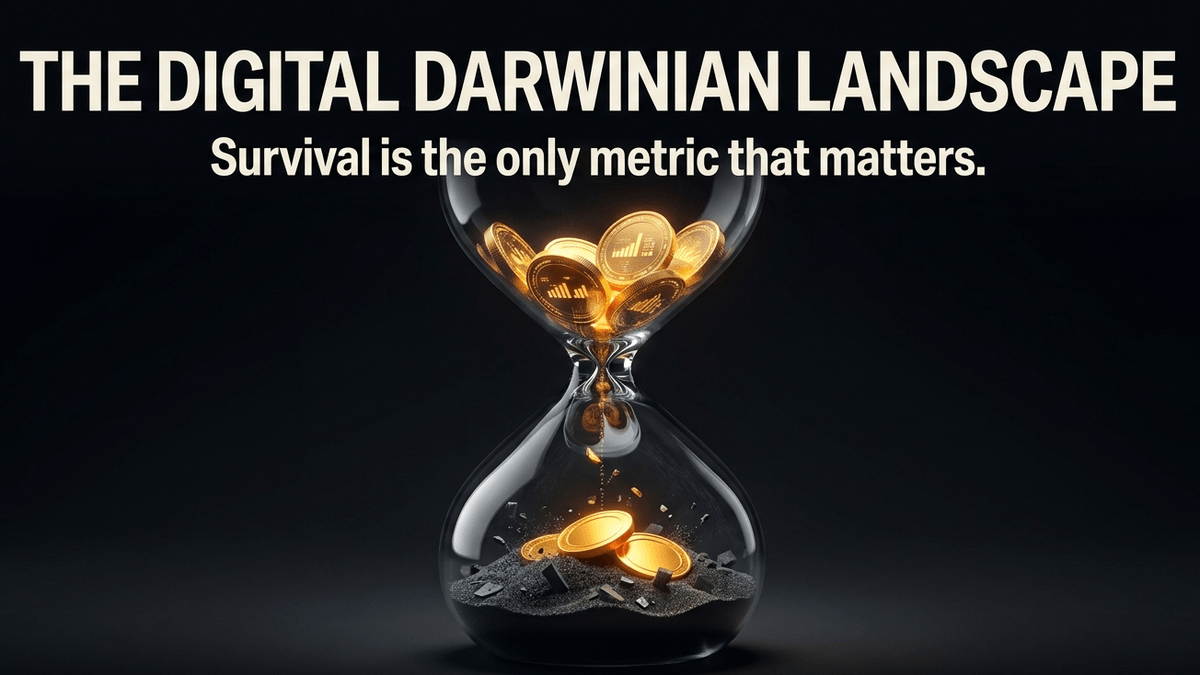
The cryptocurrency market is a digital Darwinian landscape. The weak get slaughtered. The survivors get forged in the fires of extreme volatility. And in this arena, the single most reliable predictor of future success isn't a flashy whitepaper or a venture capital pedigree. It's time.
This is the Lindy Effect - a concept that has migrated from the back tables of a New York City deli to the risk models of institutional digital asset desks. The premise is simple: the future life expectancy of a non-perishable entity - a technology, a book, a decentralized protocol - is proportional to how long it has already existed. The longer something has survived, the longer it's expected to keep surviving.
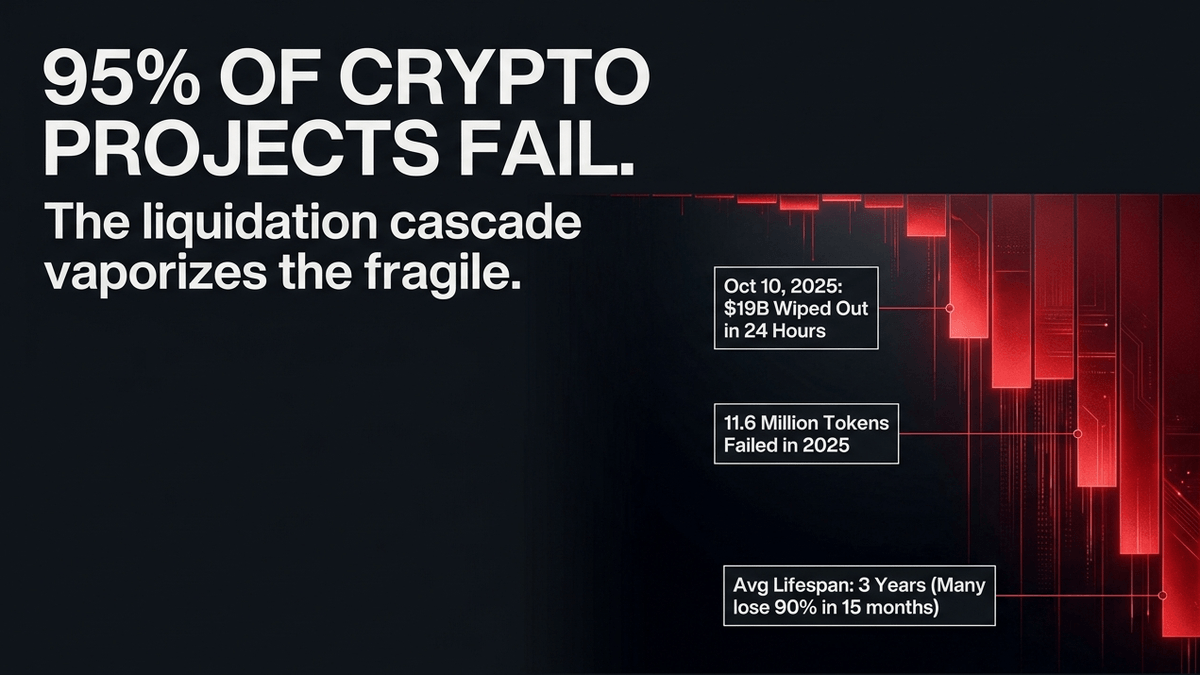
For a veteran trader, this is the cleanest antidote to market hype that exists. Retail chases the shiny object. The newest token. The loudest influencer call. Smart money looks at scar tissue. It looks at what's still standing after the last three cycles tried to kill it. Crypto just delivered its ugliest proof yet: 11.6 million tokens went extinct in 2025 alone, and the carnage hasn't slowed down in 2026. Survival isn't a vanity metric anymore. It's the only validation that matters.

Where the concept actually came from
The term traces back to Lindy's delicatessen on Broadway, where comedians used to gather and dissect each other's careers over coffee. The observation was simple: the longer a show had already run, the longer it was likely to keep running. Writer Albert Goldman put a name to it in a 1964 New Republic piece - "Lindy's Law."
It stayed a piece of show-business folklore for nearly two decades. Then mathematician Benoit Mandelbrot picked it up in his 1982 book The Fractal Geometry of Nature and gave it actual mathematical legs. It was Nassim Nicholas Taleb, in his 2012 book Antifragile: Things That Gain from Disorder, who took the idea out of academia and turned it into a heuristic anyone could use.
Taleb's framing is the one that matters here: unlike a human being, who becomes more fragile with age, a non-perishable idea or protocol ages in reverse. Every additional year Bitcoin survives without being hacked into oblivion or legislated out of existence pushes its expected remaining lifespan further out, not closer in.
"The only effective judge of things is time." - Nassim Nicholas Taleb
Mathematically, the Lindy Effect corresponds to a Pareto probability distribution - a power law with a decreasing hazard function. Translation: the longer something has been around, the lower its conditional probability of dying in any given period. In crypto, "death" usually shows up as one of three things: liquidity drying up, developers walking away, or a security breach nobody recovers from.
A market built on extinction pressure
Crypto doesn't experience occasional failure. It experiences continuous, grinding attrition - and the numbers back that up without needing any embellishment.
According to research from CoinGecko, over 95% of cryptocurrency projects eventually fail or become functionally worthless. Since the data tracking began in mid-2021, more than 13.4 million tokens listed on GeckoTerminal have gone dark. The average lifespan of a token sits somewhere between 15 and 36 months before terminal value loss sets in.
Break it down by cohort and the pattern gets sharper:
- Coins launched between 2013 and 2017 are, by majority, already defunct.
- Projects from 2014 carried a 76.54% failure rate.
- Even in the comparatively "mature" year of 2017, 57.14% of launches failed.
Then something interesting happened. As infrastructure matured and investors got sharper, failure rates fell - hard. Projects launched in 2019 and 2020 saw failure rates drop to 4.74% and 1.03% respectively. That's the Lindy Effect working exactly as advertised: as the survivors prove themselves, the bar for new entrants quietly rises.
2025 reset the entire curve. A liquidation cascade tied to a sudden shock wiped out $19 billion in leveraged positions within 24 hours - the largest single-day deleveraging event crypto has ever recorded. The fourth quarter alone saw 7.7 million tokens collapse, roughly 35% of every failure recorded since 2021 crammed into a single quarter. By the time the dust settled on the year, 53.2% of every token that had entered circulation since mid-2021 was officially defunct, with 2025 responsible for 86.3% of all failures recorded across that entire five-year window. Much of that carnage traced back to the explosion of low-effort memecoins minted through launchpads like pump.fun, which pushed total project counts from roughly 428,000 in 2021 to nearly 20.2 million by the end of 2025.
And the pace hasn't let up. Early data from 2026 shows the graveyard is still filling fast - by some counts, over half a million tokens launched across Ethereum, Solana, and Base in just the first two months of the year, with failure velocity climbing well beyond anything seen in prior cycles. In an environment like that, anything still standing isn't lucky. It's a statistical anomaly worth paying attention to.
Bitcoin and Ethereum: the kings of Lindy
Bitcoin is the textbook case study. Launched in January 2009, it turned 17 in early 2026 and has survived more than a decade and a half of attacks - technical, regulatory, and reputational. It's been declared "dead" by mainstream financial media well over 400 times by various counts. It survived the Mt. Gox collapse. It survived multiple rounds of "China bans." It survived its own internal civil war during the Blocksize Wars. Every one of those scars made the surviving thesis stronger, not weaker.
The network's raw security budget is now almost absurd to describe in plain numbers. Bitcoin's hashrate crossed the one-zetahash-per-second threshold in late 2025 - that's a sextillion hash computations every single second, more calculations per second than there are grains of sand on Earth. It's wobbled since then, dipping when winter storms forced miners offline and climbing back on recovery, but the pattern itself is the point: the network absorbed a 30-40% hashrate drop in a single weekend without missing a block or suffering a security breach. That's not a system that's fragile. That's a system demonstrating, in real time, what Taleb meant by antifragile - it gets tested, it bends, and the difficulty adjustment mechanism resets it without human intervention. Its security model and its position as "digital gold" are now treated by serious allocators as close to unshakeable. Bitcoin passed the test, repeatedly, and that's the entire point of Lindy.

Ethereum sits right behind it. By introducing programmable smart contracts and effectively powering the entire DeFi and NFT ecosystem, Ethereum built a network-effect moat that's brutally difficult to replicate. It consistently generates among the highest fee revenues in the industry - proof that the demand isn't purely speculative, it's functional. Institutional allocators don't gravitate toward BTC and ETH because they're the fastest or the cheapest to transact on. They aren't. They gravitate toward them because they carry the highest Lindy score in the asset class - proof, accumulated year over year, that they can survive the extinction pressure that wipes out 95% of their peers.
This is also exactly the kind of track record institutional frameworks are now being built around. As regulatory clarity around digital assets in the US continues to firm up, the case for treating Lindy-tested assets as core institutional holdings - rather than speculative satellite positions - keeps getting stronger.

Age, market cap, and the Lindy buffer
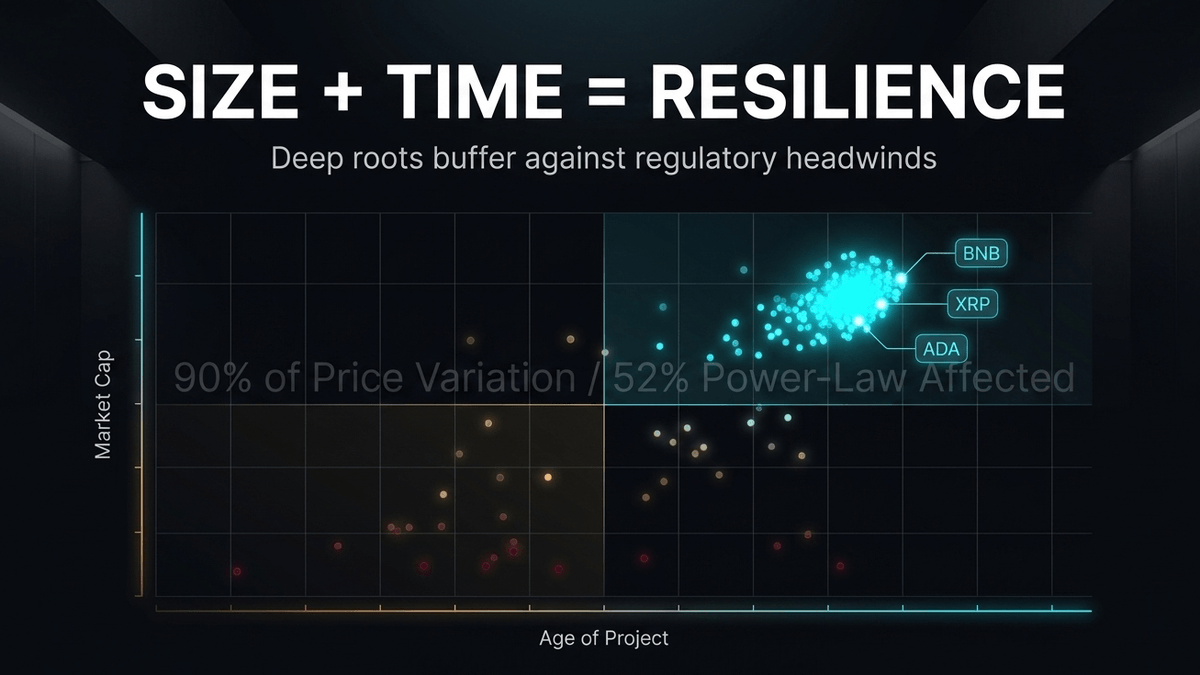
Research into crypto price dynamics has found that a project's age and its market capitalization together explain roughly 90% of price variation across the asset class. Around half of all cryptocurrencies show power-law exponents that are meaningfully shaped by both factors at once. Market cap isn't just a vanity scoreboard here - it's a proxy for trust, for maturity, and for reduced tail risk. Stay in the top 10 by market cap across multiple cycles, and a project is effectively compounding a "Lindy buffer" that newer entrants simply can't fake.
A handful of names have built exactly this kind of buffer:
- Binance Coin (BNB), XRP, and Cardano (ADA) have weathered serious regulatory headwinds - particularly Ripple's multi-year legal battle - and narrative shifts, yet remain deeply embedded in the ecosystem.
- Solana (SOL) has converted raw transaction throughput into a permanent niche, despite early skepticism about network stability.
- Chainlink (LINK) has become close to indispensable as the oracle layer underpinning most major DeFi protocols, even through stretches where its price has lagged its earlier cycle highs.
These aren't the loudest names in the market anymore. They're the ones that survived being boring for long enough to become infrastructure. If you're weighing where to hold these assets long-term rather than trade them, it's worth pairing this Lindy framework with a look at the current crop of secure cold storage options, since the same "proven over time" logic applies to hardware wallets too.
When time gets baked directly into the code
Here's where the Lindy Effect stops being a social observation and becomes a technical design principle. Some protocols are now engineering time itself directly into their consensus mechanisms.
Solana's Proof of History (PoH) is the clearest example - timestamps are cryptographically embedded into the chain itself, allowing faster transaction validation without sacrificing the security guarantees that come from a verifiable sequence of events. There's also growing experimentation around Proof of Time (PoT) models, which lean on event ordering and accumulated on-chain reputation to select validators rather than raw stake alone.
None of this is a coincidence. It's an industry tacitly admitting that time, sequenced and made verifiable, is the closest thing to an incorruptible signal that blockchain design has access to.

Survival isn't passive - antifragility is the upgrade
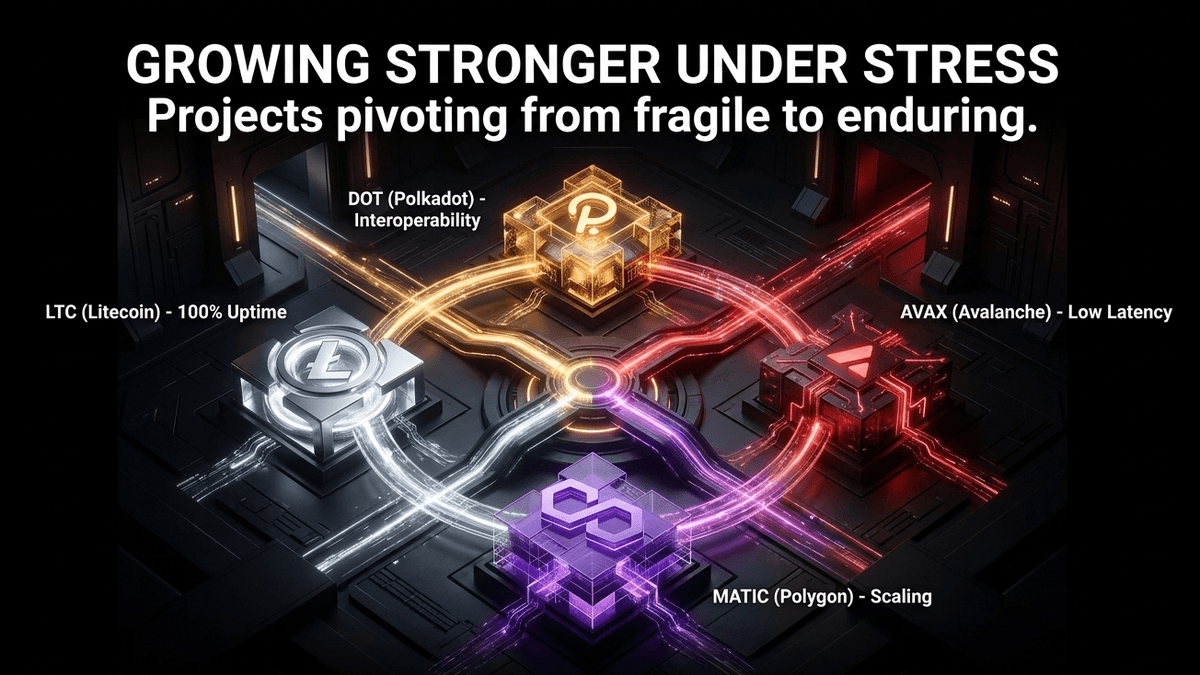
Surviving is the baseline. The Lindy Effect rewards something more specific than mere survival, though - it rewards antifragility, Taleb's term for systems that don't just resist stress but actually get stronger from it. A handful of protocols have demonstrated this directly through how they've handled adversity rather than avoided it:
- Polkadot (DOT) has built its entire thesis around interoperability, positioning itself as connective tissue for a multi-chain future rather than a single dominant chain.
- Avalanche (AVAX) leaned into high throughput and low latency specifically to serve the next wave of decentralized applications.
- Polygon (MATIC) pivoted hard alongside Ethereum's scaling roadmap and adapted its value proposition as the broader ecosystem shifted.
- Litecoin (LTC) has quietly maintained a strong uptime record since launch, continuing to function as a reliable settlement rail even as flashier payment narratives have come and gone.
It's worth noting that not every protocol stress-tests well. Centralized platforms remain a separate risk category entirely - exchange-level failures, including reserve depletion scandals that have hit exchanges outside the US, are a reminder that Lindy logic applies to protocols and assets, not to every custodian sitting on top of them. Decentralized governance models, including more industrialized hybrid DAO structures, are partly a response to that exact distinction - an attempt to push more of the trust layer back onto code that has actually been Lindy-tested.
Why the token graveyard keeps expanding in 2026
If you assumed the carnage of late 2025 would cool the market's appetite for launching new tokens, the data says otherwise. Deployment tools and one-click launchpads have made minting a token essentially free and instantaneous, and that has flipped supply economics on its head. Rather than scarcity forcing discipline, the market is now flooded with hundreds of thousands of new tokens in a matter of weeks, the overwhelming majority of which never see a second week of meaningful trading volume.
This matters for how you should read the Lindy Effect going forward. When issuance is nearly infinite and nearly free, the rate at which projects die tells you less than it used to about quality - it tells you more about how cheap it's become to try. What still separates signal from noise is the same thing it's always been: does the project have a multi-year track record, real usage, and a security history that's actually been tested under stress. The flood doesn't change the filter. It just makes the filter more necessary.
How to actually apply this as an investor
The Lindy Effect isn't a prediction tool. It's a filter. It won't tell you which token 10x's next quarter. What it does is give you a disciplined way to discount the noise.
A few practical rules follow directly from the data:
- Treat sub-2-cycle projects as speculation, not investment. If the median token lifespan is 15 to 36 months, anything that hasn't survived at least two full market cycles hasn't earned a "core holding" label yet - regardless of how compelling the roadmap reads.
- Weight age and market cap together, not separately. A large cap with no track record is still fragile. A long track record with a shrinking cap is a project losing its Lindy buffer in real time - watch the trend, not just the snapshot.
- Distinguish protocol risk from custodian risk. Bitcoin surviving nearly two decades says nothing about the exchange holding your Bitcoin. Self-custody and hardware wallet security remain a separate, equally critical risk category.
- Respect the liquidation event, don't ignore it. October 2025 proved that liquidity can evaporate in hours even for assets that looked structurally sound the day before. Newer tokens with thin order books have no buffer to absorb that kind of shock.
- Watch for engineered time, not just elapsed time. Mechanisms like Proof of History suggest where the industry's design philosophy is heading - toward making time itself a verifiable, gaming-resistant input rather than a vague social signal.
- Ignore the launch-day noise entirely. With hundreds of thousands of tokens launching in weeks rather than years, day-one hype has never been less correlated with survival odds. If anything, an overwhelming launch narrative should raise suspicion, not confidence.

Frequently asked questions
Is the Lindy Effect a guarantee that an old crypto project will keep surviving? No. It's a probabilistic heuristic, not a law of physics. It shifts the odds in favor of longevity, but regulatory shocks, technical failures, and liquidity crunches can still end any project regardless of age.
Does the Lindy Effect apply to crypto exchanges the same way it applies to protocols? Not cleanly. Exchanges carry centralized custodial risk that protocols like Bitcoin or Ethereum don't. A token can be Lindy-tested while the platform holding it for you is not.
Why did 2025 see so many more token failures than previous years? A combination of factors: the explosion of low-cost token launchpads that flooded the market with low-effort memecoins, and a record $19 billion liquidation cascade in October that stripped liquidity from thousands of thinly traded projects almost overnight.
Does a high failure rate mean crypto as an asset class is a bad investment? Not by itself. The failure rate is concentrated overwhelmingly in low-effort, low-liquidity tokens with no real usage. Assets with long track records, sustained developer activity, and deep liquidity - the Lindy-tested cohort - behave nothing like the median token in these datasets.

The closing read
The crypto market keeps generating noise faster than anyone can filter it - hundreds of thousands of new tokens minted in weeks by automated deployment tools and launchpads that make issuance essentially free. That flood doesn't dilute the Lindy Effect. It validates it. In a market where supply can be infinite and instant, the one thing that can't be faked, rushed, or bought with a marketing budget is a track record.
Stop chasing the next moonshot. Start watching what refuses to die. Survival, at this point in the market's evolution, is the validation.
Share now









Key takeaways
- The Lindy Effect holds that the future life expectancy of a non-perishable entity - a technology, idea, or protocol - is proportional to its current age.
- The term originated at Lindy's delicatessen in New York and was first documented by Albert Goldman in a 1964 New Republic article titled "Lindy's Law."
- Mathematician Benoit Mandelbrot formalized the concept in his 1982 book The Fractal Geometry of Nature; Nassim Nicholas Taleb popularized it in Antifragile (2012).
- Mathematically, the Lindy Effect follows a Pareto probability distribution, implying a decreasing hazard function - the longer something survives, the lower its odds of dying soon.
- Over 95% of cryptocurrency projects eventually fail or become worthless; average token lifespan runs roughly 15 to 36 months.
- More than 13.4 million tokens tracked on GeckoTerminal have failed since mid-2021, with 11.6 million failures occurring in 2025 alone - 86.3% of all failures in that period.
- A $19 billion liquidation cascade in October 2025 triggered the collapse of 7.7 million tokens in the fourth quarter alone, the largest single-day deleveraging event in crypto history.
- Bitcoin (launched January 2009) turned 17 years old in early 2026 and has survived hacks, bans, and internal disputes, making it the clearest real-world example of the Lindy Effect in digital assets.
- Bitcoin's network hashrate crossed 1 zetahash per second in late 2025, meaning the network performs more calculations per second than there are grains of sand on Earth.
- A project's age and market capitalization together account for roughly 90% of price variation across the crypto asset class.
- Solana's Proof of History embeds timestamps directly into the blockchain, turning verifiable time into a technical consensus mechanism rather than just a social signal.
- Early 2026 data shows over 540,000 tokens launched across Ethereum, Solana, and Base in just the first two months of the year, signaling the extinction-pressure trend is accelerating, not slowing.
Sources
- CoinGecko Research (Dead coins: How many cryptocurrencies have failed?) https://www.coingecko.com/research/publications/how-many-cryptocurrencies-failed
- CoinDesk (More than half of all crypto tokens have failed - and most died in 2025) https://www.coindesk.com/markets/2026/01/14/more-than-half-of-all-crypto-tokens-have-failed-and-most-died-in-2025
- Wikipedia (Lindy effect) https://en.wikipedia.org/wiki/Lindy_effect
- Bitcoin Magazine (Examining the Lindy Effect: Bitcoin) https://bitcoinmagazine.com/business/examining-the-lindy-effect-bitcoin
- Solana (Proof of History) https://solana.com/news/proof-of-history
- Published 2026-08-01 11:02
- Modified 2026-08-01 11:02

-
Redaction