

-
 Redaction
Centaurus A: a galaxy that remembers its past
Centaurus A bears the scars of an ancient galactic collision. See how new JWST images reveal its hidden structure, black hole jets and fossil star clusters.
The night sky often presents a facade of eternal stillness, a tapestry of light that seems fixed and unchanging. Yet, for those who look through the sophisticated eyes of modern observatories, the cosmos is a restless archive of trauma and rebirth. Standing as perhaps the most evocative witness to this cycle is Centaurus A. Also known as NGC 5128, this celestial titan is more than just a smudge of light in the southern constellation of Centaurus; it is a profound laboratory for the study of galactic archeology. In recent infrared images from the James Webb Space Telescope (JWST), we are granted an intimate look at the scars of a past collision, a reminder that even in the vastness of space, history is never truly forgotten.
Centaurus A resides somewhere between 11 and 13 million light-years from Earth - astronomers still argue over the precise figure, which tells you something about how hard this galaxy is to pin down. In the cosmic scale of things, this makes it our next-door neighbor. Because of this proximity, it serves as the primary specimen for astronomers seeking to understand the life cycles of galaxies. When we peer into its depths, we are not just looking at stars; we are looking at the wreckage of a collision that occurred long before our own species existed. The galaxy's appearance is striking and peculiar: a giant, glowing elliptical sphere bisected by a dark, warped lane of dust. It is a visual discordance that hints at a violent heritage, and it has puzzled skywatchers since it was first cataloged by the Scottish astronomer James Dunlop in 1826.

The anatomy of a cosmic collision
The story of Centaurus A is a story of two becoming one. In 1954, astronomers Walter Baade and Rudolph Minkowski proposed a hypothesis that was radical for its time: they suggested that the unusual structure of Centaurus A resulted from a merger between a giant elliptical galaxy and a smaller, gas-rich spiral galaxy. This was not a peaceful integration. It was a gravitational demolition derby, playing out across hundreds of millions of years, and we are only now, with instruments sensitive enough to see through dust, beginning to read its full transcript.
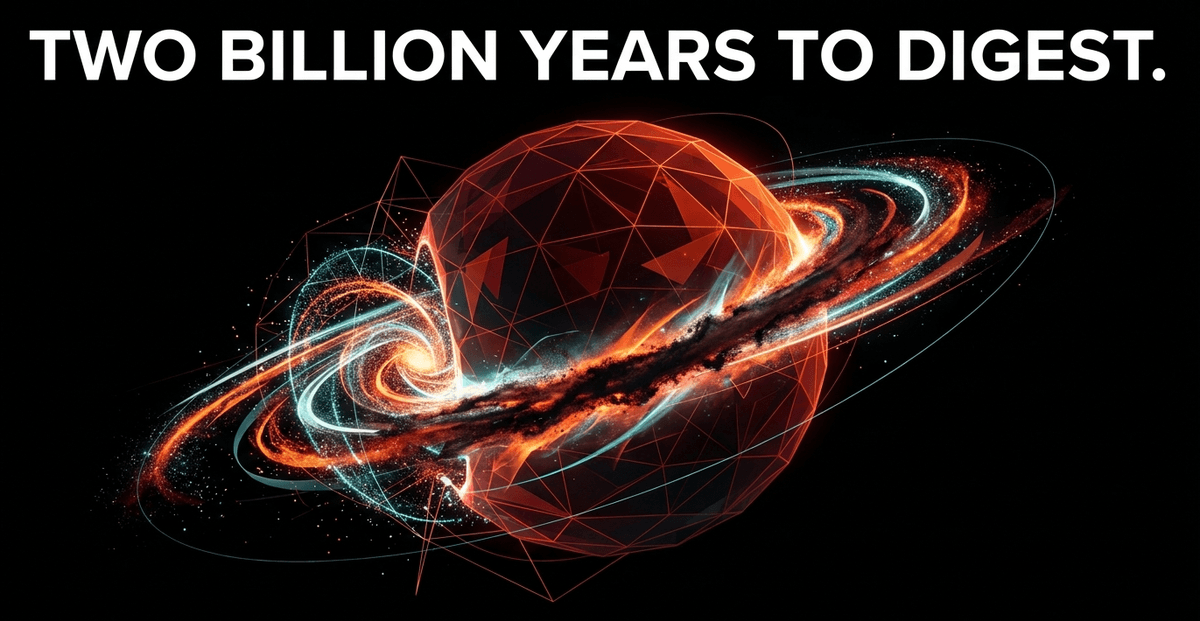
Roughly two billion years ago - itself a number revised and refined many times since Baade and Minkowski's day - a smaller spiral galaxy wandered too close to the elliptical giant that would become Centaurus A. Gravity did the rest. The spiral was torn apart, its stars, gas, and dust dragged into long streamers that wrapped around the larger galaxy like ribbons caught in a slow wind. What we see today as that famous dark lane cutting across the galaxy's middle is essentially the flattened remains of that consumed spiral, still settling, still churning with fresh star formation two billion years after the fact.
It is worth pausing on that timescale. Two billion years sounds abstract until you consider that it predates complex life on Earth. The wound is ancient. And yet the galaxy still bears it openly, the way a tree ring records a single hard winter decades after the frost has passed.
"No single telescope tells the whole story," said Shawn Domagal-Goldman, division director of astrophysics at NASA Headquarters. "Discoveries build over time, and new observatories expand on the foundations laid by earlier missions."
That sentiment could serve as a motto for Centaurus A research generally. Ground-based telescopes gave us the silhouette. The Hubble Space Telescope, for all its power, could not push past the dust shrouding the galaxy's center. NASA's Spitzer Space Telescope, working in infrared, finally traced the large-scale structures hidden within, but its resolution was too coarse to pick out individual stars. Each instrument added a layer, and each layer left something still concealed.
Seeing through the dust
This is where Webb changes the conversation entirely. Webb's exceptional sensitivity across near- and mid-infrared wavelengths lets it cut straight through the thick dust lanes that have frustrated visible-light observers for two centuries, revealing a densely packed field of individual stars and an active, ever-changing galactic core. What was once an opaque smear becomes, under Webb's gaze, something closer to a census - millions of individual points of starlight, each one a data point in the galaxy's biography.
The mid-infrared instrument, known as MIRI, has been especially revealing. It highlights dust structures glowing in shapes that have left astronomers scratching their heads: a warped, parallelogram-like band stretches across the galactic center, while wispy filaments of material drift outward like clouds caught mid-exhale. Most puzzling of all is a looping, S-shaped feature wrapped around the galactic nucleus, whose origin remains genuinely unexplained. Nobody yet knows for certain whether it is a direct fingerprint of the ancient merger, a consequence of the black hole's ongoing activity, or some combination of the two.
There is something almost poetic in that uncertainty. We can now resolve individual stars eleven million light-years away, and still the galaxy keeps a few secrets close.
Webb's near-infrared camera, NIRCam, tells a complementary story. Where the mid-infrared view emphasizes dust and structure, the near-infrared view resolves what first appears as grainy noise into something else entirely: a densely packed tapestry of millions of individual stars, each one now available for study on its own terms. Astronomers describe this as a case of true galactic archeology - each star, once resolved, helps reconstruct a piece of the timeline. When did the oldest stellar populations form? When did star formation slow, and when did it flare back up during the collision itself? Which stars were born later, from gas stirred up in the merger's long aftermath? Assembled together, these details begin to read less like scattered clues and more like a coherent history.
A black hole with an appetite
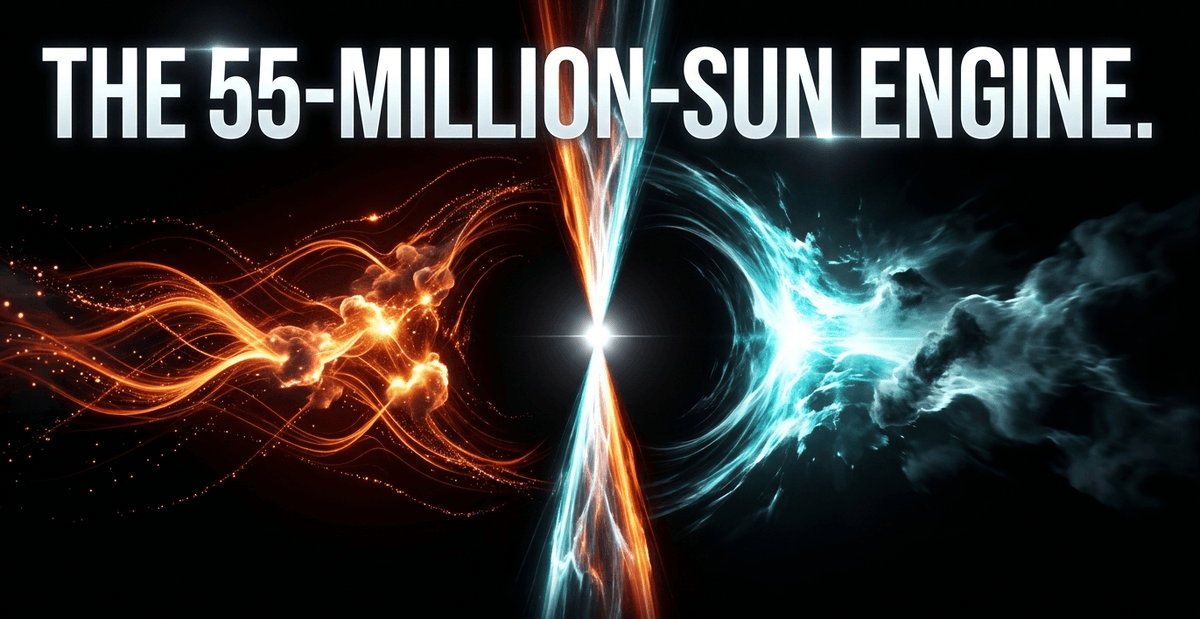
At the heart of all this drama sits a supermassive black hole with an estimated mass of about 55 million times that of our Sun. It is not a passive resident. This black hole is actively feeding on infalling gas and dust, and as it does, it launches jets of material outward at velocities approaching the speed of light. These jets extend for extraordinary distances - the visible jet structure reaches roughly 13,000 light-years from the black hole itself, while the larger radio lobes generated by this activity balloon outward to nearly a million light-years, dwarfing the visible galaxy that hosts them.
This makes Centaurus A the nearest large radio galaxy to Earth, and one of the most extensively studied active galactic nuclei in the sky. In 2021, the Event Horizon Telescope collaboration achieved a milestone: for the first time, astronomers could resolve the base of Centaurus A's jet, tracing its structure on the smallest scales yet observed for any radio galaxy of this kind, at sixteen times sharper resolution than any previous attempt. It offered, in a very literal sense, a view of a jet being born - matter caught in the act of being flung away from the edge of oblivion.
The connection between the black hole and the galaxy's broader story is not incidental. That ancient merger delivered a fresh supply of gas and dust into the galactic center - exactly the kind of raw material a hungry black hole needs to keep feeding. Webb's spectroscopic data now allows astronomers to trace the movement of this gas directly. Ionized gas has been observed moving rapidly outward, almost certainly driven by the black hole's energetic activity, while closer to the center, warmer molecular hydrogen rotates within a warped, tilted disk. The picture that emerges is genuinely complex: the black hole appears capable of both triggering fresh star formation, by compressing surrounding gas into dense knots, and suppressing it, by blasting material away before it can collapse into new stars. Which effect dominates, and when, remains an open and active question.
Fossils in the halo
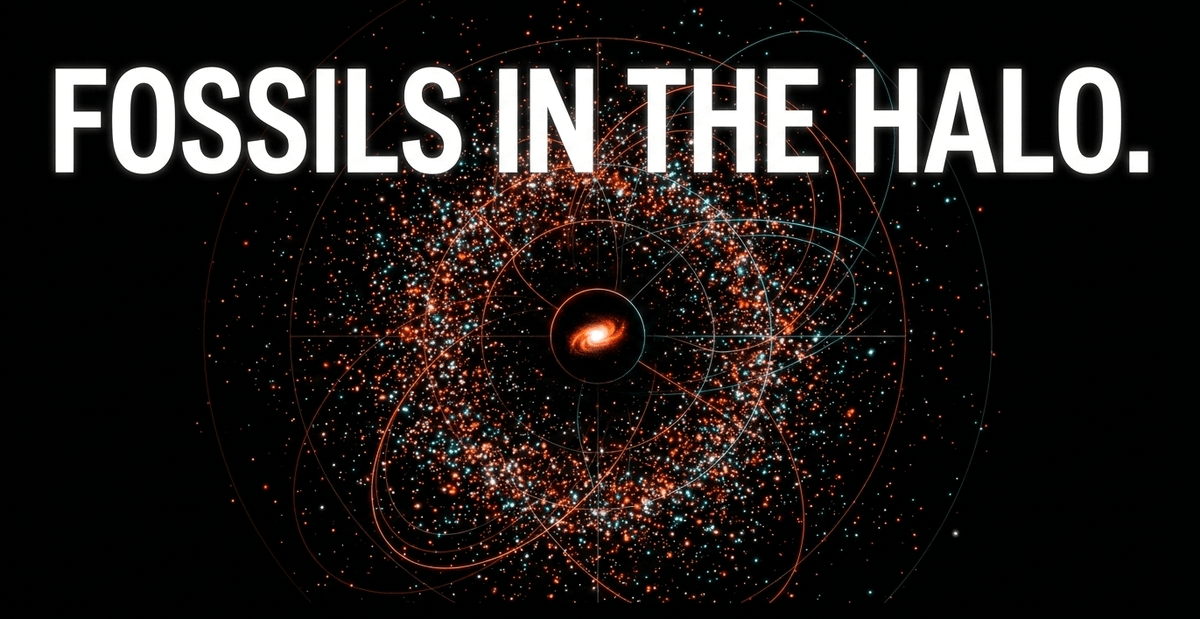
Zoom out from the galactic core, and the story of collision is written just as clearly in Centaurus A's outer halo. Because the galaxy sits too far away for astronomers to resolve individual stars across its full extent, researchers instead rely on globular clusters - dense, ancient groupings of thousands of stars that formed together and have remained gravitationally bound ever since - as proxies for the galaxy's deep history.
The numbers here are worth sitting with. A comprehensive survey led by astronomers at the University of Arizona's Steward Observatory cataloged approximately 40,000 globular cluster candidates surrounding Centaurus A, extending out to a projected radius of nearly 150 kiloparsecs - close to half a million light-years from the galactic center. Of these candidates, roughly 1,900 are considered highly likely to be genuine globular clusters, warranting priority follow-up observation. It is, by a wide margin, one of the richest globular cluster systems ever surveyed around any galaxy.
Why does this matter? Because globular clusters carry chemical fingerprints. Each cluster retains the elemental composition of the environment in which it originally formed, essentially freezing a chemical snapshot in place. When researchers find a chain of clusters sharing similar metallicity and moving with similar velocities, it signals that those clusters likely originated together, probably stripped from a dwarf galaxy or similar object that Centaurus A once absorbed and is, in some cases, still in the process of digesting. As one researcher on the project memorably put it, describing the galaxy's layered history of consumption, this corner of the universe operates on a straightforward principle: it is, in the plainest terms, a galaxy-eat-galaxy universe.
Beyond mapping merger history, these clusters serve a second purpose. By tracking their positions and velocities across such a wide swath of the galaxy's halo, astronomers can begin to reconstruct Centaurus A's total mass distribution, and from there, infer how much of that mass is invisible - the dark matter scaffolding that every large galaxy appears to carry, but which no telescope can see directly.
Why this particular galaxy matters so much
There are, of course, other examples of galaxy mergers on display throughout the universe, some far more dramatic and visually obvious than Centaurus A's own. Early-stage mergers often announce themselves with unmistakable tidal tails, long streamers of stars flung outward that leave no doubt about what happened. Wide-field surveys, including recent work from the Vera C. Rubin Observatory, have captured spectacular examples of these ongoing collisions in progress.
But mergers do not stay obvious forever. Over time, those dramatic visual signatures fade, tidal tails disperse, and the merging galaxies gradually settle into something that looks, at a glance, deceptively ordinary. This is precisely what makes Centaurus A such a valuable case study: it represents a merger old enough that the obvious signs have mostly faded, yet close enough, and observable enough, that astronomers can still dig up the subtler evidence buried beneath the surface. It occupies a kind of sweet spot in cosmic time, not a fresh wound and not yet a fully healed scar.
This is also why Centaurus A functions as what astronomers sometimes call a nearby laboratory. Most galaxies exhibiting this kind of extreme activity sit at distances that make detailed, star-by-star study essentially impossible. Centaurus A's relative proximity means it can serve as a template - a reference point that helps astronomers interpret far more distant, and far more ambiguous, active galaxies observed elsewhere in the universe. Understanding how a nearby black hole shapes its host galaxy, in exquisite detail, informs how we interpret the same processes happening in galaxies we can barely resolve at all.
If you would like a sense of just how differently galaxies handle a collision, it is worth reading about how galaxy mergers aren't always obvious, since 2026 alone has already reshaped much of what astronomers thought they understood about how stars are born and how galaxies evolve through these violent encounters.

What comes next
Webb's observations of Centaurus A have not closed the book on this galaxy so much as opened several new chapters simultaneously. The origin of the mysterious S-shaped dust feature near the nucleus remains unresolved. The precise interplay between the black hole's outflows and the galaxy's ongoing star formation is still being untangled, one spectroscopic measurement at a time. And the outer halo, with its tens of thousands of globular cluster candidates, still holds far more clusters awaiting confirmation than have been confirmed so far.
What is clear is that Centaurus A rewards patience. It has been studied since the early nineteenth century, identified as a powerful radio source in the mid-twentieth century, and reexamined by essentially every major observatory launched since. Each generation of instruments has peeled back another layer of dust, another degree of resolution, another piece of the timeline. Two billion years after a smaller galaxy fell into its gravity and was torn apart, Centaurus A is still, in a very real sense, digesting the encounter, and still offering up the evidence for anyone patient enough to look closely.

There is something grounding in that. We tend to think of collisions as instantaneous, catastrophic events, over in a flash. But at galactic scale, collision is a process rather than a moment. It unfolds slowly enough that the wreckage itself becomes a kind of living archive, still generating new stars, still feeding a black hole, still visible for any species with a telescope powerful enough to look back and read the story written in dust and starlight. Our own Milky Way, astronomers note, is itself expected to merge with the Andromeda galaxy in the distant future. Whatever future observers eventually study of that collision, Centaurus A offers a preview of what such a wound looks like once it has had time to settle, and how much it can still tell us, even after the dust has mostly - but never entirely - cleared.
Share now









Key takeaways
- Centaurus A (NGC 5128) is the closest large radio galaxy to Earth, located somewhere between 11 and 13 million light-years away, with astronomers still divided on the precise figure.
- Its peculiar warped shape is the result of a major merger between a giant elliptical galaxy and a smaller, gas-rich spiral galaxy, first proposed by astronomers Walter Baade and Rudolph Minkowski in 1954.
- The collision occurred roughly two billion years ago, and its remnants are still visible today as the galaxy's signature dark dust lane.
- At its core lies a supermassive black hole of approximately 55 million solar masses, actively feeding on infalling gas and dust.
- The black hole launches relativistic jets that extend roughly 13,000 light-years, feeding radio lobes that balloon outward to nearly a million light-years across.
- In 2021, the Event Horizon Telescope achieved the sharpest-ever image of the base of Centaurus A's jet, offering an unprecedented view of a black hole jet in formation.
- Webb Space Telescope's 2026 infrared observations, marking the telescope's fourth science anniversary, cut through dense dust to reveal individual stars and unusual features, including a warped parallelogram-shaped band and a mysterious S-shaped structure of still-unknown origin.
- The galaxy hosts an estimated 40,000 globular cluster candidates, one of the richest such systems ever cataloged, extending nearly half a million light-years into its outer halo.
- Of those candidates, roughly 1,900 are considered highly likely to be confirmed genuine globular clusters.
- Globular clusters act as chemical fossils, preserving the elemental signatures of the smaller galaxies Centaurus A has absorbed over its history.
- Centaurus A was first cataloged by astronomer James Dunlop in 1826, and later identified as a powerful radio source in 1949.
- Its black hole appears to both trigger and suppress star formation, compressing gas into new stars while also driving material away from the galactic center.
Sources
- NASA Science https://science.nasa.gov/missions/webb/nasa-webb-uncovers-unusual-galaxy-shaped-by-cosmic-collision/
- ESA/Webb https://esawebb.org/news/weic2615/
- University of Arizona News https://news.arizona.edu/news/new-treasure-trove-globular-clusters-holds-clues-about-galaxy-evolution
- Center for Astrophysics, Harvard & Smithsonian https://www.cfa.harvard.edu/news/eht-pinpoints-dark-heart-nearest-radio-galaxy
- Wikipedia https://en.wikipedia.org/wiki/Centaurus_A
- Published 2026-07-12 00:34
- Modified 2026-07-12 00:34
