





-
 Redaction
Banksy installs new sculpture in central London
Banksy installed a new statue overnight at Waterloo Place, London. A suited figure walks blind off a ledge, face wrapped in a flag. Westminster says it stays.
Sculpture installation at Waterloo Place
Residents and early commuters in central London woke on Wednesday, 29 April 2026 to find an unexpected addition to one of the city's most storied public spaces. A new, permanent-style sculpture had appeared overnight at Waterloo Place - the grand, monument-lined thoroughfare in the heart of the historic St James's district - occupying a prominent traffic island at the junction with Pall Mall.

The installation arrived without any prior public announcement, a deliberate move entirely consistent with the working methods of the artist later confirmed as its creator: Banksy.
What the sculpture looks like
The work depicts a larger-than-life male figure dressed in a modern suit, caught mid-stride as though walking unknowingly off the edge of a tall stone pedestal. The most arresting detail is a large, billowing flag that has wrapped entirely around the figure's head, completely obscuring his vision.
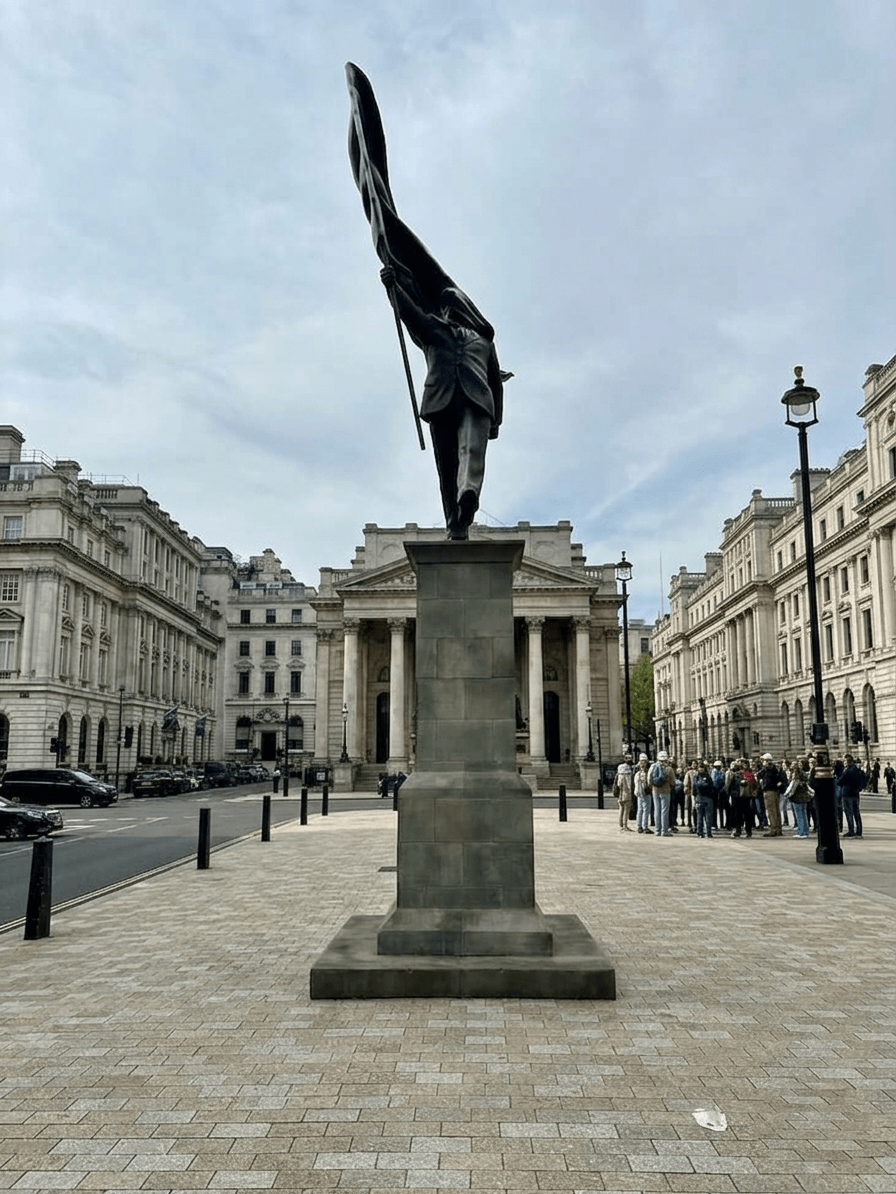
The flag is rendered with impressive material detail - deep folds and wind-swept textures that imply high-velocity movement, despite the entirely stationary nature of what is believed to be a fiberglass or resin casting. A dark finish across the whole piece mimics the patina of traditional bronze monuments, a deliberate choice that allowed the sculpture to blend seamlessly into its surroundings before its origins were identified.
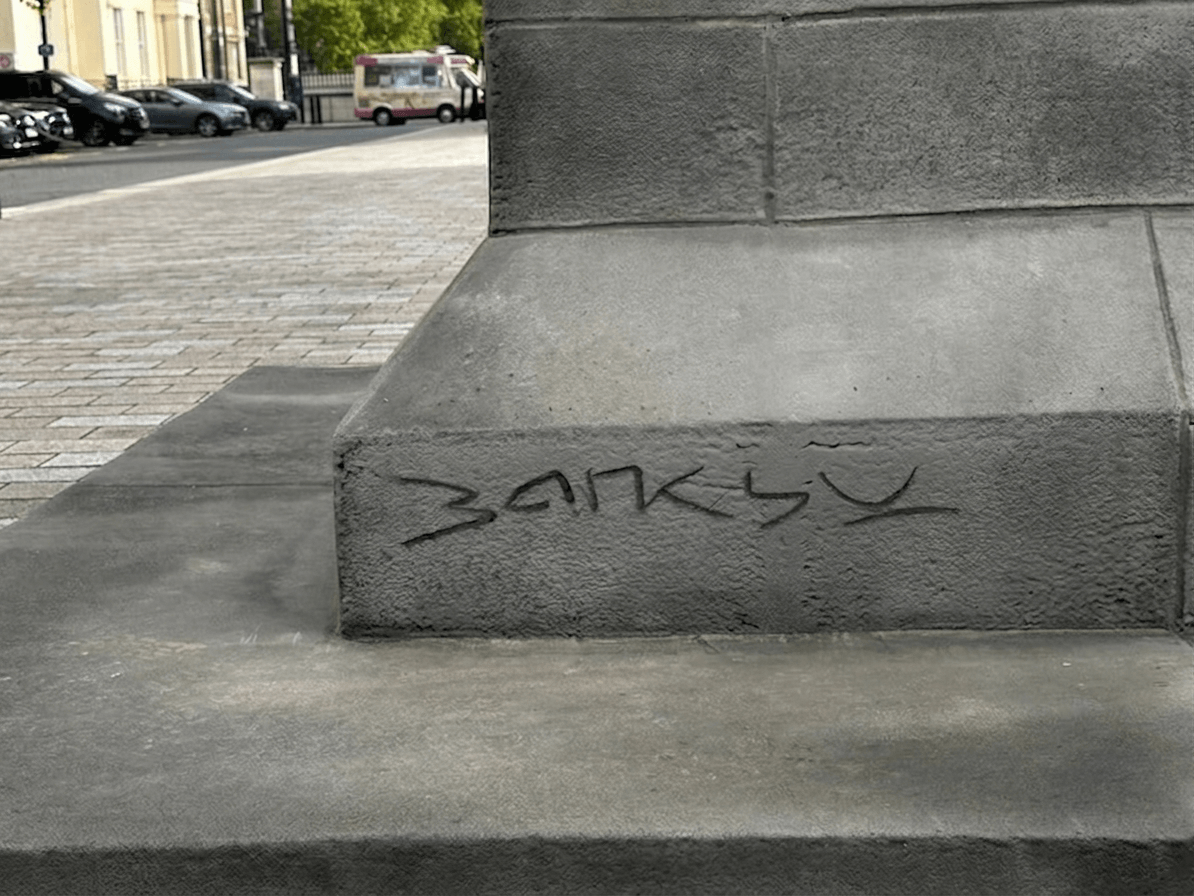
Banksy's signature is scrawled visibly along the base of the plinth - the detail that first drew public attention and triggered the gathering crowds by dawn.
How Banksy confirmed the work
Several hours after the sculpture was first discovered, the artist confirmed it as his own through a video posted to his verified Instagram account. The footage offers a rare behind-the-scenes look at the installation: a large vehicle arriving under cover of darkness, traffic cones being positioned, and the statue being lifted into place using heavy equipment.
The video is interspersed with cuts to recognisable London iconography - Big Ben, a statue of Winston Churchill, a black cab, and a guardsman soldier - creating a visual essay that frames the new sculpture within a broader conversation about British identity and national symbols. A member of the public is also heard approaching the work and audibly declaring: "I don't like it."
This method of authentication via social media has become Banksy's standard protocol for high-profile public interventions, functioning as a digital signature that makes it effectively impossible for imitators to claim credit.
The meaning behind the sculpture
Art historians and cultural critics have wasted no time in unpacking the work's symbolism. The central image - a powerful, suited figure striding confidently and blindly toward his own downfall, face smothered by the very flag he carries - reads as a pointed critique of blind nationalism and the dangers of uncritical devotion to national symbols.
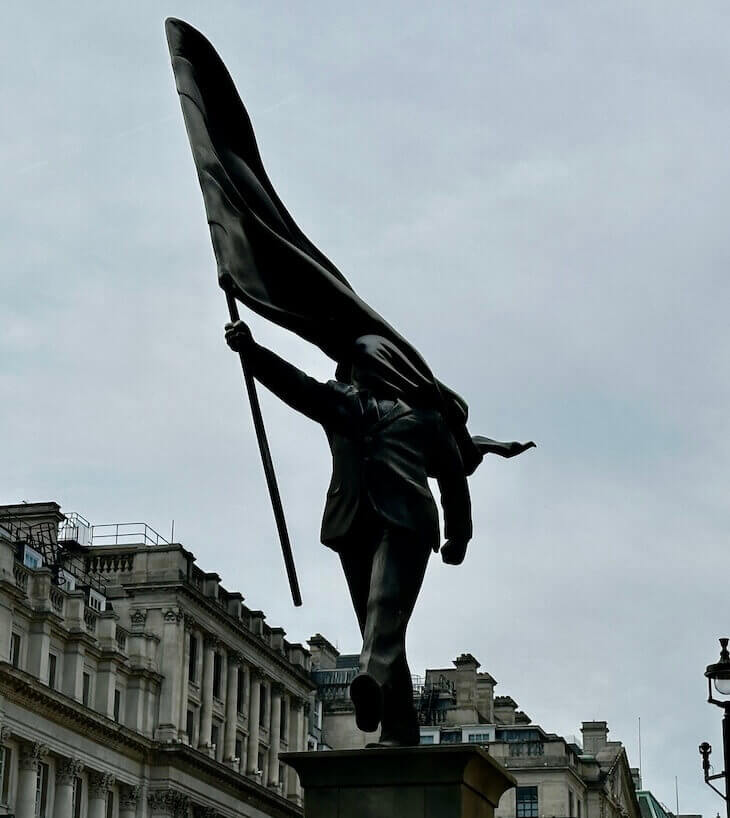
The figure's modern attire - a business suit rather than military uniform or historical dress - grounds the message in the contemporary political landscape, suggesting the commentary applies to leaders and institutions of the present day rather than the historical past. The choice of a flag, specifically, as both the carried object and the instrument of blindness is layered: the very symbol of national pride becomes the thing that prevents the bearer from seeing clearly.
Banksy has provided no written statement to accompany the visual work, a characteristic refusal that leaves interpretation entirely to the viewer - and generates significantly more public discourse as a result.
Location: surrounded by London's historic monuments
The choice of Waterloo Place is far from incidental. Art historians have noted the sculpture's placement in close proximity to several significant monuments, including:
- Statues of King Edward VII and Captain Scott
- A memorial to Florence Nightingale
- The Crimean War Memorial
By positioning his work among these traditional tributes to empire, exploration, and sacrifice, Banksy creates an implicit dialogue between past and present - his flag-blinded figure standing in silent, ironic counterpoint to the heroic confidence of the figures that surround him. The heritage context amplifies the work's critical charge considerably.

Westminster's response: the statue stays
Westminster City Council confirmed on Friday, 1 May 2026 that it would not be removing the sculpture. In a public statement, the council formally welcomed the piece, describing it as "a striking addition to the city's vibrant public art scene" and confirming it would remain accessible to the public.
This represents a notably permissive stance. Westminster has historically maintained a varied record on unauthorised public art, often finding itself navigating a tension between strict heritage and zoning regulations on one side and significant public interest on the other. In this case, public enthusiasm appears to have been decisive.
Security personnel have been stationed at the site to prevent vandalism - a standard precaution for any high-profile Banksy work, which routinely attracts both admirers and those seeking to deface or remove them.
Public reaction and the surge in foot traffic
Local businesses in the St James's area have reported a sharp increase in foot traffic since Banksy's Instagram confirmation went viral. The site has remained consistently busy with onlookers, and the volume of visitors shows no signs of diminishing.
Public opinion on the work is, predictably, divided. Traditionalists argue that any unauthorised addition to Waterloo Place - however artistically accomplished - disrespects the existing monuments and the heritage of the space. Others view the sculpture as a legitimate and even necessary evolution of the city's cultural landscape, one that uses the language of the monument to interrogate the very values monuments are built to celebrate.
The absence of any written statement from the artist ensures the debate remains open, generative, and - as is almost always the case with Banksy's most significant works - entirely unresolved.

Banksy and unauthorised public art: a persistent tension
Banksy has operated at the intersection of art and civil disobedience for more than two decades, using public space as an unrestricted gallery and the element of surprise as a core artistic tool. High-profile interventions - from the shredded Girl with Balloon at Sotheby's to the disputed murals in Gaza - have established the artist as one of the most culturally significant and commercially valuable figures in contemporary art, despite (or because of) a working method that routinely bypasses institutional permission.
The Waterloo Place sculpture represents a particularly ambitious iteration of this approach. The logistical complexity alone - a weighted plinth, bolted to heritage paving, installed in a matter of hours in one of central London's most closely monitored public spaces - marks it as a major operational feat. Local council investigators were seen examining the base of the statue on the morning of discovery to assess whether any damage had been done to the site's infrastructure.
That Westminster ultimately chose not to remove it may itself be the most telling detail of all.
Share now









Key takeaways
- A new Banksy sculpture appeared overnight at Waterloo Place, on a traffic island at the junction with Pall Mall in the St James's district of central London.
- The work was installed during the early hours of Wednesday, 29 April 2026, by a coordinated logistical team working under cover of darkness.
- Banksy confirmed authorship on Thursday, 30 April 2026 via a video montage posted to his official Instagram account.
- The sculpture depicts a larger-than-life male figure in a modern suit, striding unknowingly off the ledge of a tall stone pedestal while a large, billowing flag wraps around his head and obscures his vision.
- The piece is believed to be made of fiberglass or resin with a dark finish that mimics the appearance of traditional bronze monuments. Banksy's signature is scrawled on the base of the plinth.
- The statue is positioned near several significant existing monuments, including statues of King Edward VII and Captain Scott, a memorial to Florence Nightingale, and the Crimean War Memorial.
- Westminster City Council confirmed on Friday, 1 May 2026 that the statue would not be removed, formally welcoming it as "a striking addition to the city's vibrant public art scene."
- The work is widely interpreted as a critique of blind nationalism - the flag both carried by and obscuring the vision of the central figure.
- Security personnel have been stationed at the site, and local businesses have reported a significant increase in foot traffic following the viral Instagram confirmation.
Sources
- NBC News (AP / Reuters) https://www.nbcnews.com/world/united-kingdom/banksy-unveils-new-statue-central-london-man-blinded-flag-rcna343103
- CNN https://www.cnn.com/2026/05/01/style/banksy-new-statue-london-intl-hnk
- Smithsonian Magazine https://www.smithsonianmag.com/smart-news/attributed-to-banksy-a-new-statue-of-a-suited-man-blinded-by-a-flag-and-walking-off-a-ledge-appeared-in-central-london-180988662/
- RTÉ https://www.rte.ie/culture/2026/0501/1571198-artist-banksy-confirms-he-is-behind-new-statue-in-central-london/
- Published 2026-05-02 15:51
- Modified 2026-05-23 16:02

-
Redaction