

-
 Redaction
Why Congress is blocking the Fort Knox gold audit
An investigative report into why the Gold Reserve Transparency Act (H.R. 3795) remains stalled despite a $1.3T valuation gap and rising security concerns.
The gatekeepers of the vault
The United States Bullion Depository at Fort Knox remains a black box. Despite mounting pressure from fiscal hawks and a public increasingly skeptical of institutional transparency, the legislative vehicle designed to pry open those doors is gathering dust in committee. H.R. 3795, the Gold Reserve Transparency Act of 2025, has not moved an inch since its referral to the House Committee on Financial Services on June 6, 2025. This gridlock is not an accident of timing. It is a deliberate exercise in committee prioritization and executive resistance.
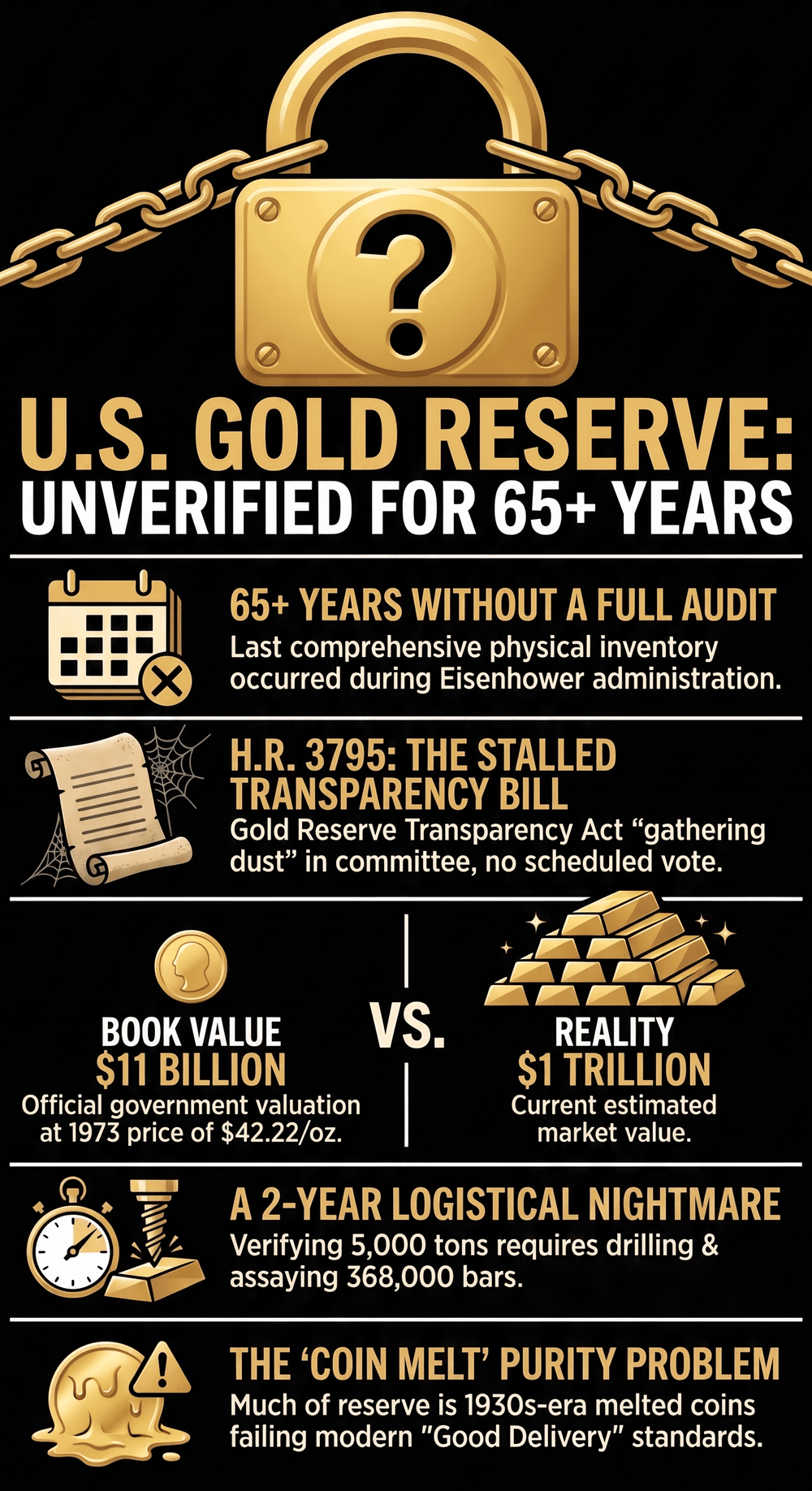
Representative Thomas Massie (R-KY) introduced the bill with a clear mandate: a full, independent physical inventory and assay of every ounce of gold owned by the United States, repeated every five years. This is not a request for a balance sheet update. It is a demand for ground-up verification of the nation's most storied asset, something that has not happened in over 65 years. Supporting him are Representatives Warren Davidson (R-OH), Addison McDowell (R-NC), and Troy Nehls (R-TX), yet their collective influence has hit a wall in the form of Chairman French Hill (AR-02). While other financial reforms move through the legislative pipeline, the gold audit remains conspicuously absent from every scheduled markup and vote.
"For over half a century, there has not been a comprehensive audit of America's gold reserves," Senator Mike Lee said when he introduced a companion Senate measure. Americans, he argued, deserve to know whether the nation's literal treasure is safe and accurately accounted for.
The legislative bottleneck in the Financial Services Committee
The House Committee on Financial Services is a hive of activity. That activity is strictly curated. In recent weeks, the committee has reported a stack of bills to the House floor, including high-profile measures on SEC restructuring and payment fraud enforcement. Chairman Hill has spent much of this Congress advancing landmark housing and cryptocurrency legislation, work that eats up the calendar and the political capital of committee leadership. The fact that these complex regulatory overhauls can find a path to the floor while a transparency mandate for physical assets cannot suggests a hierarchy of interests, and gold auditing sits near the bottom of it.
Chairman Hill has focused the committee's energy on administrative reform, housing affordability, and digital payment security. By doing so, leadership effectively sidesteps the logistical and political headache of a Fort Knox audit. The committee's silence on H.R. 3795 functions as a pocket veto. Without a scheduled markup, the bill cannot be debated, amended, or sent to the floor for a vote. This procedural stalling serves as a buffer for the Treasury Department, which has shown no appetite for the operational disruption a physical audit would entail.
Treasury resistance and the paperwork excuse
Treasury Secretary Scott Bessent has been clear in his opposition to a physical audit. His public position has consistently relied on the same refrain: the gold is present and accounted for. According to the Treasury, existing internal controls, which consist largely of paperwork exercises and periodic inspection of joint seals on vault doors, are sufficient to guarantee the integrity of the reserve.
This reliance on joint seals is a point of contention for audit proponents, and for good reason.
- A joint seal only verifies that a door has not been opened. It does not verify what sits behind that door.
- If a seal was placed on a vault compartment decades ago, the current administration is essentially vouching for the work of its predecessors, without independent confirmation of the contents.
- The only two "audits" in the depository's history, in 1953 and again in 1974, were limited, internal affairs rather than the kind of independent, third-party verification the Gold Reserve Transparency Act demands.
For Massie and his supporters, this is a dangerous assumption of trust in an era where fiscal accountability should be absolute. The Treasury's preference for paperwork audits over physical assays is seen by critics not as a cost-saving measure, but as a transparency dodge.
The staggering logistics of a true physical audit
To understand why the Treasury and committee leadership are hesitant, look at the sheer physical scale of the task. The United States holds approximately 261.5 million troy ounces of gold across four locations: Fort Knox in Kentucky, which alone accounts for roughly 147.3 million ounces (just over half the national total), the West Point and Denver Mints, and a smaller allotment at the Federal Reserve Bank of New York. Fort Knox's share works out to a little over 368,000 bars of the standard 400-ounce "Good Delivery" size, weighing in at more than 5,000 tons of metal.
This is not a matter of simply counting bars stacked in a room. A legitimate audit requires assaying, meaning drilling into or using advanced spectrometry on a statistically significant sample, to confirm the bars are not tungsten-filled or otherwise debased. Industry estimates suggest a comprehensive, bar-by-bar verification of the full national reserve would take somewhere between 18 and 24 months to complete. The logistics compound at every step:
- Bars are stacked to the ceiling in high-density vault configurations, some of them undisturbed since the Truman administration.
- Relocating, weighing, and inventorying a single bar is a slow, deliberate process when done to modern chain-of-custody standards.
- Specialized labor for handling and assaying gold at this scale is genuinely scarce.
- Security protocols for moving thousands of tons of federal bullion within a high-security military installation add heavy layers of bureaucratic and physical friction.
H.R. 3795 itself gives the Comptroller General nine months from enactment to complete the first audit, with repeat audits every five years after that. Whether nine months is remotely realistic given the physical scope of the task is itself part of the committee's quiet, unstated hesitation.
The purity problem nobody wants to pay for
H.R. 3795 goes beyond a simple count. Buried in its language is a mandate to catalogue gold that fails to meet modern "Good Delivery" standards, the London Bullion Market Association benchmark of 995 parts per thousand fineness required for international settlement.
This is where the audit debate gets uncomfortable. Much of the gold at Fort Knox is not modern mint-bar gold at all. It is "coin melt," bars cast in the 1930s from confiscated American gold coins under Executive Order 6102, running closer to 90 percent purity rather than the near-999 fineness expected on today's international market. By some estimates, as little as 17 percent of the Fort Knox stockpile meets contemporary Good Delivery purity. The rest is technically real, technically gold, and technically illiquid on the modern market without further refining.
That creates an expensive follow-on question the bill does not fully answer: what happens after the audit confirms the gold is there but isn't up to spec? Refining tens of millions of ounces to modern standards would carry a real cost, likely running into the hundreds of millions of dollars once assay, transport, and re-casting are included. In a period of fiscal tightening, that is a hard sell for a chairman already juggling SEC reform, housing policy, and crypto legislation on a shrinking legislative calendar. It is one more reason H.R. 3795 is easier to leave in committee than to bring to a vote.
The valuation gap between $42 and the spot price
The most glaring absurdity in the current system is how the U.S. government values its own gold. Since 1973, the statutory price has been fixed by law at $42.22 per ounce, a relic of the Bretton Woods collapse. On the Treasury's books, the entire 261.5-million-ounce reserve is valued at roughly $11 billion. At mid-2026 market prices, with gold trading in the neighborhood of $4,100 to $4,200 an ounce, that same reserve is worth well over $1 trillion, closer to a hundred times its official book value.
This discrepancy distorts the national balance sheet in a way few other assets do. Proponents of the Gold Reserve Transparency Act argue that a physical audit paired with a revaluation would provide a far more accurate picture of U.S. solvency. If the gold were marked to market, the sudden appearance of roughly a trillion dollars in assets could have real implications for how the debt-to-GDP ratio is perceived, though it would not come close to resolving a national debt now pushing toward $39 trillion. This revaluation question is a double-edged sword. It acknowledges that the dollar sits atop a tangible reserve, a concept the Federal Reserve has spent decades trying to distance itself from in favor of a pure fiat framework. It's worth noting that a Federal Reserve staff research note published in August 2025 examined how other countries have historically handled reserve revaluations, suggesting the idea is being taken more seriously inside the building than officials let on publicly.
The David Rush case and its shadow over the audit debate
Public confidence in the "trust the paperwork" system took a real hit following the arrest of David Rush, a former senior CIA officer, in May 2026. FBI agents searching Rush's Virginia home found more than 300 one-kilogram gold bars worth an estimated $40 million, along with roughly $2 million in cash and dozens of luxury watches. According to court filings, Rush had spent months requesting "a significant quantity of foreign currency and tens of millions of dollars in gold bars" from the agency for what investigators now believe was a fabricated, invented intelligence program built to funnel real government resources into his own pocket.
It's an important distinction from how the story spread in public discussion: this was not random contraband gold found on a private citizen with no connection to the government. It was gold that, by the government's own account, originated inside federal custody and was allegedly diverted by someone who had direct access to it. Rush has not entered a plea and remains in custody pending trial.
The case does not implicate Fort Knox directly, and the Treasury has drawn no formal link between the Rush affair and the national gold reserve. But the optics did real damage. If a federal employee could allegedly requisition tens of millions in gold bars from the government's own supply chain and walk out the door with them undetected for months, the public is left asking an obvious question: how confident can anyone be in the internal paperwork controls that Secretary Bessent insists are sufficient for Fort Knox itself? The incident gave audit advocates a concrete, recent example of exactly the kind of institutional blind spot H.R. 3795 was written to close.
The SILVER Act is a different bill solving a different problem
While the Gold Reserve Transparency Act languishes, a separate and unrelated piece of legislation has been picking up genuine bipartisan momentum: the SILVER Act (S. 4621 and its House companion, H.R. 8007). It's worth being precise about what this bill actually does, because it gets conflated with the Fort Knox debate more often than it should.
The SILVER Act does not touch Treasury's gold reserves at all. It amends the Commodity Exchange Act to address "concentration risk" in the private commodities market, specifically the fact that precious metals traded on regulated futures exchanges must currently be stored in depositories clustered near New York City. Backed by more than 40 companies and trade organizations, along with sponsors from both parties including Senators James Risch and Catherine Cortez Masto, the bill would require exchanges to use transparent, objective criteria when approving new depository locations, opening the door to vaults in places like Idaho Falls or Las Vegas.
That is a legitimate, worthwhile reform for market infrastructure. But it addresses where privately and commercially traded metal sits, not what the federal government's own gold actually is or whether it has ever been independently verified. Supporting the SILVER Act lets a member of Congress say they have "done something" on precious metals policy without going anywhere near the far more politically uncomfortable question of a Fort Knox audit. The two bills are often mentioned in the same breath. They are not solving the same problem, and treating one as a substitute for the other is a category error that happens to be politically convenient.
The cost of inaction
Every day H.R. 3795 sits without a markup is a day the U.S. Treasury operates on unverified assumptions about one of the nation's largest physical assets. The refusal to conduct a physical audit is often framed as a cost-saving measure, but the logistics of an 18-to-24-month, multi-hundred-million-dollar undertaking are real, not manufactured objections. Still, the potential cost of an unverified or partially debased reserve, in credibility if nothing else, is not obviously lower.
The committee's current path, prioritizing SEC restructuring, housing policy, and payment fraud enforcement over verification of the nation's largest physical asset, reflects a legislative calendar with finite room and a leadership team choosing where to spend it. Chairman Hill and the members of the House Financial Services Committee are, in effect, betting that the joint seals will hold and that the internal paperwork is accurate. It's a bet made with a trillion dollars of the public's presumed wealth, and one nobody in the room can actually verify.
Conclusion: accountability over access
The stall of the Gold Reserve Transparency Act is a case study in how legislative committees quietly stifle accountability without ever formally rejecting it. By keeping the bill off every markup calendar, the gatekeepers in Congress are shielding the Treasury from scrutiny it has managed to avoid for seven decades. The logistics of an audit are genuinely difficult and the refining costs are genuinely significant, but those are reasons to plan carefully, not reasons to leave the bill buried indefinitely.
The American public is being asked to trust a valuation methodology from 1973 and a security system that has not seen a full, independent physical inventory in generations. As gold prices continue to test new highs and incidents like the Rush case chip away at confidence in internal controls, the demand for a physical audit is not going away. The question is no longer whether an audit is logistically possible. It's why the people with the authority to schedule one keep finding reasons not to.
Share now









Key takeaways
- H.R. 3795, the Gold Reserve Transparency Act of 2025, has not moved since its June 6, 2025 referral to the House Committee on Financial Services.
- The bill was introduced by Rep. Thomas Massie (R-KY), with Reps. Warren Davidson, Addison McDowell, and Troy Nehls as co-sponsors.
- The U.S. holds approximately 261.5 million troy ounces of gold (about 8,133 metric tons), the largest official gold reserve in the world.
- Fort Knox holds roughly 147.3 million ounces, just over half the national total; the rest sits at the West Point Mint, Denver Mint, and the Federal Reserve Bank of New York.
- The Treasury values the entire gold reserve at a statutory $42.22 per ounce, a price fixed by law since 1973.
- At mid-2026 market prices (roughly $4,100-$4,200/oz), that same reserve is worth over $1 trillion, nearly a hundred times its official book value.
- The bill directs the Comptroller General to complete the first independent audit within nine months of enactment, with repeat audits every five years.
- Industry estimates suggest a full, bar-by-bar physical audit would realistically take 18 to 24 months.
- An estimated 83 percent of Fort Knox's gold may fail to meet modern "Good Delivery" purity standards, consisting largely of lower-purity bars cast from melted 1930s gold coins.
- Treasury Secretary Scott Bessent maintains that paperwork audits and periodic inspection of joint seals are sufficient; the depository's last recorded inspections were in 1953 and 1974.
- Former CIA officer David Rush was arrested in May 2026 after allegedly diverting over 300 gold bars (worth roughly $40 million) from federal custody using a fabricated internal program.
- The SILVER Act (S. 4621), a separate bipartisan bill addressing private commodity-market depository concentration near New York City, is often confused with the Fort Knox audit but does not affect Treasury's gold reserves.
Sources
- Congress.gov (H.R. 3795 bill text and status) https://www.congress.gov/bill/119th-congress/house-bill/3795
- U.S. Treasury Fiscal Data (Status Report of U.S. Government Gold Reserve) https://fiscaldata.treasury.gov/datasets/status-report-government-gold-reserve/
- U.S. Mint (Fort Knox Bullion Depository) https://www.usmint.gov/about/tours-and-locations/fort-knox
- NPR (Former senior CIA officer took home gold bars and millions in cash, FBI says) https://www.npr.org/2026/05/28/nx-s1-5837308/cia-officer-gold-bars
- Congress.gov (S.4621, the SILVER Act, bill text) https://www.congress.gov/bill/119th-congress/senate-bill/4621/text/is
- Published 2026-07-16 23:32
- Modified 2026-07-16 23:32

-
Redaction