


-
 Redaction
How ANSI and ASTM quietly write America's shadow law
ANSI and ASTM are private non-profits, yet their technical standards get written into federal law. Here's how incorporation by reference actually works.
To the average citizen, the law is composed of statutes passed by legislatures and regulations drafted by agencies. That picture is incomplete. A significant portion of the American legal landscape exists in a peripheral zone that scholars have taken to calling shadow law.
This phenomenon is driven by a mechanism known as incorporation by reference (IBR), where private technical manuals, safety protocols, and material specifications are folded directly into federal or state code. At the center of this system sit two organizations most citizens have never heard of: the American National Standards Institute (ANSI) and ASTM International.
Both operate as private, non-profit entities. Yet their technical decisions govern the structural integrity of skyscrapers, the safety of children's toys, and the fire resistance of building materials. When a government agency cites a specific ASTM standard in a regulation, that standard stops being a mere industry suggestion. It becomes a mandatory legal requirement, enforceable with the same weight as anything passed by a legislature.
This is the quiet mechanism worth examining closely. It is a fundamental change in how modern societies govern technical complexity - one that leverages private sector expertise while raising deep questions about democratic legitimacy, public access to the law, and the influence of industrial lobbies on public policy.
The procedural engine: how ANSI governs the governors
ANSI occupies a peculiar position in the regulatory hierarchy. It is not, strictly speaking, a standard-writing body. It is the accreditor of the process itself.
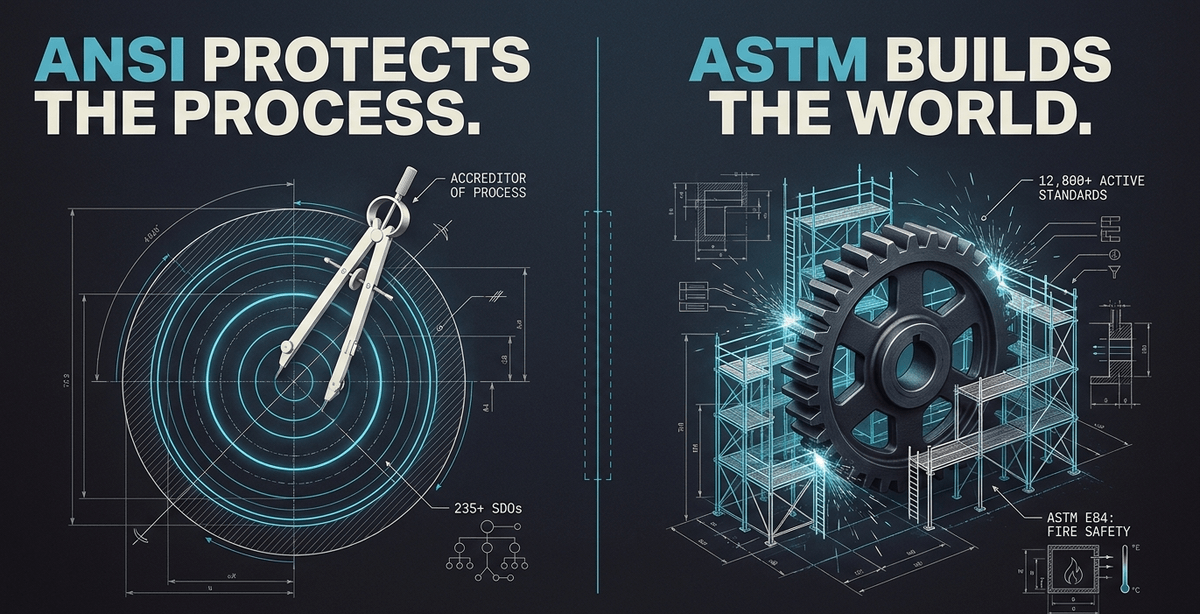
ANSI oversees roughly 235 to 240 Standards Developing Organizations (SDOs), verifying that their internal procedures meet strict requirements of openness, balance, and due process. By providing this stamp of procedural legitimacy, ANSI builds the framework through which private industry can claim a representative voice in the creation of safety and quality norms.
The system runs on what's often called a multiple-path approach. Diverse stakeholders - trade associations, academic institutions, government representatives, industry groups - negotiate the technical particulars of a standard inside committee rooms most of the public will never see. There is no single format imposed from above; ANSI accredits the process, not a specific template for running it.
ANSI's role as the sole U.S. representative to the International Organization for Standardization (ISO) and the International Electrotechnical Commission (IEC) deepens its influence further. By advocating for U.S. technical positions abroad, ANSI helps ensure that standards developed within its ecosystem become the default reference point for global trade.
There are now more than 14,000 American National Standards in effect - a figure that has grown steadily as new sectors, from artificial intelligence to biotechnology, require technical frameworks that didn't exist a decade ago.
For companies operating under ANSI-accredited quality systems, these "voluntary" standards function less like suggestions and more like oxygen. Compliance isn't optional if you want to sell into regulated markets, win government contracts, or avoid liability exposure in court.

ASTM International and the technical foundation of the physical world
If ANSI is the overseer, ASTM International is the primary architect of the physical world's technical requirements. Formerly known as the American Society for Testing and Materials, ASTM develops and publishes standards for products, systems, and services across nearly every industrial sector imaginable.
The scale here is worth sitting with. ASTM maintains more than 12,800 standards in active use, drawing on the work of over 30,000 volunteer members from more than 140 countries. Roughly half of its standards circulate outside the United States, and the organization has signed memorandums of understanding with more than 90 national and regional standards bodies.
ASTM E84, a standard test method for surface burning characteristics of building materials, illustrates the point precisely. It is not just a technical document sitting on a shelf. It is the cornerstone of fire safety regulation across the United States and in dozens of other countries, cited in building codes that determine which materials contractors are legally permitted to install.
Governments rely on ASTM because the alternative - building government-unique standards from scratch - is prohibitively expensive and often technically inferior to what industry can produce. Engineers embedded in an industry possess a granular understanding of material science that civil servants in Washington or state capitals typically lack. By adopting ASTM standards, regulators ground the law in current scientific practice rather than static legislative language.
That reliance, though, creates a symbiotic relationship where the line between private recommendation and public law becomes increasingly difficult to locate. And by ASTM's own accounting, roughly 70% of its revenue flows from the sale of its standards - a figure that will matter considerably later in this analysis, when the courts start weighing public access against institutional survival.
The mechanisms of shadow law: NTTAA and OMB Circular A-119
The transformation of voluntary standards into binding law isn't accidental. It's a matter of deliberate federal policy, codified through two specific instruments.
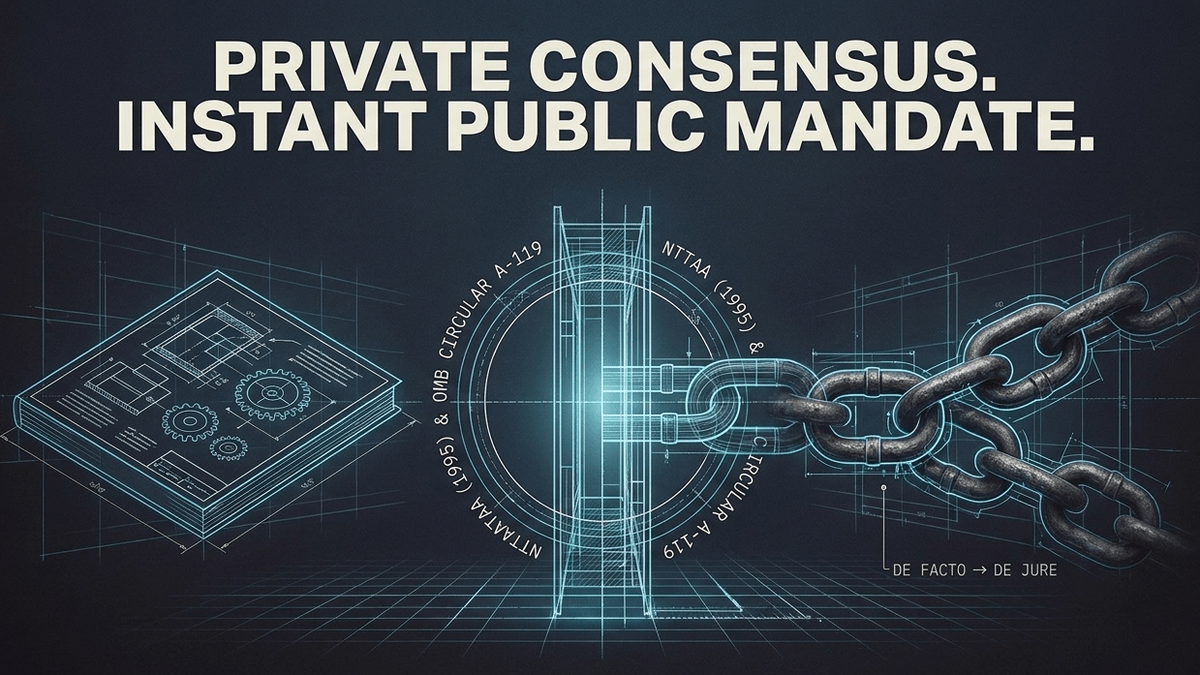
The National Technology Transfer and Advancement Act of 1995 (NTTAA) provides the legal mandate. Under the NTTAA, federal agencies are directed to use voluntary consensus standards in their procurement and regulatory activities whenever practicable, rather than developing competing government-unique specifications. The law was designed to eliminate duplicate costs and to foster innovation by aligning government requirements with private sector capability.
This mandate is reinforced by OMB Circular A-119, a directive from the Office of Management and Budget that encourages federal agencies to participate directly in SDO committees. In practice, that means government experts sit in the same room as industry engineers and trade association representatives while the future of regulation gets drafted, line by line.
This produces a specific and somewhat unusual legal pathway. Practices that exist as de facto industry norms - accepted in reality but without formal legal recognition - can become de jure law through nothing more than a citation in the Federal Register. When a regulation states that "the facility must comply with ANSI/ASHRAE Standard 62.1," the private document instantly becomes part of the law of the land, no legislative debate required.
It's worth pausing on how this pathway differs from ordinary rulemaking. When an agency writes its own regulatory text, that text goes through notice-and-comment procedures under the Administrative Procedure Act, and the final language is published in full in the Code of Federal Regulations for anyone to read. IBR takes a shortcut: the agency adopts a document it did not write, did not fully vet through public comment in its final form, and does not reproduce in the CFR at all. The citation itself is public. The substance behind the citation, historically, has not been.

The friction of copyright and public access
The most contentious aspect of this entire arrangement is the tension between intellectual property rights and the public's right to know the law it must obey.
Because ANSI and ASTM are private organizations, they hold copyrights on the standards they produce, and they fund much of their operation by selling those documents - sometimes for hundreds of dollars per volume. When these standards are incorporated by reference into law, an uncomfortable question follows: can the law be hidden behind a paywall?
For years, citizens, small businesses, and library associations argued that if a document is the law, it must be freely accessible to anyone subject to its requirements. SDOs countered that without copyright revenue, they'd be unable to fund the consensus-based development process governments depend on. Remove the copyright protection, the argument goes, and government would have to take over standards development itself - at higher cost and, likely, lower technical precision.
This conflict reached a decisive legal moment on September 12, 2023, when the D.C. Circuit Court of Appeals issued its ruling in American Society for Testing and Materials v. Public.Resource.Org, Inc. The case had been working through the courts for roughly a decade. On remand, the district court held that the non-commercial posting of standards incorporated by reference into law is fair use, and the D.C. Circuit affirmed the district court's reasonable exercise of discretion in declining to award injunctive relief.
The dispute centered on Public.Resource.Org, a non-profit that had purchased hundreds of privately written standards between 2012 and 2014 and posted them online free of charge. The American Society for Testing and Materials and other industry groups sued Public.Resource.Org, claiming copyright and trademark infringement. The case swung back and forth for years. In 2017, the U.S. District Court for the District of Columbia granted summary judgment for the industry groups, but the U.S. Court of Appeals for the D.C. Circuit later reversed and remanded on fair use grounds, and in 2022, with a more developed factual record, the district court held that Public Resource's reproduction of the standards was largely fair use, except for its reproduction of the trademarked logos. The 2023 appellate ruling closed the loop, with the court finding that the first three statutory fair-use factors weighed strongly in Public Resource's favor and the fourth was, at best, equivocal for the standards bodies.
This outcome marked a meaningful shift: when a technical standard is adopted as public mandate, its accessibility status changes, even if its underlying ownership does not. The ruling ensured that shadow law is at least visible to the public, even where the development process remains largely closed off.
The UpCodes ruling: the fight extends to for-profit publishers
If the 2023 decision closed one chapter, it opened another almost immediately. The 2023 case involved a non-profit disseminator acting for free. The next major test asked a harder question: does the same protection extend to a for-profit company built specifically to make money from publishing the law?
In April 2024, UpCodes - a commercial legal-tech startup founded in 2016 that operates a searchable online library of building codes - began publishing ten copyrighted ASTM standards covering steel and aluminum construction materials, all of them incorporated by reference into the International Building Code. ASTM sued for copyright infringement and sought a preliminary injunction to force the standards offline.
On April 7, 2026, the Third Circuit Court of Appeals affirmed the lower court's denial of that injunction, concluding that three of the four statutory fair use factors favored UpCodes and the fourth was equivocal. Writing for the panel, Circuit Judge L. Felipe Restrepo found UpCodes' copying transformative because it served a fundamentally different purpose than ASTM's own publication - conveying what the law actually is, rather than informing industry of current best practice. Notably, the court rejected ASTM's argument that verbatim, unaltered copying can never be transformative, joining the D.C., Second, and Fourth Circuits in holding that a secondary work can be transformative in function even without altering the original.
The court did leave the standards organizations one meaningful opening. It acknowledged that ASTM derives roughly 70% of its revenue from standards sales and that free copies from a commercial competitor could plausibly substitute for ASTM's own paid offerings, making the fourth fair-use factor - market harm - the closest call in the case. The ruling was explicitly preliminary, based on an incomplete record, with the court cautioning that unfettered copying could, if it caused significant economic harm, ultimately threaten an organization's capacity to keep producing new standards.
Taken together with the 2023 precedent, the UpCodes decision suggests appellate courts across multiple circuits are converging on a consistent principle: publishing an incorporated standard to disseminate the law is a different act, legally, than publishing it to compete in the market for technical guidance - even when the copying is complete and word-for-word, and even when the publisher is a commercial enterprise rather than a public-interest nonprofit.
The legislative counterattack: the Pro Codes Act
The fight isn't over. Losing repeatedly in court has pushed industry groups toward Congress instead, where a bill known as the Pro Codes Act would functionally reverse the practical effect of these rulings.
The bill, reintroduced in 2026 as the Protecting and Enhancing Public Access to Codes Act, states in its findings that Congress and government at all levels have long recognized the value private standards organizations provide, and that the resulting consensus standards are used by private industry, academia, and governments that incorporate them by reference into law. Its core mechanism is straightforward: a standard keeps its copyright protection even after a government incorporates it into binding law, as long as the sponsoring organization posts a free, read-only version online that meets federal accessibility requirements.
The bill has bipartisan sponsorship in both chambers. Senators Chris Coons, John Cornyn, Mazie Hirono, and Thom Tillis reintroduced the Senate version in March 2026, framing it as legislation that lets standards-development non-profits avoid losing their intellectual property once a regulator cites their work. Industry-aligned groups have echoed that framing. The Copyright Alliance has called it a clear win for public safety, transparency, and economic growth, while ASHRAE has argued that the balanced, multi-stakeholder ANSI process justifies protecting the resulting standards from unrestricted republication. The bill picked up momentum through the spring, with the National Fire Protection Association voicing support for the Act following a House Judiciary Subcommittee hearing on the legislation.
Opposition has been just as organized. Library associations, journalist groups, and disability rights organizations have formally opposed the measure, arguing that extending copyright to codes and standards incorporated by reference into law would restrict the public's right to freely access and reuse it. The Re:Create coalition has called the bill constitutionally flawed, warning it would restrict the public's and first responders' access to critical safety standards, obstruct commentary and scholarship on the law, and increase compliance risk by making the underlying rules harder to read.
As of mid-2026, the legislation remains pending in committee in both chambers, meaning the fair-use boundary drawn by the D.C. Circuit in 2023 and reinforced by the Third Circuit in 2026 is still the operative rule. But it is a boundary industry groups are now trying to redraw through statute, having largely exhausted the litigation path.
Legitimacy, rent-seeking, and the question of participation
Beyond the access question lies a deeper one: legitimacy. Should non-elected private organizations be permitted to make decisions that carry the force of public safety law and shape economic competition?
Critics argue the development process within some private standards bodies isn't always as participatory as its formal openness requirements suggest. Sitting on an SDO technical committee requires time, technical expertise, and money - resources that naturally favor large corporations and well-funded trade groups over small manufacturers, independent engineers, or consumer advocates.
This dynamic raises concerns about rent-seeking - when an entity uses the regulatory process to secure economic gain without providing a reciprocal public benefit. If an SDO successfully lobbies to have its specific standard written into law, it effectively creates a captive market for its publications. It may also tilt the field toward the technologies favored by its own member companies, over equally valid alternatives developed elsewhere.
The effect compounds for smaller players. Small-scale producers and manufacturers in developing economies often lack the infrastructure or capital to adopt complex ASTM or ANSI specifications. That exclusion isn't always intentional, but its result is the same: high-value markets stay closed to newcomers, and established incumbents keep their advantage.
A related, and less-discussed, criticism concerns notice. As the Third Circuit itself observed in the UpCodes case, incorporation by reference raises real accountability problems, since regulated parties can face legal consequences for violating rules they had no free, practical way to read in the first place. A contractor bound by a building code provision they cannot access without a paid subscription is, functionally, subject to a law they cannot verify - a due process concern that predates the copyright fight and will likely outlast it, regardless of how Congress eventually resolves the Pro Codes Act.
Efficiency versus democracy: a structural trade-off
None of this criticism erases the case for the system as it exists. Reliance on private standards is routinely defended - and not without reason - as a triumph of administrative efficiency.
If the federal government had to write its own technical specifications for every regulated industry, from aerospace materials to biotech manufacturing, the administrative state would need to expand well beyond its current scale. The present model lets government outsource the heavy technical lifting to the private sector while retaining full authority to enforce the final result through law.
Proponents point to speed as the decisive advantage. A bill in Congress can take years to move from introduction to passage. A technical committee, by contrast, can revise a standard in months when new safety data or engineering advances demand it. In this framing, ANSI and ASTM function as a necessary bridge between the deliberately slow pace of legislation and the genuinely fast pace of technological change - a dynamic explored in more detail in this related piece on how ISO and IEEE standards function as law through similar mechanisms of regulatory citation and contract law.
Future projections and the evolution of standards governance
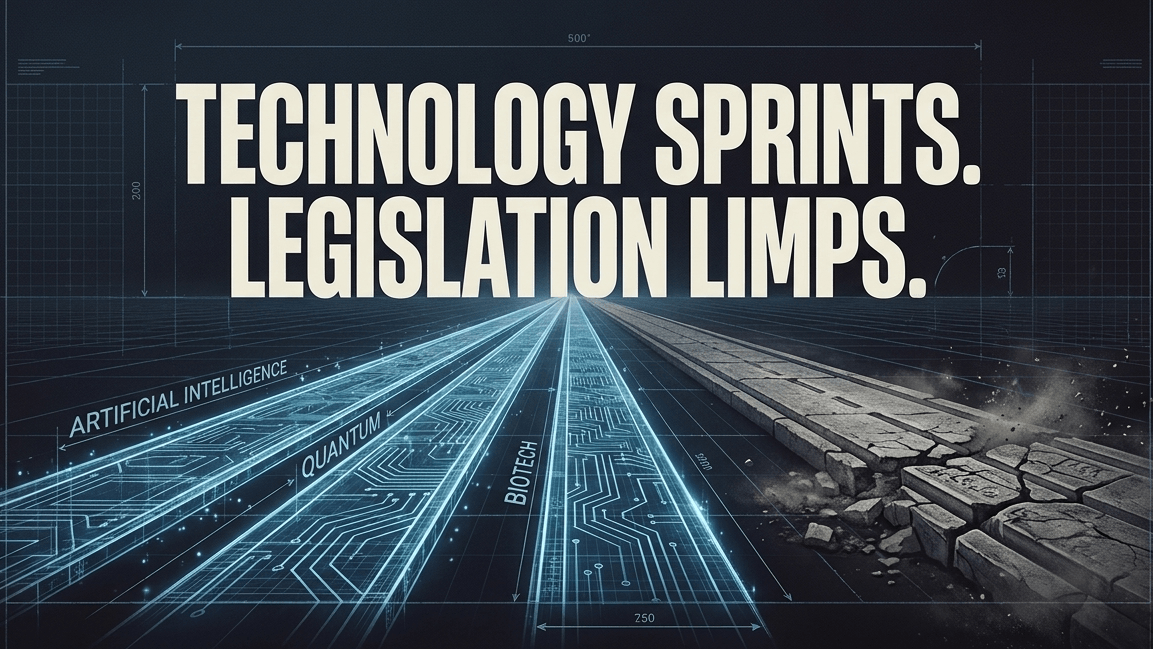
The role of SDOs is likely to expand rather than contract in the coming years. Emerging fields - artificial intelligence, quantum computing, carbon capture - require highly specific technical standards that in many cases don't yet exist in any codified form.
ANSI has already signaled where this is headed. Recent research the organization commissioned - conducted by Filippo Grillo and Justus Baron of Northwestern University's Center on Law, Business, and Economics - has examined how standardization contributes meaningfully to innovation in autonomous driving and advanced manufacturing, two sectors central to broader U.S. technology competitiveness. Government agencies are increasingly looking to ANSI-accredited bodies to build the regulatory scaffolding for these emerging technologies before formal legislation catches up - a pattern that suggests shadow law will keep expanding, moving from the physical world into digital and environmental domains alike.
To preserve public trust, SDOs will likely need to adopt further transparency measures voluntarily, rather than waiting to be forced into them by courts or legislatures. The 2023 ruling was something of a wake-up call for the industry, and the 2026 UpCodes decision made clear it wasn't a one-off: the private nature of these organizations offers no permanent shield against public demands for accessibility, and that principle is now being tested against commercial publishers, not just non-profits. The ongoing fight over the Pro Codes Act suggests the industry has heard that signal and is now trying to negotiate the terms of transparency on its own footing, rather than have them imposed by a third federal circuit. A plausible outcome is a hybrid model: development stays private, but documents become freely available - at least for reading, if not for redistribution - once legally incorporated.
Conclusion: the necessity of oversight in a delegated world
The private governance of public standards through ANSI and ASTM is a defining, if largely invisible, feature of the modern regulatory state. It represents a pragmatic compromise between the need for expert technical knowledge and the need for enforceable legal order.
But the transformation of these standards into shadow law demands ongoing scrutiny. The mechanisms of the NTTAA and IBR have produced an extraordinarily efficient system for regulating technical complexity. They have also produced a democratic deficit that hasn't gone away simply because courts in two different circuits have now ruled on the copyright access question.
Ensuring these standards are developed through genuine consensus, grounded in sound evidence, and made accessible to the people bound by them, is the only path to lasting legitimacy. As technology continues to outpace legislation, the quiet hands of ANSI and ASTM will remain among the primary drafters of the rules that keep the built world functional and safe. The challenge ahead is straightforward to state and hard to execute: governance can remain private, but accountability has to stay public.
Disclaimer: This article provides a technical and legal analysis of standards development processes and is intended for informational purposes only. It does not constitute legal advice.
Share now









Key takeaways
- ANSI and ASTM International are private non-profits, yet their technical standards are routinely incorporated into binding federal and state law.
- ANSI accredits roughly 235-240 Standards Developing Organizations (SDOs) and oversees more than 14,000 American National Standards currently in effect.
- ASTM maintains more than 12,800 active standards, drawn from over 30,000 volunteer members in 140+ countries.
- Incorporation by reference (IBR) is the legal mechanism that turns a privately written, copyrighted document into an enforceable public regulation.
- The National Technology Transfer and Advancement Act of 1995 (NTTAA) directs federal agencies to use private voluntary consensus standards instead of building government-unique alternatives.
- OMB Circular A-119 encourages federal agencies to participate directly in SDO committees, placing government experts alongside industry representatives during standards drafting.
- On September 12, 2023, the D.C. Circuit Court of Appeals ruled in ASTM v. Public.Resource.Org that non-commercial posting of standards incorporated by reference into law is fair use and not copyright infringement.
- That case had been in litigation for roughly a decade, including a prior D.C. Circuit reversal in 2018 that sent the dispute back for further fact-finding.
- The Pro Codes Act, introduced across multiple sessions of Congress, would let standards keep copyright protection after legal incorporation, provided they're posted for free public viewing online.
- Library associations, journalist groups, and disability rights organizations have formally opposed the Pro Codes Act, arguing it would restrict public access to the law.
- Critics point to rent-seeking risk: SDOs that get their standards written into law gain a captive market for their copyrighted publications.
- Small manufacturers and producers in developing economies often lack the resources to adopt complex ASTM/ANSI standards, reinforcing barriers to entry in regulated markets.
Sources
- American National Standards Institute (Wikipedia) https://en.wikipedia.org/wiki/American_National_Standards_Institute
- ASTM International - Standards enable regulation https://www.astm.org/news/standards-enable-regulation-ja10
- Husch Blackwell - D.C. Circuit Court Holds Non-Commercial Use of Industry Standards Incorporated into Law Is Fair Use https://www.huschblackwell.com/newsandinsights/dc-circuit-court-holds-non-commercial-use-of-industry-standards-incorporated-into-law-is-fair-use
- Congress.gov - Pro Codes Act, H.R. 4072, 119th Congress https://www.congress.gov/bill/119th-congress/house-bill/4072/text
- The Regulatory Review - Incorporation by Reference series https://www.theregreview.org/2015/01/26/series-incorporation-by-reference/
- Published 2026-08-05 12:55
- Modified 2026-08-05 12:55

-
Redaction


