

-
 Redaction
Tax increment financing: the $40 billion loophole
TIF was built to fix blighted neighborhoods. Now it funnels billions a year from schools and public services toward developers. Here's how the loophole works.
Beyond the visible layers of municipal governance - the city councils, the mayors, the public hearings - sits a sprawling, complex network of shadow budgets that shapes the physical and economic landscape of American cities. This network runs on a mechanism called tax increment financing, or TIF. Originally designed as a tool for reviving genuinely blighted areas, TIF has, according to a growing number of critics, evolved into a structural loophole that gives private developers outsized influence over public infrastructure decisions.
The scale of this financial architecture is significant. Well over 10,000 TIF districts now operate across the United States, and billions of dollars in property tax revenue get diverted away from general funds every single year. This is not a bookkeeping footnote. Critics describe it as a meaningful transfer of power - from elected bodies to developers, and from public services like schools and emergency responders to private-sector balance sheets. Supporters, meanwhile, argue it is one of the few tools cities have to fund development without raising taxes. Understanding how that transfer happens - and where the disagreement lies - means looking closely at the legal and financial engineering that makes TIF possible.
The mechanics of the base value freeze
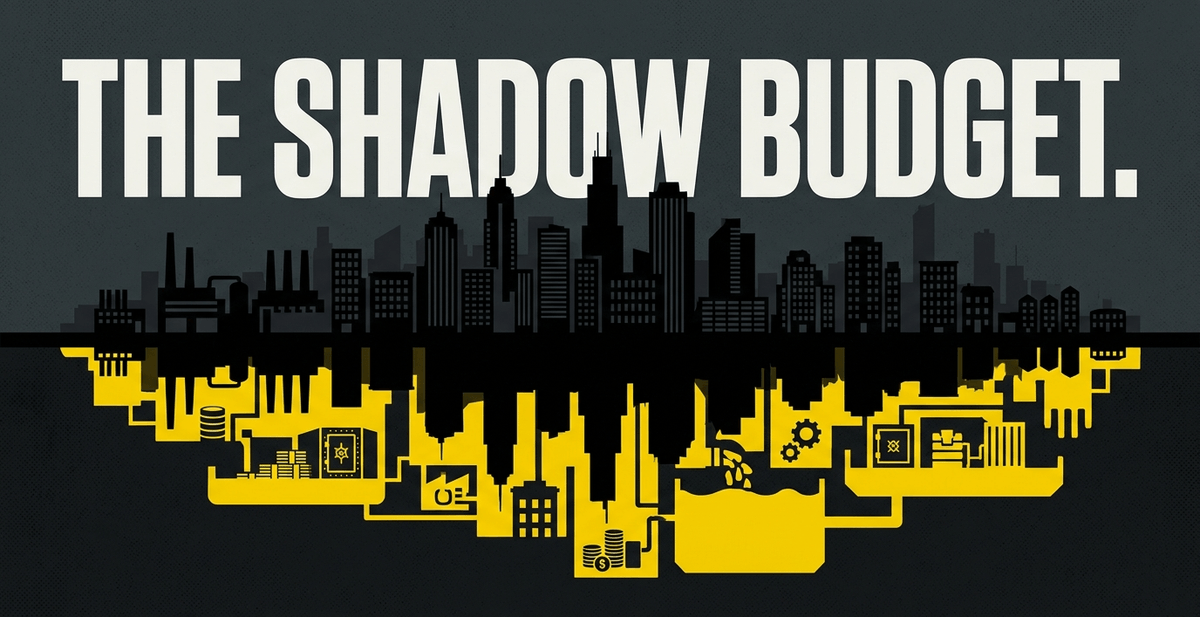
The fundamental premise of a TIF district is the base value freeze. When a municipality designates a TIF zone, current property tax revenue - the "base value" - is locked in for a period that typically runs 15 to 50 years, though 20 to 25 years is the more common statutory window. Any increase in property tax revenue generated within that district above the base value gets labeled the increment.
Instead of flowing into the city's general fund to pay for citywide services, that increment is captured and funneled into a dedicated TIF trust fund, earmarked exclusively for development costs inside that district. For the life of the district, the public treasury does not see the growth of its own tax base from that area, even as inflation and demand for city services keep climbing. Proponents describe this as a "cost-free" subsidy, since it draws on hypothetical future value rather than money currently in hand. Critics dispute that framing, arguing it functions more like a long-term claim on the city's future revenue - one that has to be paid by someone, whether through service cuts elsewhere or taxes on properties outside the district.

The but-for requirement and questions of accountability
Legal frameworks governing TIF usually hinge on the "but-for" requirement. This clause demands a municipal finding that private investment would not occur "but-for" the public financing the TIF provides. In theory, this stops cities from subsidizing projects that would have happened anyway. In practice, researchers and watchdog groups say the but-for test often functions as a rubber-stamp exercise: developers submit internal projections claiming a project is unfeasible without public aid, and municipalities - eager for any sign of growth - do not always have the expertise, staffing, or political will to challenge those assertions with independent audits.
A body of academic research - more than 30 studies by some counts - has examined whether TIF delivers on its stated goal of generating genuine economic development that would not have happened otherwise. Much of this research finds that it frequently does not: instead of creating new value, TIF districts often appear to relocate investment that was already headed for the region. Industry groups and some economists push back on this conclusion, noting that measuring a genuine counterfactual - what would have happened without the subsidy - is methodologically difficult, and that results vary considerably by city, project type, and era.
The scale of revenue diversion
The dollar figures involved are large, even if - as watchdog groups are quick to point out - exact national totals are hard to pin down, since public reporting on TIF is inconsistent from state to state. The most-cited estimate, from the TIF Illumination Project, a Chicago-based watchdog group, puts the annual diversion at over $40 billion a year removed from public services nationwide. That estimate has not been independently replicated at the national level, but it is widely cited in policy discussions about the scale of TIF activity.
Illinois offers a useful case study, if only because it is one of the few states where researchers have assembled a reasonably complete picture. Chicago is the epicenter of TIF activity in the state, and the numbers there are substantial. The cost to the Chicago city treasury in 2024 was reported at $1.59 billion. A separate accounting found that in a single recent year, roughly 127 TIF districts in the city removed $1.3 billion in property taxes from about one-third of all city properties. When a third of a city's property value is diverted into development funds tied to specific districts, the remaining two-thirds carries a larger share of the city's operational costs.
"TIFs are slush funds controlled by local city council members and mayors," writes Tom Tresser, who leads Chicago's TIF Illumination Project, describing a system he says is deliberately hard to monitor, track, and compare across jurisdictions.
It's worth noting Tresser is a longtime critic and advocate for TIF reform rather than a neutral party; city officials and TIF administrators generally reject the "slush fund" characterization and argue the funds are subject to statutory reporting requirements, even if those requirements are inconsistently enforced.
Smaller municipalities tell a similarly striking story. In Cicero, Illinois, a town with an annual budget of roughly $246.6 million, TIF districts have reportedly diverted around $326 million in property tax revenue between 1987 and 2023 - and public reporting on those districts has been sparse in recent years.
Authority delegation and private initiation
In some states, the power to create these districts has been extended directly to landowners. In Texas, property owners whose combined holdings account for at least 50 percent of a proposed zone's appraised value can petition to create a Tax Increment Reinvestment Zone, or TIRZ, without waiting on the city to act first. Texas currently has hundreds of these zones on the books, concentrated heavily in the Dallas-Fort Worth and Houston metro areas.
This delegation of authority represents a real shift in how public infrastructure gets planned. Roads, sewers, and drainage systems arrive less often through a centralized, citywide capital plan and more often as a patchwork of developer-initiated projects, each drawn around a specific parcel's boundaries. Supporters of this model argue it lets cities tap private capital and private initiative to build infrastructure that cash-strapped municipalities could not otherwise afford, shifting upfront risk onto developers rather than taxpayers. Critics counter that it lets developers effectively borrow against the city's own credit standing and tax-collection authority to build projects that serve their own interests first, with public benefit as a secondary effect rather than the starting point.
Worth noting: Texas law carves out a partial exception for public schools. Because school districts typically do not participate in TIRZ agreements, the state instead provides additional aid to offset a portion of what a district would have otherwise collected. That protection does not exist in most other states, which is part of why Illinois and similar jurisdictions have become flashpoints for school-funding fights.
The case for TIF
Before turning to the criticisms in more depth, it's worth laying out why TIF remains popular with city officials and developers alike, and why it has spread to nearly every state.
- Brownfield and blight redevelopment. TIF's original purpose was to make contaminated, vacant, or genuinely blighted sites viable for redevelopment when private capital would not otherwise touch them. Supporters point to numerous cleaned-up industrial sites and revitalized downtown cores as evidence the tool can work as designed.
- Attracting private capital without new taxes. Because TIF is funded by future tax growth rather than a new levy, officials can pursue development projects without asking voters to approve a tax increase - a politically important feature in places where tax hikes are difficult to pass.
- Financing infrastructure that might not otherwise get built. Advocates argue that in cities with limited bonding capacity or competing budget priorities, TIF is one of few practical mechanisms for financing roads, sewers, and utility upgrades tied to new development, particularly in areas the general fund would not otherwise prioritize.
- Competitive pressure between cities. In metro areas where neighboring municipalities compete for the same employers and developments, officials argue that unilaterally abandoning TIF would simply push investment across the city line, leaving their own city worse off without changing regional outcomes.
- Risk transfer to developers. Because developers typically front infrastructure costs and are reimbursed only if the anticipated tax increment materializes, supporters argue the model shifts some financial risk away from taxpayers and onto the private parties driving the project.
These arguments are not fringe positions - they represent the mainstream case made by economic development officials, bond counsel, and much of the real estate industry. The disagreement with critics is less about whether TIF can work in principle and more about how often it does in practice, and whether current oversight is strong enough to tell the difference.
Where the evidence complicates the case for TIF
Set against these arguments, independent research raises real questions about how often TIF delivers on its promises.
When a developer builds a road or a sewer line with TIF money, that infrastructure is technically public. But because the reimbursed funds are generally structured as a subsidy rather than a repayable loan, the money typically stays with the developer even if the property is later sold - which happens often. Critics argue this means the municipality pays for infrastructure that raises the property's value, while the developer captures that value twice: once through the TIF reimbursement itself, and again through a higher resale price. Defenders of the model respond that this is simply how public-private infrastructure financing works in general, and that the alternative - the city building and owning the infrastructure outright - would require more public borrowing, not less.
The market offset and geographical inequality
Supporters of TIF argue these districts generate a "halo effect" - growth that ripples outward and lifts the whole city. Independent research on this question is mixed but often skeptical: studies of Chicago's TIF districts, in particular, have found no measurable citywide boost to overall property value growth, and some have found that value growth inside a TIF district was offset by slower growth in neighboring, non-TIF areas.
Researchers call this the market offset phenomenon, and it cuts against part of the sales pitch for TIF. Rather than enlarging the economic pie, the theory goes, TIF may simply rearrange the slices - concentrating resources in a specific, often developer-influenced zone at the expense of neighborhoods just outside it. Over time, critics argue, that can produce a patchwork landscape: modernized TIF pockets alongside underinvested areas that never made the map. TIF proponents respond that market offset findings are city- and era-specific, and that well-designed districts in growing regions can and do show positive spillover effects.

The impact on public schools and essential services
One of the more consistent criticisms of TIF concerns its effect on public schools. Because school districts typically draw around 35 percent of their funding from local property taxes, the diversion of incremental tax revenue affects educational budgets directly. Once a TIF district is created, the school district's revenue from those properties is frozen for the life of the TIF - often 20 to 25 years, and in some states longer.
If development brings new families and new students into the area, the school district may need to educate more children while its tax base from that neighborhood stays flat. Critics say that mismatch creates a service-cost gap that has to be covered somehow - usually by raising taxes on homeowners outside the TIF district, or by cutting programs elsewhere. TIF supporters counter that new development also expands the tax base outside the frozen increment (through sales tax, income tax, and eventual reversion to the general fund once the district expires), and that framing TIF purely as a net loss to schools overstates the case in districts where the underlying growth would not have happened otherwise.

Public service gaps and the unfunded burden
Schools are not the only service potentially affected. TIF projects can increase demand for fire protection, police patrols, and sanitation services, and because the tax increment generated by that same development is earmarked for the TIF fund, the general fund does not automatically see new revenue to cover the added service load. Critics describe this as a structural mismatch: cities can end up with growing restricted TIF trust funds alongside constrained general-fund budgets for day-to-day services. Municipal finance officials note that some TIF agreements build in service-cost offsets or fee structures specifically to address this gap, though such provisions are not universal and their effectiveness varies by jurisdiction.
How TIF debt behaves differently than other municipal borrowing
There is a financial wrinkle to all of this that rarely makes it into public debate: TIF bonds are generally not treated the same way as ordinary municipal debt by the markets that buy them. Because repayment depends on future property value appreciation rather than an existing, reliable revenue stream, credit rating agencies typically rate TIF bonds one to two notches below comparable general obligation or revenue bonds issued by the same city. That translates into real borrowing costs - often more than a percentage point higher than what the city would pay on its standard debt.
This is not a purely theoretical concern. During the 2008-2009 downturn, TIF districts established in the years just before the crash saw actual tax collections fall short of projections in several major cities, leaving some funds struggling to cover debt service. That episode is frequently cited by critics as evidence that TIF debt carries more risk than city presentations sometimes convey, since when property values stagnate, it is often taxpayers - not developers - who end up absorbing the shortfall through the general fund or reduced services.
Navigating the future of municipal accountability
The proliferation of TIF districts has, by most accounts, outpaced the public's ability to monitor them. Because TIF funds are often managed by redevelopment authorities or semi-autonomous boards rather than directly by city councils, they can lack the transparency built into a standard budgetary process. Residents may not realize that a portion of their property taxes is being diverted to a private project blocks away until a local school district announces a budget shortfall.
Reforming the TIF model
Even researchers and officials who see value in TIF as a tool generally agree that oversight has not kept pace with its growth. Commonly proposed reforms include:
- Independent but-for audits. Municipalities could employ independent third-party analysts to verify a project genuinely cannot proceed without public funds, rather than relying solely on a developer's own projections.
- Duration caps. TIF diversions could be limited to 10 or 15 years rather than the 25-to-50-year windows common today, so the tax base returns to public hands sooner.
- School district protections. More states could follow Texas's partial model and either exempt school districts from TIF capture or guarantee them offsetting state aid.
- Clawback provisions. Agreements could carry performance benchmarks, so that if a developer misses job-creation or property-value targets, diverted funds return to the general fund.
- Public reporting standards. States could require standardized, annual, publicly searchable reporting for every active TIF district, replacing the patchwork of inconsistent disclosures that currently defines the system.
Weighing short-term growth against long-term flexibility
The appeal of off-budget financing is clear for local officials: it allows them to pursue major projects without asking voters for a direct tax increase, and in genuinely blighted areas it can unlock development that otherwise would not happen. But the tool's critics argue that its long-term costs - reduced flexibility for schools and public services, uneven geographic benefits, and weak independent oversight - are too often left out of the conversation when districts are created.
Whether TIF is functioning as intended in a given city is, in the end, an empirical question that depends heavily on local design choices: how rigorously the but-for test is applied, how long the district runs, and how transparently the funds are reported. Reformers on both sides of the debate generally agree on one point - that better data and independent oversight, whatever conclusions they lead to, would serve cities better than the current patchwork of inconsistent reporting.
For logged in users only
Share now









Key takeaways
- Well over 10,000 TIF districts currently operate across the United States.
- TIF diversions remove an estimated $40 billion a year from public treasuries nationwide, according to the TIF Illumination Project.
- TIF is legal in every U.S. state except Arizona.
- Chicago's TIF districts cost the city treasury $1.59 billion in 2024 alone.
- In a recent year, roughly 127 TIF districts in Chicago removed $1.3 billion in property taxes from about one-third of all city properties.
- The base value freeze locks in current property tax revenue for a TIF zone, typically for 20 to 25 years, though some run as long as 50.
- Public schools rely on property taxes for roughly 35 percent of their funding, making them especially exposed to TIF diversions.
- In Texas, property owners holding at least 50 percent of a proposed zone's appraised value can petition to create a Tax Increment Reinvestment Zone (TIRZ) themselves.
- Research spanning more than 30 academic studies has found TIF often fails to generate development that would not have happened anyway.
- Credit rating agencies typically rate TIF bonds one to two notches lower than comparable general obligation bonds from the same city.
- TIF-funded subsidies to developers are typically structured as a cash gift, not a loan - meaning the money stays with the developer even after a property sale.
- Studies of Chicago TIFs found no citywide boost to property values; growth inside TIF zones was often offset by decline in neighboring non-TIF areas.
Sources
- Shelterforce https://shelterforce.org/2026/03/17/tax-increment-financing-harms-cities-lets-rein-it-in/
- Good Jobs First https://goodjobsfirst.org/tax-increment-financing/
- Federal Highway Administration (FHWA) https://www.fhwa.dot.gov/ipd/fact_sheets/value_cap_tax_increment_financing.aspx
- Texas Comptroller of Public Accounts https://comptroller.texas.gov/economy/development/prop-tax/ch311/about-tirz.php
- Lincoln Institute of Land Policy https://www.lincolninst.edu/pt-br/publications/articles/why-tax-increment-financing-often-fails-how-communities-can-do-better/
- Published 2026-07-24 12:37
- Modified 2026-07-24 14:48

-
Redaction