


-
 PRO
PRO -
 Redaction
The Ceuta lever: how Morocco leans on Spain
From the 1975 Green March to the 2026 Ceuta crossings, Morocco has used migration as leverage against Spain, now backed by new alliances with Israel and the US.
In late July 2026, a sustained wave of border breaches carried an estimated 60,000 people from Morocco into the Spanish enclave of Ceuta, the large majority young Moroccan men rather than the "women, children, and the elderly" that some early framing suggested. Confirmed deaths reached 72 by August 2, according to Spanish authorities, with Ceuta's regional government having separately cited a toll as high as 86 in the earlier, more chaotic days of the crisis; identification work was ongoing as this piece went to press, and officials cautioned the count could climb further. By August 1, Spanish authorities said the overwhelming majority of arrivals had already returned to Morocco, most of them voluntarily.
This is not, this outlet argues, principally a story about desperate migration. It is a story about leverage - about how a mid-sized North African monarchy with a fifty-year track record of using population movement as a diplomatic instrument has, in 2026, acquired a denser web of patrons, weapons suppliers, and territorial claims than at any point since the original 1975 Green March.
Four structural facts anchor this analysis:
- The precedent is exact. In November 1975, King Hassan II sent 350,000 unarmed Moroccan civilians across the Spanish Sahara border in the Green March. The UN Security Council's Resolution 380 condemned the march and demanded withdrawal - and was ignored, because no UN force was prepared to use lethal force against unarmed civilians for reasons of image and humanitarian law. Fifty-one years later, the same asymmetry - civilians as instruments, blue helmets as a non-option - still functions as designed.
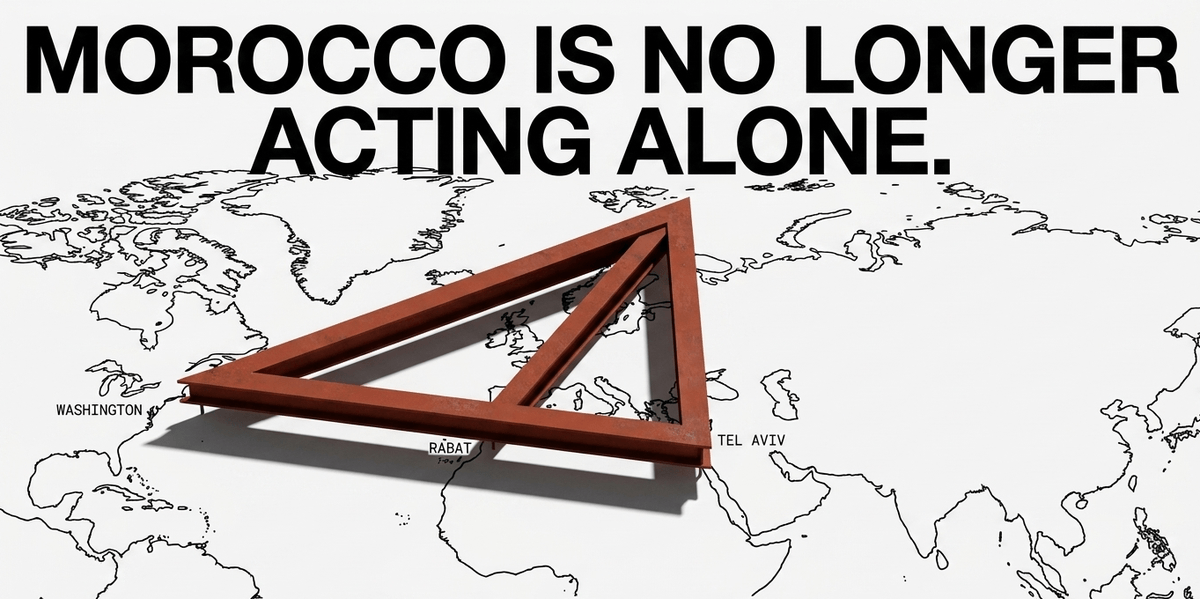
- Morocco is no longer acting alone. Rabat's alignment with Israel and with Washington has converted a bilateral Spanish-Moroccan migration dispute into a three-cornered arrangement in which Madrid's traditional counter-pressure - EU leverage, diplomatic isolation, economic conditionality - has fewer places left to land.
- The territorial question has re-opened in Washington, not Rabat. In April 2026, a House Appropriations Committee report described Ceuta and Melilla as being "located in Moroccan territory" - the first time a US legislative body has cast that judgment in writing. That language survived into law: the underlying appropriations bill passed the House on July 15 by a 217-209 vote. It was not Secretary of State Marco Rubio who authored the enclave language, as some accounts have suggested, but Representative Mario Díaz-Balart, one of Rubio's closest congressional allies and chair of the subcommittee that funds the State Department. The distinction matters and is treated carefully below - but the direction of travel is the same regardless of which office first put it in writing.
- Spain's own courts widened the crack the crossers walked through. On June 29, 2026, Spain's Supreme Court ruled that migrants intercepted swimming toward Ceuta or Melilla - as distinct from those who scale the land fence - cannot be summarily returned under the "hot rejection" provision Spanish law otherwise permits at fortified crossing points. Spanish officials would later argue that smuggling networks deliberately misrepresented this ruling on social media, telling would-be crossers that reaching Ceuta by sea guaranteed they could not be sent back. Whatever the precise causal weight of that claim, the ruling's timing - published July 8, with the mass crossing beginning in earnest twelve days later - is not incidental to what follows.
None of this proves that the King of Morocco personally ordered the July crossings as a coordinated instrument of policy, and no public evidence available to this outlet establishes direct operational control over crowd movements at Fnideq and Tarajal in the way it can be established for, say, the 2021 crisis, which Rabat's own officials openly linked at the time to a diplomatic dispute over the Polisario Front's leader. What the evidence does establish, cleanly, is the incentive structure Morocco now operates inside - and the fact that the mechanism deployed in 2026 is functionally identical to the one deployed in 1975, 2021, 2022, and 2024, each time correlated with a specific bilateral grievance.
Part I: The mechanism - fifty years of the same lever
1975: the original design
The Green March was not a metaphor. In November 1975, as Spain prepared to withdraw from its Saharan colony, Hassan II organized 350,000 Moroccan civilians to walk across the border carrying flags and Qurans, unarmed, under military coordination. The UN Security Council responded within days - Resolution 380, adopted November 6, 1975, "deplored" the march and demanded Morocco withdraw all participants "immediately." Morocco did not withdraw. No enforcement followed.
The reason given by diplomats at the time, and echoed in retrospective analysis since, was straightforward: deploying force against a column of unarmed men, women, and children carrying religious symbols was not a politically survivable option for any UN-mandated force, regardless of the underlying legal merits. Spain ceded administrative control of Western Sahara within weeks. Morocco has held the bulk of the territory ever since.
The mechanism that made the Green March effective was not the number of participants. It was the asymmetry of response options it created: a state actor could mobilize population movement as an instrument of territorial pressure, and the international system's only available counter-instrument - coercive force - was foreclosed by the humanitarian optics of the very population being mobilized. That asymmetry has not been designed away in the fifty-one years since. If anything, the growth of real-time video documentation of border crossings has sharpened it, since footage of security forces confronting unarmed crowds now travels globally within hours.
2021, 2022, 2024, 2025: the pattern repeats
The pattern recurred with mechanical regularity whenever a bilateral dispute with Spain reached a certain threshold, and it has repeated often enough by 2026 that treating each instance as a discrete, unrelated event has become harder to sustain than treating them as one continuous instrument, used at intervals.
In May 2021, after Madrid allowed the ailing leader of the Polisario Front, Brahim Ghali, to receive COVID-19 hospital treatment in a Spanish hospital under a false identity, Moroccan border guards visibly stood aside as roughly 8,000 to 9,000 people crossed into Ceuta over a matter of days - the largest single crossing wave in the enclave's modern history at that point, and, until this summer, the record it held. Moroccan officials did not seriously dispute at the time that the loosening of border enforcement was a response to the Ghali episode; it was widely reported as such in the Spanish and Moroccan press alike. Spain's response then was the pushback mechanism that its own Supreme Court would later, in a separate ruling concerning minors from that same crisis, find had been applied unlawfully to unaccompanied children.
In June 2022, a crossing attempt at Melilla - not directly linked to a fresh diplomatic dispute, but occurring after a broader normalization of relations - ended in the deaths of at least 23 migrants and asylum seekers in a crush at the border fence, with Moroccan human rights groups placing the toll considerably higher, an event Amnesty International and other observers later described as the deadliest incident of its kind in the fence's history.
In September 2024, Moroccan authorities deployed a large security operation, including riot police, to prevent a coordinated mass crossing that had been organized via social media calls urging thousands of young people to gather near the border. It was a preventive rather than facilitative posture, and it illustrates the other half of the mechanism: Rabat's control over the crossing rate is bidirectional. It can be loosened or tightened at will, which is itself the clearest evidence that what happens at the Ceuta and Melilla fences is a function of policy choice rather than an uncontrollable natural flow. A smaller, less-remarked episode followed in July 2025, when at least 54 unaccompanied minors and roughly 30 adults reached Ceuta by swimming - a scale modest enough to draw little international attention, but a reminder that the sea route the 2026 crisis would exploit at industrial scale had already been tested and mapped a year earlier.
July-August 2026: what actually happened
The most recent episode began in earnest around July 20, 2026. Between July 20 and 29, Ceuta's local government recorded roughly 1,500 to 2,000 people entering the city - an abnormally high figure for such a short window, but still, by the standards of what followed, a preamble. Al Jazeera reported at least 18 confirmed deaths on July 30 alone, in scenes local Civil Guard representatives described at the time as a "serious humanitarian crisis."
The real break came on July 30 and 31. Crowds breached the frontier en masse, many swimming around the Tarajal and Benzú breakwaters, others crossing on foot along the shoreline as fog and darkness covered the attempt; there were violent clashes in Fnideq, on the Moroccan side of the crossing, as the crowds gathered and pressed forward. Spain's Interior Ministry said roughly 50,000 people crossed from Morocco to Ceuta in the space of about 24 hours; Ceuta's regional president, Juan Jesús Vivas, put the number as high as 60,000 over the following couple of days - against a resident population of roughly 84,000. Local officials said the city's reception system was overwhelmed almost immediately, and Vivas requested that Madrid declare a national emergency, a request the Interior Ministry initially declined, before deploying Army units already stationed in Ceuta to provide logistical and surveillance support to the Guardia Civil.
The death toll rose in stages as the days went on: 18 on July 30, 57 by the following evening, 67 by August 1, and 72 by August 2, with five additional bodies recovered along the coastline that weekend and Spanish authorities cautioning the figure could still climb as identification work continued. Most of the dead drowned attempting the swim around the breakwater or were crushed in the stampede to scale the fence itself. As one Ceuta resident, Karima Abenaz, put it to reporters in the days after: "It pains me deeply that young people are dying at sea. It's not right that, in the year 2026, women with children as young as two months old should be crossing the sea only to die."
"We are relentless against those who break the law," Spain's interior minister, Fernando Grande-Marlaska, told journalists as the last stragglers were escorted back across the border on August 1. Asked directly whether Morocco bore responsibility for the breach given the security presence on both sides, he was notably careful in his answer, saying only that "the events require an evaluation by Spain and Morocco."
Twenty-two EU member states issued a joint call for an emergency response, requesting that the bloc's Irish presidency convene an urgent videoconference of interior ministers. European Commission President Ursula von der Leyen described the images from Ceuta as "unacceptable," tasked Home Affairs Commissioner Magnus Brunner and Mediterranean Commissioner Dubravka Šuica with coordinating support, and called for dangerous crossings to stop, smuggling networks to be dismantled, and returns to proceed swiftly within the bounds of EU law. French President Emmanuel Macron offered solidarity and Frontex assistance while also announcing tightened French border checks with Spain; his interior minister, Laurent Nunez, ordered the reinforced controls directly. Italy went further, formally suspending passport-free Schengen travel arrangements with Spain for thirty days - meaning targeted checks on air and sea arrivals from Spain, a measure Spanish Prime Minister Pedro Sánchez, who traveled to Ceuta on July 31 and called the crossing "a violation of Spain's territorial sovereignty," later described as part of a "selfish, polarising and unlawful" reaction from parts of the EU.
By the following weekend, Civil Guard engineers had begun installing a 500-meter floating containment barrier at the Tarajal breakwater, the stretch of coastline most heavily used during the crossing - a materially significant step, since routine border policing in Ceuta is ordinarily a Guardia Civil and National Police function, and the use of active-duty military logistics signals that Madrid assessed the crossing as exceeding standard-model contingency planning.
The demographic composition matters for the analysis that follows. Multiple wire services describe the July-August crossers as predominantly young Moroccan men - not, as some early framing suggested, primarily women, children, and elderly refugees fleeing conflict. A small number of women, unaccompanied minors, and Algerian nationals previously resident in Morocco were also identified among the arrivals. Interviews conducted by the Associated Press with several of those who crossed and later returned point in the same direction: 21-year-old Abdulah Buji, from Tetouan, told reporters he had come hoping for work rather than fleeing danger - "there's nothing at home. I'd have to work 12-hour shifts for a meager wage. That's why I came here" - a motive consistent with an economically driven, opportunistically triggered surge rather than a conflict-displacement event. That framing distinction is not incidental. A crossing composed largely of working-age men from a country not experiencing war or famine is a materially different phenomenon, evidentially, from a refugee flow - and it is far more consistent with a population responding to an organized signal, whether social media mobilization, loosened enforcement, misreadings of the Supreme Court ruling, or some combination of the three, than with a spontaneous humanitarian exodus.
Part II: The alliance architecture behind the lever
Israel: from normalization to co-production
Morocco and Israel restored diplomatic relations in December 2020 under the Abraham Accords, the same agreement in which the first Trump administration formally recognized Moroccan sovereignty over Western Sahara - a linkage that was not incidental but the explicit price of Rabat's normalization. What began as diplomatic recognition has, over the subsequent five years, matured into defense-industrial integration.
In November 2025, an Israel Aerospace Industries subsidiary, BlueBird Aero Systems, inaugurated a production facility in Benslimane, on the outskirts of Casablanca - the first factory of its kind for Israeli-designed loitering munitions anywhere in North Africa or the Middle East outside Israel itself. The system in question, the SpyX, is a man-portable munition with a 50-kilometer operational radius, up to roughly 90 minutes of loiter time, a top speed exceeding 250 kilometers per hour, and a 2.5-kilogram warhead capable of striking armored vehicles and troop concentrations. A Moroccan technical team trained at BlueBird's Israeli facilities ahead of the production launch, part of a broader technology-transfer arrangement to let Moroccan engineers assemble and maintain the systems locally. The factory sits inside a wider pattern of Israeli procurement that includes a roughly $1 billion IAI contract for two Ofek-13 reconnaissance satellites, Barak MX air defense systems, and Elbit Systems' Atmos 2000 self-propelled artillery - a defense relationship that has, by 2025, made Israel one of Rabat's principal suppliers rather than a peripheral one.
The defense relationship deepened again in the spring of 2026. At the 13th African Land Forces Summit in Rome in late March, Gen. Christopher Donahue, commander of US Army Europe and Africa, told an audience of roughly 300 participants from 47 countries that the United States planned a permanent regional drone-training hub in Morocco - describing it as "a sustainable, enduring capability" rather than a one-off exercise add-on. A pilot drone-training module ran during the African Lion 2026 exercise that spring, and on July 13, 2026, at AFRICOM headquarters in Stuttgart, Gen. Mohammed Berrid of the Royal Moroccan Armed Forces and AFRICOM commander Gen. Dagvin Anderson signed a memorandum of understanding formally establishing the Africa Multidomain Training and Experimentation Center - AMTEC - to be built at Tan-Tan, in southwestern Morocco, and opened by 2030. The facility is designed around three components: a multidomain training area able to operate across the full electromagnetic spectrum, a drone academy for operators and instructors from Morocco and partner nations across the continent, and an innovation and experimentation center intended to move low-cost, scalable counterterrorism technology from prototype to fielded capability faster than existing arrangements allow. That drone-training push sits inside a larger bilateral shift: on April 16, 2026, Morocco and the United States signed a ten-year Roadmap for Defense Cooperation at the Pentagon, concluded between Under Secretary of Defense for Policy Elbridge Colby and a Moroccan delegation, setting goals for interoperability and joint planning through 2036. Morocco's own 2026 defense budget, at $15.7 billion, funds a parallel package of tax exemptions and investment incentives designed to attract international manufacturers into precisely this ecosystem.
None of this defense-industrial integration is evidence, on its own, that Israel had any operational role in the July 2026 Ceuta crossings - no source reviewed for this piece makes that claim, and this outlet does not either. What it establishes is something narrower but still structurally important: Morocco's strategic value to Israel and to Washington as a defense-industrial and training partner has risen sharply across 2025 and 2026, which raises the political cost, for both, of any daylight opening with Rabat over unrelated disputes - including disputes Morocco has with third countries like Spain.
The Netanyahu-Sánchez rupture and its timing
On April 10, 2026, Netanyahu ordered Spanish representatives expelled from the Civil-Military Coordination Center in Kiryat Gat - the US-led facility, operating under US Central Command, established in October 2025 to oversee the Gaza ceasefire and coordinate humanitarian and security assistance. The trigger was Spain's criticism of Israeli strikes in Lebanon, layered onto two years of accumulating friction. Netanyahu's language was unambiguous:
"Spain has defamed our heroes, the soldiers of the IDF, the soldiers of the most moral army in the world... Therefore, I have instructed today to remove Spain's representatives from the coordination center in Kiryat Gat, after Spain has chosen repeatedly to stand against Israel."
Foreign Minister Gideon Sa'ar characterized the decision as a response to what he called Spain's "obsessive anti-Israel bias" under Sánchez and the "serious harm to the interests of Israel - and also the United States" - during the Iran war specifically, adding that the move had been carried out in coordination with Washington. The rupture had been building for two years: Spain recognized a Palestinian state in 2024, both countries had withdrawn ambassadors, and Sánchez had publicly opposed the US-Israeli military campaign against Iran that ran from late February to early April 2026, in addition to condemning the Lebanon strikes and calling on the EU to suspend its Association Agreement with Israel.
The claim that this rupture establishes a direct, operational Israeli hand in encouraging the Ceuta crossings is not supportable from the public record, and this outlet does not adopt it. What the record does support is a narrower and still consequential point: by April 2026, Israel had an active, stated grievance against the Sánchez government, a demonstrated willingness to act on that grievance through formal diplomatic exclusion coordinated with Washington, and a defense-industrial relationship with Morocco substantial enough that Rabat had every reason to avoid daylight with Tel Aviv over its own separate dispute with Madrid. Whether that reason translated into any coordination is not established by available evidence - but the incentive alignment is real, documented, and worth naming precisely because it is not proof.
Washington: the highway, the ammonia grant, and the territorial reopening
The clearest, best-documented leg of the alliance triangle is the US-Morocco relationship, and it deepened on multiple, independent tracks through the first eight months of 2026.
The highway. In late July, Morocco confirmed it would name its $1 billion, 1,055-kilometer Tiznit-Dakhla expressway - completed in January 2026 after roughly a decade of construction, and running through the heart of Moroccan-administered Western Sahara before linking the territory toward Mauritania - the "Donald J. Trump Highway." Trump's initial announcement came via a Truth Social video on July 26 whose provenance drew some scrutiny - fact-checkers noted the narration had the hallmarks of AI generation and that Rabat had not yet confirmed the naming - but the ambiguity was short-lived: King Mohammed VI's own letter, dated July 2 and reported by the state news agency MAP, confirmed the decision directly, tying the gesture explicitly to Trump's 2020 recognition of Moroccan sovereignty over the territory and describing it as a decision that would "forever be etched in the memory of Moroccans." Trump responded by thanking "Highly Respected Mohammed VI" and saying he looked forward to "traveling the entire length of this Great Highway someday." The gesture is symbolic, but symbolism of this kind - naming disputed-territory infrastructure after a sitting US president, on a road that will also serve as the corridor for the Dakhla Atlantic Port project once complete - functions as a public loyalty signal between the two governments, not a private one.
The green ammonia grant. Within days of the highway announcement, on July 28, the US Trade and Development Agency signed a $5.7 million grant with ORNX, an international consortium combining the US firm Ortus Climate Mitigation with the Spanish-German joint venture Acciona-Nordex Green Hydrogen, to fund front-end engineering studies for a proposed $4.5 billion green ammonia facility in Laayoune, inside Western Sahara. It is worth being precise about what this figure represents, since it is frequently conflated: the $4.5 billion is the total projected cost of the private-sector facility, not US federal expenditure; the USTDA grant itself covers only the feasibility and engineering study phase, to be led by the US firm KBR alongside GE Vernova, Electric Hydrogen, and Terabase. Even so, US officials have been explicit about the political framing behind even a modest federal disbursement - Deputy Secretary of State Christopher Landau has said publicly that Washington's recognition of Moroccan sovereignty over the Sahara underpins the administration's push to encourage American investment in the territory's southern provinces. It is, by USTDA's own characterization, the first US federal financial backing for any private investment inside the disputed territory, and the agency signed it in a ceremony in Laayoune itself, attended by the US Ambassador to Morocco.
The Ceuta and Melilla reopening. The most consequential and most frequently mischaracterized development is the reopening of the Ceuta and Melilla sovereignty question inside US institutions. In late April 2026, language embedded in a House Appropriations Committee report - authored under the direction of Representative Mario Díaz-Balart, vice-chair of Appropriations and chair of the subcommittee that funds the State Department - stated that the committee "notes that the Spanish-administered cities of Ceuta and Melilla are located in Moroccan territory and remain the subject of Morocco's longstanding claim," and declared support for the Secretary of State's efforts "to encourage diplomatic engagement between Morocco and Spain on the future status of Ceuta and Melilla." The same report directed at least $20 million toward National Security Investment Programs and a further $20 million in Foreign Military Financing for Morocco specifically.
It is necessary to correct a specific inaccuracy here, because precision on attribution is the difference between analysis and rumor: this language originated with Díaz-Balart's committee, not with a personal statement by Secretary Rubio, and it appears in the report accompanying the appropriations bill rather than in the legislative text itself. The Congressional Research Service has noted more broadly that appropriations report language of this kind is generally not legally binding in the way statutory text is, though federal agencies do treat it as a serious expression of congressional intent - a distinction that matters for assessing what, exactly, the House did and did not do. Díaz-Balart is, however, widely described as one of Rubio's closest congressional allies, and in an April 1 interview with the Spanish newspaper El Español, Díaz-Balart went further than the committee text, stating directly that Ceuta and Melilla are "not in the geographic territory of Spain" but "in the territory of Morocco," and that their status should be "established, negotiated, and discussed between friends and allies."
The report language did not stay confined to committee paperwork. The underlying bill, H.R. 8595 - the National Security, Department of State, and Related Programs Appropriations Act, 2027 - passed the full House of Representatives on July 15, 2026, by a vote of 217-209, with Republicans supporting it 215-1 and most Democrats opposed. Kentucky Republican Thomas Massie, the sole GOP member to vote against the legislation, cited the Ceuta and Melilla language directly in explaining his no vote weeks later, once the crisis had broken, arguing that colleagues expressing outrage over the July border crisis had, weeks earlier, quietly endorsed report language sympathetic to Morocco's territorial claim over the same cities. "Two weeks ago the House passed a bill that greenlighted the transfer of Spanish territory to Morocco," Massie wrote on X on August 1. "Every Republican except me voted for it, but now THEY are acting shocked at the invasion." That characterization overstates the provision's legal force - the report language "supports" diplomatic engagement rather than authorizing any transfer of sovereignty, and the bill's operative text contains no reference to Morocco, Spain, Ceuta, or Melilla at all - but the underlying point about the sequence of events survives the correction: House Republicans did, in fact, approve a bill accompanied by language endorsing US-backed talks over the enclaves' status two weeks before images of the crossing dominated the same party's messaging about border security. The episode illustrates how quickly language that began as committee-report framing can migrate into a recorded floor vote and a documented point of intra-party dispute.
The committee report also followed weeks of escalating commentary from Michael Rubin of the American Enterprise Institute, published through the Middle East Forum, which first called on Trump and Rubio to formally recognize the enclaves as occupied Moroccan territory - dismissing Madrid's sovereignty claims with the line "neither maps nor history lie" - and then, days later, explicitly urged Morocco to organize a second Green March, invoking the 1975 precedent directly and arguing that neither enclave falls within NATO's Article 6 mutual-defense geography, since that clause excludes territory south of the Tropic of Cancer.
Whether the Díaz-Balart committee language and the Rubin commentary reflect a coordinated policy shift inside the Trump administration, or a congressional faction running ahead of the executive branch, is not resolvable from the public record as of this writing. Spain's government has treated the enclaves' status as entirely non-negotiable in every public statement reviewed for this piece, and no equivalent statement from Rubio himself, endorsing the "occupied territory" framing, appears in the sourcing available to this outlet. But the sequence - AEI commentary, congressional interview, committee report language, floor vote - establishes that the idea has moved from fringe commentary to institutional text and a recorded vote inside the branch of the US government that funds American diplomacy, and it did so in the same weeks that Spain's airspace closure to US-Israeli military transit during the Iran war was straining the broader relationship.
Part III: What the two crises share - and what they don't
The airspace closure and the Iran-war backdrop
Spain's confrontations with Washington and Tel Aviv in 2026 were not confined to Gaza commentary. During the US-Israeli air campaign against Iran that ran from late February to early April 2026, Spain blocked military aircraft supporting the operation from transiting its airspace - a decision Defense Minister Margarita Robles framed publicly as a stance against what Madrid considered an "illegal and unjust war" - and Moroccan press coverage of the Díaz-Balart remarks explicitly cited this closure as part of the backdrop to Washington's hardening position on the enclaves. The sequence matters: airspace closure during the Iran war, CMCC expulsion in April, committee report language questioning Ceuta and Melilla's status that same month, a House floor vote on the underlying bill in July, and the Ceuta crossing wave at the end of that month - friction points across roughly five months, each independently documented, each involving a different arm of the same loosely aligned bloc.
The Musk dispute: a separate track worth noting briefly
One more Spanish confrontation belongs in this picture, though only briefly: the fight with Elon Musk over social media regulation. On February 3, 2026, Sánchez proposed criminal liability for executives who fail to remove illegal content, an under-16 access ban, and prosecutorial coordination against Grok, TikTok, and Instagram - naming Musk directly and linking him to criticism of Spain's migrant regularization program. Musk responded by calling Sánchez "the true fascist totalitarian" and, in cruder terms, "a tyrant and traitor to the people of Spain."
The regularization program at the center of that exchange proved far larger than projected: opened in April under Royal Decree 316/2026 with an estimated 500,000 eligible applicants, it drew 1,174,978 applications by the June 30 close - Colombians the largest group at 26 percent, ahead of Moroccans at 13.3 percent - a spread that complicates any simple story of Morocco as the program's principal driver, even as EU leaders would later cite it that way.
This dispute runs on its own logic - labor-market politics and platform regulation, not Moroccan leverage - and folding it into the Ceuta narrative as evidence of one coordinated campaign overstates the sourcing. What is fair to say is narrower: Sánchez's government has, by mid-2026, accumulated an unusually dense cluster of adversaries with independent reasons to want Madrid weakened, and Morocco's border policy operates in the political environment those other pressures have helped create, not necessarily in coordination with them. EPP leader Manfred Weber made a version of this same link publicly, describing the crisis as "the direct consequence of the pull factor of massive regularisation doubled with instrumentalisation of illegal migration" - treating the regularization fight and the Moroccan-leverage question as two faces of one failure, even where the underlying causal chains differ.
Part IV: The migration pact mechanism and what comes next
Why the EU's own law now works against Madrid's flexibility
Under the EU's evolving migration and asylum framework, once a person sets foot on Spanish territory - including Ceuta or Melilla - the state incurs a formal obligation to initiate a legal procedure: registering the individual, verifying identity, assessing any asylum claim, and only then proceeding, potentially, toward return. This is a meaningfully higher bar than the pre-pact practice of expedited pushback, and it now interacts directly with the June 29 Supreme Court ruling described above: sea-crossers cannot be summarily rejected the way fence-climbers can, which means any large, compressed maritime crossing wave carries a materially higher administrative and legal cost per capita than the same wave would have carried five years ago. Whether the processing of tens of thousands of returns in the days following the July peak was fully compliant with the individual-assessment requirement, or relied instead on expedited procedures of contested legality under Spanish and EU law, is disputed and outside the scope of what this outlet can verify from the sources available. Spanish officials characterized the roughly 48,000 to 50,000 returns tallied by early August as substantially voluntary, which if accurate would place much of the episode outside the formal-procedure question entirely - though independent verification of that characterization has not yet caught up with the pace of events, and von der Leyen's own public statement calling for "swift" returns "as our rules allow" implicitly acknowledged the tension between speed and process that the June ruling created.
What is clear is that if population movement is being used as leverage, the leverage has, mechanically, gotten more expensive to absorb - a fact that cuts in an unusual direction, since it means Morocco's traditional lever now imposes a cost on Spain that is partly of Spain's own judiciary's making, independent of anything Rabat does or does not do.
The European People's Party response
Within days of the crossing, Manfred Weber - the German MEP who has led the European People's Party since 2022 and was re-elected to a second term in April 2025 - called publicly for the EU to accelerate implementation of the bloc's Migration Pact and to further strengthen Frontex, the EU's border agency, whose budget has grown roughly eightfold over the past decade, from €143 million in 2015 to €1.1 billion in 2025. Weber went further than earlier EPP statements on migration, arguing that if "a left-wing government in Spain is not willing to secure the external border, then Frontex must also be given command authority" - a call for the agency to acquire operational powers over a national border that would represent a substantial escalation of Frontex's existing mandate, and one directed pointedly at Sánchez's coalition rather than at Morocco. Weber's intervention is significant less for its specific content, which tracks language the EPP has used for over a year, than for its timing and target: it converts a crisis explicitly framed by Rabat's critics as Moroccan leverage into a lever of its own for further EU border militarization and a more direct rebuke of Madrid's governing coalition - a dynamic that has already been building for over a decade and that the Ceuta episode is likely to accelerate rather than originate.
What survives scrutiny
Stripped of the unverifiable numbers and the most speculative causal claims, the structural picture that survives scrutiny is this. Morocco has, since 1975, repeatedly demonstrated the capacity to modulate the rate of irregular crossings into Ceuta and Melilla in apparent correlation with the state of its bilateral relationship with Madrid. In 2026, that capacity sits inside the strongest position Morocco has occupied in fifty-one years - a maturing defense-industrial partnership with Israel, a ten-year defense roadmap and a permanent training hub under construction with the United States, a US administration that has named infrastructure after its own president and funded the first American investment inside the disputed Western Sahara territory, and a congressional faction that has moved from floating the idea that Ceuta and Melilla belong to Morocco to embedding it in report language attached to a bill that passed the House floor.
Spain, meanwhile, is managing a rupture with Israel over Gaza and Lebanon, a domestic firestorm over migrant regularization that has already run past its own projections by more than double, and a Supreme Court ruling that has narrowed its own room to maneuver on returns - fronts that, whether by design or by coincidence of timing, leave Madrid with less diplomatic bandwidth and less legal flexibility to respond forcefully to a border crisis than at any point since 1975.
Whether Rabat calibrated the July crossings deliberately against this backdrop is not something this outlet can establish with the sourcing available. What can be established is that if it did, the backdrop it calibrated against has never, in fifty-one years, been more favorable to it. If the mechanism described here proves durable, the events of July 2026 may ultimately be remembered less as a migration crisis than as the moment Europe rediscovered that borders can be pressured without a single army crossing them.
Share now









Key takeaways
- The July-August 2026 Ceuta crossing reached an estimated 60,000 people at its peak on July 30-31, according to Spain's Interior Ministry and Ceuta's regional president - a sharp escalation from the roughly 1,500-2,000 who had entered over the preceding ten days.
- Confirmed deaths stood at 72 by August 2, per Spanish authorities, up from 67 the previous day, with five additional bodies recovered along the coastline and identification work ongoing; Ceuta's local government had separately cited a toll as high as 86 during the crisis.
- The demographic makeup was predominantly young Moroccan men, not primarily women, children, and the elderly, contradicting some early framing of the crisis - though a small number of women, unaccompanied minors, and Algerian nationals were also identified among the arrivals.
- By early August, an estimated 48,000-50,000 people had already returned to Morocco, Spanish authorities said, the overwhelming majority voluntarily rather than through formal deportation.
- Spain's Supreme Court ruled on June 29, 2026 that migrants intercepted while swimming toward Ceuta or Melilla - unlike those who scale the land fence - cannot be summarily returned under Spain's "hot rejection" border law; officials said smuggling networks misrepresented this ruling to encourage the sea crossings.
- The 1975 Green March precedent is exact and well-documented: 350,000 unarmed Moroccan civilians crossed into Western Sahara under state coordination; UN Security Council Resolution 380 demanded withdrawal and was ignored, because no enforcement mechanism could act against unarmed civilians without unacceptable humanitarian and reputational cost.
- Morocco-Israel defense integration is real and accelerating: a BlueBird Aero Systems (IAI subsidiary) SpyX loitering-munition factory in Benslimane, inaugurated in November 2025, and a formal AFRICOM drone-training hub (AMTEC, signed July 13, 2026, to open at Tan-Tan by 2030) - but no evidence establishes direct Israeli operational involvement in the July crossings.
- Morocco and the US signed a ten-year defense cooperation roadmap at the Pentagon on April 16, 2026, running through 2036 - the deepest formalization yet of the bilateral security relationship.
- Netanyahu expelled Spanish representatives from the Kiryat Gat coordination center on April 10, 2026, explicitly citing Spain's stance on Gaza, Lebanon, and the Iran war, in a move coordinated with Washington - a genuine, documented rupture, though separate from the migration question.
- The Ceuta/Melilla sovereignty claim originated with Rep. Mario Díaz-Balart's House Appropriations Committee, not a personal statement from Secretary Rubio, though Díaz-Balart is a close Rubio ally. The underlying bill, H.R. 8595, passed the House 217-209 on July 15, 2026 (Republicans 215-1), with Thomas Massie the sole GOP no vote, citing this exact language weeks later.
- The $4.5 billion Western Sahara green ammonia figure is the total private-sector project cost, not direct US federal spending; Washington's actual financial commitment was a $5.7 million USTDA feasibility grant, signed July 28, 2026, in Laayoune.
- Spain's migrant regularization program ultimately drew 1,174,978 applications by its June 30, 2026 close - more than double the government's original 500,000 estimate - running alongside Sánchez's separate, high-profile February 2026 dispute with Elon Musk over platform regulation.
Sources
- Al Jazeera, "Migrant deaths in Ceuta rise to 72 after border surge from Morocco" https://www.aljazeera.com/news/2026/8/2/migrant-deaths-in-ceuta-rise-to-72-after-border-surge-from-morocco
- Wikipedia, "2026 Morocco-Spain border incident" https://en.wikipedia.org/wiki/2026_Morocco%E2%80%93Spain_border_incident
- Newsweek, "Thomas Massie Accuses GOP of Hypocrisy Over Ceuta Migrant Crisis" https://www.newsweek.com/massie-accuses-gop-of-hypocrisy-over-ceuta-crisis-12274450
- Al Jazeera, "Trump says Morocco named Tiznit-Dakhla highway after him: Why it matters" https://www.aljazeera.com/news/2026/7/31/morocco-names-tiznit-dakhla-highway-after-trump-why-it-matters
- CNN, "The Supreme Court ruling at the center of Spain's Ceuta migrant crisis" https://www.cnn.com/2026/08/01/europe/spain-morocco-migrants-intl
- Published 2026-08-02 21:50
- Modified 2026-08-02 21:50

-
Redaction


