

-
 Redaction
Why modern wars are never officially declared
Modern conflict avoids formal declarations of war. Discover how gray zone tactics, cyber ops and AI reshape global competition below the threshold of war.
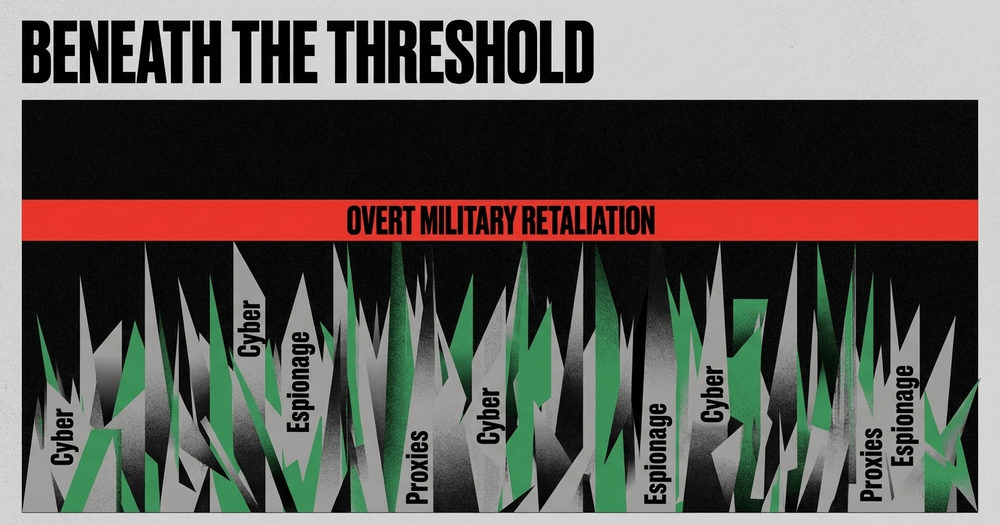
The old binary of war and peace has dissolved into something murkier. Strategic planners call it the gray zone - the contested space between routine statecraft and overt military hostilities, where state and non-state actors compete aggressively without crossing the line into open conflict. The formal declaration of war, once the opening act of any major confrontation, has become a relic of the mid-20th century. In its place sits a constant, low-intensity contest that pursues strategic objectives while staying beneath the threshold that would trigger a conventional military response.
I've spent enough time around operational planning to know that success in the gray zone is never measured the way it was during the era of armored columns and amphibious landings. It isn't about territorial conquest through a decisive maneuver. It's about the slow erosion of an opponent's position - a cable cut here, a patrol vessel nudged a little closer there, an information campaign that quietly reshapes what a population believes to be true. This is not the absence of conflict. It's conflict that has learned to avoid the appearance of being conflict.
The ambiguity and deniability
Ambiguity sits at the center of every gray zone operation. By blurring the line between peace and conflict, an actor makes it genuinely difficult for a targeted state to identify the source of a threat or to craft a response that fits the provocation. The uncertainty isn't limited to who did it. It extends to what kind of activity this even is, which legal framework applies, and whether the action even rises to the level of something a state is obligated to respond to.
This matters more than it sounds like it should. When the identity of the actor behind an operation is obscured, the entire logic of deterrence begins to strain. Deterrence relies on the credible threat of retaliation, and it is hard to threaten retaliation against a party you cannot name with confidence. If a country cannot establish with confidence who disabled its power grid or who manipulated its information environment, it has a much weaker legal and political basis for a response. Gray zone strategy is built, in large part, around exploiting that gap.
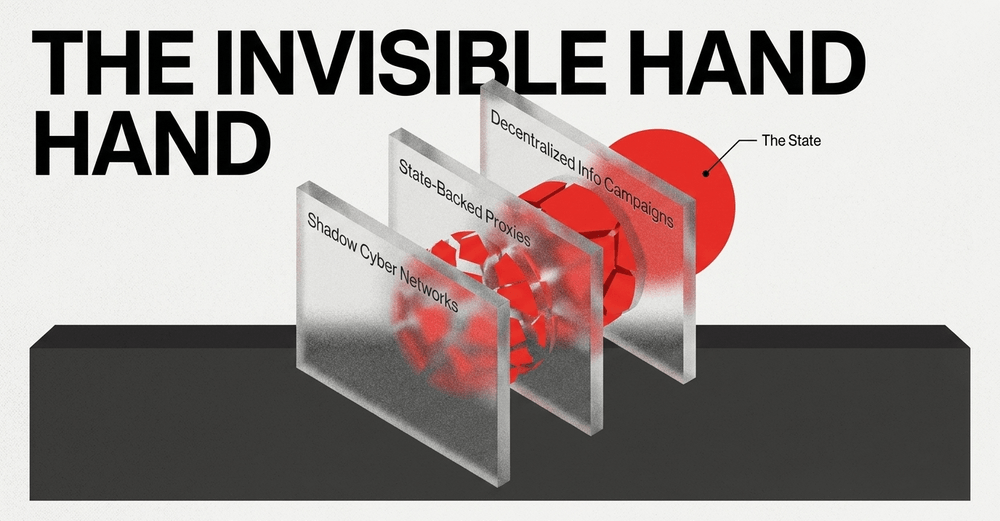
Deniability is ambiguity's operational partner. Actors pursuing gray zone objectives often rely on what intelligence professionals call plausible deniability - a position achieved through a calculated mix of proxies, opaque networks, and decentralized information campaigns. By inserting layers of separation between state leadership and the people actually executing an operation, a government can complicate direct attribution and delay the international consequences that would normally follow. The goal in the gray zone isn't to be invisible. It's to make sure a hand can never quite be proven, even when its influence is obvious to everyone watching.
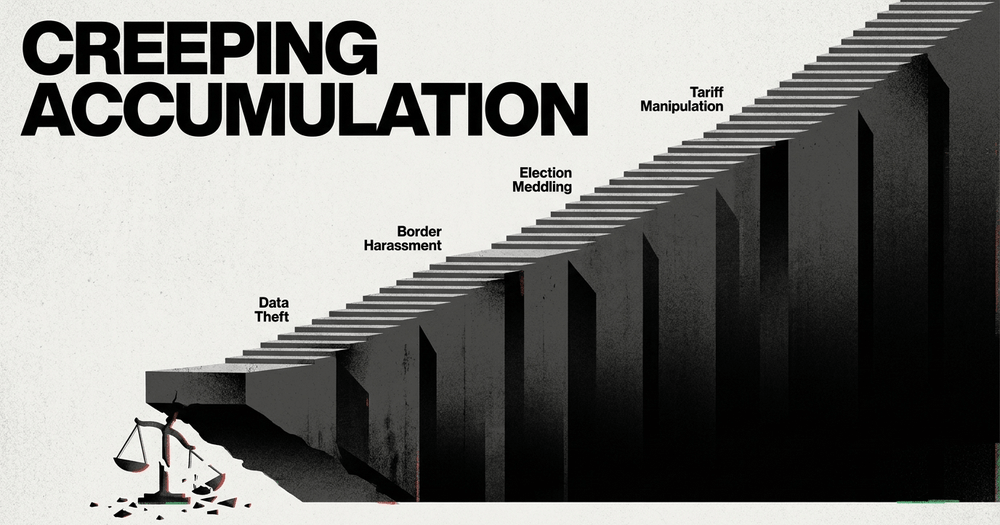
Gradualism sets the tempo. Unlike the large, decisive campaigns that dominated late-20th-century military thinking, gray zone activity tends to move through the slow accumulation of small advantages. This is sometimes called salami slicing - taking one thin slice at a time, each one too small to justify a forceful response on its own, until the cumulative effect has shifted the balance of power. The approach exploits something every operator who has worked alongside a democratic government understands well: the bureaucratic inertia and political hesitation that comes from having to justify escalation to a skeptical public over what looks, in isolation, like a minor incident.
Hybrid tactics: the toolkit of modern competition
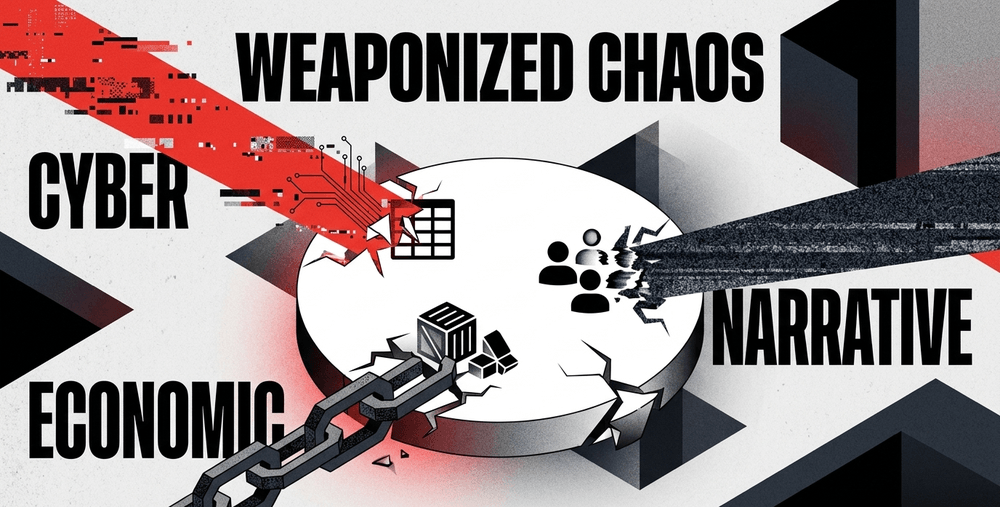
Gray zone activity draws on a wide range of tools, military and non-military alike, all aimed at weakening a target from the inside - its social cohesion, its economy, its technological base. One of the most effective tools is the narrative attack. Coordinated information campaigns use generative AI and social media to distort facts, deepen domestic divisions, and chip away at trust in public institutions. Get the manipulation right, and an actor can blunt an opponent's political will without ever firing a shot.
Cyber operations function as the kinetic edge of this toolkit. They target critical infrastructure, financial systems, and private data networks with a level of stealth no conventional weapon can match. The Center for Strategic and International Studies has tracked this closely through its Gray Zone Project, describing the phenomenon as a contested arena that goes by several names depending on who's discussing it - hybrid threats, sharp power, political warfare, malign influence, irregular warfare, and modern deterrence. Whatever the label, the operations are persistent. They run continuously, across digital borders, whether anyone is paying attention or not.
Some of the toolkit is harder to dress up as anything other than what it is. A few of the recurring categories:
- Economic coercion - leveraging trade dependencies, debt arrangements, or resource access to extract political concessions.
- Political interference - meddling in elections and domestic governance to favor particular outcomes or simply sow discord.
- Industrial espionage - acquiring sensitive technology to skip past years of research and development a rival had to pay for.
- Proxy engagement - using state-backed paramilitary forces and informal networks to keep a state's own uniforms off the front line.
- Critical infrastructure pressure - targeting the physical backbone of modern economies, from power grids to the undersea cables that carry global data traffic.
That last category has become harder to ignore. Since 2023, security analysts have documented at least eleven undersea cables and pipelines damaged in the Baltic Sea alone, a run of incidents serious enough that NATO eventually stood up a dedicated surveillance mission, Baltic Sentry, in response. The pattern is consistent: a commercial vessel operating in international waters drags its anchor across the seabed, a cable or pipeline goes dark, and attribution proves maddeningly difficult under existing maritime law. On the last day of 2025, a telecoms cable connecting Helsinki to Tallinn was severed; Finnish authorities boarded the cargo vessel Fitburg, found its anchor lowered, and escorted it into port at Kantvik. It was hardly an isolated case. Earlier incidents include the rupture of the Nord Stream pipelines in 2022, damage to a Baltic data cable and the Balticonnector gas pipeline in October 2023, and a string of cable failures connecting Lithuania, Sweden, Finland, and Germany through late 2024 and early 2025 - close enough in time and geography that European officials and NATO member states repeatedly described the pattern as hybrid activity, even where formal attribution proved elusive. Our piece on undersea cables as a hybrid war front line goes deeper into why this particular seam in global infrastructure has become such an attractive target, and worldwide, something on the order of 200 undersea cables are cut or disrupted in an average year, the overwhelming majority by fishing gear and anchors rather than sabotage - which is precisely what makes the deliberate cases so hard to separate from ordinary maritime accidents.
What makes attribution so difficult in nearly every one of these cases is the involvement of what's become known as the shadow fleet - aging tankers and cargo vessels with murky ownership structures, often sanctioned, often carrying more than they declare. Investigators looking into the Baltic incidents have repeatedly run into the same wall: a vessel's flag state has little incentive to cooperate, its corporate ownership traces through several jurisdictions, and its crew - frequently a mix of nationalities with no obvious chain of command back to any government - offers nothing resembling a confession. Even in the rare case where a ship is boarded and its anchor found dragging across a cable route, prosecutors have struggled to prove intent rather than negligence in court, as happened when a Finnish court dismissed the case against the captain of the tanker Eagle S in 2025. It's a near-perfect gray zone instrument: civilian in appearance, plausibly accidental in execution, and almost impossible to definitively pin on a state actor.
Why modern conflict is rarely declared
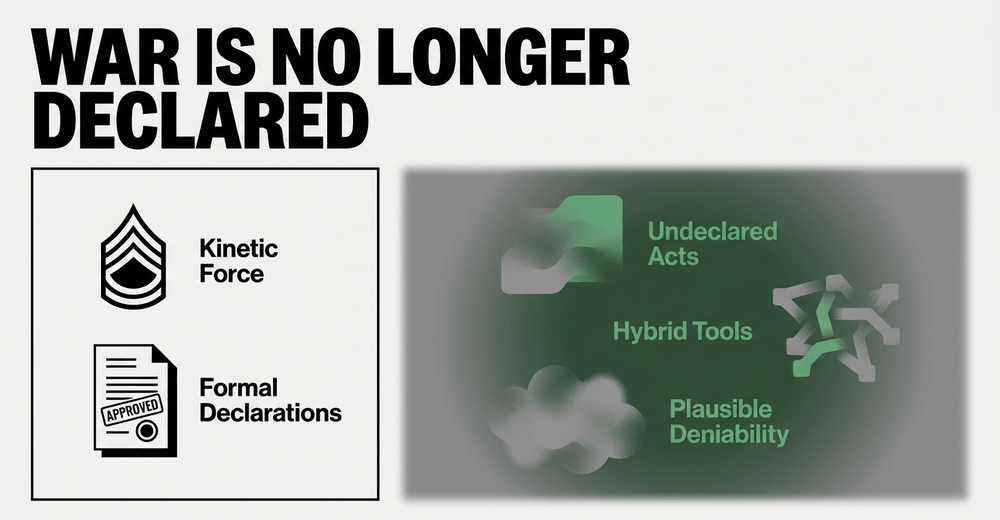
The decline of the formal war declaration is a global pattern, and it isn't accidental. It's driven by the operational flexibility a leader retains by avoiding one, and by the legal consequences a declaration would trigger. The United States, for instance, has formally declared war only eleven times in its history, the last instance dating to 1942. Every major American military engagement since - Korea, Vietnam, the Gulf, Afghanistan, Iraq - has been conducted under congressional authorizations, UN resolutions, or executive action, but never under a formal declaration.
There's a practical reason for that beyond politics. A declared war activates specific domestic and international obligations - economic controls, treaty triggers, public commitments - that can box a leader into a posture they may need to abandon later. Framing a military action as a limited operation or a security response lets a government scale its involvement up or down without the legislative friction that comes with putting a country on a formal wartime footing. It is, frankly, a more flexible tool for an executive than the alternative.
International law has shifted in a way that makes this easier. Under the Geneva Conventions and the body of international humanitarian law built around them, the legal protections owed to civilians and combatants apply to any armed conflict, regardless of whether a state has bothered to declare one. Legal advisers at the International Committee of the Red Cross have made the point explicitly in recent analysis: legal criteria, not political narratives, determine whether a situation constitutes an armed conflict, and getting that classification right matters for whether the relevant protections actually apply. That distinction is precisely what gray zone actors exploit. The humanitarian obligations stay in force, but the broader geopolitical stigma of being an official belligerent - the label that brings sanctions, condemnation, and alliance obligations - can often be avoided entirely.
There's also a simpler, more domestic calculation at play. A formal declaration typically signals that a wartime economy is coming, and that's a politically costly conversation for any leader already managing inflation, budget pressure, or a restless electorate. Undeclared, low-visibility operations let a state pursue strategic gains without forcing that conversation at home.
Historical context and the transition from the Cold War
The vocabulary is new, but the underlying logic isn't. During the Cold War, the major powers built an entire architecture of proxy engagements and influence operations specifically to avoid a direct confrontation that risked catastrophic escalation. Today's gray zone is, in large part, that same playbook running on faster hardware. Academic researchers studying the concept have traced its formal articulation to scholars like Frank Hoffman, who in his 2007 monograph Conflict in the 21st Century: The Rise of Hybrid Wars defined hybrid threats as the simultaneous use of multiple modes of warfare - conventional capabilities, irregular tactics, and criminal disorder - often blending state and non-state actors within the same campaign.
A few cases have become the standard reference points for understanding how this plays out in practice.
Crimea's annexation in 2014 is the textbook example, and it's referenced in nearly every serious academic treatment of the subject. The operation combined unmarked soldiers - the so-called "little green men" - with economic pressure and an information campaign coordinated tightly enough that the tactics proved effective at achieving strategic objectives without engaging in open warfare, at least during the initial phase. The South China Sea presents a related but distinct logic, built around what analysts now describe as a "three sea forces" structure. Coast guard vessels, maritime militia fishing boats, sand dredgers, and commercial cargo vessels operating through opaque ownership structures form layered rings of presence around contested features, with the civilian-looking vessels absorbing most of the friction while naval assets stay further back as an escalation option. Recent reporting on the scale of this fleet is striking: satellite imagery analysis by CSIS's Asia Maritime Transparency Initiative found that the militia's daily average presence reached 241 vessels in 2025, the highest level recorded since systematic monitoring began, with activity concentrated heavily around Mischief Reef and Whitsun Reef, which together account for roughly half of all observed vessel-days.
Proxy-based approaches in the Middle East follow a different model still, built around arming and financing allied militant groups across the region in a way that lets a state exert influence without committing its own regular military to a major conflict. Cyber-focused approaches carve out a niche almost entirely in digital space, using theft and intrusion to fund weapons programs while avoiding the kind of conventional provocation that would invite a unified response from neighboring states. None of these are anomalies. They are, collectively, the dominant mode of competition for any actor that wants to challenge the existing order without risking a conflict it cannot win outright.
The South China Sea as a case study in scale
It's worth pausing on the South China Sea a little longer, because the data behind it is some of the most thoroughly documented gray zone activity anywhere in the world. China's maritime militia - made up of both a professional component trained and equipped to confront foreign law enforcement directly, and a much larger civilian component known as the Spratly Backbone Fishing Fleet - has been a fixture of the dispute since at least 1974, when militia vessels supported the seizure of the Paracel Islands. It played a documented role in China's 2012 takeover of Scarborough Shoal from the Philippines, and analysts tracking it since have catalogued a long, escalating record of close-quarters maneuvers, blocked resupply missions, and confrontations involving water cannons and lasers against coast guard and fishing vessels from multiple claimant states.
What makes the campaign durable is precisely its ambiguity. A Chinese maritime militia boat looks, on paper, like a fishing vessel. It is sometimes crewed by professionals who receive military training and operate in direct coordination with the navy and coast guard. Other times it's a genuine fishing crew whose militia role is secondary, mobilized only when summoned. Researchers have developed methods to flag this kind of activity by looking at where vessels actually spend their time relative to where commercial fishing would normally occur - the idea being that a vessel spending significant time in waters where it has no plausible commercial reason to be is functioning as an extension of state gray zone activity, regardless of what flag or registration paperwork says otherwise. Tracking is complicated further by the fact that most militia vessels simply switch off their automatic identification systems, forcing analysts back onto commercial satellite imagery as the only reliable count.
Around Taiwan, a related architecture produces a slightly different effect - less about resource control and more about wearing down a sense of normalcy. Since a fatal speedboat chase near Kinmen in February 2024, China's coast guard has carried out dozens of incursions a year into restricted and prohibited waters around Taiwan's outlying islands, each one framed by Beijing as routine law enforcement. Taiwan's coast guard logged over sixty such incursions in the year following that incident alone, and the pace has if anything increased since, with vessels returning on consecutive days using different formations and approach routes. Each incursion individually looks survivable. The cumulative effect, incident by incident, chips away at the psychological buffer that a sense of sovereign control depends on.
The impact of artificial intelligence on gray zone evolution
Technology is the engine driving the gray zone's growing sophistication, and artificial intelligence is by far the most consequential development in the field right now. AI functions as what some analysts call a structural enabler - it doesn't invent new categories of gray zone activity so much as it lets existing categories run at a scale and speed that simply weren't achievable by human operators alone.
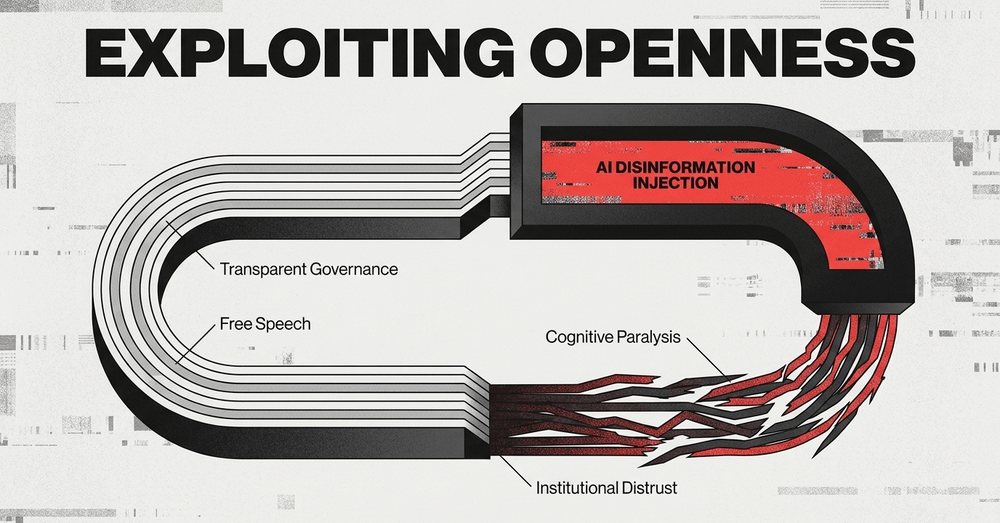
In narrative warfare, generative AI can now produce synthetic media and multilingual disinformation convincing enough that distinguishing it from authentic material requires forensic effort most ordinary observers will never make. This automates the entire production pipeline of an influence operation, allowing an actor to flood the information environment with competing, contradictory narratives until the target population settles into something close to cognitive paralysis - not believing any particular falsehood, necessarily, but losing confidence that truth is knowable at all. That outcome may, in fact, be the more dangerous one.
In cyber operations, AI is doing something similar to the economics of attack and defense. Automated systems can scan for vulnerabilities continuously and generate exploit code faster than human defenders can patch the underlying flaws, producing a condition some researchers describe as economic attrition - the defending side is forced to spend increasingly large sums on protection, while the attacking side's marginal cost per attempt keeps falling. Research on hybrid threat modeling has also pointed to a deeper structural problem here: deterrence theory assumes a state can identify and threaten the actor responsible for an attack, but in the AI-accelerated gray zone, hostile behaviors don't simply materialize as a single confrontation but as a continuous combination of military and non-military, overt and covert operations that resist the kind of clean attribution deterrence requires.
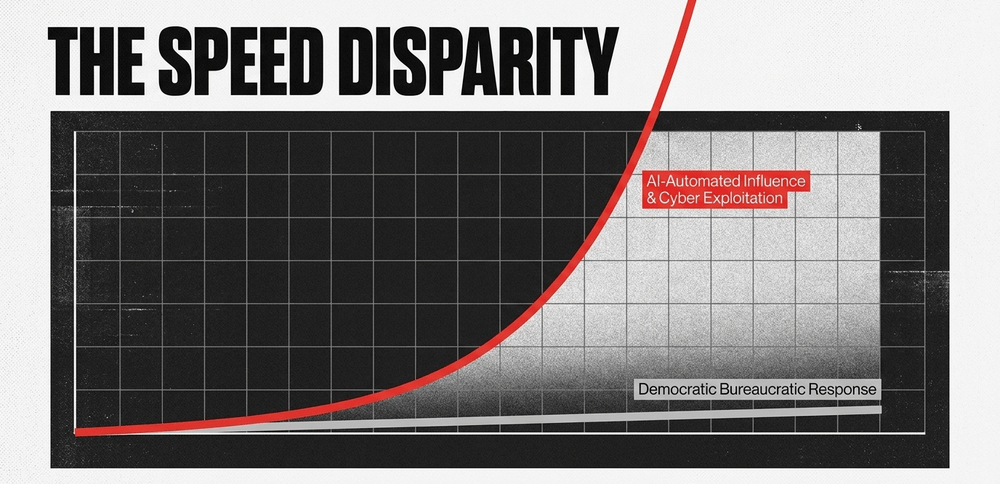
There's a decision-speed dimension worth naming directly. AI compresses the time a defending government has to recognize, deliberate, and respond. While officials in a deliberative system are still working through the appropriate interagency process to characterize a cyber incident or an information campaign, an AI-driven operation has often already advanced to its next phase. That asymmetry in tempo is one of the more durable advantages a fast-moving, centralized actor holds over a deliberative government, and it's not one that gets solved by buying better firewalls.
Academic perspectives and the challenge for open societies
The U.S. National Intelligence Council has offered one of the more widely cited formal definitions of the gray zone, describing it as the space of competitive interactions among and within state and non-state actors that fall between the traditional binary of peace and war. Academic literature on the subject has converged on a related but distinct point: gray zone competition describes the environment, while hybrid warfare describes the methods used within it. As one recent academic treatment puts it, the gray zone sets the stage and hybrid warfare provides the playbook - a useful distinction, since the two terms get used almost interchangeably in casual commentary despite referring to different things.
Researchers studying the legal dimension have flagged a genuine structural problem facing governments built around due process. Most international humanitarian law and most domestic legal frameworks were built around a binary - peace or war - and gray zone activity is specifically engineered to sit in the space those frameworks weren't designed to address. The ICRC's own legal advisers have warned that loose, politically driven use of terms like "hybrid warfare" risks suggesting the law is unclear or non-existent in situations where it actually isn't, which is its own kind of problem: it can lead governments to assume they have less legal footing to respond than they actually do.
Open societies carry a structural disadvantage here that's worth being honest about. Governments that value free speech and transparent governance are, almost by design, more exposed to disinformation and political interference than closed ones. A system built around due process and public accountability cannot easily match a more centralized rival's willingness to use proxies, deny involvement outright, or restrict its own population's access to outside information. That asymmetry isn't going away, and pretending otherwise doesn't help anyone build a workable defense.
The objective of the grey zone is to keep the conflict smouldering and bleed the economy, maintain instability, and keep activity below the threshold of conventional war.
That framing, drawn from recent academic work on the subject, captures something the operational community has understood for a while: the gray zone isn't a prelude to conventional conflict. For most actors using it well, it's a substitute for one - a way to extract the strategic gains that would once have required an invasion, without paying the costs of one.
Future projections and operational readiness
Looking ahead, the gray zone is only going to get more crowded. As more states and well-resourced non-state actors acquire serious cyber and AI capability, the barrier to entering this kind of competition keeps dropping. The world is moving toward a state where the distinction between peacetime and wartime, and between civilian and combatant, continues to blur rather than sharpen. Surviving that environment requires what defense planners increasingly call a "total defense" approach - one that treats military readiness, economic resilience, and social cohesion as a single integrated system rather than three separate problems.
A capable military is necessary but nowhere near sufficient. A nation also needs resilient cyber infrastructure, a population with enough media literacy to resist the cruder forms of disinformation, and a legal system fast enough to react to hybrid provocations without waiting on the slow grind of conventional diplomacy. Cooperation between government and the private sector has become non-negotiable, since the actual front line of most gray zone activity - the data centers, the telecom networks, the social platforms - runs through privately owned infrastructure that no military can simply commandeer in peacetime. The European Commission's move to fund a dedicated subsea infrastructure protection package and cable security toolbox in early 2026 is one early sign that governments are starting to treat this as core defense spending rather than an afterthought.
Practical readiness, in my experience, comes down to a short list of operational priorities:
- Real-time attribution capability - the faster a state can credibly identify who is behind an action, the faster deterrence logic starts working again.
- Infrastructure hardening at the landing point, not just at sea - protecting the cables themselves matters less than protecting the shore stations where they connect to national networks, a vulnerability that's gotten far less attention than it deserves.
- Coordinated economic monitoring - tracking patterns of coercive trade or debt leverage before they mature into political pressure.
- Public-private incident response - since most targets of gray zone activity are private companies, not government agencies.
- AI-enabled defensive automation - matching the speed of automated disinformation and cyber probing requires automated detection, not committee meetings.
- Repair capacity surge planning - the commercial cable-repair fleet was sized for routine fault rates, not for an adversarial environment, and that gap needs a public-private fix before the next major outage rather than after.
None of this guarantees a clean answer to the legal question that keeps coming up in academic and policy circles: at what point does a cyber operation or a sustained campaign of economic coercion actually cross into an act of war? There's no settled international consensus on that line, and until there is one, the gray zone will keep functioning exactly as its practitioners intend it to - a space where the rules are unclear enough that the side willing to act first usually gets to define them.
The age of the declared war may genuinely be fading. What's replaced it isn't peace - it's a persistent, low-grade contest that never quite stops and never quite escalates, fought by actors who have learned that the smartest way to gain ground is to make sure no one can prove a fight is happening at all.
That integrated posture, more than any single weapons system or piece of legislation, is what separates the states that will hold their ground in the gray zone from the ones that will keep discovering, incident by incident, just how much of it they've already lost.
Share now









Key takeaways
- The gray zone is the contested space between routine statecraft and overt armed conflict, where actors pursue strategic gains while avoiding the threshold that triggers a conventional military response.
- The United States has formally declared war only eleven times in its history, with the last declaration dating to 1942; every conflict since has run under authorizations or resolutions instead.
- Hybrid warfare describes the methods used inside the gray zone - the gray zone is the environment, hybrid warfare is the playbook.
- International humanitarian law, including the Geneva Conventions, applies to any armed conflict regardless of whether a formal declaration of war was ever issued.
- Since late 2023, at least 11 undersea cables and pipelines have been damaged in the Baltic Sea, fueling NATO's launch of the Baltic Sentry surveillance mission.
- China's maritime militia in the South China Sea reportedly reached a record daily average of 241 boats by early 2026, concentrated around contested reefs like Mischief and Whitsun.
- Researchers have documented 270 specific incidents of harassment and assault tied to China's maritime militia in the South China Sea since 2012.
- Shadow fleet vessels - tankers and cargo ships with obscured ownership - are increasingly linked to both sanctions evasion and undersea cable sabotage.
- Generative AI acts as a structural enabler in gray zone competition, automating disinformation production and accelerating cyber vulnerability scanning beyond what human defenders can match.
- Democracies face a structural disadvantage in gray zone competition because open, transparent societies are inherently more exposed to disinformation and political interference than closed, authoritarian ones.
Sources
- CSIS Gray Zone Project https://www.csis.org/programs/gray-zone-project
- ICRC - Hybrid threats, grey zones, competition, and proxies https://blogs.icrc.org/law-and-policy/2025/01/16/hybrid-threats-grey-zones-competition-and-proxies-when-is-it-actually-war/
- Jamestown Foundation - Hybrid attacks rise on undersea cables in Baltic and Arctic regions https://jamestown.org/hybrid-attacks-rise-on-undersea-cables-in-baltic-and-arctic-regions/
- CSIS - Signals in the swarm: the data behind China's maritime gray zone campaign near Taiwan https://www.csis.org/analysis/signals-swarm-data-behind-chinas-maritime-gray-zone-campaign-near-taiwan
- RAND Corporation - Understanding and countering China's maritime gray zone operations https://www.rand.org/pubs/research_reports/RRA2954-1.html
- Published 2026-07-17 18:31
- Modified 2026-07-17 18:31

-
Redaction