

-
 Redaction
Tunnel warfare: the underground combat nightmare
From Roman siege mines to the Gaza metro, tunnel warfare has shaped military history. Explore the tactics, technology, and terror of underground combat.
The transition from the open sky to the crushing weight of the earth is not merely a change in geography; it is a fundamental shift in the nature of human conflict. Subterranean combat, a domain often relegated to the shadows of military history, represents perhaps the most visceral and terrifying theater of war.
It is a world where the sun never shines, where the air is a finite resource, and where the very walls can become a weapon. From the hand-dug saps of antiquity to the reinforced concrete 'metros' of modern asymmetric conflict, the underground remains a tactical nightmare that defies the traditional advantages of superior firepower and satellite-driven intelligence.
To understand the gravity of this environment, one must visualize the physical constraints. In a standard tunnel, the field of fire is reduced to a narrow corridor. There is no flanking. There is no high ground. Success depends on raw nerve, specialized technology, and a willingness to enter a space that the human brain is evolutionarily programmed to fear. As global urbanization increases, the merger of city warfare and subterranean operations is becoming inevitable, forcing modern militaries to confront a darkness they have spent decades trying to avoid.
The deep roots of the underground struggle
The history of digging beneath an enemy is as old as the concept of the wall itself. The Roman Empire, despite its preference for open-field maneuvers, became masters of the subterranean siege. During the Bar Kokhba revolt between 132 and 136 AD, Jewish rebels utilized complex tunnel systems to negate the numerical and organizational superiority of the Roman legions. This was not merely about hiding; it was about creating a parallel world from which they could strike and disappear. The Romans responded with counter-mining, a brutal process of digging to intercept enemy tunnels, leading to subterranean skirmishes where men fought to the death in pitch-black, oxygen-deprived holes using nothing but short blades and their bare hands.
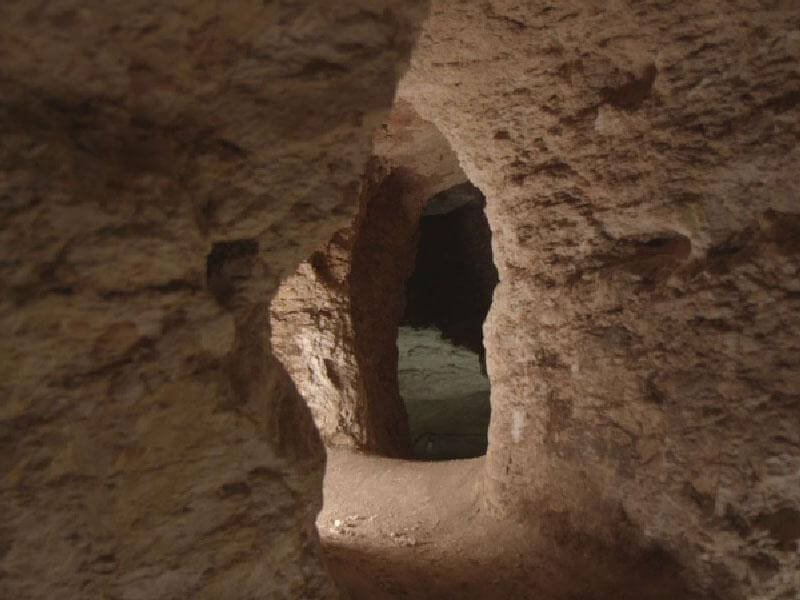
The introduction of gunpowder in the 15th century transformed these tunnels from mere passageways into delivery systems for massive destruction. The goal shifted from undermining foundations to planting 'mines' - large caches of explosives - directly beneath enemy fortifications. This evolution was gradual but inexorable, and by the time European armies were clashing on the American continent during the Civil War siege of Petersburg in 1864, mining enemy positions had become a refined, if horrifying, military art.
The Western Front goes underground
The stalemate of World War I drove warfare into the geology itself in ways no commander had fully anticipated. On the Western Front, both sides developed dedicated tunneling units - specialist engineers whose entire war was fought in the dark. The British Royal Engineers' tunneling companies and their Australian counterparts dug in conditions that defy imagination: working in silence, using rubber-handled tools to avoid giving away their position, listening for the sounds of enemy picks through stethoscopes pressed against the earth.
This reached a horrific zenith in 1917 at the Battle of Messines. General Sir Herbert Plumer's Second Army completed nineteen mines containing around one million pounds of high explosive.
At 3:10 a.m. on June 7, 1917, the charges detonated simultaneously. The blast from the explosions could be heard in London, some 130 miles distant, and the resulting virtual earthquake immediately killed as many as 10,000 German soldiers. It remains one of the largest non-nuclear explosions in recorded history.
What makes Messines remarkable beyond the sheer scale of the destruction is the planning that preceded it. Work on laying the mine galleries had begun nearly eighteen months before zero hour. In the face of active German counter-mining, 8,000 metres of tunnel were constructed under German lines. This was a war within a war - a subterranean contest of listening, nerve, and counter-digging, all happening beneath the feet of men who had no idea how close they were standing to their own annihilation.
The 20th century and the rise of the guerrilla network
As the world moved into the era of modern ideological conflict, the tunnel evolved from a siege tool into a permanent strategic asset. During the Sino-Japanese War, Chinese resistance forces developed didao zhan - tunnel warfare - into a primary defensive doctrine. These were not simple burrows but sophisticated networks with hidden firing ports and false exits designed to lure invaders into kill zones. This allowed lightly armed peasants to inflict significant casualties on the technologically superior Imperial Japanese Army by turning the very soil they stood on into an active participant in the defense.
This doctrine found its most famous expression in the jungles of Vietnam. The Viet Cong and North Vietnamese Army constructed the Cu Chi tunnels - a labyrinth whose scope still staggers the imagination. At its peak during the Vietnam War, the network of tunnels in the Cu Chi district linked support bases over a distance of some 250 kilometers, from the outskirts of Saigon all the way to the Cambodian border. That is roughly 155 miles of hand-dug passageways beneath a jungle that American air power had already bombed to near-oblivion.
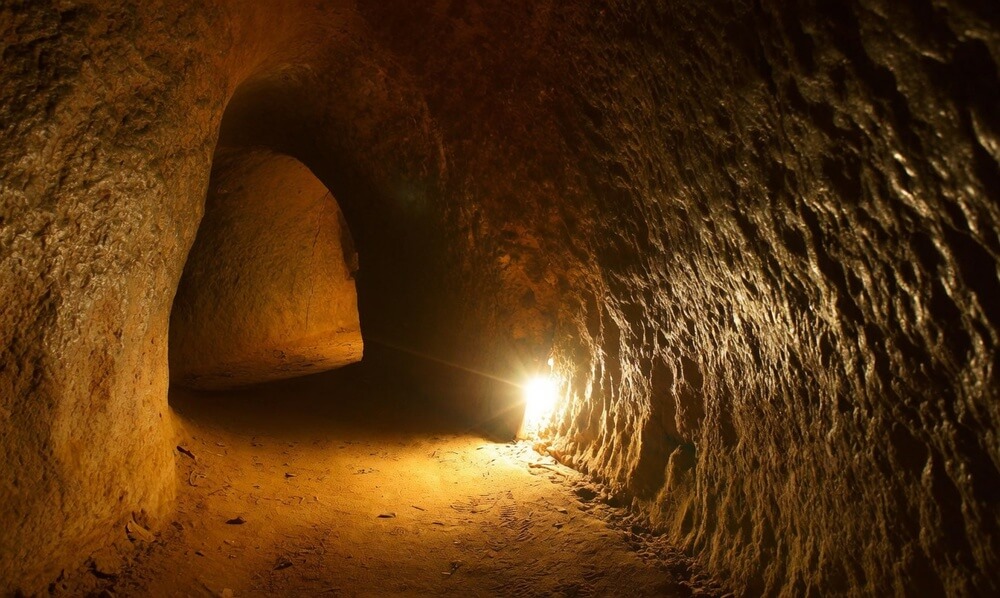
The tunnels were relatively narrow, measuring around 70 centimeters in height and 40 centimeters in width - built to accommodate the smaller stature of Vietnamese fighters, making it difficult for larger Western soldiers to navigate. These dimensions were not incidental. They were a deliberate design feature, a physical filter that turned the architecture itself into a weapon.
These tunnels housed everything from hospitals and command centers to weapon factories and kitchens. The US response involved the 'tunnel rats' - volunteer infantrymen often armed only with a flashlight and a .45 caliber pistol - soldiers who entered a world of booby traps, venomous snakes, and sudden ambushes. Tunnel rat veterans coined a phrase for the experience: the black echo, a term that captures both the acoustic horror of the environment and the way it seemed to swallow a man whole.
Despite operations like Operation Crimp, which used massive amounts of explosives and chemical agents, the tunnels remained operational until the end of the war. Aerial bombardment simply could not reach what lay beneath the clay. The Cu Chi soil, rich in iron compounds, behaved almost like reinforced concrete once exposed to air - easy to dig, nearly impossible to destroy from above.
The underground war's forgotten theater: Iwo Jima
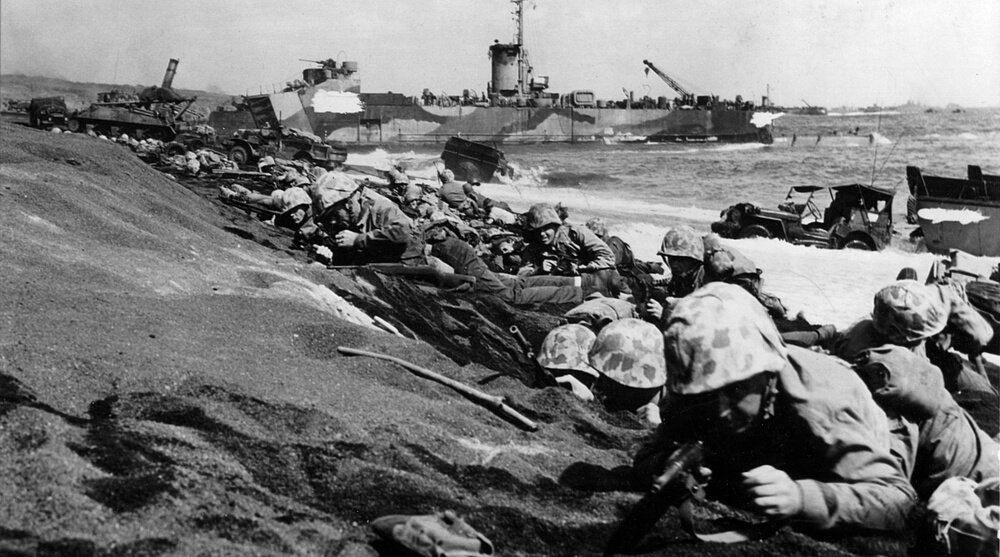
The Pacific theater of World War II offers one of the starkest examples of how subterranean defense can neutralize overwhelming conventional superiority. On the small volcanic island of Iwo Jima, Japanese General Tadamichi Kuribayashi abandoned the beach-defense doctrine entirely. Instead, his garrison carved a network of underground fortifications - tunnels, bunkers, and interconnected firing positions - directly into the volcanic rock. The Japanese strategy was to fight the battle almost entirely underground, with 1,500 rooms in the rock connected by roughly 16 miles of tunnels.
The result was catastrophic for the attackers. Months of naval bombardment and aerial attack had achieved almost nothing against positions buried deep in basalt. When the Marines landed on February 19, 1945, they faced an enemy that had essentially disappeared into the earth. The United States suffered nearly 26,000 casualties, including more than 6,800 killed, making Iwo Jima one of the bloodiest battles in Marine Corps history.
The underground environment turned war into a test of psychological attrition. Japanese defenders lived in hot, sulfurous tunnels for weeks under constant shelling, yet they maintained a level of resistance that stunned commanders who had expected a brief campaign. Kuribayashi's tunnels did not save the island - but they extracted a price so catastrophic that American planners cited Iwo Jima as a primary reason for the eventual decision to use atomic weapons rather than invade the Japanese mainland.
The modern nightmare in Gaza and beyond
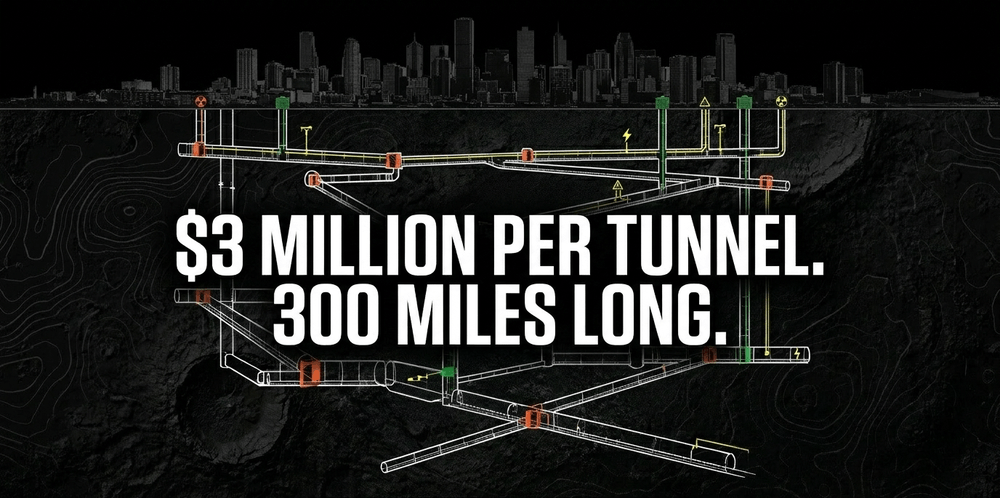
In the 21st century, the complexity of subterranean warfare has escalated to a qualitatively new level. The Gaza Strip serves as a contemporary case study in high-tech tunnel engineering. What Israeli forces and military analysts refer to as the 'metro' is a network of staggering scale. Before the post-October 2023 war began, estimates suggested there were around three hundred miles of tunnels ranging from fifteen feet to over two hundred feet below the surface, with close to 5,700 separate shafts.
These facilities are not mere hiding spots; they are integrated combat platforms. Hamas tunnels are outfitted with telephone lines, electricity, and railways, and each tunnel reportedly costs around $3 million to build. They feature blast doors to mitigate the effects of thermobaric weapons, internal communication lines that bypass electronic eavesdropping, and sophisticated ventilation systems that allow fighters to remain underground for extended periods.
Data from the 2014 Gaza conflict highlights the extreme lethality of this terrain. According to military medical records, a substantial proportion of casualties in the underground environment died before they could even be extracted to a medical facility. The injuries documented are uniquely horrific: blast-overpressure injuries, toxic smoke inhalation, and crushing injuries as structures collapsed. This data suggests that the environment itself often causes more damage than direct small-arms fire.
As scholar Daphne Richemond-Barak, an expert on underground warfare at Reichman University and author of Underground Warfare, has noted, "It's a very intricate, very large - huge - network of tunnels on a rather small piece of territory." What makes these tunnels distinct from earlier examples is that they were constructed beneath one of the most densely populated places on earth - a fact that has profound humanitarian implications for any military operation aimed at destroying them.
Why technology fails underground
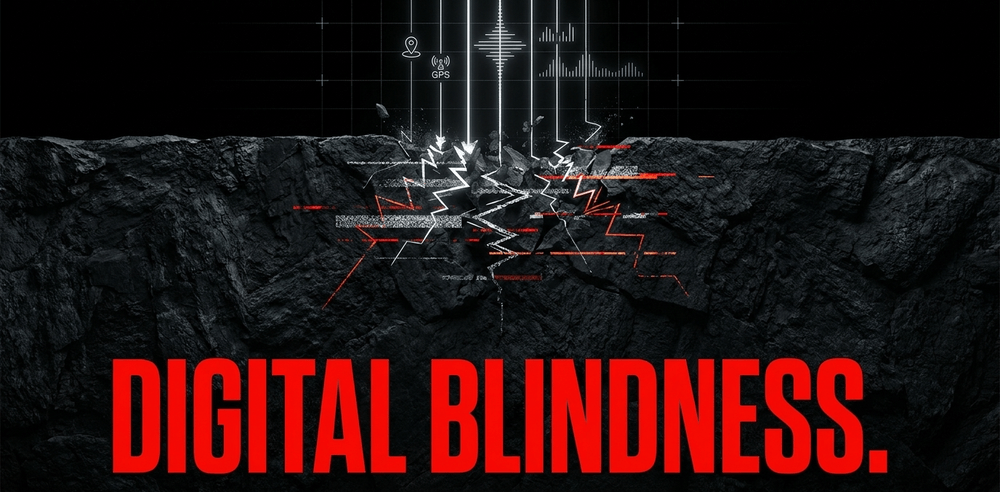
The primary reason subterranean environments are so difficult to master is the total failure of conventional military technology once it goes beneath the surface. Global Positioning Systems do not function. Standard FM and digital radios, which rely on line-of-sight or atmospheric reflection, are rendered useless by meters of rock and soil. This leaves units in a state of digital blindness - unable to communicate with their command structure or even with teams in adjacent tunnels a few meters away. The isolation is not merely inconvenient; it is a major driver of the profound psychological stress experienced by soldiers.
The physical environment is inherently hostile to human life even without anyone shooting at you. Tunnels are often oxygen-poor and may contain high concentrations of carbon monoxide or methane. They are damp, attracting vermin and disease-carrying insects. In many parts of the world, scorpions and snakes seek refuge in these cool, dark spaces, adding a biological hazard to the tactical one.
The home-field advantage is also absolute in a way that has no parallel in surface warfare. A defender who knows the layout of a tunnel can move with complete confidence in the dark, while an attacker must use artificial light, which immediately betrays their position to any observer waiting at the far end of a corridor. Every advantage that modern western militaries have spent decades and trillions of dollars developing - precision munitions, ISR platforms, networked communications - is neutralized by twenty feet of compacted earth.
The crushing psychological weight of the dark
The mental toll of tunnel warfare is perhaps its most distinct characteristic. Military psychologists have long studied the effects of closeness and sensory deprivation on combat performance. In a tunnel, the fog of war is literal. Smoke from gunfire does not dissipate; it hangs in the air, blinding the shooter and choking the lungs. The acoustic environment is equally disorienting, as gunshots are amplified to deafening levels while the direction of the sound becomes impossible to identify.
Soldiers describe a feeling of being hunted by an invisible enemy. The threat is 360 degrees - it can come from the front, from a hidden trapdoor in the ceiling, or from a crawlspace behind you. This constant state of hyper-vigilance leads to rapid performance degradation. Fatigue sets in faster than in any other combat environment, and the lack of natural light disrupts the body's circadian rhythms, leading to hormonal imbalances that impair the very decision-making faculties that keep soldiers alive.
"The environment is more hostile than the enemy itself."
- Col. Townley Hedrick, US Army Maneuver Center of Excellence
Research into tunnel warfare veterans consistently reveals elevated rates of post-traumatic stress disorder, with some studies noting that the closed, sensory-deprived environment may produce psychological effects distinct from those of conventional combat trauma. The dark does something to people that open-ground warfare does not.
Specialized technologies for the subterranean front
To counter these threats, global powers are investing in a new generation of subterranean-specific equipment. The US Army has committed significant funding toward equipping and training combat brigades for this specific purpose. The Army released dedicated doctrine in TC 3-20.50 and invested over $500 million in modular training infrastructure, with Range 68 at Fort Liberty providing two-thirds of a mile of maze-like corridors beneath a mock village. The shift is from 'clearing and destroying' to 'maneuvering and holding' underground spaces. Key technological developments include:
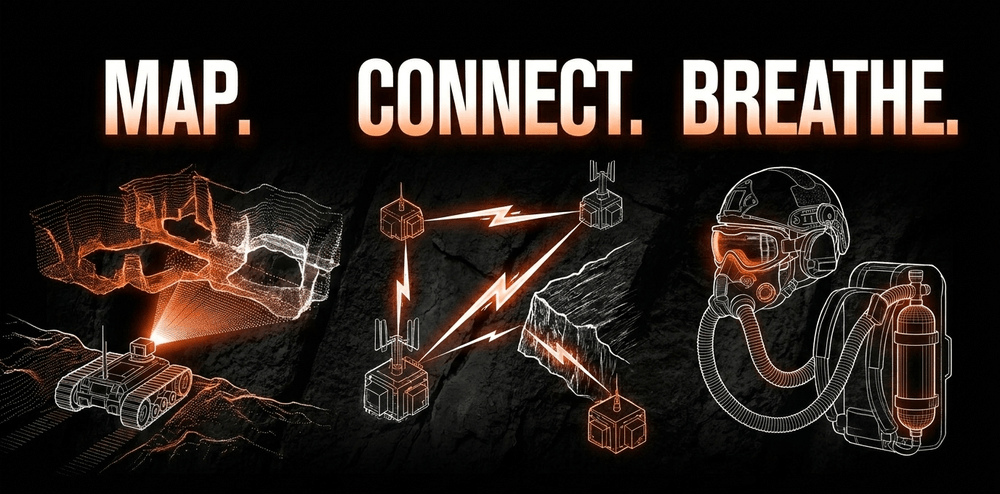
- Robotics and autonomous systems. Since sending a human into a tunnel is the highest-risk option, robots are used as the 'point man.' These units can map 3D spaces using LiDAR and detect hazardous gases before troops enter, providing commanders with a first look at what lies ahead without sacrificing a soldier for the intelligence.
- Subterranean communications. MESH network technology allows soldiers to drop 'nodes' as they move, creating a daisy-chain of signal boosters that can penetrate around corners and through thick walls. In some cases, militaries are reverting to solutions their grandfathers would have recognized - hard-wired telephone lines, which are immune to electronic jamming and work regardless of signal conditions.
- Breaching and life support. Modern tunnel operators carry battery-powered saws, thermal lances, and self-contained breathing apparatuses. Because traditional gas masks do not protect against low-oxygen environments, oxygen tanks are critical for survival in deep or smoke-filled complexes.
- Sensory enhancement. Night vision goggles are often inadequate in total darkness where there is no ambient light to amplify. This has led to the development of thermal imaging and white phosphor technology that provides better depth perception in confined spaces.
Training for the abyss
Equipment alone is not enough to survive a tunnel. It requires a radical departure from standard infantry doctrine. Specialized training facilities provide thousands of feet of realistic tunnel networks where soldiers practice modified Close Quarters Battle tactics. In a tunnel, the fatal funnel - the doorway or opening where an attacker is most vulnerable - is the entire length of the hallway. Soldiers must learn to move in near-total silence, communicating via touch or vibration-based devices rather than voice.
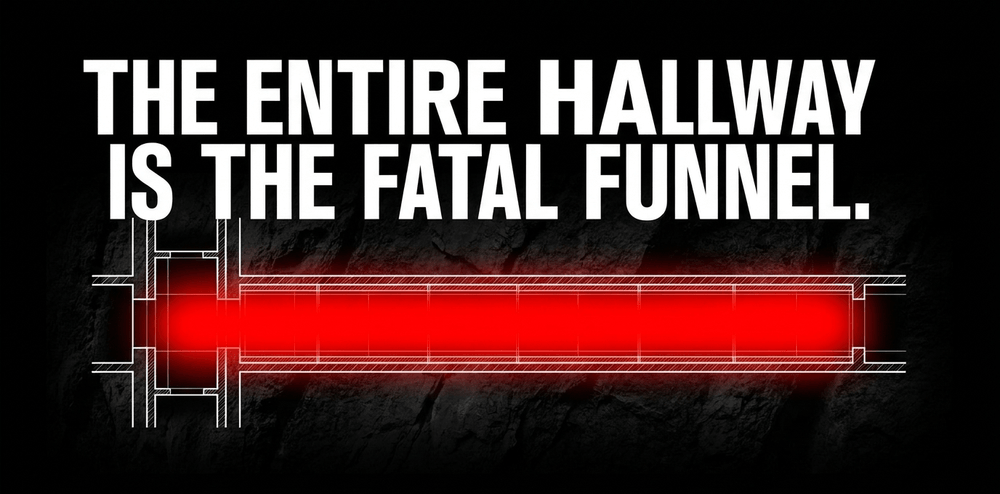
Vertical rescue is another critical component. If a soldier is wounded several stories underground, traditional medevac procedures are impossible. Units must be trained in technical rope rescue and casualty extraction through narrow vertical shafts. The goal of this training is to normalize the environment - to reduce the panic factor that occurs when a soldier first encounters the oppressive reality of being buried alive while someone is trying to kill them.
The US Army Asymmetric Warfare Group has produced handbooks - the Subterranean Warfare Handbook and the Subterranean Operations Handbook - though both fall short of establishing a comprehensive subterranean doctrine or full set of tactics, techniques, and procedures. The doctrinal gap remains one of the more pressing problems facing militaries that have spent most of the last century thinking above ground.
Strategic implications and the future of global security
The proliferation of underground military facilities is a direct response to the era of precision-guided munitions. When an adversary knows that their surface structures can be destroyed with a single satellite-guided bomb, the logical response is to move critical infrastructure underground. There are currently estimated to be more than 10,000 significant underground military facilities worldwide.
North Korea represents the most extreme example of this strategic philosophy. US estimates range from 5,000 to 8,000 underground sites, which include not only invasion tunnels but also leadership bunkers, artillery positions, and troop shelters, along with at least three major underground air bases, one of which features a 5,900-foot runway that passes entirely through a mountain. China is believed to have thousands of miles of tunnels, while North Korea may have thousands of bunkers and even air bases with subterranean taxiways.

This trend suggests that the decisive battles of the future may not be fought in the air or on the sea, but in what strategists are beginning to call the sovereign underground. For a state or non-state actor, a well-constructed tunnel network is the ultimate equalizer. It negates the sensor-to-shooter advantage that modern western militaries have spent decades perfecting and forces conflict back into a primal, man-to-man struggle where numbers and raw endurance matter more than satellite imagery and precision munitions.
Academic studies suggest that while tunnels rarely win wars on their own, they can extend a conflict's duration indefinitely, turning a swift surgical strike into a decades-long quagmire. The underground does not need to defeat an enemy. It only needs to exhaust one.
The megacity problem
As we look toward the mid-21st century, the integration of smart cities and subterranean infrastructure will only deepen the challenge. Subways, sewers, and utility tunnels are the blood vessels of the modern megacity. Cities like Tokyo, New York, Seoul, and São Paulo already contain hundreds of miles of subterranean infrastructure, much of it unmapped with military precision. Any future urban conflict will inevitably spill into these spaces.
Non-state actors such as Hamas, Hezbollah, and the Houthis have made underground infrastructure an indispensable component of their hybrid warfare doctrine - multi-functional military assets designed for concealment, resilience, and strategic deception.
The lesson being absorbed by militaries from Washington to Beijing is uncomfortable: the underground is no longer an edge case or a niche tactical environment. It is a primary domain of modern conflict.
The military that fails to master the subterranean domain will find itself fighting a ghost - an enemy that exists everywhere but is visible nowhere. To fight underground is to fight the earth, the dark, and the very limits of human endurance.
The necessity for this specialized expertise has never been more apparent as global tensions move into the deep places of the world.
Share now









Key takeaways
- Tunnel warfare dates back to antiquity - during the Bar Kokhba revolt (132-136 AD), Jewish rebels used complex tunnel networks to counter the superiority of Roman legions, prompting the Romans to develop counter-mining operations fought in near-total darkness.
- At the Battle of Messines (June 7, 1917), British forces detonated 19 mines packed with approximately one million pounds (454 tonnes) of high explosive, killing as many as 10,000 German soldiers instantly - an explosion heard in London, 130 miles away.
- The Cu Chi tunnel network in Vietnam stretched approximately 250 kilometers (155 miles) at its peak, linking support bases from the outskirts of Saigon to the Cambodian border, and housed hospitals, weapon factories, and command centers.
- At Iwo Jima (1945), the Japanese garrison carved roughly 16 miles of tunnels with 1,500 rooms into volcanic rock; the resulting battle cost the United States more than 6,800 killed and nearly 26,000 total casualties despite overwhelming naval and air superiority.
- The Hamas tunnel network in Gaza - known as the 'metro' - was estimated to include around 300 miles of tunnels at depths of up to 200 feet, with close to 5,700 separate shafts, costing an estimated $3 million per tunnel to construct.
- Standard military technology fails completely underground: GPS does not function, FM and digital radio is rendered useless by rock and soil, and soldiers operate in a state of digital blindness - isolated from command and unable to coordinate with adjacent units.
- The underground environment presents compounding biological hazards: oxygen depletion, carbon monoxide, methane, vermin, and venomous creatures - meaning the environment itself frequently causes more casualties than direct enemy fire.
- "Tunnel rats" in Vietnam described the experience using the term black echo - a phrase that captured both the acoustic horror of confined gunfire and the total psychological isolation of the environment.
- North Korea is estimated to maintain between 5,000 and 8,000 underground military sites, including at least three major air bases with subterranean runways, artillery bunkers along the DMZ, and shelters capable of housing fully armed combat brigades.
- The US Army has invested over $500 million in subterranean training infrastructure and released dedicated doctrine (TC 3-20.50), with facilities like Range 68 at Fort Liberty providing two-thirds of a mile of realistic underground corridors for training exercises.
Sources
- Britannica - Battle of Messines https://www.britannica.com/event/Battle-of-Messines
- HISTORY - Cu Chi Tunnels https://www.history.com/articles/cu-chi-tunnels
- Modern War Institute (West Point) - Gaza's Underground: Hamas's Entire Politico-Military Strategy Rests on Its Tunnels https://mwi.westpoint.edu/gazas-underground-hamass-entire-politico-military-strategy-rests-on-its-tunnels/
- Modern War Institute (West Point) - The Elephant in the Tunnel: Preparing to Fight and Win Underground https://mwi.westpoint.edu/elephant-tunnel-preparing-fight-win-underground/
- Hudson Institute - Notes From the Underground: The Long History of Tunnel Warfare https://www.hudson.org/national-security-defense/notes-from-the-underground-the-long-history-of-tunnel-warfare
- Published 2026-06-05 19:45
- Modified 2026-06-10 23:18

-
Redaction