


-
 PRO
PRO -
 Redaction
Americas empty magazine: The Iran war costs 2026
Operation Epic Fury data reveals how logistics, signal discipline, and precision-guided munitions impact high-intensity kinetic warfare outcomes.
Executive summary
Seven weeks of Operation Epic Fury - the American and Israeli air campaign against Iran launched on February 28, 2026 - have consumed a historically significant share of the United States' most critical precision munitions and missile defense interceptors.
While the United States retains sufficient conventional bombs and short-range precision munitions to sustain operations against Iran should the current fragile ceasefire collapse, the depletion of high-end interceptors and long-range precision munitions has created what CSIS describes as a "near-term risk" of operational failure in a subsequent high-intensity conflict against a near-peer adversary.
"The high munitions expenditures have created a window of increased vulnerability in the western Pacific."
- Mark F. Cancian, CSIS Senior Adviser and retired U.S. Marine Corps Colonel, CNN, April 21, 2026
"It will take one to four years to replenish these inventories and several years after that to expand them to where they need to be."
- Mark F. Cancian, CSIS
"Even before the Iran war, stockpiles were deemed insufficient for a peer competitor fight. That shortfall is now even more acute and building stockpiles to levels adequate for a war with China will take additional time."
- Cancian and Chris H. Park, CSIS, Last Rounds? Status of Key Munitions at the Iran War Ceasefire, April 21, 2026
The consequences extend far beyond the Middle East theater. Weapons deliveries to NATO allies on the eastern flank - Estonia, Lithuania, and Latvia - have been formally suspended for the duration of the Iran conflict.
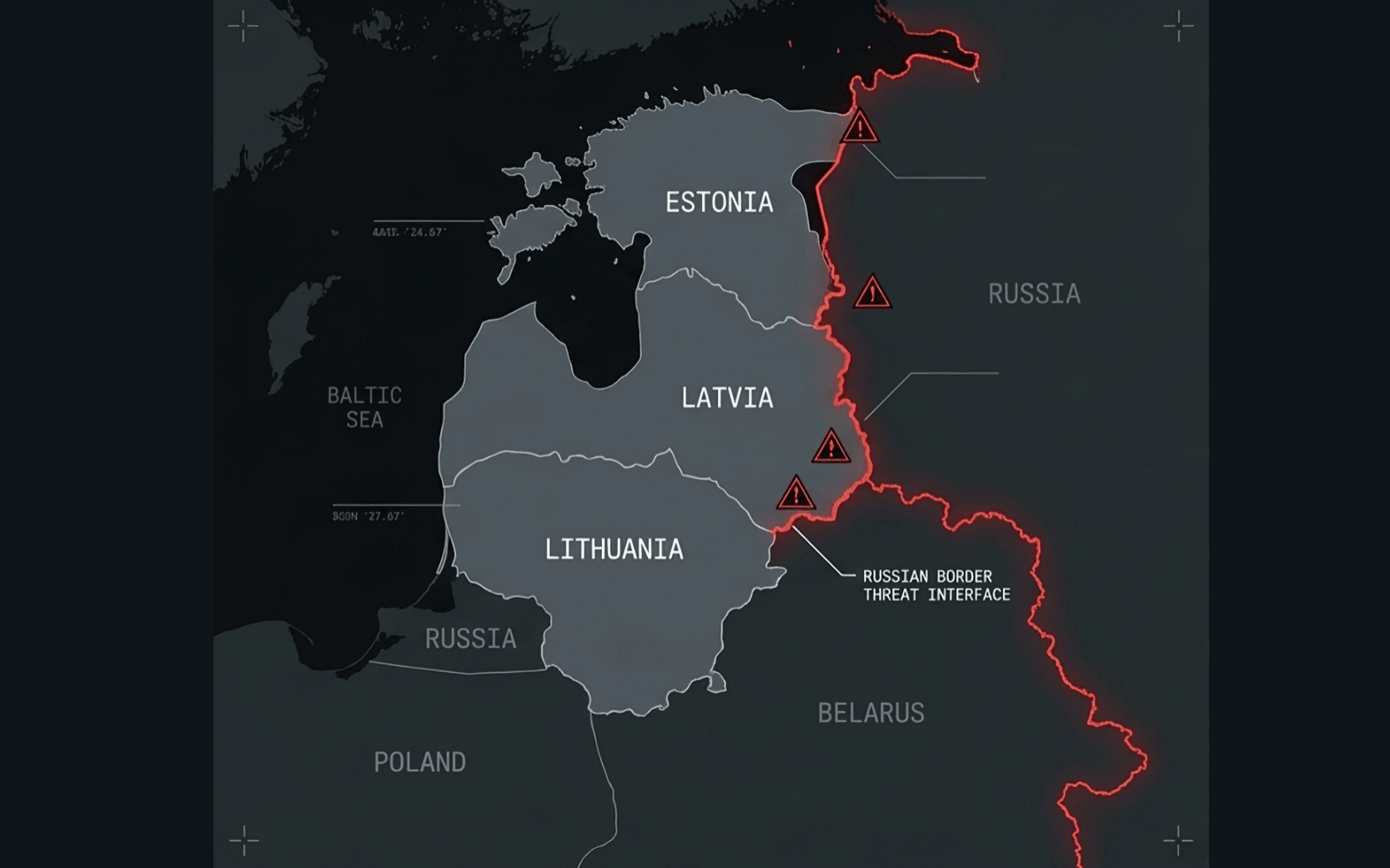
Ukraine, fighting Russia's invasion with continued dependence on Western-supplied air defense munitions, faces a growing risk of Patriot interceptor shortfalls. And U.S. deterrence posture toward China in the Western Pacific has been meaningfully degraded at precisely the moment when Beijing is watching most closely.
The accumulated drain - three conflicts, one arsenal
The red sea campaign: The first drain
The depletion of U.S. munitions inventories that is now visibly acute did not begin with Operation Epic Fury. It began with the U.S. Navy's engagement against Houthi attacks on commercial shipping in the Red Sea, a campaign that lasted from late 2023 through early 2026. Over that period, the United States expended approximately 200 Standard Missile-2 (SM-2) and Standard Missile-6 (SM-6) interceptors in air defense engagements. Each SM-6 costs approximately $4.3 million. Each engagement that used SM-6 against a Houthi drone costing as little as $20,000-$50,000 represented a cost-exchange ratio that was strategically untenable from the beginning - a problem that Secretary of State Marco Rubio acknowledged publicly when he noted that Iran was "producing, by some estimates, over 100 of these missiles a month. Compare that to the six or seven interceptors that can be built a month."
The Red Sea campaign also depleted Tomahawk Land Attack Missiles (TLAMs) used in offensive strikes against Houthi infrastructure. The Pentagon had procured only 68 Tomahawks in FY 2023 and requested a mere 22 TLAMs for FY 2025 - numbers that even before Operation Epic Fury were considered woefully insufficient relative to projected wartime use rates.
The october 2024 and june 2025 Iran-Israel wars
Following the October 2024 Iranian ballistic missile attacks on Israel (True Promise II), the United States fired approximately 12 SM-3 interceptors to assist Israeli defenses. This was relatively modest and had limited impact on overall inventories.
The decisive drain came during the June 2025 Twelve-Day War (Operation Rising Lion / True Promise III), in which Israel struck Iran's nuclear and missile complexes, and Iran retaliated with an unprecedented barrage of ballistic missiles. According to CSIS, JINSA, and corroborating CNN and Wall Street Journal reporting, the United States expended during those 12 days:
- Over 150 THAAD interceptors - some estimates range 100-150; Wall Street Journal reporting from U.S. officials placed the figure above 150, representing roughly 25 percent of the entire U.S. THAAD stockpile
- Approximately 80 SM-3 interceptors - approximately 20 percent of all SM-3 interceptors expected to be delivered to U.S. forces through end-2025
- Approximately 30 Patriot PAC-3 interceptors defending Al Udeid Air Base in Qatar
The JINSA report (Ari Cicurel, July 2025) calculated that even the more conservative lower-bound estimate of 92 THAAD interceptors consumed approximately 14 percent of the total estimated stockpile. CNN, reporting from two sources familiar with the operation, confirmed the higher figure of roughly 25 percent of the stockpile - which, combined with subsequent Operation Epic Fury expenditures, brings the total depletion across both conflicts to approximately 50 percent or more of what had been on hand before the June 2025 war.
Operation epic fury: The decisive drain
Operation Epic Fury commenced on February 28, 2026, when U.S. CENTCOM forces struck over 1,000 targets in the first 24 hours, alongside Israeli strikes on more than 750 additional targets. The opening phase required large quantities of long-range standoff weapons - Tomahawk cruise missiles and JASSM (~$3.5 million per shot) - to suppress Iran's integrated air defense network.
As Iranian retaliatory salvos began, U.S. and Gulf coalition forces were forced to conduct sustained air defense operations at a scale not seen in American military history. Iran launched over 2,000 drones and 500 ballistic missiles in the first four days alone. Gulf states - Bahrain, Kuwait, Saudi Arabia, and the UAE - reported intercepting at rates of 80-90 percent, but each interception consumed expensive and increasingly scarce interceptors.
A landmark data point confirms the Tomahawk burn rate: the Washington Post reported on March 27 that the U.S. Navy had fired at least 850 Tomahawks in the first month of the Iran war alone - the most expended in any single military campaign in history, surpassing the previous record of 802 TLAMs fired during Operation Iraqi Freedom. CSIS estimates the United States retains approximately 3,000 Tomahawk missiles in its remaining arsenal as of the ceasefire.
After seven weeks of continuous combat operations, the cumulative picture is stark. Per the April 21, 2026 CSIS analysis:
| Weapon System | Estimated Depletion After 7 Weeks |
|---|---|
| THAAD interceptors | ≥ 50% of total inventory |
| Patriot (PAC-3 MSE) interceptors | ≈ 50% of total inventory |
| Precision Strike Missiles (PrSM) | ≥ 45% of total inventory |
| SM-3 interceptors | > 30% of total inventory |
| Tomahawk cruise missiles | ≈ 20-30% of total inventory |
| JASSM / JASSM-ER | > 20% of total inventory |
| SM-6 missiles | ≥ 10% of total inventory |
Figures, confirmed by three individuals with access to the Pentagon's classified stockpile assessments, establish the most significant single-conflict depletion of American high-end munitions since the Second World War.
The mathematics of depletion - System by system
THAAD: The most alarming shortfall
THAAD is the backbone of American theater-level ballistic missile defense. The United States operates eight THAAD batteries, each with six launchers and eight interceptors per launcher - 48 interceptors per battery, 384 total assigned to operational launchers. With a pre-Twelve-Day-War total delivered inventory of approximately 534 interceptors (per CSIS P-21 data), only about 150 were available as reload and strategic reserve - a dangerously thin margin for a conflict of this intensity.
The cumulative depletion across the June 2025 war and Operation Epic Fury has consumed the majority of that reserve. THAAD interceptors are manufactured by Lockheed Martin at a unit cost of $12.7-15 million per missile (rising to nearly $24 million per unit under supplemental procurement conditions). Production as of the CSIS December 2025 brief stood at approximately 12 interceptors per year under base procurement - a rate so low that it would take between three and eight years to replenish what was consumed in 12 days of the June 2025 war alone, let alone the additional expenditure during Operation Epic Fury.
DOD reprogrammed $700 million from Israel Security Supplemental Act funds to boost THAAD procurement post-June 2025, sufficient at $15 million per unit for approximately 45 additional missiles - far less than one battery's worth of reloads. A January 2026 framework agreement with Lockheed Martin aimed to increase THAAD production from 96 to 400 interceptors per year, but this increase is staggered over seven years and will not materially affect near-term availability. No new U.S. THAAD interceptors had been delivered to American inventory between July 2023 and the December 2025 CSIS report - a gap driven by production being dedicated to the Saudi Arabia sale of 360 interceptors under the 2017 agreement.
A separate factor compounds the THAAD crisis: no new deliveries to U.S. inventory are expected until April 2027 for interceptors procured in FY 2021. The pipeline of 100 procured but undelivered THAAD interceptors will arrive too late to affect the current conflict or the immediate readiness posture.
Patriot (PAC-3 MSE): Better, but not good enough
The Patriot PAC-3 Missile Segment Enhanced (MSE) interceptor presents a less acute but still serious picture. Over the FY 2015-2024 period, DOD procured an average of approximately 270 MSE missiles per year. In 2025, Lockheed Martin delivered 620 PAC-3 MSE interceptors, a 20 percent increase over the prior year reflecting pre-war production acceleration. A seven-year framework agreement announced in January 2026 aims to increase production from approximately 600 to 2,000 MSEs per year, and a $4.76 billion Army contract was awarded in April 2026 - though 94 percent of that contract's initial funding derives from Foreign Military Sales accounts, meaning allied demand, not U.S. domestic replenishment, is the primary driver.
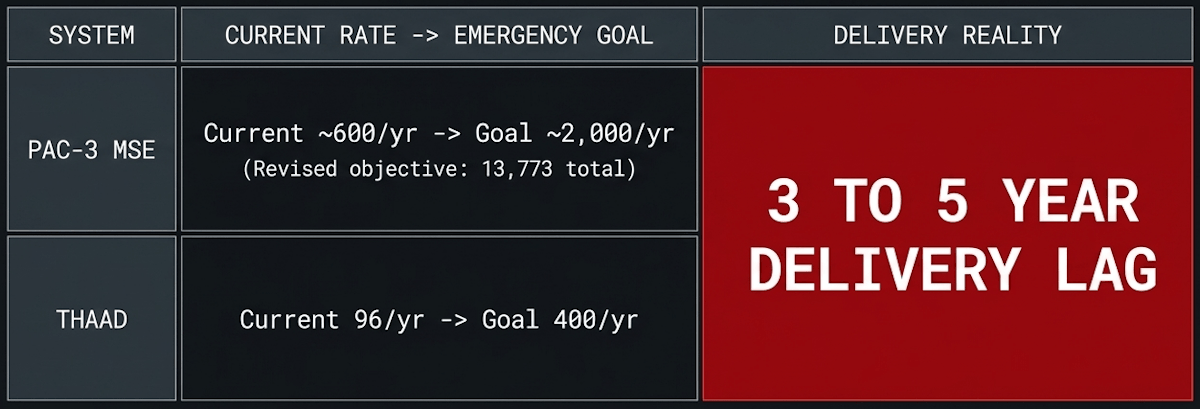
Despite healthier production relative to THAAD, the consumption rates of Operation Epic Fury have been extraordinary. With approximately 50 percent of the Patriot interceptor stockpile consumed across the extended campaign, the U.S. Army's revised procurement objective - now set at 13,773 total missiles, up from 3,376 - reveals the scale of the acknowledged shortfall. At current delivery rates, meeting even the lower pre-revision objective would require sustained procurement over many years.
Critically, the depletion of Patriot interceptors has a direct and immediate impact on the U.S. ability to supply Ukraine. As Ukrainian President Volodymyr Zelenskyy stated in early March 2026: "more U.S.-made Patriot defense systems were used in three days of the Iran war than in Ukraine since 2022" - a statement that encapsulates the acute competition between theaters for a finite and scarce supply.
Tomahawk cruise missiles: A record-breaking burn rate
The Tomahawk Land Attack Missile (TLAM) remains the United States' primary conventional long-range precision strike weapon. CSIS estimates the U.S. retains approximately 3,000 Tomahawks in its remaining inventory as of the ceasefire. The 850+ TLAMs fired in the first month of operations alone - confirmed by the Washington Post and Pentagon officials - constitutes the largest Tomahawk expenditure in any single military campaign in history, surpassing the 802 used in Operation Iraqi Freedom.
The procurement math makes this burn rate deeply alarming. In FY 2026, Congress granted only $257 million for the purchase of 55-58 Tomahawk missiles - a number so small that, as Heritage Foundation analysis noted, if equally divided among all 73 Arleigh Burke-class destroyers, each ship would receive less than one Tomahawk per year. The FY 2027 budget request has attempted to address this by requesting 785 Tomahawks for approximately $3 billion - an increase of over 1,200 percent. Vice Admiral Ben Reynolds, the Navy's budget director, acknowledged at the April 21, 2026 Pentagon budget briefing that weapons production capacity "is absolutely the challenge" and declined to confirm whether all 785 missiles could actually be delivered within the fiscal year.
JASSM: The air-launched standoff strike weapon
The Joint Air-to-Surface Standoff Missile (JASSM) and its extended-range variant (JASSM-ER), at approximately $3.5 million per round, were used heavily in Operation Epic Fury to suppress Iranian integrated air defense networks in the opening days of the campaign. The new CSIS analysis confirms that more than 20 percent of the JASSM inventory was expended during the conflict. The FY 2027 budget request reflects this depletion acutely, with JASSM procurement jumping from 381 to 821 missiles - more than doubling - at a total cost that signals the severity of the shortfall.
Precision strike missiles (PRSM): A new system already depleted
The Army Precision Strike Missile - a long-range ground-launched precision strike weapon replacing the older ATACMS - entered service in 2025 and was used in combat during Operation Epic Fury, where it proved effective against hardened Iranian targets. However, with a pre-war inventory that was already limited given the system's recent introduction, the expenditure of at least 45 percent of the stockpile within seven weeks has created a near-term production crisis.
Existing contracts, as of March 2026, call for delivery of 335 PrSMs by 2029 - 54 in 2026, 208 in 2028, and 73 in 2029. This pipeline reflects years of modest contract awards that assumed a relatively low tempo of peacetime consumption. The FY 2027 budget includes substantial new PrSM procurement alongside the $30 billion total critical munitions investment requested by the Pentagon, but near-term deliveries remain constrained by the two-to-three year gap between contract award and production of sophisticated precision weapons.
Standard missiles: The naval defense backbone under pressure
The SM-3 Block IIA, the U.S. Navy's primary theater ballistic missile defense interceptor, now shows depletion of over 30 percent according to the latest CSIS analysis - factoring in expenditures across the October 2024 strike response, the June 2025 Twelve-Day War, and Operation Epic Fury. At a production rate of only 12 SM-3 IIAs per year under base procurement, the system is being consumed at a rate that cannot be sustained.
The SM-6, a multi-mission weapon capable of engaging aircraft, cruise missiles, and ballistic missiles in their terminal phase, was procured at approximately 125 per year under a multiyear contract from 2017-2023. Despite this healthier baseline, the Red Sea campaign consumed approximately 200 SM-2 and SM-6 interceptors before Operation Epic Fury began, and the new CSIS data confirms at least 10 percent of SM-6 stockpiles were additionally consumed during the Iran war.
The cost-exchange problem and Iran's strategic logic
Understanding the depletion crisis requires understanding the cost-exchange mathematics that Tehran has deliberately exploited. Iran's offensive strategy has been built around an asymmetric arithmetic that turns the expense of missile defense against the defender.
A Houthi Shahed-136 drone - a weapon Iran produces at scale - costs approximately $20,000-$50,000. An SM-6 used to intercept it costs $4.3 million - a cost-exchange ratio of roughly 86:1 in Iran's favor. A THAAD interceptor at $12.7-15 million used against an Iranian ballistic missile costing $500,000-$2 million represents a ratio of 6:1 to 25:1 in Iran's favor.
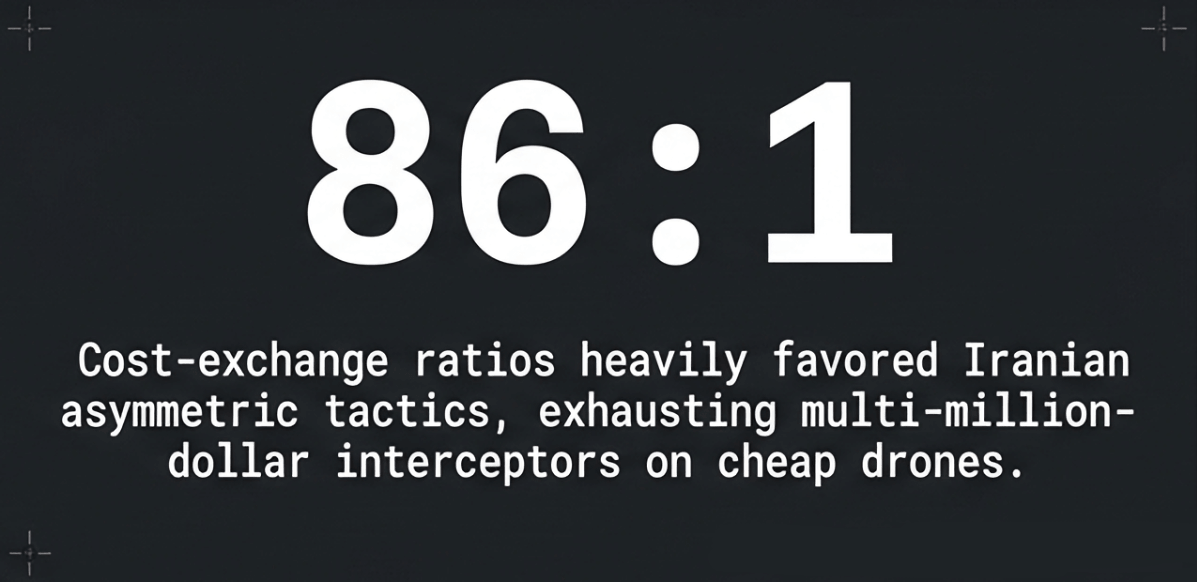
Iran has explicitly structured its missile campaign to exploit this arithmetic. JINSA and FPRI analyses both document that Iran deployed older, cheaper liquid-fueled ballistic missiles in its earliest salvos - deliberately using lower-value weapons to force the expenditure of high-value U.S. interceptors. Once those interceptors were reduced, the path would be clear for more advanced and precise follow-on strikes.
Iran's own production base has partially absorbed the war's damage. U.S. intelligence estimates, reported by SOF News in mid-April 2026, indicate that Iran retains approximately 40 percent of its pre-war long-range attack drone arsenal and approximately 60 percent of its pre-war ballistic missile stockpile as of the ceasefire. While the White House announced on April 7, 2026, that "more than 85 percent of the regime's defense industrial base" had been destroyed, and that Iran's "ballistic missile arsenal and production capacity has been razed," these intelligence estimates suggest that Iran's residual offensive capacity remains material - and that U.S. stockpile exposure is far from theoretical.
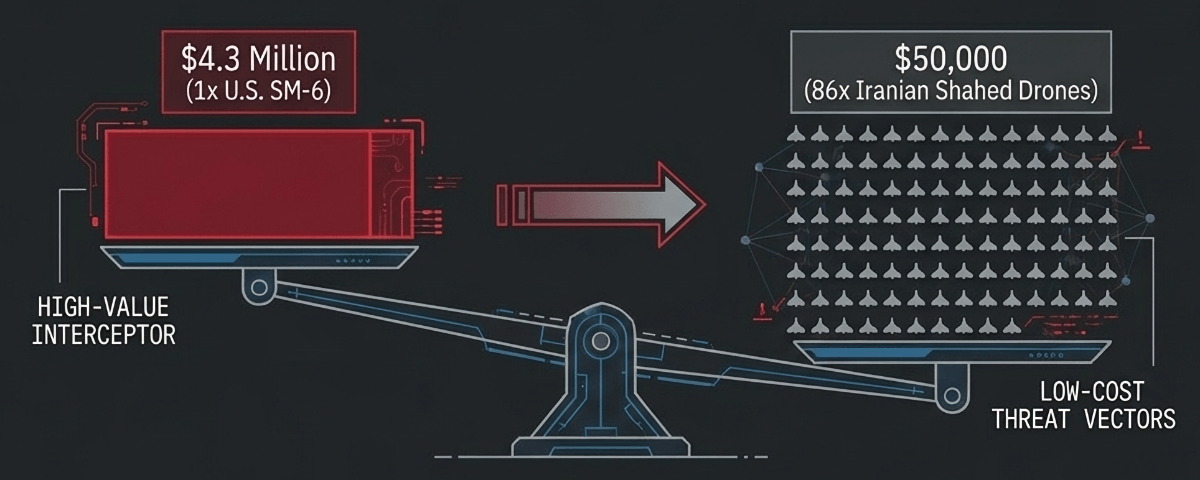
Secretary of State Marco Rubio publicly acknowledged the production imbalance on March 4, 2026, noting that Iran was producing "over 100 missiles a month" while the U.S. could only manufacture "six or seven interceptors a month." The statement encapsulates the fundamental strategic arithmetic of the crisis: the supply of the defense is structurally insufficient relative to the demand created by even a moderately capable adversary.
Global strategic consequences
NATO's eastern flank: Deliveries suspended
The most immediate and politically consequential consequence of the munitions crisis has been the formal suspension of U.S. weapons and ammunition deliveries to NATO's eastern flank allies. On April 17-21, 2026, the governments of Estonia, Lithuania, and Latvia were formally notified by Washington that U.S. arms deliveries were on hold for the duration of the Iran conflict.
The affected deliveries confirmed by Estonian Defense Minister Hanno Pevkur - who received notification directly from Defense Secretary Pete Hegseth - include ammunition for the M142 HIMARS multiple launch rocket system and Javelin anti-tank missiles. These two weapons systems are among the most operationally critical in NATO's deterrence posture on the eastern flank, given their demonstrated effectiveness in high-intensity combat in Ukraine and their centrality to Baltic defense planning against a potential Russian conventional attack.
Pevkur stated on April 21, 2026, that the suspension would "certainly last longer than weeks - more likely months." Lithuania reported approximately $640 million in outstanding U.S. orders, including Javelin missiles, while Estonia has approximately $160 million in outstanding orders for HIMARS ammunition and Javelins. Latvia has separately purchased HIMARS for its military and faces equivalent delivery uncertainties.
The FY 2027 budget request reflects this crisis in the HIMARS line item as well, with a proposed budget jump of 1,112 percent - from $61 million to $745 million - for HIMARS-related procurement. The scale of that increase is perhaps the most visible single admission in the public budget documents that the Baltic and eastern flank supply situation has become untenable.
The strategic implications are severe. The Baltic states border Russian territory and lie directly on NATO's most exposed frontier. All three are spending approximately 5 percent of GDP on defense as they race to strengthen their militaries in response to the threat from Moscow. NATO's largest 2026 exercise - Steadfast Dart 2026, involving approximately 10,000 troops - was notably conducted without direct U.S. participation. German Armed Forces Chief of Defence Carsten Breuer described the Russian threat as "real," emphasizing that Moscow continues reorienting its military toward the West.
Ukraine: The interceptor famine
Before Operation Epic Fury, Ukraine's air defense situation was already acute. Russia's sustained campaign of drone and missile attacks against Ukrainian cities and infrastructure had steadily consumed Ukraine's air defense interceptors. U.S. Patriot missile interceptors were repeatedly cited by both the Biden and Trump administrations as a constraint on further supply - inventories were already thin.
Ukrainian President Zelenskyy's observation that more U.S.-made Patriot systems were used in three days of the Iran war than Ukraine had received in total since 2022 encapsulates the competition between theaters. Senator Richard Blumenthal of Connecticut, a member of the Senate Armed Services Committee, stated plainly in March 2026:
I am deeply concerned about Ukraine. Just as a matter of common sense, our resources and supplies are limited, and I think we will be hard pressed, at some point, to tell Ukraine what is coming.
Democratic senators also highlighted the contradiction in the administration's position:
We've been told again and again and again one reason that we can't provide interceptors for the Patriot system or other munitions for Ukraine is that they're in short supply,
The Wall Street Journal reported in March 2026 that "Ukraine may not have enough air defense missiles due to the conflict between the United States and Iran." Russia's strategic air campaign against Ukrainian infrastructure is calibrated to this vulnerability - the more interceptors are drawn to the Middle East, the more exposed Ukrainian cities and power generation infrastructure become to Russian missile attacks.
Taiwan and the Western Pacific: A window of vulnerability
The gravest long-term strategic consequence of the Iran war's munitions depletion may be the one least immediately visible: the degradation of U.S. deterrence credibility in the Western Pacific. This concern is not theoretical; it is quantified in multiple independent analyses, all of which converge on alarming conclusions.
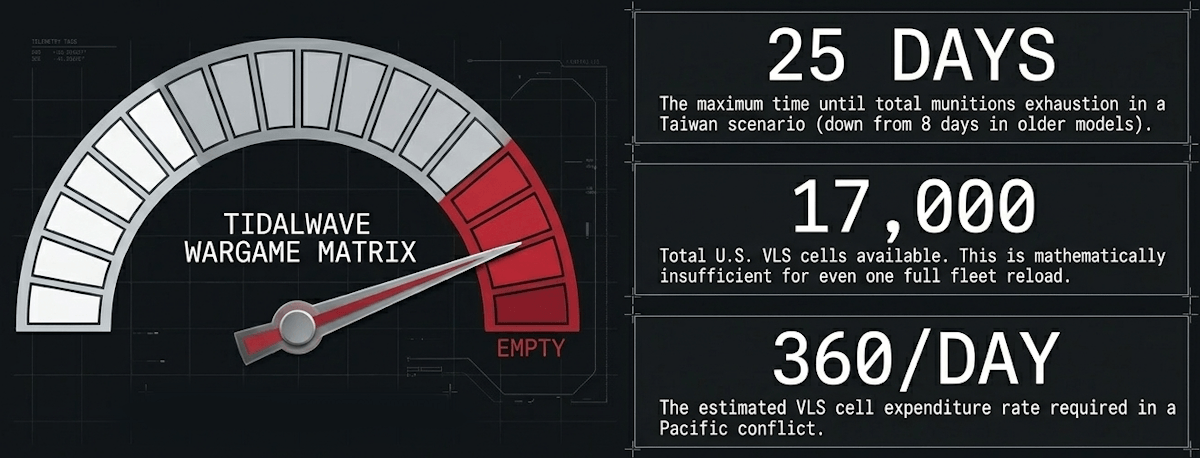
The January 2026 Heritage Foundation TIDALWAVE report - a detailed operational assessment of a hypothetical high-intensity U.S.-China conflict over Taiwan - found that the "initial stock" of U.S. munitions would be exhausted within approximately 25 days of high-intensity combat, after which "U.S. forces will almost certainly be forced to enter the main phase of combat around Day 30 in a logistically degraded state, ultimately leading to systemic operational failure as platform losses, fuel bottlenecks, and munitions demand converge." This assessment was made before the Iran war's additional depletion.
The report further found that:
- Key precision-guided munitions including LRASM are depleted in approximately one week of high-intensity Indo-Pacific operations
- The total estimated inventory of approximately 17,000 VLS munitions is insufficient for even one full fleet reload of U.S. surface combatants
- An estimated demand of 360 VLS cells per day in a large conflict far exceeds available replenishment rates
- High-end interceptors - SM-3, SM-6, PAC-3 MSE, and THAAD - "would likely be exhausted within days of sustained combat, with some systems depleted after just two to three major PLA salvoes"
Earlier Heritage Foundation wargaming produced an even more pessimistic estimate: the United States would run out of critical munitions only eight days into a high-intensity conflict with China over Taiwan. These figures were already deeply concerning before the Iran war. The additional 20-50 percent depletion of key systems during Operation Epic Fury and the June 2025 war has compressed that timeline further.
CSIS's Cancian stated the strategic implication directly: "The major risk is not that we're going to run out for this war, but that the inventories are inadequate for a possible conflict with China." Kelly Grieco, senior fellow at the Stimson Center, characterized the situation bluntly: the U.S. is "using [munitions] faster than we can replace them."
China - described by virtually every recent U.S. defense assessment as the "pacing challenge" - is watching carefully. Asia Times noted that "U.S. rivals like China will be watching closely" as intercept rates, stockpile signals, and industrial capacity data become visible through open-source tracking of Operation Epic Fury's operational rhythm.
Once Operation Epic Fury ends and naval assets return to the Pacific, munitions inventories will begin to recover - but the CSIS report is unambiguous that "restoring depleted stockpiles and then achieving the desired inventory levels will take many years."
Elbridge Colby, the Undersecretary of Defense for Policy and the administration's leading advocate for prioritizing Pacific deterrence, acknowledged the tension in congressional testimony. He had authored the memo that paused weapons shipments to Ukraine before the Iran war began - precisely to preserve stocks for a potential China conflict. The Iran war has now consumed, in seven weeks, a significant portion of what his memo was designed to protect.
President Xi Jinping has set 2027 as the date by which the PLA should be ready for military action over Taiwan. The depletion timeline for U.S. munitions replenishment - estimated at one to four years to reach pre-war levels and several additional years to expand - creates a period of acute vulnerability precisely coinciding with the anticipated window of Chinese military readiness.
The Strait of Hormuz: A New operational theater
The ceasefire that took hold in early April 2026 introduced a new strategic complication: the partial blockade of the Strait of Hormuz. Following the failure of ceasefire negotiations in Islamabad on April 11, 2026, the United States initiated a naval blockade targeting vessels engaged in commercial activity with Iranian ports. Iran, meanwhile, imposed its own conditions on Strait transits, requiring ships to apply for permission, follow an Iran-designated route, accept a naval escort, and pay a reported toll estimated at approximately $1 million to $2 million per tanker.
With the ceasefire expiring on April 21, 2026, and Pakistan continuing to work toward new talks, the situation in the Strait remains unresolved. Two Avenger-class mine-hunters have been redeployed from Japan toward the Middle East, and two Arleigh Burke-class destroyers - USS Frank E. Peterson and USS Michael Murphy - transited the Strait on April 12 to "begin the process of establishing a new passage," per CENTCOM Commander Admiral Brad Cooper. The naval demands of sustaining this blockade and ensuring freedom of navigation add further operational burden to assets whose VLS magazines are already substantially depleted.
Allied confidence and structural dependence
The suspension of deliveries to NATO's Baltic members and the diversion of Patriot and THAAD capacity away from European and Pacific partners also poses a less quantifiable but strategically significant risk: the erosion of allied confidence in U.S. supply-chain reliability.
Nations that have built their military procurement strategies around U.S. Foreign Military Sales programs - including the Baltic states, Poland, Japan, South Korea, Taiwan, and the Gulf states - now have direct evidence that a high-intensity U.S. military engagement elsewhere will interrupt their supply chains. This creates incentives to diversify procurement sources, potentially to European or other suppliers, and reduces the network effects that make U.S. military systems the dominant standard across allied militaries.
Europe, meanwhile, faces its own munitions crisis. By some estimates, Europe has only about 5 percent of the air defense systems it needs to protect its eastern border from a war with Moscow. Germany possesses approximately 150 operable Taurus cruise missiles. The United Kingdom has so few Tomahawks that VLS cells on its Type 45 destroyers were reportedly used for storage rather than weapons. France and the UK ran out of precision-guided munitions less than a month into the 2011 Libya campaign - an operation dramatically less intense than a potential Russia-NATO conflict.
The industrial base - Structural failure, emergency response
The root cause: Decades of underinvestment
The munitions crisis exposed by the Iran war is not a sudden accident. It is the predictable consequence of decades of systematic underinvestment in the defense industrial base, combined with the repeated use of scarce high-end weapons in lower-priority conflicts. The fundamental problem is the persistent misalignment between operational demand - which has been high and growing - and budgetary demand signals - which have been inconsistent, driven by continuing resolutions, annual appropriations uncertainty, and intermittent supplemental funding.
Production lines cannot be maintained, let alone expanded, without predictable, multi-year contract commitments. The capital expenditure required to build new manufacturing facilities, qualify new suppliers, expand the workforce, and invest in supply-chain resilience requires a planning horizon of five to ten years - not the one-year cycles of congressional appropriations. The result is a defense industrial base that has been systematically prevented from making the investments necessary to produce the munitions the military is now consuming.
CSIS identified several specific manifestations of this structural failure: THAAD procurement fluctuated by more than ±100% from year to year over the past decade, making long-term workforce and facility planning impossible; SM-3 IB production was terminated in favor of the IIA variant, sacrificing total numbers for range capability; Tomahawk procurement was reduced to levels insufficient to arm the existing fleet even once; and PrSM contracts were structured around peacetime attrition assumptions incompatible with the burn rates revealed by the first weeks of Operation Epic Fury.
Emergency measures: Too late, too slow
In response to the crisis, the U.S. government has announced a series of emergency industrial mobilization agreements and a sweeping FY 2027 budget request:
PAC-3 MSE: A seven-year framework agreement signed with Lockheed Martin in January 2026 aims to increase production from approximately 600 to 2,000 interceptors per year. A $4.76 billion contract was awarded in April 2026. Boeing and Lockheed Martin announced a separate agreement to triple seeker production capacity. The Army revised its total PAC-3 MSE procurement objective from 3,376 to 13,773 missiles.
THAAD: A January 2026 framework agreement aims to increase production from 96 to 400 interceptors per year, staggered over seven years. Emergency reprogramming of $700 million post-June 2025 purchased approximately 45 additional missiles.
Tomahawk: The FY 2027 budget requests 785 Tomahawks for approximately $3 billion - a 1,200% increase over the 55-58 procured in FY 2026. The Trump administration has called on defense companies to "quadruple production," but Vice Admiral Reynolds acknowledged that production capacity remains the binding constraint.
JASSM: FY 2027 requests 821 JASSMs, up from 381 - more than doubling procurement to address the >20% depletion.
PrSM and Mid-Range Capability: The FY 2027 budget allocates part of its $30 billion critical munitions investment to Army long-range precision fires, including PrSM and the Mid-Range Capability missile system.
Drones: The Pentagon is requesting $54 billion for military drones and related technology and $21 billion for drone-defeat systems in FY 2027 - triple the prior year's spending - reflecting the operational lessons of a conflict in which Iranian drone swarms proved the dominant tactical challenge.
AIM-260: The advanced long-range air-to-air missile designed to outrange anything Russia or China currently fields sees its procurement funding surge from $894 million to approximately $2.94 billion in FY 2027, strongly suggesting full-rate production is now underway.
Despite these measures, CSIS is unambiguous: the delivery timeline to replace depleted systems is three to five years even with increased production capacity. "Near-term deliveries, however, are relatively low because of small orders in the past. Even if Congress appropriates the requested FY 2027 funds, it will take years for these missiles to be delivered," per the April 21 CSIS report.
The demand signal problem: Not just a funding issue
CSIS's fundamental recommendation is that funding alone cannot solve the problem without structural changes to how the Department of Defense communicates long-term demand to industry. The Army's decision to increase its PAC-3 MSE requirement from 3,376 to 13,773 total missiles is an example of the right approach - it signals a durable, multi-decade commitment to production that gives manufacturers confidence to invest in facilities, workforce, and supply chain capacity.
Similar revisions are needed across THAAD, SM-3, Tomahawk, and PrSM programs. Multi-year contracting authority must be expanded for missile programs. And the practice of allowing stockpiles to be consumed in regional engagements without proportionate immediate replacement orders must end.
A critical non-funding constraint on production acceleration is U.S. dependence on Chinese-controlled critical minerals - gallium and germanium - essential for precision guidance system semiconductors. China's dominance in these materials introduces a geopolitical supply-chain vulnerability embedded in the munitions ramp-up itself, one that cannot be resolved by contract awards alone.
The political dimension - Competing narratives
The munitions depletion crisis has generated a sharp political dispute in Washington. The Trump administration's public position has been consistent denial of strategic vulnerability.
President Trump stated on Truth Social that U.S. munitions stockpiles "at the medium and upper medium grade have never been higher or better," claiming "a virtually unlimited supply of these weapons." He added the qualification: "At the highest end, we have a good supply, but are not where we want to be" - an acknowledgment that the most capable systems are constrained.
Chief Pentagon spokesman Sean Parnell stated the military "has everything it needs to execute at the time and place of the President's choosing." Elbridge Colby told Congress: "I think we need to work hard on the defense-industrial complex, but nobody should get the wrong impression - we're ahead of the problem."
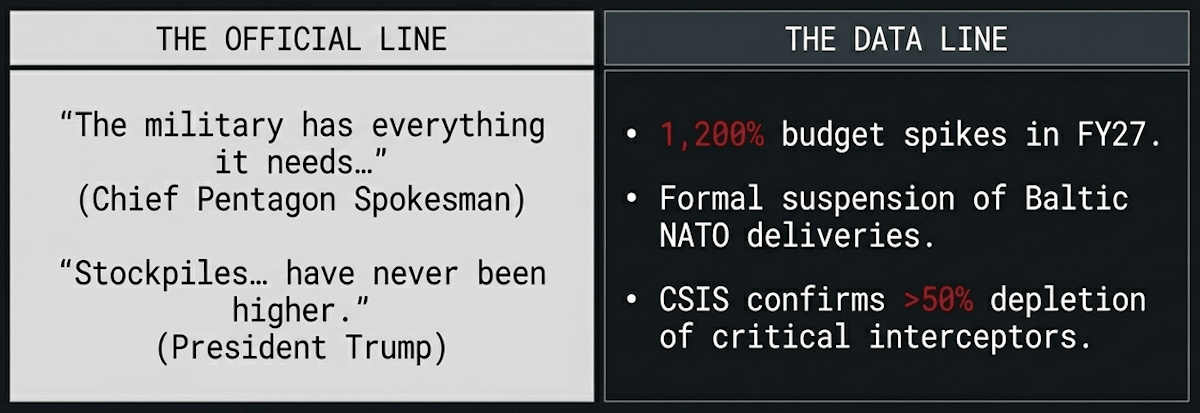
The White House, in its April 7, 2026 victory statement, announced that Operation Epic Fury had "exceeded core military objectives in just 38 days" and that over "85 percent of the regime's defense industrial base, including the majority of its ballistic missiles, launcher vehicles, and long-range attack drones, has been destroyed."
Democratic lawmakers have been sharply critical. Senator Richard Blumenthal cited "deep concern" for Ukraine. Senator Mark Kelly of Arizona said:
At some point this becomes a math problem. And how can we resupply air defense munitions? Where are they going to come from?
Other Democrats pointed out the administration's contradiction: the same interceptors previously withheld from Ukraine due to scarcity were now being expended at scale in Iran.
Joint Chiefs Chairman General Dan Caine had warned Trump before the war's start that a protracted campaign "could impact U.S. weapons stockpiles - particularly those that support Israel and Ukraine." That warning was given; the decision to proceed was made; the consequences are now being measured in percentage points of depleted stockpiles.
The FY 2027 budget request, released on April 21, 2026, is itself the most compelling official admission that the public assurances of adequacy do not fully square with the internal procurement reality. A 1,200% increase in Tomahawk procurement, a 387% increase in Iran-war munitions spending broadly, and a total defense spending request of $1.5 trillion - the largest in American history - are not the acts of an administration that believes its stockpiles are fully adequate.
The strategic assessment - A window of vulnerability
The convergence of the data presented in this report points to a period of strategic vulnerability for the United States that is both quantifiable and serious. The window is not hypothetical - it is defined by the replenishment timeline.
Pre-war level restoration: CSIS estimates 1-4 years to return inventories to pre-war levels, accounting for emergency production agreements currently underway.
Meaningful expansion above pre-war levels: Several additional years beyond restoration, given the structural constraints of the defense industrial base.
Chinese military readiness timeline: President Xi Jinping has set 2027 as the target year for PLA readiness for a Taiwan operation.
The gap: The period from 2026 through approximately 2028-2030 represents a window in which U.S. munitions inventories will be at their most depleted and industrial capacity ramp-up will not yet have delivered meaningful additional supply. This coincides with, or slightly precedes, the principal stated Chinese military readiness milestone.
The Heritage Foundation's TIDALWAVE wargame assessment - that U.S. munitions stocks were already insufficient for sustained high-intensity conflict before the Iran war's additional depletion - is now further validated by real-world consumption data. The same report found that key PGMs would be exhausted in approximately one week of high-intensity Indo-Pacific operations, that the 17,000-round VLS inventory is insufficient for one fleet reload, and that critical munitions would face systemic depletion within 25-35 days.
None of this means that a Chinese military action over Taiwan is inevitable or imminent. What it means is that the deterrence calculation - the assessment that an adversary makes before deciding whether to initiate military action - has been altered. Deterrence is most effective when a potential aggressor is certain that military action will be met with sufficient, sustained, and overwhelming defensive and retaliatory capacity. The Iran war has introduced visible uncertainty into that calculation precisely when it is most consequential.
Conclusion: Anteing up - or folding
The United States entered Operation Epic Fury with a defense industrial base that was already structurally inadequate for sustained high-intensity conflict. The conflict has confirmed, accelerated, and made publicly visible a munitions crisis that was years in the making. Seven weeks of combat have consumed more than half of the THAAD inventory, half of the Patriot interceptors, nearly half of the Precision Strike Missiles, over 30 percent of SM-3 interceptors, and significant shares of Tomahawks, JASSMs, and SM-6s - systems that cannot be replaced in months but require years.
The consequences are already materializing across multiple strategic theaters: NATO allies on the eastern flank are receiving suspension notices for HIMARS and Javelin deliveries; Ukraine's air defense interceptor supply is under new pressure as Patriot missiles are consumed in the Middle East; and Taiwan's defenders watch the erosion of the U.S. strategic reserve that underwrites the credibility of American deterrence in the Pacific.
The emergency industrial mobilization measures announced in early 2026, and amplified in the FY 2027 budget request, are necessary and appropriate - but they cannot correct in months what has been eroded over decades. Three to five years of production ramp-up will not fill the gap that exists today. The administration's public assurances that stockpiles are adequate clash directly with the quantitative assessments produced by CSIS, Heritage, JINSA, FPRI, and the Pentagon's own classified analyses - and most revealingly, with the administration's own FY 2027 budget request.
As CSIS Senior Adviser Mark Cancian stated in the most direct assessment of the crisis available in open sources:
"The high munitions expenditures have created a window of increased vulnerability in the western Pacific. It will take one to four years to replenish these inventories and several years after that to expand them to where they need to be."
In the meantime, the United States' adversaries - Russia on Ukraine's border, China watching the Pacific - are calibrating their decisions against the most current information about American military capacity. The munitions crisis is not merely an accounting problem or a procurement planning failure. It is a strategic liability in the most consequential geopolitical competition of the twenty-first century.
Share now









Key takeaways
- Seven weeks of Operation Epic Fury (February 28 - April 2026) consumed at least 45% of U.S. Precision Strike Missile (PrSM) stockpiles, at least 50% of THAAD interceptor inventory, approximately 50% of Patriot (PAC-3 MSE) interceptors, over 30% of SM-3 interceptors, more than 20% of JASSM air-launched cruise missiles, at least 10% of SM-6 missiles, and 20-30% of Tomahawk cruise missiles, per a CSIS analysis confirmed by three individuals with access to classified Pentagon stockpile assessments (CSIS, April 21, 2026).
- 850+ Tomahawks fired in the first month of the Iran war - the most Tomahawks expended in any single military campaign in history, surpassing the 802 used during Operation Iraqi Freedom (Washington Post, March 27, 2026). CSIS estimates approximately 3,000 Tomahawks remain in U.S. inventory as of the ceasefire.
- The depletion is cumulative: prior conflicts - including the Red Sea Houthi campaign (approx. 200 SM-2/SM-6 interceptors), the June 2025 Twelve-Day War (150+ THAAD and 80 SM-3 interceptors), and the October 2024 True Promise II strike response (12 SM-3) - had already significantly degraded inventories before Operation Epic Fury began.
- CSIS Senior Adviser Mark Cancian: "The high munitions expenditures have created a window of increased vulnerability in the western Pacific. It will take one to four years to replenish these inventories and several years after that to expand them to where they need to be." (CNN, April 21, 2026)
- CSIS authors Cancian and Park: "Even before the Iran war, stockpiles were deemed insufficient for a peer competitor fight. That shortfall is now even more acute and building stockpiles to levels adequate for a war with China will take additional time." (Last Rounds? Status of Key Munitions at the Iran War Ceasefire, April 21, 2026)
- Iran retains significant residual capability: U.S. intelligence estimates that Iran retains approximately 40% of its pre-war long-range attack drone arsenal and approximately 60% of its pre-war ballistic missile stockpile as of the ceasefire, despite White House claims that 85% of Iran's defense industrial base has been destroyed (SOF News / White House, April 2026).
- Even with emergency production agreements - including a Lockheed Martin framework to increase PAC-3 MSE output from ~600 to ~2,000 per year and a THAAD production increase from 96 to 400 per year - the delivery timeline for replacement munitions is 3-5 years due to long supply chains, qualification cycles, and prior underinvestment (CSIS, April 21, 2026).
- The FY 2027 defense budget request - totaling $1.5 trillion, the largest in U.S. history - includes a 1,200% increase in Tomahawk procurement (from ~55 to 785 missiles, ~$3 billion), a doubling of JASSM procurement (from 381 to 821), a 1,112% increase in HIMARS funding ($61M to $745M), $30 billion+ for critical munitions broadly, and $54 billion for drone procurement and $21 billion for drone-defeat systems (Pentagon FY2027 Budget Request, April 21, 2026).
- The Heritage Foundation's TIDALWAVE report (January 2026) found, before the Iran war's additional depletion, that U.S. munitions inventories for a high-intensity Taiwan conflict would be exhausted within approximately 25 days; earlier wargaming estimated only 8 days for critical precision munitions; the total VLS inventory of approximately 17,000 rounds is insufficient for even one full fleet reload.
- The United States formally suspended weapons and ammunition deliveries to NATO's Baltic members - Estonia, Lithuania, and Latvia - for the duration of the Iran conflict, directly affecting HIMARS ammunition and Javelin anti-tank missiles critical to eastern flank deterrence. Estonia has approximately $160 million in outstanding U.S. orders; Lithuania approximately $640 million (Defense News / Estonian World, April 20, 2026).
- Ukrainian President Zelenskyy stated that more U.S.-made Patriot defense systems were used in three days of the Iran war than Ukraine had received in total since 2022. U.S. Patriot interceptor supply to Ukraine was already severely constrained before Operation Epic Fury further depleted inventories.
- Iran's strategic missile campaign exploited cost-exchange asymmetry: a Shahed-136 drone costs $20,000-50,000; an SM-6 interceptor costs $4.3 million (ratio: ~86:1 in Iran's favor); a THAAD interceptor costs $12.7-15 million (ratio: 6:1 to 25:1 in Iran's favor). Iran deliberately used older, cheaper ballistic missiles in early salvos to exhaust U.S. and Israeli interceptor inventories.
- China's military has set 2027 as the target readiness date for a potential Taiwan operation. The 1-4 year replenishment window for U.S. munitions creates a period of acute vulnerability that directly overlaps with this stated Chinese timeline.
- Secretary of State Marco Rubio publicly acknowledged the production-consumption imbalance: Iran produces over 100 missiles per month; the U.S. can produce only approximately 6-7 high-end interceptors per month (CNN, March 4, 2026).
- THAAD production stood at approximately 12 interceptors per year under base procurement before emergency measures; the estimated 534 THAAD interceptors delivered to U.S. inventory through 2025 have been reduced by 50% or more across two Iran-Israel wars and Operation Epic Fury; no new THAAD deliveries to U.S. inventory occurred between July 2023 and early 2026, as production was dedicated to the Saudi Arabia 360-interceptor sale (CSIS, December 2025).
- A key non-funding constraint on production acceleration is U.S. dependence on Chinese-controlled critical minerals - gallium and germanium - essential for precision guidance system semiconductors, creating a geopolitical supply-chain vulnerability embedded in the munitions ramp-up itself.
- The structural root cause of the crisis is decades of inconsistent defense procurement - driven by continuing resolutions, annual appropriations uncertainty, and the repeated use of high-end munitions in secondary conflicts without proportionate replacement orders - that prevented the defense industrial base from investing in the production capacity necessary for sustained high-intensity war.
Sources
- Cancian, Mark F., and Chris H. Park. "Last Rounds? Status of Key Munitions at the Iran War Ceasefire." CSIS, April 21, 2026. https://www.csis.org/analysis/last-rounds-status-key-munitions-iran-war-ceasefire
- Cancian, Mark F., and Chris H. Park. "Assessing the Air Campaign After Three Weeks: Iran War By the Numbers." CSIS, March 25, 2026. https://www.csis.org/analysis/assessing-air-campaign-after-three-weeks-iran-war-numbers
- Rumbaugh, Wes. "The Depleting Missile Defense Interceptor Inventory." CSIS, December 5, 2025. https://www.csis.org/analysis/depleting-missile-defense-interceptor-inventory
- Cohen, Zachary, and Natasha Bertrand. "US at risk of running out of missiles if another war breaks out after depleting stockpile in Iran operations." CNN, April 21, 2026. https://www.cnn.com/2026/04/21/politics/us-military-missile-stockpile
- CNN. "How many missiles do Iran and the US have? The war's troubling munitions math." March 4, 2026. https://www.cnn.com/2026/03/04/politics/missiles-weapons-stockpile-iran-us-war
- Heritage Foundation. "Chapter 6: Assessing the U.S. Indo-Pacific Munitions System." TIDALWAVE Report, January 2026. https://www.heritage.org/tidalwave/chapters/chapter-6-assessing-the-us-indo-pacific-munitions-system
- Cicurel, Ari. "Shielded by Fire: Middle East Air Defense During the June 2025 Israel-Iran War." JINSA, July 2025. https://jinsa.org/jinsa_report/rising-lion-air-defense/
- Foreign Policy Research Institute. "Shallow Ramparts: Air and Missile Defenses in the June 2025 Israel-Iran War." FPRI, October 2025. https://www.fpri.org/article/2025/10/shallow-ramparts-air-and-missile-defenses-in-the-june-2025-israel-iran-war/
- TIME Magazine. "Iran War Burning Through Crucial US Weapons Stockpiles." March 2026. https://time.com/7382582/trump-iran-war-weapons-stockpiles/
- Al Jazeera. "Amid Iran war, will Russia exploit Ukraine's shortage of Patriot missiles?" March 6, 2026.
- Estonian World. "Iran conflict – the US pauses arms deliveries to Estonia." April 20, 2026. https://estonianworld.com/security/iran-conflict-the-us-pauses-arms-deliveries-to-estonia/
- Defense News. "Baltic nations brace for impact of Iran war delaying US weapons shipments." April 20, 2026. https://www.defensenews.com/global/europe/2026/04/20/baltic-nations-brace-for-impact-of-iran-war-delaying-us-weapons-shipments/
- Small Wars Journal. "Magazine depth: Rapid depletion of missile stockpiles in Iran raises concerns about US readiness." March 27, 2026. https://smallwarsjournal.com/2026/03/27/magazine-depth-iran-missiles-stockpile-readiness/
- Asia Times. "China watching as US missile stocks drain over Iran." March 5, 2026. https://asiatimes.com/2026/03/china-watching-as-us-missile-stocks-drain-over-iran/
- Fortune. "As Trump says military has plenty of munitions for Iran war, Democrats point out U.S. didn't give Ukraine more interceptors because of low supply." March 7, 2026.
- Stars and Stripes. "US used 14% of its THAAD stockpile against Iran, a report says. It could take years to replenish." July 23, 2025.
- CNN. "US used about 25% of its THAAD missile interceptors during Israel-Iran war." July 28, 2025.
- Army Recognition. "U.S. Army Awards $4.76B PAC-3 MSE Contract." April 2026.
- Navy Times. "US Navy seeks 1,200% increase in Tomahawk missile procurement for 2027." April 7, 2026. https://www.navytimes.com/news/your-navy/2026/04/07/us-navy-seeks-1200-increase-in-tomahawk-missile-procurement-for-2027/
- Associated Press / WSLS. "US military pushes for boost in 2027 spending on drones and air defenses used in Iran war." April 21, 2026. https://www.wsls.com/news/politics/2026/04/21/us-military-pushes-for-boost-in-2027-spending-on-drones-and-air-defenses-used-in-iran-war/
- White House. "Peace Through Strength: Operation Epic Fury Crushes Iranian Threat as Ceasefire Takes Hold." April 7, 2026. https://www.whitehouse.gov/releases/2026/04/peace-through-strength-operation-epic-fury-crushes-iranian-threat-as-ceasefire-takes-hold/
- SOF News. "Epic Fury Update – April 19, 2026." https://sof.news/middle-east/epic-fury-19april2026/
- Taxpayers for Common Sense. "Budget Request Supersizes Munitions Procurement, Undercutting Case for War Supplemental." April 2026. https://www.taxpayer.net/national-security/budget-request-supersizes-munitions-procurement-undercutting-case-for-war-supplemental/
- O'Donnell, Wes. "What's Really in Trump's 2027 $1.5 Trillion Defense Budget?" April 2026. https://www.wesodonnell.com/p/whats-really-in-trumps-2027-15-trillion
- Published 2026-04-22 17:32
- Modified 2026-04-22 20:43

-
Redaction

