

-
 Redaction
Bioluminescence: The science behind cold light
Bioluminescence is an efficient cold light produced by luciferin and luciferase. This chemical process first emerged in animals 540 million years ago.
The chemistry of cold light
Nature possesses a quiet, efficient way of illuminating the dark - without the heat of a flame or the friction of electricity. This process, known as bioluminescence, is a form of chemiluminescence where living organisms generate visible light through internal chemical reactions. At the heart of this glow is a substrate called luciferin and its partner enzyme, luciferase. When luciferase catalyzes the oxidation of luciferin, it creates an excited-state molecule known as oxyluciferin. As this molecule relaxes back to its ground state, it releases energy in the form of photons - in other words, light.

This reaction is remarkably efficient. Unlike incandescent bulbs that lose most of their input energy to heat, bioluminescence is often called cold light because nearly all of the energy is converted directly into illumination. The basic biochemical principle remains constant across species, yet the molecules themselves vary significantly across the tree of life. Fungi, bacteria, and marine animals have each developed distinct luciferin structures - strong evidence that this ability did not descend from a single ancestor, but emerged through independent evolutionary paths. In some hydromedusae like Aequorea victoria, the process is even more specialized: it relies on photoproteins that flash instantly upon contact with calcium ions, bypassing the luciferin-luciferase mechanism altogether.
A timeline reaching back 540 million years
For many years, the scientific community believed bioluminescence was a relatively recent adaptation in the animal kingdom. Earlier records pointed to ostracods - small crustaceans - as the pioneers of biological light, at approximately 267 million years ago. A landmark 2024 study dramatically shifted that timeline. Research published by the Smithsonian Institution indicates that the earliest animal bioluminescence emerged roughly 540 million years ago in the common ancestor of octocorals (soft corals and related organisms). This pushes the origin of biological light back by nearly 300 million years, placing its birth in the ancient marine environments of the Cambrian period.

Evolution has since replicated this success many times over. Current estimates suggest bioluminescence has evolved independently at least 94 times across the tree of life. Within ray-finned fishes alone, light production has appeared in 27 independent evolutionary events, distributed across 14 major lineages. In some cases, fish produce their own light through intrinsic chemistry; in others, they host symbiotic bacteria that provide the glow. While diverse among bony fish, the trait is rare in sharks - having evolved only once (or possibly a few times) in that group's entire history.
How bioluminescence works at the molecular level
Understanding bioluminescence at a deeper level means appreciating how tightly controlled these light-emitting reactions are. Organisms do not glow continuously or without purpose - the chemistry is precisely regulated.
In most systems, the reaction requires three components working together: luciferin (the light-emitting molecule), luciferase (the enzyme that drives oxidation), and molecular oxygen. ATP (adenosine triphosphate) is also involved in firefly reactions, linking the glow directly to the organism's available energy. The result is the emission of a photon with a specific wavelength, often in the blue-green range (440-480 nm) in marine environments - a spectrum that travels furthest through seawater.
Different lineages have evolved entirely different luciferins. Coelenterazine, common in marine invertebrates and fish, is structurally unrelated to the firefly luciferin found in terrestrial beetles. This molecular diversity is itself a testament to convergent evolution: nature found the same ecological solution to darkness through entirely different chemical routes.
The glow of the modern coast and deep seas
Residents along the coast of Southern California - including Newport Beach and Ventura - regularly witness the ocean's chemistry firsthand during bioluminescent red tides. These events are caused by large blooms of the dinoflagellate Lingulodinium polyedra. These single-celled organisms produce light in specialized organelles called scintillons. When waves or movement agitate the water, they emit electric-blue flashes that can turn breaking surf into a striking neon display. During intense blooms, concentrations can reach millions of cells per liter.

Further out and deeper down, the newly described West Australian Lantern shark (Etmopterus westraliensis) - a species formally identified in 2025 from specimens collected in 2022 - offers another perspective entirely. This deep-sea shark uses specialized light organs called photophores to emit a blue-green glow. Like many lanternsharks, it employs counterillumination: matching the faint ambient light from above to erase its own silhouette from predators swimming below. Many lanternsharks regulate their photophores using hormonal signals such as melatonin, adding another layer of biological sophistication to the process.
Functions of light in the dark
Organisms do not expend energy on light production without significant ecological benefit. In the pelagic deep sea - the open water column between 200 and 1,000 metres - roughly 75-80% of animals are estimated to produce bioluminescence. The functions driving this extraordinary prevalence fall into several categories.
Defense is one of the most widespread applications. Dinoflagellates use rapid light flashes to startle potential predators, while some creatures employ a "burglar alarm" strategy: flashing to attract a larger predator that might consume the immediate threat. This multi-level deterrence is elegant in its simplicity.
Camouflage through counterillumination is equally widespread. Many deep-sea fish and squid match the intensity of downwelling light from above, effectively disappearing when viewed from below - one of nature's more counterintuitive uses of light.
Communication drives bioluminescence in others. Species recognition and mate attraction are primary selective pressures in the lightless deep ocean, where visual signals cannot rely on sunlight. Fireflies on land solve the same problem with species-specific flash patterns.
Predation rounds out the picture. The anglerfish's iconic esca - a bioluminescent lure dangled in front of its jaws - is perhaps the most recognisable example, but similar lure strategies appear independently across numerous deep-sea lineages.
Where to see bioluminescence in person
For those seeking a direct encounter with living light, several locations offer reliable, documented experiences.
Southern California remains one of the most accessible options during red tide events, typically occurring in spring and summer. Beaches near San Diego, Newport Beach, and Ventura can produce brilliant blue surf when L. polyedra blooms are active - no equipment required.
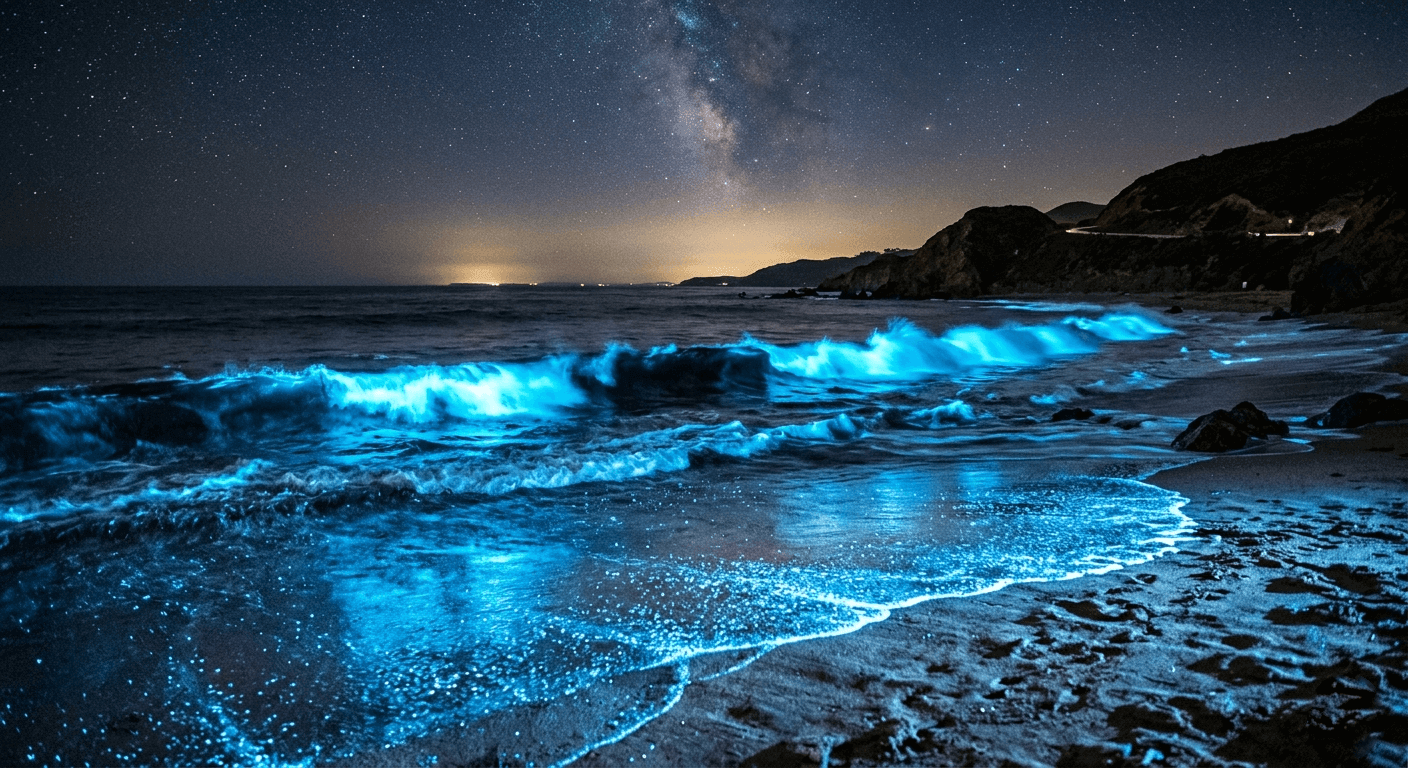
The Bioluminescent Bay in Vieques, Puerto Rico (Mosquito Bay) is widely regarded as one of the world's most concentrated bioluminescent bays, sustained year-round by dense dinoflagellate populations. Tours typically run at night from kayaks.
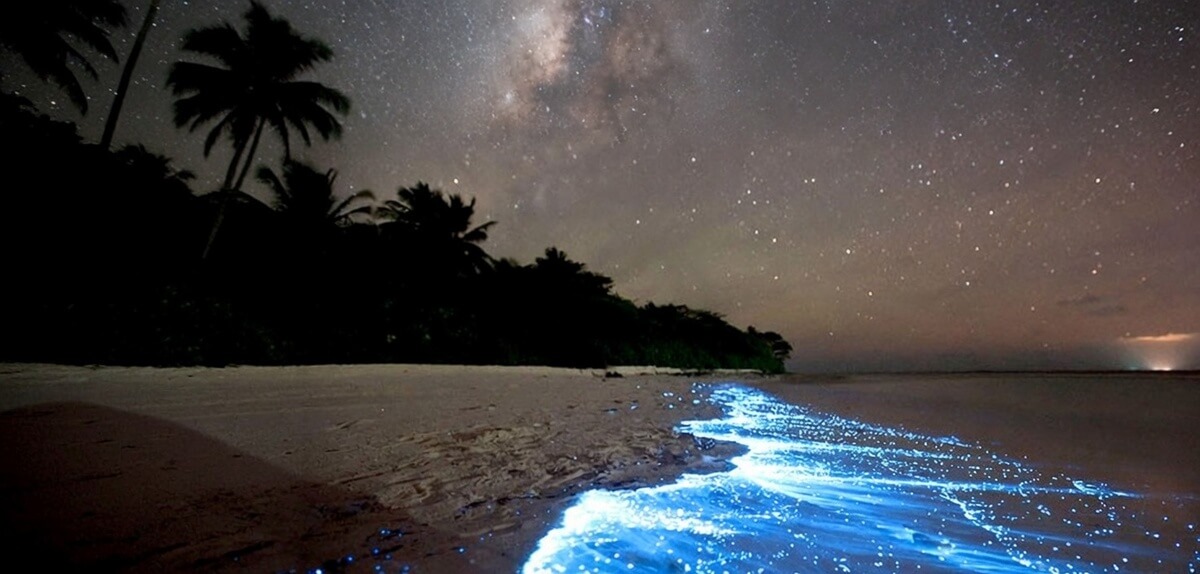
Luminous Lagoon in Jamaica (near Falmouth) is another consistently glowing bay. The warm, shallow conditions and nutrient-rich water create ideal conditions for dinoflagellate blooms.
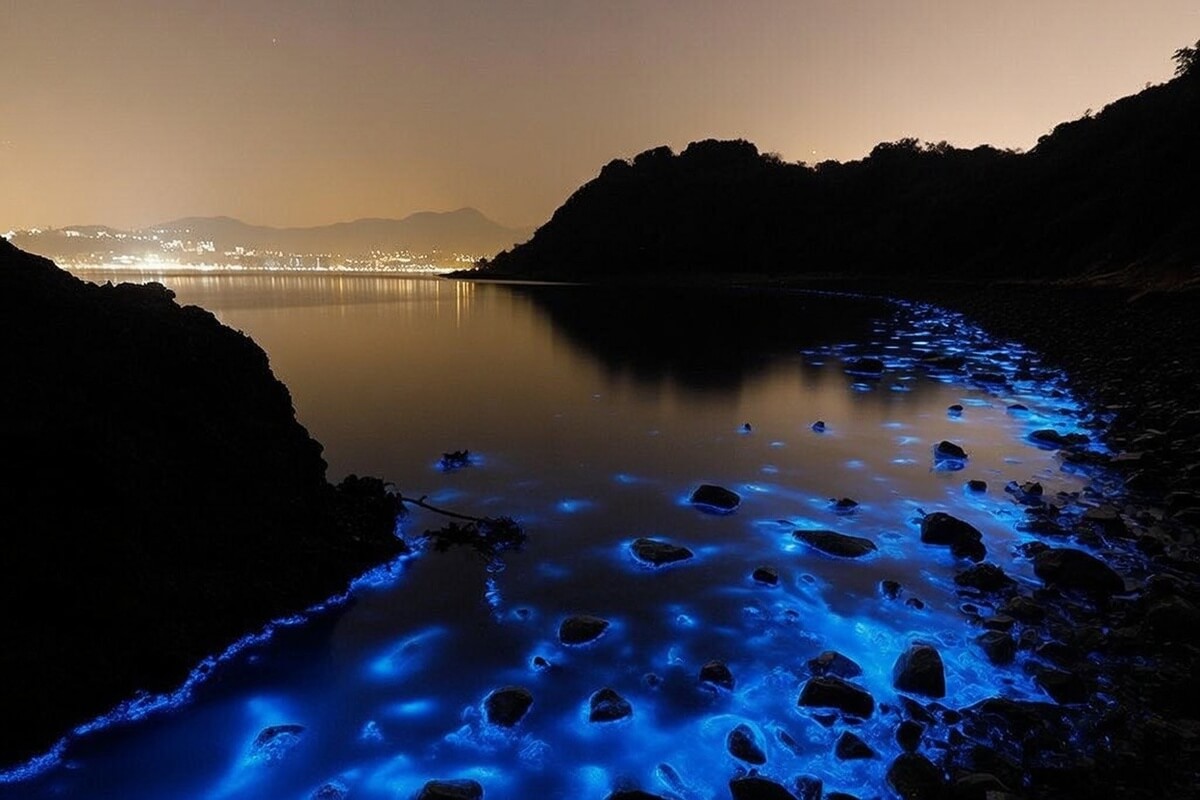
The Maldives offers open-ocean encounters, particularly on beaches facing deeper water, where Noctiluca scintillans blooms turn breaking waves a ghostly blue.
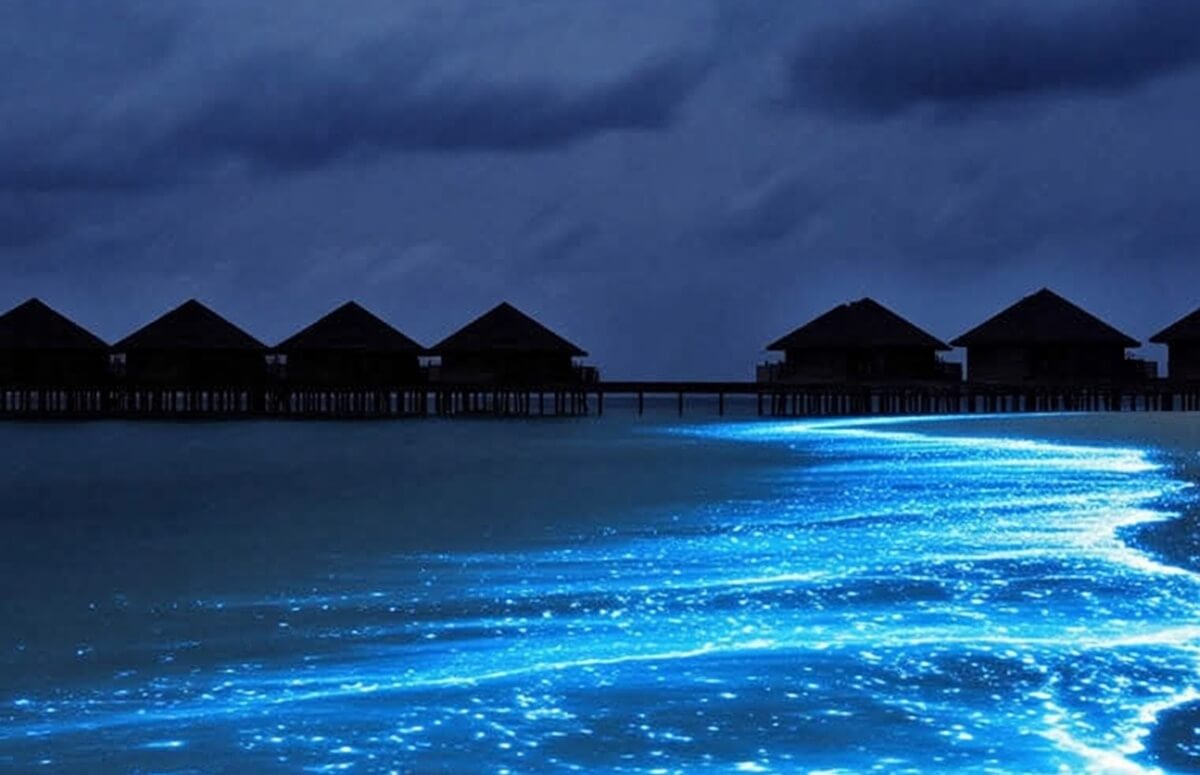
In all cases, the best viewing conditions share the same requirements: a moonless night, minimal light pollution, and physical disturbance of the water - a paddle stroke, a wave, or simply wading in.
Lighting the cities of tomorrow
Beyond its ecological beauty, bioluminescence is being seriously explored as a tool for human sustainability. Researchers are investigating bioluminescent plankton and bacteria as potential low-energy, carbon-neutral light sources for urban environments. Some laboratory cultures have shown promising light output - though scaling the technology from a petri dish to a street lamp involves considerable biological and engineering challenges.
Plankton often follow strict circadian rhythms, naturally brighter at night but typically requiring mechanical stimulation to trigger a glow. Cultivation protocols must also confirm that strains used in public installations are non-toxic and suitable for long-term maintenance. Current research directions include engineering higher-yield strains through synthetic biology and developing self-sustaining bioreactor panels that could replace backlit signage or provide ambient lighting in sustainable architecture.
The prospect of living, glowing light sources - self-repairing, requiring only water and nutrients, and producing zero electrical waste - offers an intriguing glimpse into a future where biology and technology work in harmony. Whether that vision reaches cities within a decade or a generation remains an open question, but the chemistry has been quietly solving the problem for half a billion years already.
Share now









Key takeaways
- Bioluminescence is a chemical reaction involving luciferin and luciferase (or photoproteins) that produces cold light with minimal heat loss.
- A 2024 study indicates that bioluminescence first evolved in animals at least 540 million years ago in the ancestor of octocorals - nearly 300 million years earlier than previously thought (ostracods ~267 Ma).
- Bioluminescence has evolved independently at least 94 times across life; in ray-finned fishes it arose in 27 independent evolutionary events across 14 major lineages.
- In the deep-sea pelagic zone, approximately 75-80% of organisms utilize bioluminescence for camouflage, communication, defense, and predation.
- Scientists continue to investigate bioluminescent plankton and bacteria as sustainable lighting alternatives, though practical urban applications still face technical and biological challenges.
- Bioluminescent "red tides" caused by Lingulodinium polyedra are a recurring natural phenomenon along the Southern California coast, producing spectacular blue-glowing waves at night.
Sources
- Smithsonian Institution https://www.si.edu/newsdesk/releases/bioluminescence-first-evolved-animals-least-540-million-years-ago
- NOAA Ocean Exploration https://oceanexplorer.noaa.gov/ocean-fact/bioluminescence/
- Davis et al. (2016), PLOS ONE https://journals.plos.org/plosone/article?id=10.1371/journal.pone.0155154
- Ferrón (2023), Palaeontology https://onlinelibrary.wiley.com/doi/10.1111/pala.12641
- CSIRO https://www.csiro.au/en/news/All/Articles/2025/October/New-species-of-shark-and-crab
- Wikipedia - Bioluminescence https://en.wikipedia.org/wiki/Bioluminescence
- Published 2026-04-27 00:08
- Modified 2026-05-22 14:38

-
Redaction