

-
 Redaction
The math of fairness: why no vote is perfect
Discover why mathematicians proved that no voting system can ever be perfectly fair, and how Arrow's impossibility theorem still shapes today's elections.
The quest for the perfect ballot
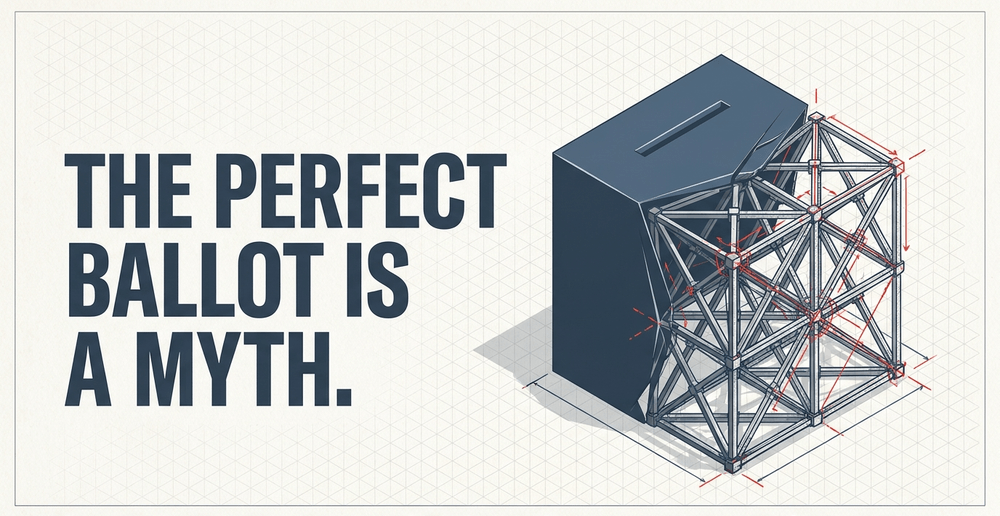
To understand the architecture of modern democracy, one must first confront a sobering mathematical reality: a truly fair and perfect voting system is not merely an elusive political goal. It is a proven impossibility. We tend to think of voting as a simple administrative mechanism for aggregating preferences, a kind of tally that turns many opinions into one answer. Social choice theory tells a different story, one riddled with paradoxes and unavoidable trade-offs. The deeper one investigates the mechanics of how a group makes a decision, the more it becomes clear that the friction between individual liberty and collective coherence is built into the arithmetic of the ballot itself.

The pursuit of a flawless electoral method has old roots. It was driven, in part, by an Enlightenment faith that reason could dissolve the friction of human disagreement. The Marquis de Condorcet pursued such a system in the 18th century, and centuries earlier the Majorcan polymath Ramon Llull had sketched similar ambitions. But the 20th century brought a rigorous mathematical ceiling to these aspirations. Through the lens of welfare economics, we have learned that whenever three or more choices appear on a ballot, no ranking system can consistently satisfy a basic set of fairness requirements. This is not a failure of political will. It is a constraint of logic, as fixed as any theorem in geometry.
Arrow's impossibility theorem and the structural limits of choice
In 1951, the economist Kenneth Arrow published Social Choice and Individual Values, a slim but seismic work that reshaped how we think about collective decision-making. Arrow, who would later receive the Nobel Memorial Prize in Economic Sciences in 1972, set out to find a "social welfare function" - a method for converting individual ranked preferences into a single societal ranking - that could satisfy a handful of conditions most people would consider obviously fair. His conclusion was bracing: no such method exists, unless it collapses into a dictatorship.
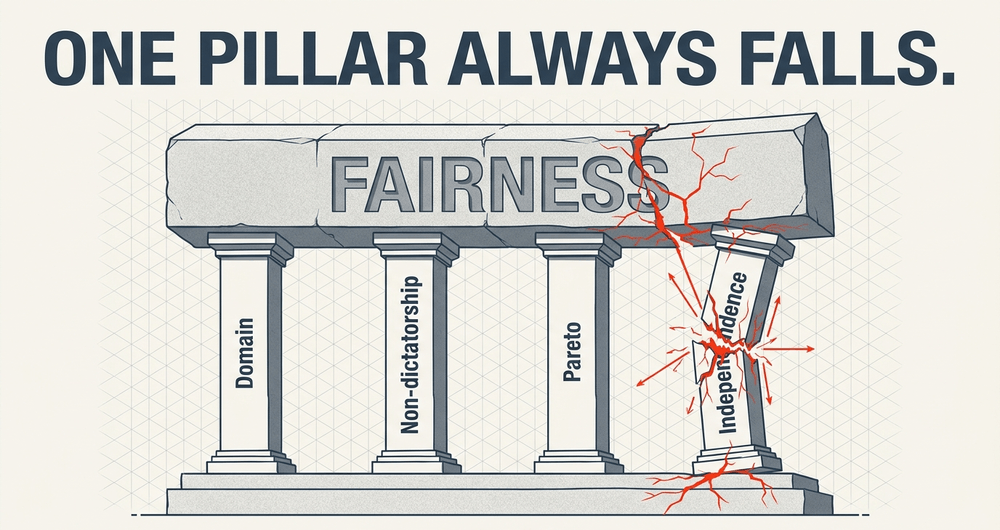
To appreciate the weight of that finding, it helps to walk through the conditions themselves. Arrow asked only for:
- Unrestricted domain - the system must process any possible set of individual preferences without crashing or refusing to produce a result.
- Non-dictatorship - no single voter's preference should automatically become the societal outcome regardless of what anyone else wants.
- Pareto efficiency - if every voter prefers Candidate A to Candidate B, the final societal ranking must place A above B as well.
- Independence of irrelevant alternatives - the collective choice between A and B should depend only on how voters rank A against B, not on how a third candidate, C, happens to be faring.
Each one, taken alone, sounds like common sense. Taken together, Arrow proved they sound the death knell for any non-dictatorial ranking system.

The friction of irrelevant alternatives
It is the fourth condition, independence of irrelevant alternatives, where most real systems quietly fall apart. The idea is intuitive enough: if a group prefers A over B, that preference shouldn't flip to B over A simply because a third "spoiler" candidate has entered the race. And yet it does, constantly, in the world's actual elections.
Arrow's proof showed that requiring a system to be transitive - meaning that if society prefers A to B, and B to C, it must also prefer A to C - while simultaneously satisfying the other three conditions, leaves only one way out: a dictatorship, where one voter's preference determines the outcome regardless of the rest. One pillar must always fall. This is the rigorous, mathematical reason modern elections so often feel "spoiled" or arbitrary. The system is not malfunctioning. It is navigating a genuine logical minefield, where every step toward one kind of fairness is a step away from another.
It's worth pausing on a subtlety that often gets lost when Arrow's theorem is invoked as a blanket verdict on democracy itself. Arrow's proof applies specifically to ranked, or ordinal, voting systems, and Arrow himself later acknowledged that rules based on cardinal utilities - where voters score or rate candidates rather than simply ranking them - are not subject to his theorem. Score voting and approval voting, which ask voters to rate each candidate independently rather than place them in a strict order, sidestep the specific mathematical trap Arrow identified. That does not make them perfect; as we'll see, a sibling theorem closes off that escape route too. But it is a meaningful asterisk, and one too rarely mentioned in popular accounts of the theorem.
The strategic dilemma of the Gibbard-Satterthwaite theorem
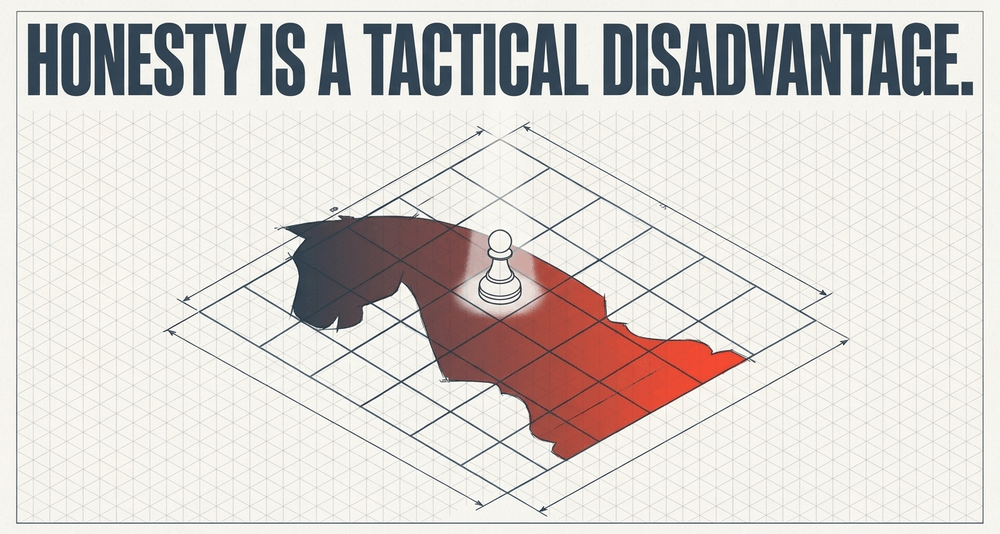
If Arrow's work exposed the structural fragility of voting outcomes, the Gibbard-Satterthwaite theorem, established in the mid-1970s through the independent work of Allan Gibbard and Mark Satterthwaite, turns the lens toward the behavior of voters themselves. It addresses strategic voting - the act of a voter misrepresenting their genuine preferences in order to engineer a better personal outcome. Anyone who has voted for a "lesser evil" mainstream candidate, while quietly preferring someone with no realistic chance of winning, has lived this theorem firsthand.
The theorem states that any deterministic voting rule with more than two possible outcomes must be one of three things: dictatorial, limited to only two options, or manipulable. There is, in other words, no fully "strategy-proof" system once you have three or more candidates and want to avoid handing power to a single voter. In every reasonable rank-order system, there exist scenarios where lying about your preferences pays off. And crucially, this constraint does not vanish for cardinal methods - while rated systems escape Arrow's theorem, they remain vulnerable to strategic manipulation under Gibbard's broader theorem, since no voting game can guarantee a single, always-best honest strategy. A voter's optimal move ends up depending on a guess about how everyone else will vote, which turns democratic expression into something closer to a game of tactical positioning than a sincere declaration of values.
The Condorcet paradox and the cycle of majority rule
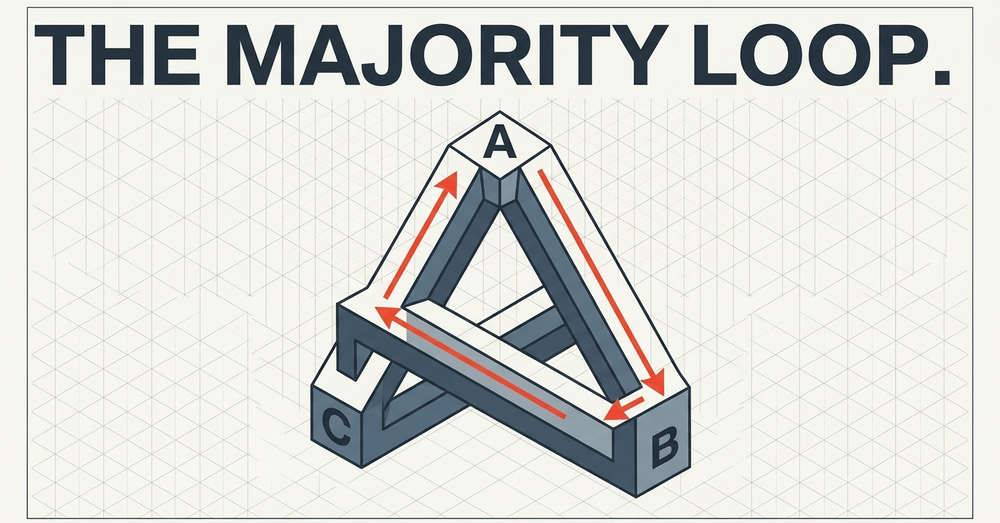
Set strategic manipulation aside entirely, assume every voter is perfectly honest, and you still run into the Condorcet paradox. Named for the same 18th-century French mathematician and philosopher who first identified it, this paradox demonstrates that collective preferences can be cyclical even when every individual's preferences are perfectly rational and linear.
Picture three voters ranking three candidates:
Voter 1 prefers A over B over C. Voter 2 prefers B over C over A. Voter 3 prefers C over A over B.
A majority - Voters 1 and 3 - prefers A to B. A majority - Voters 1 and 2 - prefers B to C. By the ordinary logic of transitivity, society should therefore prefer A to C. But a majority - Voters 2 and 3 - actually prefers C to A. The result is a closed loop, a kind of electoral rock-paper-scissors in which no candidate can honestly claim to be the true majority choice. It is a direct violation of the transitivity that any stable social preference would require.
How often does this actually happen? The honest answer is: it depends enormously on which model you trust. Under the "impartial culture" assumption, where every possible ranking is equally likely, theoretical estimates for three-candidate elections tend to cluster somewhere in the range of 6 to 9 percent. But empirical work tells a gentler story: an analysis of 883 three-candidate elections drawn from 84 real-world ranked-ballot contests run by the Electoral Reform Society found a Condorcet cycle likelihood of just 0.7 percent, while a parallel analysis of American National Election Studies survey data from 1970 to 2004 found a likelihood of 0.4 percent. Other analyses, pooling dozens of individual studies together, have found higher figures - one summary of 37 studies covering 265 real-world elections found 25 instances of the paradox, a rate of roughly 9.4 percent, though the author cautions this may be inflated since paradoxical elections are simply more likely to get written up and studied in the first place. Real voters, it turns out, don't distribute their preferences randomly. Ideology clusters people along recognizable lines, and that clustering quietly suppresses the cycles that pure mathematics would otherwise predict.
Evaluating common electoral failures
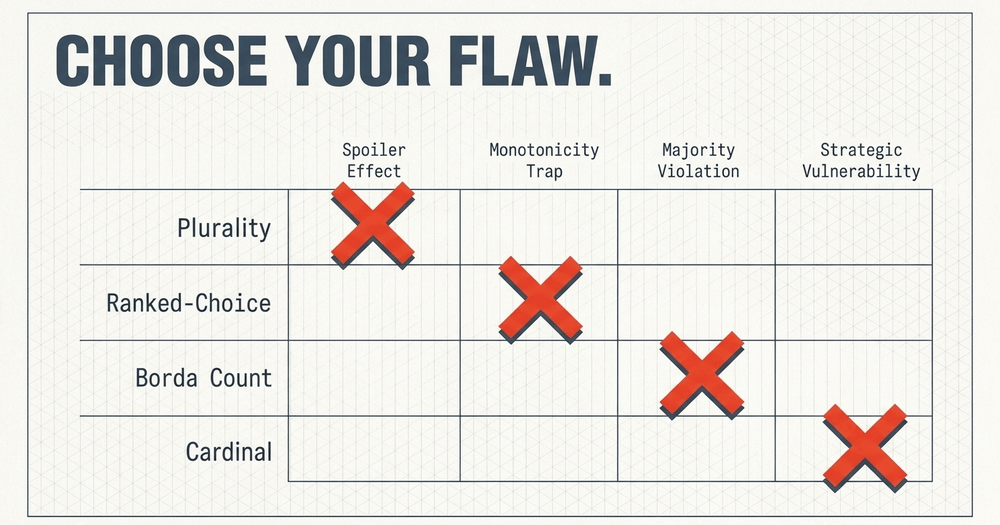
These theoretical impossibilities are not confined to academic journals. They manifest in very real ways across the voting methods used worldwide today. No system escapes the reach of these theorems, but each fails in its own characteristic, often predictable way. Examining those failures tells us something about which specific flavor of unfairness a given society has chosen to live with.
Plurality and the spoiler effect
The most common system in the English-speaking world is plurality voting, often called first-past-the-post. The candidate with the most votes wins, full stop, regardless of whether that candidate has secured an actual majority. Its central weakness is a near-total surrender to the independence of irrelevant alternatives problem. Plurality is acutely vulnerable to the spoiler effect, in which a third-party candidate siphons votes away from an ideologically similar major candidate, effectively handing victory to a rival the majority of voters would actually have preferred to lose. The system marginalizes minority political voices and, over time, tends to compress the political landscape into two dominant parties, since voting for anyone else risks "wasting" a ballot.
Ranked-choice voting and the monotonicity trap
Instant runoff voting, more commonly known as ranked-choice voting, is frequently proposed as the cure for plurality's spoiler problem. Voters rank candidates in order of preference; the candidate with the fewest first-place votes is eliminated, and their support is redistributed according to those voters' next preferences, round after round, until someone secures a majority. It does meaningfully reduce spoiler effects. But it carries its own characteristic flaw: the monotonicity paradox.
This is the genuinely strange scenario where a candidate loses an election precisely because they gained support, or wins one because they lost support. The mechanism is the order of elimination. Because IRV proceeds in discrete rounds, a candidate picking up additional first-place votes can change which rival gets eliminated early, which can in turn allow that candidate's strongest opponent to survive into a final round they would otherwise never have reached. Empirical research bears this out: an analysis of instant-runoff elections in California between 2008 and 2016, together with Vermont's notorious 2009 Burlington mayoral race, found an upward monotonicity anomaly in roughly 0.74 percent of all such elections - but that figure climbed to 7.7 percent once the analysis was narrowed to competitive three-candidate contests, which is precisely where the paradox bites hardest. The Burlington race remains the textbook case: a Condorcet winner, a candidate who would have beaten every other contender in a head-to-head matchup, was eliminated before the final round under IRV's own counting rules. Ranked-choice voting solves one problem and quietly opens a different door.
The mathematics is one thing. The politics surrounding it, lately, is quite another. Ranked-choice voting has become, almost paradoxically, the most rapidly expanding and the most aggressively banned electoral reform in the United States at the same time. Dozens of cities have adopted it in recent years, drawn by research suggesting it softens negative campaigning and broadens the field of candidates willing to run. New York City's mayoral primaries, Minneapolis, Cambridge's decades-long use of a proportional variant, the addition of new municipalities each election cycle - the reform keeps spreading at the local level. And yet, in the same stretch of time, close to twenty state legislatures have moved in the opposite direction, banning the method outright, generally before a single ballot under that system has ever been cast within their borders. It's a vivid illustration of the article's broader theme: a reform that demonstrably fixes one structural flaw is, simultaneously, distrusted precisely because of the different flaw it introduces. Readers interested in how this same tension between procedural reform and entrenched political resistance plays out in other corners of law and policy might find a useful companion in this site's examination of how legal precedent shapes and constrains institutional change.

The Borda count and the majority criterion
The Borda count, which awards points according to rank - three points for first place, two for second, one for third, and so on - shows up in sports awards (it's the system behind the Heisman Trophy and most MVP voting) and in a handful of political contexts, most notably the Pacific island nations of Kiribati and Nauru. It captures something plurality misses entirely: a sense of overall consensus rather than raw first-place enthusiasm. But it can violate the majority criterion with startling ease. A candidate who is the sincere first choice of 54 percent of voters can still lose, if the remaining 46 percent rank that candidate dead last while ranking someone else second. The result is a "compromise" candidate elected over one with genuine, demonstrated majority support - a paradox that has made the Borda count a perennial subject of academic skepticism, even as it persists in award ceremonies.
Cardinal alternatives and their own limits
It is worth dwelling for a moment on the systems that try to escape this entire framework by abandoning ranking altogether. Approval voting, where citizens simply mark every candidate they find acceptable, and score voting, where they rate each candidate on a numerical scale, are both cardinal rather than ordinal systems. Because candidates are evaluated independently rather than ranked against one another, Arrow's theorem - built entirely on the logic of ordinal ranking - simply does not apply to them. Fargo, North Dakota became the first American city to adopt approval voting, partly on the strength of this theoretical advantage.
The catch, as with everything in this field, is that the advantage is narrower than it first appears. These methods remain fully vulnerable to strategic voting under Gibbard's theorem, and their resistance to the spoiler effect holds only under specific assumptions about how voters use the rating scale - it tends to break down once voters start adjusting their scores relative to whoever else is in the race, rather than against some fixed, absolute standard. There is no clean escape from the underlying tension. There is only a different point along the same trade-off curve.

Beyond the ballot: quadratic voting, sortition, and liquid democracy
If the conventional menu of voting methods all share the same impossibility ceiling, a smaller and more experimental tradition has tried to change the question entirely, rather than tinker with how preferences get tallied.
Quadratic voting is perhaps the most mathematically elegant of these attempts. Instead of casting one vote per person, each voter is given a budget of "voice credits" to spend across any number of issues or candidates, with the cost of each additional vote on a single option rising with the square of the votes cast - so two votes cost four credits, three votes cost nine, and so on. The idea, developed by the economist Glen Weyl and the legal scholar Eric Posner, is to let people express the intensity of their preferences rather than a flat, undifferentiated yes or no. It has had real, if modest, test runs: the Democratic caucus of the Colorado House of Representatives experimented with it in 2019 to rank legislative priorities, and it has since found a niche in blockchain governance and participatory budgeting platforms, where citizens allocate a limited pool of points across competing civic projects. Quadratic voting does not escape Gibbard's strategic-manipulation problem any more than score voting does, but it does something none of the classical systems attempt: it lets a voter who cares passionately about one issue spend disproportionately on it, at a cost that grows steeply enough to discourage simply buying the outcome outright.
Sortition - choosing decision-makers by lottery rather than election - takes an even more radical detour. It sidesteps Arrow's theorem altogether, because there is no aggregation problem to solve when nobody is voting in the first place; a randomly selected citizens' panel doesn't need to reconcile competing rankings, since it was never assembled by ranking anyone. The method has ancient credentials, having governed the selection of many public offices in Athenian democracy, and it persists today in the most ordinary of modern institutions: jury selection. Its modern advocates argue that a representative sample of the population, given time to deliberate, may better reflect the public's considered judgment than a popularity contest that rewards charisma and name recognition over policy substance. Its critics counter, not unreasonably, that removing the vote also removes accountability - there is no mechanism for un-electing a juror who governs badly, because no one elected them in the first place.
Liquid democracy tries to split the difference between direct and representative governance. Each citizen retains the right to vote on any issue personally, but may instead delegate that vote to someone they trust - a friend, an expert, a representative - and that delegate's vote can, in turn, be further delegated onward, creating chains of trust that can shift fluidly from issue to issue. The German and French Pirate Parties experimented with the model through platforms like LiquidFeedback in the early 2010s. In principle, it lets expertise concentrate where it is most needed without permanently surrendering anyone's voice. In practice, research on these systems has identified a tendency for voting power to pool around a small number of highly delegated "super-voters," reproducing, in a more fluid form, exactly the concentration of influence that direct democracy was meant to dissolve.
None of these alternatives breaks free of the underlying mathematics. They simply choose a different point of failure, which is, in a sense, the entire lesson of this field restated once more.
Broadening the scope: proportional vs. majoritarian systems
Step back from the mechanics of a single ballot, and the same trade-offs reappear at the level of legislative design. Most democracies choose between majoritarian systems and proportional representation. Majoritarian systems, of the kind found in the United States and the United Kingdom, prioritize stability and clear lines of accountability. They tend to produce single-party governments capable of passing legislation without negotiating fragile coalitions. The price is disproportionality: a party that wins 40 percent of the national vote might walk away with 60 percent of the seats, leaving a substantial share of the electorate effectively unrepresented in the chamber that governs them.
Proportional representation aims, instead, to make the legislature a faithful mirror of the national vote. Win 10 percent of the vote, and you should get roughly 10 percent of the seats. It feels fairer in a strict representational sense, and it is - but it tends to produce fragmented parliaments and coalition governments that can be fragile by design. Small, ideologically narrow parties sometimes become kingmakers, wielding influence wildly disproportionate to their vote share simply because a larger party needs their votes to form a government. It is the trade-off between representative fairness and executive stability, restated at a different scale.
This same family of paradox even reaches into the seemingly dry mechanics of seat apportionment. The United States discovered this the hard way in 1880, when census calculations revealed that hypothetically increasing the total number of seats in the House of Representatives would actually have cost Alabama a seat - shrinking its delegation from eight members to seven, even though nothing about Alabama's own population had changed. This became known as the Alabama paradox, and it is a cousin of the monotonicity failures that haunt IRV: a system behaving in a way that violates the basic intuition that more should never translate into less. It is, in its own quiet way, a reminder that Arrow's family of impossibility results extends well beyond the ballot box and into the architecture of representation itself.

Practical implications for voters and reformers
Given that no system passes every test, what is a modern democracy actually meant to do with this knowledge? The current consensus in social choice theory is not to chase a system that satisfies every fairness criterion - that search is provably futile - but to identify systems that fail least often, and fail in ways least corrosive to social cohesion.
A few practical orientations follow from this:
- Acknowledge the trade-offs honestly. Moving to ranked-choice voting solves the spoiler problem but introduces monotonicity violations. There is no reform that arrives free of cost.
- Identify local priorities. Some communities will value representing every minority political voice, which points toward proportional systems. Others will prioritize the ability to decisively remove an unpopular government from office, which points toward majoritarian ones.
- Simulate before adopting. Researchers increasingly rely on probabilistic models, run across tens of thousands of simulated electorates, to test which systems fail least often under realistic - rather than worst-case - conditions. These simulations consistently show that failure rates vary enormously depending on how closely voter preferences mirror real political clustering versus a purely random distribution, which is exactly why theoretical worst-case bounds and empirical observed rates can diverge so sharply.
- Watch how voters actually behave, not just how theorists model them. Survey work from jurisdictions that have already made the switch to ranked-choice voting consistently finds that the large majority of voters rank more than one candidate when given the chance, and most report finding the ballot straightforward to complete. The gap between a system's worst-case mathematical vulnerability and its lived, day-to-day experience is often wider than the theory alone would suggest.
Moving beyond binary fairness
The mathematics of fairness teaches a particular kind of humility. The "will of the people" is not a single, discoverable truth sitting out there waiting to be correctly measured. It is a complex web of individual desires, capable of being woven together in many different - and equally defensible, yet inherently imperfect - ways. Arrow's work did not merely identify a flaw to be patched. It demonstrated that the destination so many reformers have searched for, a perfect social welfare function, simply does not exist on the map.
None of this means every system is equally flawed, or that reform is pointless. It means the conversation has to mature beyond the search for a perfect system and toward a deliberate, values-based negotiation. Which do we prioritize: the right of the majority to govern, the protection of the minority from being permanently outvoted, or the stability of the state itself? Recognizing the mathematical limits of our tools doesn't end the debate over electoral design. It clarifies what the debate has actually been about all along, and gives us a more honest vocabulary for choosing our imperfections deliberately, rather than stumbling into them by accident.

Share now









Key takeaways
- Kenneth Arrow proved in 1951 that no ranked voting system involving three or more choices can simultaneously satisfy a basic set of fairness conditions without collapsing into a dictatorship. He received the Nobel Memorial Prize in Economic Sciences in 1972 for this and related work.
- Arrow's theorem applies specifically to ranked (ordinal) voting systems; cardinal systems like approval voting and score voting are not subject to it, since candidates are rated independently rather than ranked against one another.
- The Gibbard-Satterthwaite theorem shows that any deterministic voting rule with more than two outcomes must be dictatorial, limited to two options, or vulnerable to strategic manipulation - including cardinal systems, which escape Arrow but not Gibbard.
- The Condorcet paradox demonstrates that collective preferences can form a cycle (A beats B, B beats C, but C beats A) even when every individual voter's preferences are perfectly rational.
- Theoretical models estimate Condorcet cycles occur in roughly 6 to 9 percent of three-candidate elections under random preference assumptions, but real-world studies of actual elections find much lower rates, often well under 1 percent.
- Plurality voting (first-past-the-post) is highly vulnerable to the spoiler effect, where a third-party candidate splits votes and hands victory to a candidate most voters actually opposed.
- Instant-runoff voting (ranked-choice voting) reduces spoiler effects but is susceptible to the monotonicity paradox, where gaining first-place votes can actually cause a candidate to lose. The Burlington, Vermont mayoral election remains the most cited real-world case.
- Quadratic voting, where the cost of additional votes on one option rises with the square of votes cast, lets voters express the intensity of a preference; it has been piloted by the Colorado House Democratic caucus and in several participatory-budgeting platforms.
- Sortition - choosing decision-makers by lottery\, as in modern jury selection - sidesteps Arrow's theorem entirely by removing the aggregation problem\, since no ranking ever takes place.
- The Borda count, used in sports awards like the Heisman Trophy and in national elections in Kiribati and Nauru, can violate the majority criterion, allowing a candidate preferred by over half of voters to still lose.
- Proportional representation mirrors a party's vote share in legislative seats but tends to produce fragile coalition governments; majoritarian systems favor stability at the cost of disproportional outcomes.
- The 1880 Alabama paradox in U.S. congressional apportionment showed that increasing the total number of seats in a legislature can paradoxically cause a state to lose a seat, a structural cousin of the monotonicity failures seen in ranked-choice systems.
Sources
- Wikipedia, Arrow's impossibility theorem https://en.wikipedia.org/wiki/Arrow%27s_impossibility_theorem
- Stanford Encyclopedia of Philosophy, Voting Methods https://plato.stanford.edu/entries/voting-methods/
- Wikipedia, Gibbard-Satterthwaite theorem https://en.wikipedia.org/wiki/Gibbard%E2%80%93Satterthwaite_theorem
- Wikipedia, Condorcet paradox https://en.wikipedia.org/wiki/Condorcet_paradox
- FairVote, Ranked choice voting in 2025: a year in review https://fairvote.org/report/ranked-choice-voting-in-2025-a-year-in-review/
- Published 2026-07-11 02:07
- Modified 2026-07-11 02:07
