
-
 Redaction
Delivery robots vs. humans: The struggle for urban sidewalks
Autonomous delivery robots face rising vandalism and "robot abuse" in cities. Psychology, broken infrastructure, and fragmented regulations hinder deployment.
Autonomous delivery robots are quietly reshaping city streets - but the road ahead is far bumpier than their makers anticipated. Companies like Starship Technologies, Kiwibot, and Serve Robotics have invested heavily in engineering reliable last-mile machines, yet a persistent and surprising obstacle has emerged: the humans sharing the sidewalk.
Why people attack delivery robots
Researchers describe a growing pattern of what they call "robot abuse" - acts ranging from minor obstruction to outright vandalism and what some academics have termed humiliation rituals. Within weeks of their initial deployment in Philadelphia, delivery robots were already experiencing targeted attacks. In Leeds, UK, two men were filmed tossing a Starship robot into a bush. In Los Angeles, a unit was smeared with feces. In Sheffield, England, two Uber Eats robots operated by Starship Technologies were covered in spray-painted graffiti reading "off our streets," prompting the company to involve local police.
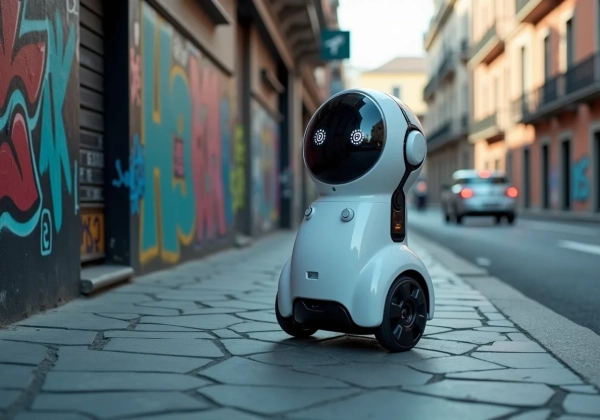
Psychologist Lindsay Ouellette has found that aggression toward robots activates many of the same psychological mechanisms as human-directed violence - even though the targets are machines. This is a significant finding, because it suggests the problem cannot easily be designed away. Kiwibot's machines, for instance, feature animated digital eyes and emit polite voice prompts, both deliberate attempts to build empathy. CEO Felipe Chavez has described the strategy as trying to make bots feel like members of the community rather than corporate intrusions. Yet humanizing features like these do not consistently deter hostile behavior.
Ouellette's research points to dehumanization as a key factor: people normalize harm when they perceive a target as an object rather than a subject. This allows attacks to be rationalized as harmless mischief - or, in cases involving theft of cargo, as instrumental violence with a practical payoff. The 2015 case of hitchBOT, the Canadian hitchhiking robot that was destroyed during its journey across North America, showed the world an early, high-profile example of the same impulse. More than a decade later, the pattern has only become more common as robot deployments multiply.
It is also worth noting that resistance is not always purely emotional. At UC Berkeley, the student body passed a formal resolution condemning Kiwibot over labor practices, and community members raised concerns about surveillance, sidewalk obstruction, and delivery job displacement. For many, attacking a robot is a proxy for frustration with the tech industry itself.
Infrastructure and regulatory challenges
Social acceptance is only one front in the battle. The physical environment presents its own serious obstacles. Sidewalks and public paths across most cities were designed decades ago for foot traffic alone - not for a new category of autonomous machine making dozens of trips daily.
Cracked pavement, steep inclines, and absent curb cuts drive up maintenance costs and reduce operational uptime. Robots sometimes stop abruptly mid-pavement while recalibrating sensors, creating friction with pedestrians who quickly tire of navigating around a stationary machine. These incidents, though minor on their own, compound community resentment over time.
The regulatory landscape compounds the challenge further. There is currently no comprehensive federal framework in the United States governing sidewalk robots. The patchwork that has emerged is wide and inconsistent:
- Virginia and Pennsylvania grant delivery robots rights and responsibilities roughly equivalent to pedestrians.
- San Francisco initially introduced severe restrictions and a permit system requiring human minders for each robot - a measure that, in practice, undermined the cost argument for automation entirely.
- Weight limits across states range from as little as 80 pounds to 500 pounds, creating compliance nightmares for companies operating across multiple cities.
At least 23 U.S. states have passed some form of governing legislation, but liability questions - particularly around collisions with pedestrians or pets - remain largely unresolved. For operators, this legal ambiguity is not an abstract problem: it directly shapes insurance costs, deployment decisions, and investor confidence.
In 2024, the U.S. Department of Transportation took a step forward by finalizing exemption templates covering sidewalk robots under 400 pounds, replacing the previous case-by-case waiver process. The EU has similarly moved to define micro-carrier requirements. Progress is real, but fragmented.
Economic case and social costs
The primary economic driver behind autonomous delivery is stark: last-mile logistics is the most expensive segment of the entire supply chain, often accounting for more than 50% of total delivery costs. Industry estimates suggest autonomous robots can reduce cost-per-mile from around $1.60 for a human driver to roughly $0.06 - a reduction of more than 95%. Against a backdrop of rising e-commerce volumes and persistent labor shortages in the courier sector, the business logic is compelling.
The market is growing accordingly. The global autonomous last-mile delivery sector was valued at approximately $21.5 billion in 2024 and is projected to reach over $185 billion by 2033, according to market research firm Astute Analytica. Starship Technologies surpassed 8 million autonomous deliveries in 2025. Serve Robotics expanded through partnerships with Uber Eats and DoorDash into Los Angeles, Miami, Dallas, Chicago, and Atlanta. The industry is moving beyond the pilot phase.
But the economic gains accrue unevenly. Research by economists Daron Acemoglu and Pascual Restrepo at MIT found that for every industrial robot added per 1,000 workers, local employment falls by approximately six workers, and average wages in the same commuting zone decline. Displacement effects are strongest among workers in routine delivery and logistics roles - jobs that typically offer accessible entry points to employment for people without advanced qualifications.
Labor organizations including the International Longshore and Warehouse Union have voiced concern that widespread robot adoption will hollow out storefront retail and last-mile delivery, converting local commercial hubs into unmanned distribution nodes. Robotics companies respond that machines will take over repetitive tasks while freeing humans for more complex work - but critics argue the pace of transition is outstripping workers' ability to retrain and adapt, and that the more complex jobs promised do not arrive in the same communities or in the same numbers.
What comes next for sidewalk robots
Despite resistance, the trajectory of the technology is upward. Hardware costs have fallen sharply: solid-state LiDAR units that once cost thousands of dollars are now available for under $500, and battery energy density improvements have extended typical robot range to roughly 18 urban miles per charge. AI edge processing chips now handle obstacle avoidance and localization without cloud dependency, improving reliability in dense urban conditions.
The metrics that matter for commercial viability - deliveries per robot per day and route completions without human intervention - are improving across the industry. Serve Robotics reported delivery volumes up approximately 78% quarter-on-quarter in Q2 2025. DoorDash has deployed over 3,500 Serve Robotics units in Los Angeles alone.
The more durable challenges are social and political rather than technical. Building genuine community acceptance will require more than better design. It will require transparency about data collection, honest engagement on labor displacement, accessible infrastructure improvements that benefit all pedestrians - not just robots - and regulatory clarity that protects both operators and the public. Companies that treat resistance as a communications problem to be managed risk repeating the conflicts already documented in Berkeley, Philadelphia, Sheffield, and beyond.
The machines are getting better at sharing the sidewalk. The harder question is whether the communities they operate in will come to feel that sharing is worth it.
Frequently asked questions
Why do people vandalize delivery robots? Psychological research suggests aggression toward robots draws on the same mechanisms as human-directed violence. Dehumanization allows people to rationalize harm as inconsequential. In many documented cases, attacks also reflect broader frustrations with tech industry expansion, concerns about surveillance, or anger over job displacement - with the robot serving as an accessible, low-consequence target.
Are delivery robots legal on sidewalks in the United States? Legality varies significantly by state and city. At least 23 states have passed some form of governing legislation, but there is no federal framework. Some states treat robots as pedestrians with equivalent rights; others have imposed strict weight limits, minder requirements, or outright bans. Operators must navigate a patchwork of local rules.
How much cheaper is robot delivery compared to human drivers? Industry estimates put the cost per mile for human drivers at approximately $1.60, versus around $0.06 for autonomous sidewalk robots - a reduction of over 95%. However, these figures do not always account for vandalism repair, remote monitoring labor, or the cost of navigating regulatory requirements.
Do delivery robots take jobs away from workers? MIT research (Acemoglu and Restrepo) found that each additional industrial robot per 1,000 workers correlates with roughly six fewer jobs and a 0.42% decline in wages in the surrounding area. Labor unions argue that delivery automation will disproportionately affect lower-income workers in logistics roles, while the industry contends that new roles will emerge over time.
Which companies operate delivery robots in the US? The leading operators include Starship Technologies (the global volume leader, with over 8 million deliveries by 2025), Serve Robotics (partnerships with Uber Eats and DoorDash in multiple U.S. cities), Kiwibot (campus-focused deployments), and Avride (launched on Uber Eats in Jersey City in 2025), among others.
Share now









Key takeaways
- Kiwibot reported approximately 1,600 vandalism incidents out of its first 80,000 deliveries at UC Berkeley - roughly one incident every 50 deliveries - with each unit carrying a replacement cost of $2,500.
- Autonomous delivery robots can reduce last-mile cost per mile from approximately $1.60 for a human driver to just $0.06 - a saving of over 95%.
- At least 23 U.S. states have passed laws governing sidewalk robots, yet weight limits alone range from 80 to 500 pounds depending on jurisdiction - with no federal framework in place.
- MIT economists Acemoglu and Restrepo found that adding one industrial robot per 1,000 workers reduces local employment by approximately six workers and cuts average wages by 0.42%.
- Documented incidents of robot vandalism and "humiliation rituals" have occurred in Philadelphia, Sheffield, Leeds, Los Angeles, and Berkeley, highlighting that social resistance is a global, not local, phenomenon.
- The global autonomous last-mile delivery market was valued at approximately $21.5 billion in 2024 and is projected to surpass $185 billion by 2033 (CAGR ~22-23%).
- Starship Technologies surpassed 8 million autonomous deliveries by 2025, operating across 100+ service areas in the US, UK, and EU.
- Psychological research indicates that dehumanization is a primary driver of robot aggression - victims of robot abuse include bystanders, who report emotional distress even from briefly witnessing attacks.
Sources
- Kiwibot vandalism incidents and CEO Felipe Chavez statements https://futurism.com/robots-and-machines/delivery-robot-vandalism-problem
- Delivery robots face vandalism from UC Berkeley to Sheffield (broader incident reporting) https://www.newsbytesapp.com/news/business/delivery-robots-face-vandalism-from-uc-berkeley-to-sheffield-england/tldr
- Research on robot-directed aggression and dehumanization (sociotechnical definition of robot abuse) https://www.tandfonline.com/doi/full/10.1080/0144929X.2025.2462268
- Victims and observers: gender, victimization, and perceptions of robot abuse (University of Texas UTRGV) https://www.researchgate.net/publication/371868178_Victims_and_Observers_How_Gender_Victimization_Experience_and_Biases_Shape_Perceptions_of_Robot_Abuse
- MIT Sloan - Acemoglu & Restrepo: robots and jobs, evidence from US labor markets https://mitsloan.mit.edu/ideas-made-to-matter/a-new-study-measures-actual-impact-robots-jobs-its-significant
- MIT Stone Center - Robots and Jobs: Evidence from US Labor Markets (full paper) https://shapingwork.mit.edu/research/robots-and-jobs-evidence-from-us-labor-markets/
- MIT News - Study finds stronger links between automation and inequality https://news.mit.edu/2020/study-inks-automation-inequality-0506
- Last-mile delivery robots: navigating sidewalks and scaling in cities (2024-2025 deployment data) https://roboticsandautomationnews.com/2025/09/26/last-mile-delivery-robots-navigating-sidewalks-and-urban-landscapes/94758/
- Autonomous last-mile delivery market size and forecast to 2033 https://www.globenewswire.com/news-release/2025/05/26/3088157/0/en/Autonomous-Last-Mile-Delivery-Market-Set-to-Surpass-US-185-30-Billion-By-2033-Astute-Analytica.html
- Regulatory landscape for sidewalk robots - Thomas Net overview of top delivery robot companies https://www.thomasnet.com/insights/top-delivery-robot-companies/
- Published 2026-04-14 02:44
- Modified 2026-05-20 11:55
