-
10
Views
-
0
Comments
-
0
Like
-
Bookmark

-
 PRO
PRO -
 Redaction
AI and autonomous drones: The new era of digital warfare
From Ukraine to the Middle East, digital wars are here. Learn how AI-driven drones and space-based intelligence are transforming the global military landscape.
The laboratory of necessity
The geography of modern conflict has shifted from the mud of the trenches to the invisible architecture of the algorithm. In the rolling fields of Ukraine and the arid expanses of the Middle East, the world is witnessing more than just a clash of nations; it is observing the birth of the first truly digital wars. These regions have become high-stakes laboratories where artificial intelligence (AI), low-cost robotics, and pervasive satellite surveillance are evolving at a pace that traditional defense procurement cycles could never match. This is not the future of war; it is the present, refined by the brutal urgency of survival.
As of April 7, 2026, the data emerging from these fronts suggests a paradigm shift. The reliance on legacy platforms-heavy tanks, manned aircraft, and centralized command hubs-is being challenged by decentralized, AI-driven systems that are cheaper, faster, and increasingly autonomous. This technological acceleration is driven by the stark realities of asymmetric warfare, where smaller forces must find a digital edge to blunt the weight of superior conventional numbers.
The asymmetric edge: Drones and data
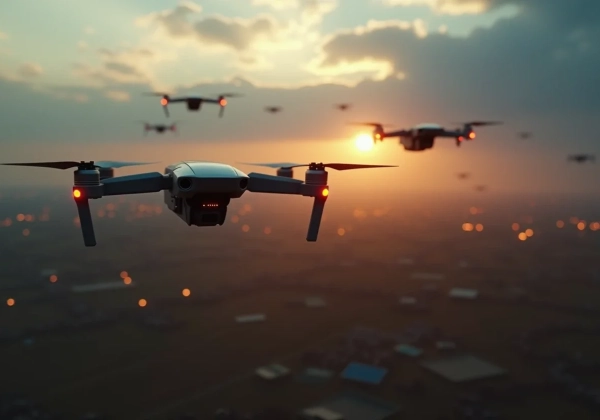
Ukraine has arguably become the world's premier drone superpower by sheer necessity. Facing a massive conventional adversary, Kyiv has turned to a strategy of mass-produced, low-cost attrition. The scale is staggering: current estimates suggest Ukraine is producing 4.5 million drones annually, with goals to reach 7 million units by next year. However, the volume is only half the story. The true evolution lies in the software.
Early in the conflict, First-Person View (FPV) drones were hindered by electronic warfare and human error, with strike accuracy hovering between 30% and 50%. The integration of AI-assisted terminal guidance-where the drone's onboard processor identifies and locks onto a target in the final seconds of flight-has pushed that accuracy to 80%. This 'kill chain' compression is the hallmark of the new era. By opening access to real-time battlefield data, collected from tens of thousands of combat flights, Ukrainian developers are training models on millions of annotated frames of actual combat, creating a feedback loop that no simulation can replicate.
In the Middle East, the validation of low-cost technology has followed a similar trajectory. Iranian-designed systems and U.S. responses have proven that commercial off-the-shelf technology, when paired with AI models and satellite internet like Starlink, can achieve strategic effects. During 'Operation Epic Fury,' U.S. Central Command leveraged AI-enabled planning tools to process and strike over 1,000 targets in a single 24-hour window. Such a tempo would have been physically and cognitively impossible for human targeting teams a decade ago.
The eye in the sky: From warning to defense
While drones dominate the tactical level, a revolution in space-based intelligence is transforming the strategic horizon. The U.S. Space Development Agency (SDA) is currently executing a shift toward a Proliferated Warfighter Space Architecture (PWSA). This involves moving away from a few billion-dollar satellites to hundreds of smaller, interconnected units in Low Earth Orbit (LEO).
Recent awards totaling $3.5 billion for 72 'Tranche 3' satellites signify a move from 'missile warning' to 'missile defense.' These satellites are designed to provide 'fire-control quality tracks,' enabling the interception of maneuverable hypersonic glide vehicles that were previously thought to be nearly unmaskable. This persistent, near-continuous global tracking layer ensures that the invisibility once offered by speed and altitude is rapidly evaporating.
However, the West does not hold a monopoly on this geospatial revolution. Chinese firms, such as MizarVision and Jinghan Technology, have emerged as sophisticated players in the Open-Source Intelligence (OSINT) market. By fusing commercial satellite imagery with aircraft and vessel tracking data, these PLA-certified suppliers provide near real-time intelligence on U.S. carrier strike groups. Reports indicate that these AI-enhanced products are being used by regional actors to refine targeting of military installations, effectively 'democratizing' high-end surveillance that was once the sole province of superpowers.
The doctrine of decision dominance
The ultimate prize in this technological race is what military theorists call 'decision dominance.' The U.S. military is explicitly pivoting toward an 'AI-first' warfighting posture, aiming to out-think and out-pace adversaries in every domain. This goes beyond better sensors; it is about data fusion-the ability to take disparate streams of information from a drone in a trench, a satellite in orbit, and a cyber-sensor in a network, and present a coherent, actionable picture to a commander in seconds.
Yet, this transition brings profound complications for international alliances. As AI becomes the backbone of modern military operations, it creates a 'capability gap' between tech-heavy nations and their allies. Interoperability becomes a matter of software compatibility rather than just fuel types or radio frequencies. Furthermore, the speed of AI-driven combat leaves little room for the traditional, deliberative consultation that characterizes democratic alliances. When the window for a decision is measured in seconds, the time for diplomatic debate vanishes.
The accountability gap and the human toll
As the line between human-guided and autonomous systems blurs, the world faces a mounting ethical crisis. The use of AI-powered Decision Support Systems (DSS) has already drawn criticism in the Iran conflict, where rapid target generation reportedly led to strikes on civilian infrastructure, including schools and hospitals.
There is a growing 'accountability gap' in the laws of armed conflict. If an autonomous system commits a war crime, where does the liability lie? International law is built on the concept of human intent, a framework that struggles to address the 'black box' of algorithmic decision-making. Western doctrine maintains that humans must remain 'in the loop' or 'on the loop,' but as the tempo of warfare accelerates, the human role risks becoming a mere formality-a rubber stamp for a machine's conclusion.
Beyond accountability, there is the risk of algorithmic bias. AI models trained on specific datasets may behave unpredictably in complex urban environments, leading to unintended civilian casualties. This unpredictability complicates post-incident evaluations and threatens to trigger an unchecked arms race where safety and ethics are sacrificed for the sake of speed.
The golden dome and the path ahead
The culmination of these trends is perhaps best seen in the 'Golden Dome' program. With a projected fiscal year 2027 budget of $17.5 billion, this multi-layered defense system aims to integrate space-based interceptors with ground-based AI to neutralize everything from cruise missiles to hypersonic threats. The U.S. has already tapped innovators like Anduril and Impulse Space to develop the technology, with an operational demo expected by 2028.
The conflicts of 2026 have proven that the battlefield is no longer just a place of physical confrontation; it is a processing plant for data. The nations that can most effectively harvest, analyze, and weaponize that data will define the global order for the remainder of the century. As we move deeper into the age of the autonomous warfighter, the challenge will be ensuring that in our quest for the perfect weapon, we do not lose the human judgment that is supposed to guide it.
Share now






Key takeaways
- Ukraine is scaling drone production from 4.5 million in 2024 to a projected 7 million by 2026.
- AI integration has increased Ukrainian FPV drone accuracy from 30% to over 80%.
- The U.S. Space Development Agency is investing $3.5 billion in a Tranche 3 satellite tracking layer to counter hypersonic threats.
- Chinese firms like MizarVision are providing PLA-certified real-time intelligence using open-source AI tools.
- Operation Epic Fury saw over 1,000 targets struck in 24 hours through AI-enabled planning.
- The U.S. is seeking $17.5 billion for the 'Golden Dome' multi-layered missile defense system in fiscal year 2027.
