
-
234
Views
-
0
Comments
-
0
Like
-
Bookmark

-
 PRO
PRO -
 Redaction
Expedition identifies 38 new species in Japans deep-sea waters
A collaborative international expedition by the Ocean Census and JAMSTEC has confirmed the discovery of 38 previously unknown species in the deep waters of Japan.
An international scientific collaboration between The Nippon Foundation-Nekton Ocean Census and the Japan Agency for Marine-Earth Science and Technology (JAMSTEC) has confirmed the discovery of 38 new species, with an additional 28 potential new species still under detailed examination.
The findings stem from a landmark deep-sea expedition conducted in June 2025 aboard JAMSTEC's research vessel Yokosuka, using the renowned manned submersible Shinkai 6500. During the mission, scientists explored two of Japan's most understudied deep-ocean regions: the tectonically active Nankai Trough and the remote volcanic Shichiyo Seamount Chain, located hundreds of kilometers southeast of Tokyo.
Over the course of the expedition, the team collected more than 528 specimens. These were carefully catalogued, photographed, and preserved for further morphological and genetic analysis. In October 2025, taxonomists from Japan and around the world gathered at JAMSTEC headquarters for a dedicated Species Discovery Workshop to verify the new species and plan scientific publications.
Remarkable symbiosis discovered
One of the most captivating findings involves an intricate symbiotic relationship at the Shichiyo Seamount Chain. Researchers discovered a large glass sponge (a hexactinellid with a delicate silica skeleton often described as a “glass castle”) hosting two entirely new species of polychaete worms living inside its body:
- Dalhousiella yabukii
- Leocratides watanabeae
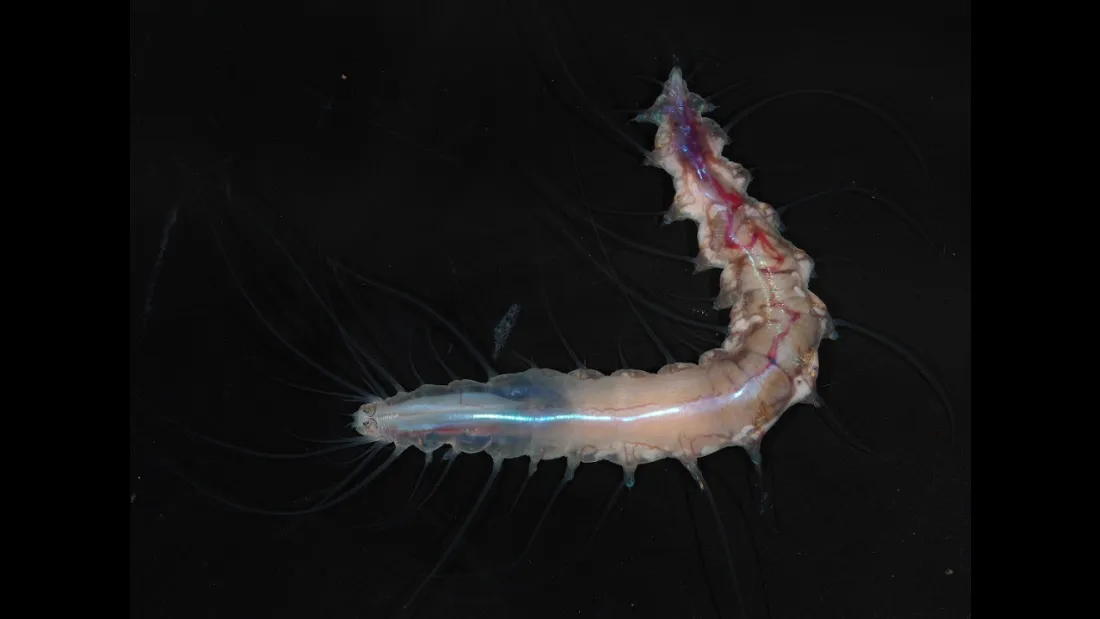
Worms have evolved to thrive within the protective, translucent structure of the sponge - a striking example of deep-sea adaptation and co-evolution.
Additional discoveries and scientific impact
Beyond the symbiotic worms, the expedition yielded:
- Five new species of squat lobsters (genus Munidopsis and others)
- New species of ribbon worms, sea stars, brittlestars, and other invertebrates
- Significant new insights into biodiversity at cold seeps in the Nankai Trough, with one study revealing a five-fold increase in known species in that habitat
Two key scientific papers have already resulted from the expedition:
- A comprehensive survey published in Ecosphere (led by Dr. Chong Chen, JAMSTEC), highlighting dramatically higher biodiversity at cold seeps.
- A detailed study in The Zoological Journal of the Linnean Society (led by Dr. Naoto Jimi), describing the evolutionary history of the sponge-dwelling worms.
Why this matters
These discoveries underscore how little we still know about Earth's oceans. The deep sea remains one of the least explored environments on the planet, yet it plays a vital role in global ecosystem health, carbon cycling, and evolutionary processes.
The specimens continue to undergo genetic and morphological analysis to better understand their ecological roles within the complex deep-sea food web. The findings provide critical baseline data for marine conservation efforts and future monitoring of these fragile ecosystems in the face of climate change and potential human impacts.
As Mitsuyuki Unno from The Nippon Foundation noted, such expeditions remind us of the vast unknown that still awaits discovery beneath the waves.
Share now






Key takeaways
- The Nippon Foundation–Nekton Ocean Census and JAMSTEC confirmed the discovery of 38 new species.
- The findings resulted from a landmark international expedition aimed at documenting deep-ocean biodiversity around Japan.
- The research utilized advanced deep-sea technology to survey previously unexplored marine habitats.
- Many of the discovered species belong to diverse marine groups, highlighting the ecological richness of the region's deep waters.
